On this page
- Choose the review audience
- Define the decision first
- Keep baseline, exposure and outcome separate
- Create a claim register
- Use proposed review grades consistently
- Capture the full operating method
- Make the calculation reproducible
- Choose a comparison method
- Budget for evidence, not only storytelling
- Define metrics and confidence rules
- Know when the available evidence is insufficient
- Keep evidence classes separate
- Review quotations and disclosures
- Where BrandWell fits
- Prepare a reviewed drafting brief
- Final case study checklist
- A fictional claim-register example
- Show the current BrandWell workflow accurately
- Common questions
Design an intent-program case study around an evidence packet before writing the story. Define the question, eligible population, intervention, comparison, outcome window and calculations. Link each proposed claim to a source, denominator, method, limitation and reviewer.
A measured process result, a customer opinion and a causal finding are different kinds of evidence. Publish the strongest statement the available records support, and preserve contrary or unresolved findings.
Choose the review audience
This guide is for marketing and RevOps leaders, analysts, agency owners, customer marketers, executives, and legal or compliance reviewers who need a credible intent data case study. It covers evidence design for one intent program. It does not cover generic customer-story copy, an agency-wide case-study strategy, QBR design, an executive dashboard, or a standalone ROI proof hub.
Separate observed events from inferred identity and research relevance. Record the method and unresolved cases. A topic or identity match does not establish consent, purchase readiness, causation or a future result.
Define the decision first
Choose one primary decision: expand a use case, revise the operating model, continue a pilot, approve a larger evaluation, or stop. A case study designed to answer “Should we expand account prioritization?” needs different evidence from one designed to answer “Can our agency reliably produce branded topic reports?”
Write the protocol before reviewing the most favorable accounts. Include:
- decision owner and intended audience;
- unit of analysis: person, account, buying group, campaign, opportunity, or client;
- eligible population and exclusions;
- intervention and operating workflow;
- business-as-usual baseline or counterfactual;
- primary and secondary outcomes;
- observation and outcome windows;
- assignment or comparison method;
- calculation and currency rules;
- minimum sample and materiality threshold;
- privacy, customer, legal, and publication approvals;
- stop conditions and known limitations.
Pre-specification reduces the temptation to select a window, segment, or metric after seeing the result. If the design changed, keep the original and amended versions and explain why.
Keep baseline, exposure and outcome separate
The baseline describes what happened before or without the program: existing account selection, response, opportunity, and cost patterns. The intervention is the complete change – not merely “we added intent data.” It might include new signals, identity resolution, routing, account research, ads, outbound drafts, sales training, and reporting.
Exposure records which eligible units actually received the intervention. An account that entered an audience but received no impression is not exposed to the same degree as an account that received ads and a seller action. An account that generated a signal but was never accepted by sales is different again.
Outcome is the predefined later event: accepted account, qualified meeting, accepted opportunity, stage progression, win, gross profit, or a process result. Keep outcome records distinct from provider scores and influenced-pipeline labels.
The counterfactual asks what would have happened without the intervention. A randomized holdout is strongest when feasible. Other options include a phased rollout, comparable region, cutoff design, or a carefully matched cohort. A before-and-after comparison can be descriptive but is vulnerable to seasonality, staff changes, media shifts, and pipeline mix.
The Magenta Book distinguishes monitoring outcomes from estimating an intervention’s additional effect through a counterfactual. Apply that distinction when selecting the strongest wording your evidence supports.
Create a claim register
Create one row per material statement with these fields:
- Claim ID and proposed wording.
- Claim type: fact, calculation, observation, attribution, causal finding, testimonial, projection, or opinion.
- Unit, population, and denominator.
- Source system and source record.
- Data owner and extraction logic.
- Method and comparison.
- Time and geography scope.
- Evidence grade and uncertainty.
- Known limitations and alternative explanations.
- Customer approval and material-connection disclosure.
- Privacy, legal, compliance, and editorial review status.
- Approved wording and channels.
This is the core intent data case study template. The published article may be short; the underlying evidence table should be detailed enough for another qualified reviewer to reproduce the calculation.
Use a transparent evidence ladder:
- Causal finding: supported by a credible experimental or quasi-experimental design and appropriate analysis.
- Comparative observation: treatment or exposed units differed from a stated comparison, with material limitations.
- Descriptive observation: a measured fact about the program without causal attribution.
- Calculation: reproducible arithmetic from named, quality-checked inputs.
- Testimonial or opinion: a person’s honest experience, not independent proof of performance.
- Projection: a future scenario based on labeled assumptions, not a result.
Never promote a descriptive observation into a causal headline. “Opportunity creation was higher among activated accounts” is not the same as “intent activation increased opportunities.” The latter requires a design capable of supporting the causal interpretation.
Use proposed review grades consistently
Give each source a grade based on relevance and method, not on whether it favors the program:
- Grade A: prospective comparison with strong assignment, exposure, data quality, and analysis.
- Grade B: relevant quasi-experimental comparison or strong internal observational analysis with bounded assumptions.
- Grade C: quality-checked descriptive program data, reproducible calculations, or a closely comparable primary case.
- Grade D: vendor claim, customer recollection, generic benchmark, anecdote, or unverified estimate.
A Grade D source can still appear when clearly labeled – for example, a customer explaining why the project mattered. It should not substantiate an objective performance claim. The case study’s conclusion should reflect the weakest critical link, not the average grade across all rows.
Build the evidence packet before drafting objective claims. Ask a qualified reviewer to check the proposed wording, evidence and intended publication context; this worksheet is not a legal determination.
Capture the full operating method
A credible case study describes the workflow with enough detail to judge transferability:
- How intent topics and thresholds were chosen.
- Which first-, second-, or third-party signals were used.
- How accounts or people were resolved and confidence recorded.
- Which fit, freshness, suppression, and consent or lawful-use rules applied.
- How records were routed and who accepted or rejected them.
- Which ads, research, content, or outreach actions were performed.
- How quickly actions occurred after the signal.
- Which concurrent programs could affect the outcome.
- How control or comparison units were protected.
- How results, corrections, complaints, and missing data were logged.
Include implementation failures. If only half the eligible accounts received the action, that is part of the result. Report both intent-to-treat outcomes based on assignment and an action-taken view when useful, clearly noting that action-taken analysis can be selected by rep behavior.
Make the calculation reproducible
The right case study design for intent programs does not require a particular software brand. It requires controlled inputs and repeatable calculations:
- a warehouse or exported source files with immutable snapshots;
- a data dictionary defining signals, identities, exposures, outcomes, and exclusions;
- versioned SQL or formulas for every reported number;
- an experiment or assignment register;
- an exposure and contamination log;
- a calculation workbook with denominators and currency rules;
- a claim register linked to screenshots or source records;
- an approval log for the customer, brand, legal, privacy, and editorial teams;
- a change log showing corrections after review.
For a small program, a locked spreadsheet plus exported CRM and platform files can be sufficient. For a larger program, use version control, warehouse models, access controls, and reproducible notebooks. Tool sophistication does not compensate for changing definitions or cherry-picked accounts.
Choose a comparison method
Consider random assignment where feasible, using the correct unit and a defined outcome window. Record implementation failures, mixing between groups and missing data. Do not assume the assignment alone makes a small or incomplete study conclusive.
If random assignment is unavailable, ask the analyst to choose and document a suitable comparison method, assumptions and sensitivity checks. A similar-looking comparison group does not automatically eliminate selection bias.
Multi-touch attribution and platform conversion reports are descriptive allocation systems. They are valuable for understanding recorded journeys and operations, but they do not automatically estimate the counterfactual. Likewise, “influenced pipeline” can show that opportunities overlapped with an audience or touch; it is not necessarily incremental pipeline.
The Magenta Book analytical annex describes experimental and quasi-experimental methods with different conditions and limitations. Select the method with an analyst; the case-study template does not establish a valid impact estimate.
Budget for evidence, not only storytelling
Case study cost includes protocol design, data extraction, identity and outcome reconciliation, analyst time, quality assurance, customer interviews, copy and design, privacy and legal review, customer approval, redaction, hosting, and future maintenance. Add the opportunity cost of preserving a holdout or delaying the rollout for measurement.
If evidence is likely to be reused in sales, proposals, ads, partner content, and LLM-facing pages, invest in a claim register that records approved wording by channel. If the customer requires anonymity, budget for aggregation, masked screenshots, and re-identification risk review.
The most efficient path is often to build evidence collection into the program from the start. Reconstructing exposure, definitions, and permissions after a success has been noticed is expensive and prone to bias.
Define metrics and confidence rules
Report the complete funnel: eligible units, signaled units, resolved units, fit-qualified units, accepted units, activated units, exposed units, meetings, accepted opportunities, wins, gross profit, cost, corrections, suppressions, and complaints. Always show denominators.
Predefine deduplication, account and opportunity windows, multi-client rules, currency conversion, gross-margin assumptions, and treatment of missing data. Segment results only when the sample supports the cut; otherwise label segment observations as exploratory.
For comparative results, report absolute and relative differences, uncertainty intervals, sample sizes, and practical significance. A large percentage lift from a tiny baseline can be commercially trivial and statistically unstable. Do not hide zero or negative outcomes in an appendix.
Set publication rules before analysis:
- publish a causal claim only when the design and review support it;
- publish a comparative observation with the comparison and limitation close by;
- publish a descriptive metric with its population and denominator;
- publish a projection only as a scenario with its assumptions;
- remove or narrow any claim that cannot be reproduced;
- stop publication for unresolved permission, privacy, security, or material accuracy issues.
Know when the available evidence is insufficient
A case study is decision-useful when definitions are stable, source records are accessible, exposure is known, outcomes are recorded, the comparison is credible, and the operating context is described. It is insufficient for strong performance claims when the sample is tiny, only successful accounts were selected, the baseline changed, concurrent campaigns are uncontrolled, sales manually chose treatment, or the outcome window excludes delayed failures.
Do not solve insufficient evidence with confident copy. Publish a process case study instead: the problem, workflow, feasibility metrics, lessons, and next test. Saying “the pilot established that the team could resolve, review, and route accounts within the approved SLA” can be useful even when revenue impact remains unknown.
Keep evidence classes separate
Maintain separate fields for each evidence class. Intent describes the observed topic or behavioral signal and its source. Fit describes whether the account meets the chosen commercial criteria. Identity describes the probable match and confidence. Freshness describes actionability. Activation records the actual action. Outcome records what occurred later.
Never use identity confidence as intent intensity or treat an activation event as a positive outcome. Preserve corrections and unmatched records. Explain whether the signal is account-level or person-level and avoid language that attributes account research to a named individual without adequate evidence and permitted use.
For the publication plan, review data access, necessary fields, retention, redaction and customer permission. Test screenshots and small segments for unintended disclosure. Assign owners for corrections and removal requests.
Review quotations and disclosures
A customer quote must be honest, approved, and presented in context. Record who wrote or edited it, whether the customer received compensation or another benefit, and which objective claims it implies. A testimonial is not substantiation for a claim requiring objective evidence.
Explain any material connection or compensation and place relevant limitations near the statement. Have the intended testimonial and channels reviewed before publication. Do not assume a generic disclaimer makes an unsupported result claim acceptable.
Avoid composite customers unless plainly disclosed. Do not fabricate quotes, roles, screenshots, events, or timelines. If confidentiality requires alteration, disclose the type of alteration and ensure it does not change the conclusion.
Where BrandWell fits
A small topic-research evaluation can document review effort and usefulness under a defined scope. It does not establish native branded-report automation, white-label delivery or commercial impact. Confirm product requirements before making client commitments.
Prepare a reviewed drafting brief
Use an instruction such as: “For each proposed statement, classify the claim, locate the supporting source record, reproduce the calculation, name the denominator and comparison, assign an evidence grade, list plausible alternative explanations, and recommend the narrowest accurate wording. Flag missing permissions and material connections. Do not invent sources, alter customer quotes, publish content, contact the customer, or approve legal claims.”
Require a named human to approve data access, identity use, customer outreach, quote edits, screenshots, disclosures, claims, and publication. Preserve the agent’s source citations and edits so reviewers can audit the path from record to copy.
Final case study checklist
- Freeze the decision, protocol, population, intervention, and outcomes.
- Preserve business as usual and a credible comparison where possible.
- Record assignment, exposure, noncompliance, and contamination.
- Separate intent, fit, identity, activation, and outcome evidence.
- Link every objective claim to a reproducible source and calculation.
- Show denominators, uncertainty, segments, and material limitations.
- Distinguish causal findings, comparative observations, descriptions, testimonials, and projections.
- Record customer permission, material connections, and channel-specific approvals.
- Review privacy, security, legal, compliance, and platform policy.
- Use human approval before any public claim or publication.
The strongest intent program case study is not the one with the largest number. It is the one in which a skeptical reader can see what was done, what changed, how the comparison worked, what remains uncertain, and exactly which claims the evidence can bear.
A fictional claim-register example
Two study groups each contain 100 eligible accounts. Eight treatment accounts and five comparison accounts produce a defined opportunity: 8% versus 5%. The observed difference is three percentage points, or 60% relative to the comparison rate. Neither calculation alone establishes a causal effect.
- Supported descriptive wording: Eight of the 100 treatment-assigned accounts produced the defined opportunity during the stated window.
- Comparative wording: The treatment group’s observed rate was three percentage points higher; include the assignment method and uncertainty.
- Unsupported shortcut: Intent data increased opportunities by 60%, without a design and analysis supporting that causal interpretation.
If the program cost $2,000, cost per observed treatment opportunity is $250. It is not customer acquisition cost, ROAS or an estimate of cost per incremental opportunity. Keep quoted customer experience separate from the numerical result.
Show the current BrandWell workflow accurately
MarketPulse supports topic research, with standard plans starting at $500/mo. Growth includes three topics with daily pulls; Scale includes ten topics with daily pulls. Available fields and counts vary, and audiences can overlap.
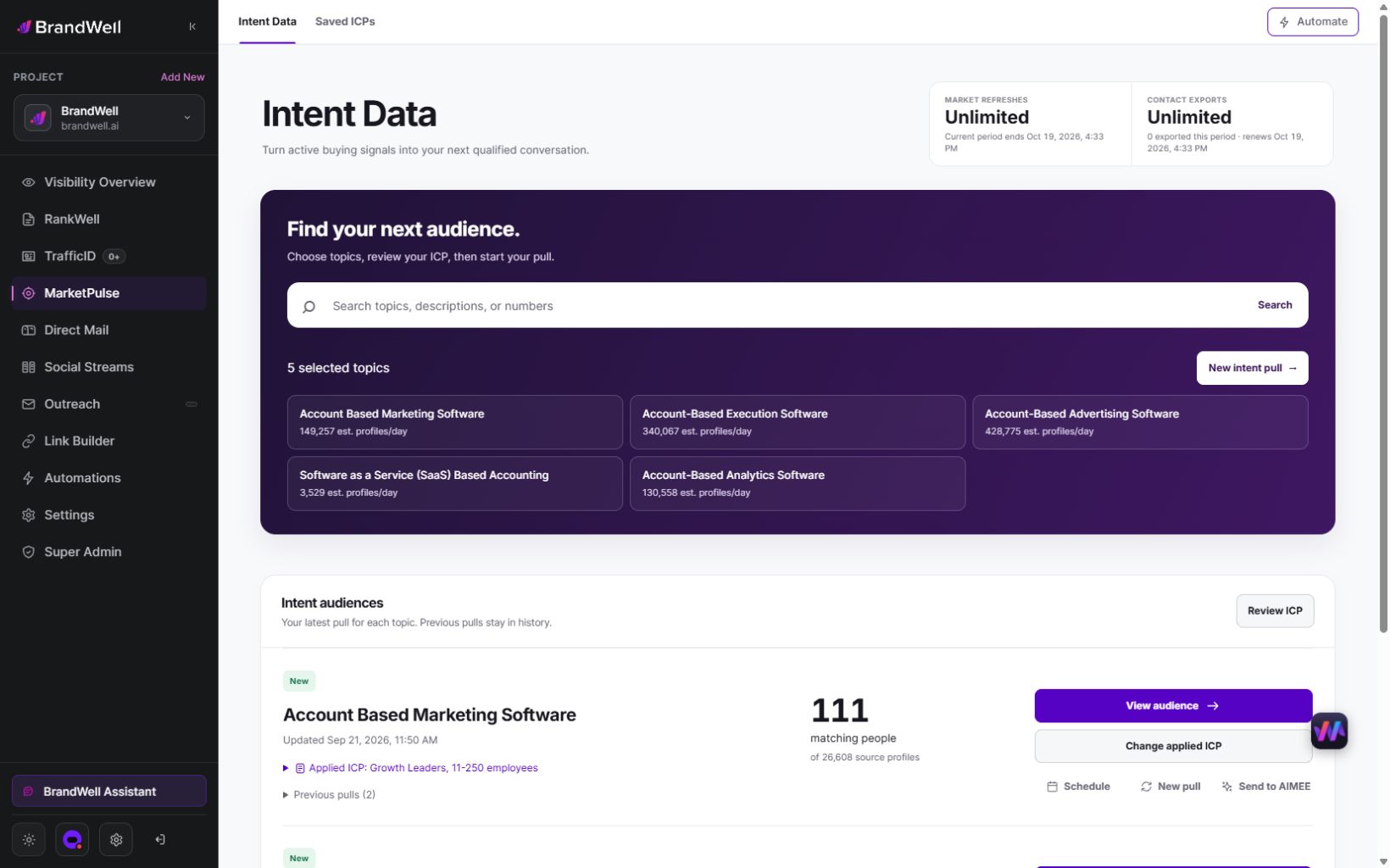
Record the chosen topic, ICP criteria, available fields and review decisions. Use your own approved evidence for the customer story rather than presenting a product screenshot as proof of pipeline or revenue.
AIMEE can help prepare research and connected tasks through configured tools and access. Preserve source citations and edits, and assign a human reviewer for the final story and publication.
Common questions
Can a testimonial prove numerical performance?
It records a person’s experience. Support objective numerical claims with the relevant underlying evidence and review.
What if no credible comparison exists?
Publish a clearly scoped process or descriptive case study and explain what remains unknown.
Are the review grades an external standard?
No. They are a proposed internal worksheet, not certification or a statistical confidence scale.
Can a short pilot establish future revenue?
No. Report the observed window and avoid extrapolating beyond the supported evidence.
Review MarketPulse’s current demo and plans or the BrandWell product directory.
Reviewed and updated October 3, 2026.

Written by