On this page
- Who this is for
- Start with an automation contract, not a tool
- The agent-ready intent service automation workflow
- Ownership, service levels, and quality checks
- Run failure drills before client go-live
- Human approval boundaries for AIMEE-assisted work
- Manual, automated, and white-label approaches compared
- Cost model, setup fee, and pricing assumptions
- Metrics for time-to-value, quality, adoption, and revenue
- Adjusting the workflow for client maturity
- Security, privacy, and integration failure modes
- Packaging automation as recurring agency revenue
- Frequently asked questions
- Make retries a tested recovery path
- A fictional time-saving calculation
- Start with one MarketPulse play
Intent service automation connects eligible research signals with documented decisions, approved actions and outcome records. Begin with an operating contract: source meaning, required context, owner, approval boundary and exception path. The ten-step workflow below is a proposed design method, not a claim of a prebuilt BrandWell automation.
An agency can reuse schemas, checks and reporting methods while keeping client data, permissions and thresholds separate. Test operating effort and client adoption before promising faster delivery or improved margin.
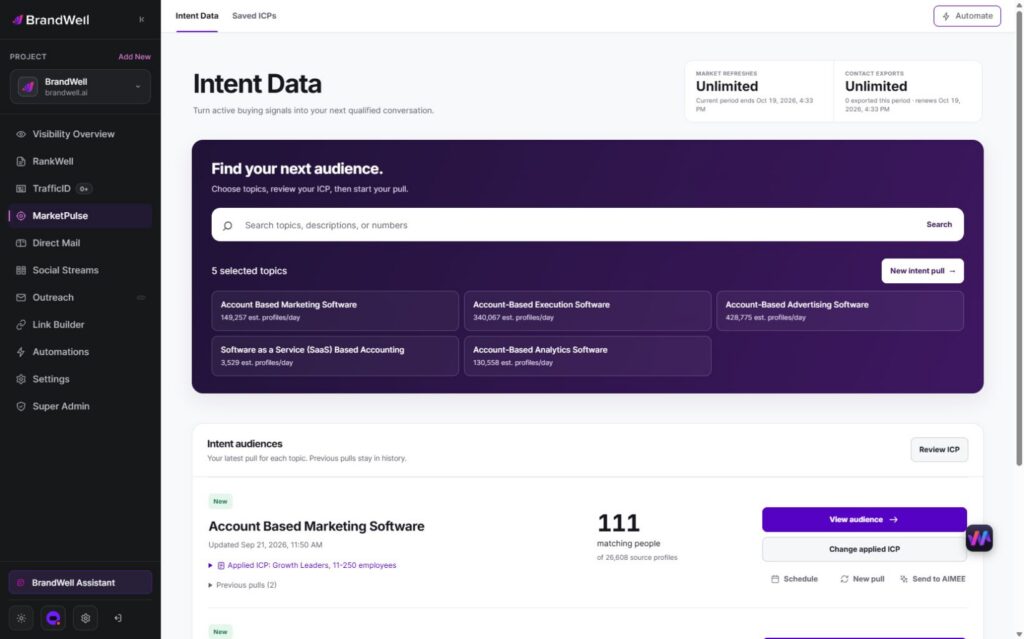
Current MarketPulse offer: intent-data plans start at $500/mo. See the product, demo, and current plans. Updated October 1, 2026.
Who this is for
- Agency founders and operations leaders productizing a recurring intent-data service.
- RevOps and GTM consultants connecting intent signals with CRM, advertising, research, and outreach workflows.
- Demand generation and paid media teams that need faster activation without giving automation unrestricted control.
- Resellers comparing manual, automated, and complete white-label delivery models.
Research and engagement do not prove purchase plans. Document whether each field is observed, resolved, inferred or client-supplied. Automation can repeat errors as readily as useful decisions; review inputs, rules, exceptions and outcome definitions before activation.
Start with an automation contract, not a tool
A client-ready automation contract should fit on one page. Define:
- Trigger: the exact event that starts evaluation.
- Required fields: source, observed time, topic or behavior, account identifier, geography, and identity level.
- Qualification: fit, intent strength, freshness, confidence, contactability, and permitted-use thresholds.
- Decision: accept, reject, suppress, investigate, or wait for another signal.
- Action: report, CRM task, audience, nurture, research brief, or reviewed outreach draft.
- Owner and SLA: who acts, by when, and what happens if the SLA expires.
- Approval boundary: which actions can run and which need a human.
- Evidence: status, rejection reason, action taken, downstream outcome, and cost.
If a client cannot agree on these fields, build the manual workflow first. Automating an undefined service usually makes delivery faster but not more useful.
The agent-ready intent service automation workflow
The scalable pattern is observe → normalize → qualify → enrich → approve → route → activate → record → report → learn.
1. Observe without over-interpreting
Capture the raw event and its provenance. A topic research event, website visit, product interaction, form fill, job change, or campaign response does not mean the same thing. Preserve what was actually observed before attaching a score or play.
2. Normalize into a shared event schema
Map every source into consistent fields: client ID, event ID, source, timestamp, topic, account domain, person ID if allowed, geography, confidence, and data-use flags. Normalize domains, time zones, company names, and topic labels. Use stable identifiers plus a tested deduplication or idempotency mechanism; an identifier alone does not prevent repeated actions.
3. Apply fit, freshness, and eligibility gates
Evaluate firmographic fit, account exclusions, topic relevance, recency, identity confidence, channel policy, jurisdiction, and suppression. Use reason codes. A strong signal from a poor-fit account should not outrank a moderate signal from a strategic account simply because the feed says “surging.”
4. Enrich only for the approved action
Add the minimum context required. Account advertising may need domain and company attributes. Seller research may need buying-group roles and recent company context. Email requires a separate contactability and compliance review. Collecting more fields “just in case” adds cost, security exposure, and ambiguity.
5. Create an approval packet
For a reviewed action, show the evidence and the proposed change together: what was observed, why the account passed, what will happen, which claims or content will be used, and what can be edited. A reviewer should not need to open five systems to understand the decision.
6. Route by client, play, and capacity
Route to a client workspace and named owner. Check seller or campaign capacity before assigning work. If the owner has reached a cap, defer the event or choose a lower-cost play; do not silently flood the queue. Track the assignment time and expiry.
7. Activate through a bounded play
Examples include a CRM research task, matched audience, nurture branch, report inclusion, browser research instruction, or outreach draft. The automation should supply context and a reversible next step. High-consequence actions need explicit approval.
8. Record both positive and negative evidence
Log accepted, rejected, suppressed, expired, duplicated, failed, and completed events. Capture why the client declined a recommendation. Without negative evidence, the workflow appears more accurate than it is and cannot improve.
9. Report decisions, not feed volume
A useful client report shows qualified accounts, relevant evidence, action status, response time, exceptions, cost, and outcome. Separate observed behavior from agency interpretation. Show denominators for acceptance and activation rates.
10. Change one rule at a time
Review thresholds on a fixed cadence. Version the rules and compare cohorts before and after a change. Do not let an agent rewrite qualification logic and activate the new version without review.
Ownership, service levels, and quality checks
Assign one accountable role at every handoff.
| Stage | Accountable role | Core SLA | Quality check |
|---|---|---|---|
| Source intake | Data operations | event available within agreed window | schema completeness and source timestamp |
| Qualification | Agency strategist | decision before signal expires | sampled precision and rejection reasons |
| Enrichment | Data/RevOps | required fields before routing | domain, identity, validation, suppression |
| Approval | Client or agency approver | action accepted, edited, or rejected | evidence and claims visible |
| Activation | Channel owner | action within play-specific window | destination, budget, content, and policy |
| Reporting | Client success | status included in agreed cadence | counts reconcile to event history |
| Optimization | Service owner | rule review on fixed cadence | version, exception trend, outcome evidence |
Swipe the table to see all columns.
Retries must be idempotent: the same event should not create two seller tasks, upload two audiences, or send two messages. Add dead-letter handling for records that repeatedly fail. Test permissions and field mappings in a non-production environment where feasible. Keep a manual recovery procedure for every critical automation.
Run failure drills before client go-live
A workflow is not production-ready because its happy path succeeded once. Test predictable failures while the client stakes are low.
- Remove a required domain and confirm the record enters an exception queue instead of receiving guessed enrichment.
- Submit the same event twice and confirm only one downstream task is created.
- Expire a credential and verify that the affected action stops, the failure is visible and a named owner can reauthorize or revoke access. Do not repeatedly retry an authorization failure or substitute a shared master credential.
- Change a CRM picklist or field name and verify schema drift stops the affected write rather than corrupting another field.
- Present a suppressed contact and confirm suppression overrides fit and intent.
- Send a stale signal and confirm expiry prevents activation.
- Exceed the assigned owner’s capacity and confirm the event is deferred or rerouted under a documented rule.
- Reject an agent-drafted action and confirm the rejection reason returns to reporting without changing the approved rules automatically.
Record recovery time, lost or duplicated actions, manual repair minutes, and whether the client report reconciles after recovery. The test is passed only when an operator can explain what failed, contain it, restore the workflow, and prove which records were affected. Include one client-facing incident communication template in the operating package. This work rarely appears in a polished automation demo, but it determines whether a recurring service can meet its SLA without consuming the agency’s margin during every exception.
Human approval boundaries for AIMEE-assisted work
Agent-ready does not mean agent-unrestricted. A good workflow instruction states the goal, inputs, permitted tools, decision rules, forbidden actions, output format, evidence required, and escalation condition.
Use AIMEE through configured tools for a bounded brief or task. Specify inputs, source references, permitted tools, forbidden actions and unresolved fields. Verify actual tool access; this workflow does not establish additional tool access or a native CRM connector.
A sensible boundary is:
- May run automatically: normalization, deduplication, public-company research, fit scoring from approved fields, draft report assembly, reversible task creation, and exception classification.
- Review before execution: person-level outreach, audience uploads, new claims, budget changes, CRM stage changes, new data sharing, sensitive attributes, and external posting.
- Do not automate without specialized governance: consequential decisions involving employment, housing, credit, health, or other sensitive contexts; attempts to infer protected traits; circumvention of platform or consent controls.
Manual, automated, and white-label approaches compared
| Approach | Speed to launch | Repeatability | Margin risk | Best use |
|---|---|---|---|---|
| Manual analyst workflow | Fast for a tiny scope | Low | Labor expands with every client | Discover rules and exception types |
| Point-to-point app automation | Moderate | Moderate | Brittle mappings and silent failures | Stable low-volume flows with few systems |
| Client-owned enterprise orchestration | Slower | High within one client | Agency becomes implementation support | Mature client with internal platform owners |
| Agency white-label engine | Moderate | High across clients | Over-customization and unclear usage | Productized recurring reseller service |
| Human-led agent workflow | Fast after controls exist | High for research and drafts | Unreviewed external actions | Context-rich work with explicit approvals |
Swipe the table to see all columns.
The right migration keeps event IDs, topic definitions, timestamps, account joins, suppression, rule versions, actions, and outcomes. Run the old and new path in parallel for a bounded validation sample. Compare eligible unique events and completed decisions, not gross records processed.
Cost model, setup fee, and pricing assumptions
Use a full-cost equation:
monthly TCO = platform and usage + integrations + direct labor + client support + media + risk reserve
One-time setup should cover the data map, client separation, topics, fields, destinations, permissions, play cards, testing, and baseline report. Recurring pricing should cover enabled modules, usage allowances, review cadence, monitoring, reporting, and support. Scope bespoke integrations, CRM cleanup, custom creative, legal review, and ad spend separately.
Protect margin with volume bands, exception caps, revision limits, service windows, and change control. An apparently cheap automation becomes expensive when analysts manually repair half of its records. Track cost per accepted action and manual minutes per event, not only software spend.
Metrics for time-to-value, quality, adoption, and revenue
Use four layers:
- Time-to-value: time from client kickoff to first usable signal; event-to-qualified; qualified-to-assigned; assigned-to-action.
- Quality: completeness, duplicate rate, accepted-signal rate, identity yield, false-positive sample, suppression accuracy, and failed-action rate.
- Adoption: queue acceptance, action completion, SLA compliance, report usage, and client-requested expansions.
- Business outcome: qualified responses, meetings, opportunities, pipeline, won revenue, retention, and gross margin – with the attribution method stated.
For ROI:
automation ROI = (incremental gross profit + labor avoided − automation cost) ÷ automation cost
Touched pipeline is not incremental profit. Prespecify the comparison, outcome, attribution window and uncertainty. A phased rollout, before/after change or matched observational cohort can still be confounded; it is not automatically a credible causal experiment.
Adjusting the workflow for client maturity
Low maturity: start with a branded report and reviewed research tasks. Avoid deep integrations. The goal is shared definitions and adoption.
Moderate maturity: add CRM routing, one audience or nurture play, identity validation, and weekly outcome feedback. Keep the exception queue visible.
High maturity: add multiple sources and channels, capacity-aware routing, versioned scoring, experiments, and executive reporting. Require stronger monitoring and change management.
The service package should also change by use case. Paid media needs audience eligibility and media measurement. SDR activation needs contactability, suppression, claims review, and seller capacity. Customer expansion needs account ownership and customer-data separation. A single generic “high intent” automation is not sufficient.
Security, privacy, and integration failure modes
Common intent service automation mistakes include schema drift, expired credentials, overprivileged service accounts, duplicate retries, silent destination failures, stale signals, cross-client leakage, unreviewed model changes, and automatic outreach from uncertain identity.
Assign security, privacy and client-system owners to review the intended workflow. The controls above are proposed operating checks, not evidence that a product is certified or that a particular use is legally permitted.
Packaging automation as recurring agency revenue
A complete recurring package can include:
- Signal desk: monitored topics, fit rules, monthly branded report, and exception review.
- Activated signal desk: weekly priority queue, enrichment, one destination, outcome logging, and optimization.
- Managed automation: agency-configured permitted plays, sourced instructions, QA, experiments and reporting. Confirm each destination and tool; a proposed service package is not a native product entitlement.
Define your own implementation service and billing separately from BrandWell product access. Confirm actual module scope, client permissions, licenses and usage. Do not promise a native branded portal, wholesale platform or resale rights from an ordinary subscription.
Validate one topic-research workflow in MarketPulse before adding another client or destination. Keep your agency’s reports and service responsibilities distinct from the product’s documented capabilities.
Frequently asked questions
How should an agency design intent service automation for fast, repeatable value?
Standardize the event schema, qualification gates, approval packet, routing, play, and outcome record. Automate stable low-risk steps and send ambiguity to a named exception owner.
What steps, owners, SLAs, and quality checks are required?
Cover intake, normalization, fit and freshness, enrichment, approval, capacity-aware routing, bounded activation, reconciliation, reporting, and rule review. Give every handoff an owner, expiry, and QA check.
Which tools and integrations are most useful?
Prioritize systems that expose provenance, identity level, rule controls, audit history, client separation, reliable destinations, and outcome feedback. Templates and a visible schema matter more than connector count.
How do manual, automated, and white-label approaches compare?
Manual delivery can help discover rules; simple automation can support stable flows; broader orchestration needs technical ownership and monitoring. Multi-client delivery also requires explicit licensing and isolation. These are proposed operating models, not product rankings.
What delivery cost and setup fee should an agency model?
Include platform, usage, integrations, setup labor, exception handling, support, media, and risk reserve. Charge separately for one-time implementation and continuing modules.
Which metrics should be used?
Measure latency, completeness, duplicate and failure rates, client acceptance, identity yield, action completion, manual minutes, cost per accepted action, later pipeline, and gross margin.
How should automation vary by client maturity?
Low-maturity clients need reports and reviewed tasks; moderate clients can add routing and one play; mature clients can support multi-source orchestration, experiments, and versioned rules.
Which signal and outcome evidence matters most?
Preserve source, time, topic, fit, identity, confidence, eligibility, rule version, action, and outcome. That chain makes quality and change effects auditable.
What are the biggest risks?
Cross-client leakage, stale credentials, overprivilege, duplicate actions, unreviewed outreach, schema drift, silent failures, and causal overclaiming can damage security, trust, and margin.
What must a recurring white-label service include?
Define isolated client access, reports, usage boundaries, approvals, service levels, exception handling, reviews and change control. Confirm implementation and licenses before promising any client-facing product feature.
Make retries a tested recovery path
AWS’s retry-with-backoff guidance distinguishes transient failures from non-transient ones and stresses idempotency. Use bounded delays and a visible failure queue; retrying everything can worsen overload or repeat side effects.
A fictional time-saving calculation
Suppose monthly processing takes 20 hours before a change and 12 hours afterward at an assumed $50/hour. Eight hours have an estimated capacity value of $400. With $300 in additional monthly automation costs, estimated net value is $100, or 33.3% of those additional costs. These invented figures are not a customer result.
Capacity value is not cash savings unless expenditure actually falls, and it is not incremental revenue. Include setup amortization, review, exception handling and overlapping costs consistently. Reviewer-labeled false positives are sample process measures, not perfect knowledge of buyer intent.
Start with one MarketPulse play
MarketPulse standard plans are starting at $500/mo for one topic with weekly refreshes. Growth includes three topics with daily pulls; Scale includes ten topics with daily pulls. Fields and audience sizes vary, and audiences can overlap.
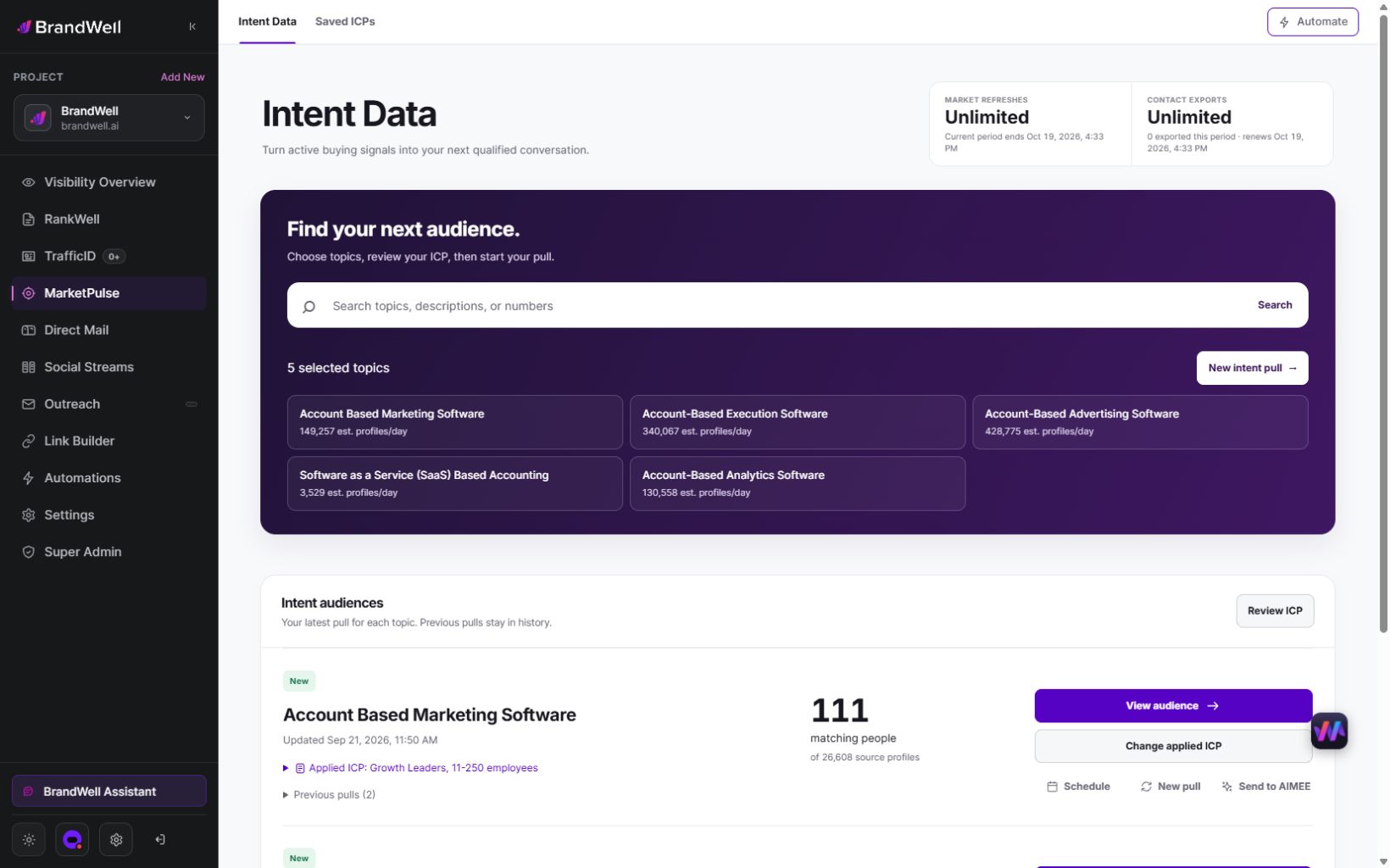
Choose a topic and ICP, inspect the available evidence and prepare one permitted action. Use AIMEE through configured tools for a sourced brief with explicit unknowns. Validate your mapping, approvals and destination before expanding. Watch the demo and review MarketPulse plans.
Reviewed and updated October 3, 2026.

Written by