On this page
- Current MarketPulse research and service boundaries
- Who this is for
- The service package framework
- Three buyer intent data service packages
- What must a recurring white-label package include?
- Service package workflow, owners, and handoffs
- Tools, templates, portals, and integrations
- Manual, automated, and white-label approaches compared
- Service package pricing and delivery cost
- Metrics, ROI, and realistic benchmarks
- Adapt the package to client maturity
- Signal sources, identity, and outcome evidence
- Risks and common mistakes
- Proposal and acceptance-test template
- Privacy and compliance guardrails
- Service package operational checklist
- Frequently asked questions
- Next step
- Make the handoff and response target measurable
An intent-data service package defines the research, review, approved action and measurement your agency will deliver. Agree the initial setup, topic and ICP scope, review cadence, operating responsibilities and evidence. A research record is a hypothesis to evaluate, not a qualified sales opportunity.
One possible commercial model separates setup from recurring work. Define markets, topics, capacity, identity level, response targets, destinations and managed effort. Required privacy and quality controls apply to every tier. Put actual allowances, exclusions and responsibilities in the order form.
Current MarketPulse offer: intent-data plans start at $500/mo. See the product, demo, and current plans. Updated October 6, 2026.
Current MarketPulse research and service boundaries
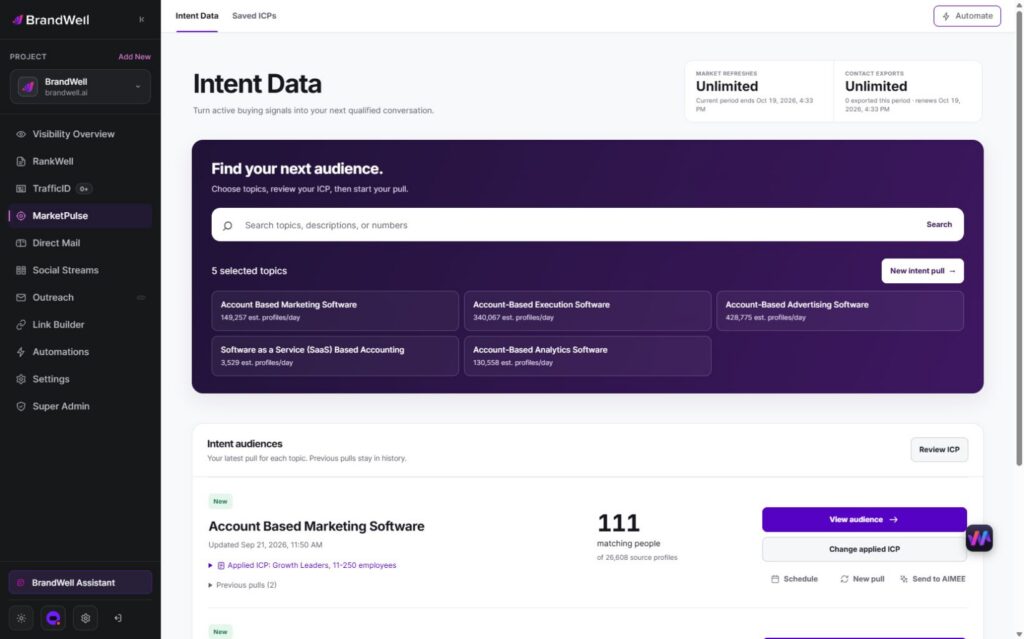
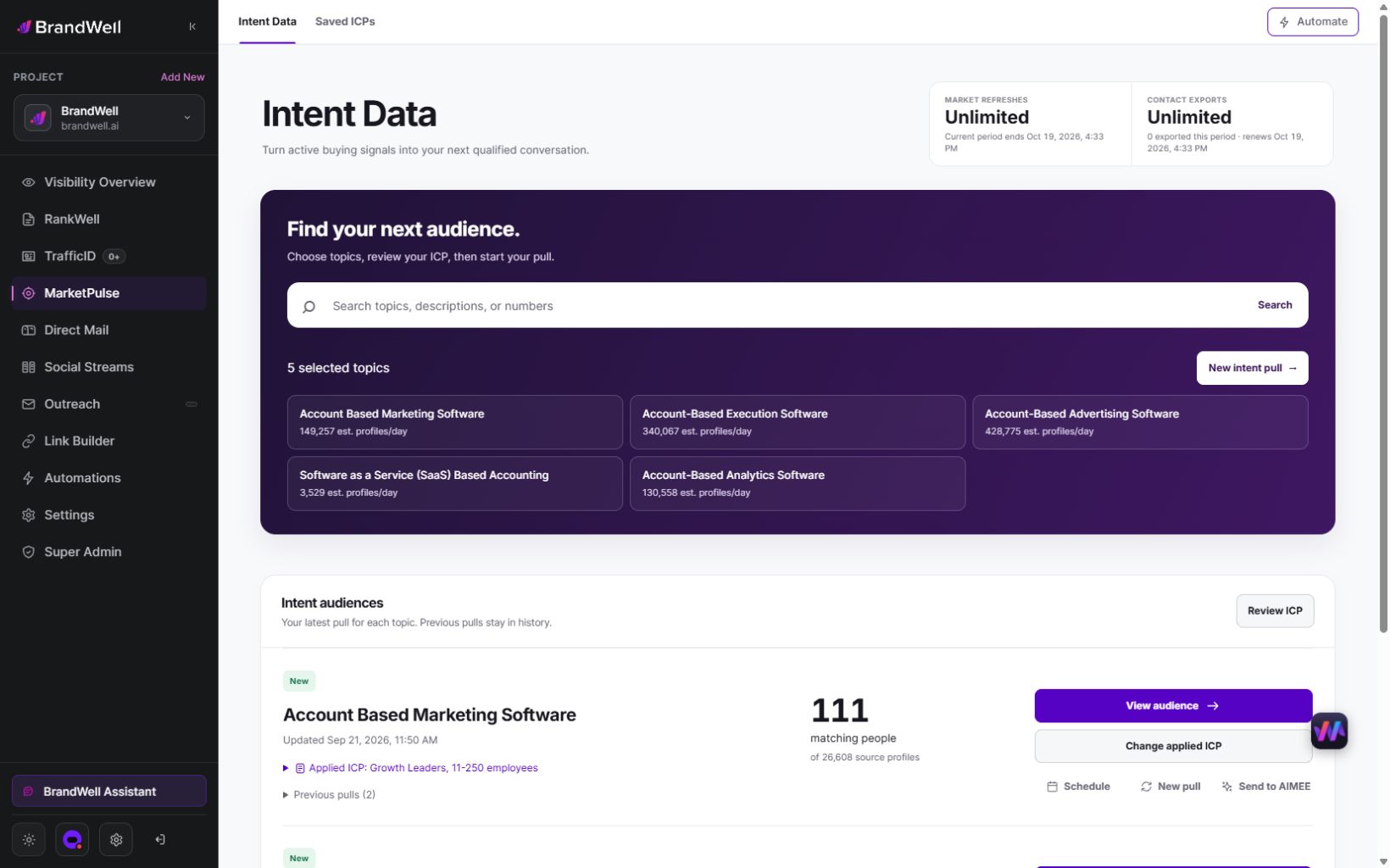
MarketPulse is starting at $500/mo. Choose available research topics, apply a saved ICP and review matching audience fields. Approve eligible exports or a configured next step separately. Custom client portals, billing and managed delivery need their own verified scope.
| Plan | Topics and refreshes | Monthly exports |
|---|---|---|
| Starter | 1 topic, weekly | 25,000 contacts |
| Growth | 3 topics, daily | 100,000 contacts |
| Scale | 10 topics, daily | Unlimited contacts |
Swipe the table to see all columns.
A pull retrieves available data from the previous 24 hours for one topic. Daily use across all included topics provides 90 Growth pulls or 300 Scale pulls in a 30-day month. Weekly Starter pulls vary by calendar month. Available audience size and contact fields vary, and audiences may overlap. Refreshes stop at the plan limit without overage charges.
- Find and qualify: search the topic catalog, save your ICP, and review the people and companies that match.
- Act on the research: export qualified contacts or prepare an Outreach or Direct Mail workflow. Connected products, channel usage, and fulfillment may cost extra.
- Get help from AIMEE: Growth and Scale include AIMEE for the initial user to research accounts and prepare the next step through connected tools.
Agencies and other service businesses can build client deliverables around their available Intent Scans and exports. Keep each client’s scope, permissions, and service fees clear. A subscription is not a promise of a white-label platform or exclusive access to a market.
Explore MarketPulse and watch the demo or compare plans starting at $500/mo. Any early-access discount is a separate, time-limited offer shown to an eligible recipient.
Who this is for
This guide is for agency owners, agency founders, GTM consultants, RevOps consultants, demand generation leaders, and lead generation leaders designing or improving a recurring intent service. It assumes the agency can help a client act on the data and access at least basic funnel outcomes. It is not for teams seeking a guaranteed volume of “hot leads” with no client participation.
The service package framework
Use five modules to define the service and its operating responsibilities.
1. Foundation and signal contract
The setup deliverable defines:
- the ideal customer profile, named accounts, geographies, buying roles, and exclusions;
- category, problem, use-case, competitor, implementation, and expansion topics;
- first-party website, CRM, marketing, and product signals;
- off-site topic research, review activity, business events, and other permitted sources;
- account-, buying-group-, and person-level identity rules;
- fit, relevance, frequency, recency, confidence, and decay thresholds;
- suppression, permitted-use, retention, and client approval rules;
- baseline funnel metrics and the pilot success definition.
The client signs off before monitoring begins. That prevents vague topics, undefined lead promises, and disputes about why a record qualified.
2. Reviewed research with clear evidence
Deliver reviewed research hypotheses on the agreed schedule. Preserve the context needed to assess fit and approve an appropriate action. Record a CRM opportunity only when the defined sales-stage criteria are met.
| Required field | Why it matters |
|---|---|
| Account, domain, and market fit | Confirms the record is eligible |
| Signal type and topic | Explains what changed |
| Source class and timestamp | Supports provenance and freshness review |
| Identity level and confidence | Determines safe account-, group-, or person-level action |
| Score inputs or tier reason | Makes prioritization explainable |
| Match, enrichment, and validation status | Separates a signal from a usable contact |
| Recommended action and owner | Turns delivery into workflow |
| Suppression and approval status | Prevents prohibited activation |
Swipe the table to see all columns.
A signal is not a lead. The agency’s job is to make it a qualified hypothesis, attach the appropriate next step, and preserve the evidence.
3. Activation workflows and SLAs
Specify exactly what happens after each tier qualifies. A practical service package activation workflows matrix might be:
Illustrative agency response targets: agree actual hours, time zone, clock start, exclusions, owner and consequences. These are not BrandWell product service guarantees or legal deadlines.
| Tier | Qualification | Default action | Owner | Response SLA | Approval boundary |
|---|---|---|---|---|---|
| Priority | High fit, relevant recent signal, sufficient identity confidence | CRM task plus researched one-to-one follow-up | Sales owner | One business day | Human approval before external contact |
| Develop | High fit, moderate or single signal | Nurture, paid audience, or watchlist | Marketing | Two business days | Campaign and suppression rules must pass |
| Monitor | Fit is plausible but evidence or identity is weak | Hold for a corroborating signal | Agency operations | Weekly review | No person-level outreach |
| Reject | Poor fit, stale, duplicate, customer, competitor, or prohibited | Suppress and code reason | Agency operations | Use the applicable required deadline and escalation procedure | No activation |
Swipe the table to see all columns.
The SLA must cover agency delivery and client response. An agency cannot promise speed-to-lead if the client’s sellers never accept or disposition tasks.
4. Monthly measurement and optimization
The monthly review should show the full chain:
monitored → matched → qualified → delivered → accepted → acted on within SLA → meeting → opportunity → pipeline → revenue
Break results down by topic, source, segment, identity level, and play. Review false positives and rejection reasons. Tune topics, thresholds, time-to-live, routing, and messaging based on evidence.
5. Governance and commercial boundaries
Every package needs:
- source and methodology documentation;
- client, agency, and vendor data roles;
- tenant isolation and access controls;
- security and subprocessor review;
- retention, deletion, correction, and export rules;
- suppression and opt-out handling;
- channel and geography restrictions;
- usage allowance, overages, correction window, and support terms;
- ownership of client data, reports, configurations, and offboarding exports;
- explicit exclusions and no-guarantee language.
Apply the same required controls across tiers: privacy and quality are baseline controls, not premium add-ons.
Three buyer intent data service packages
These intent data service packages are examples, not universal pricing recommendations. Use the tiers to make the service easier to buy and operate.
1. Signal package
Best for: a mature client with internal RevOps and activation capacity.
Deliverables:
- one market and agreed topic map;
- weekly prioritized account or person feed where coverage and permitted use support it;
- fit, recency, source, identity, and qualification evidence;
- CRM-ready export or delivery;
- monthly quality and opportunity review;
- standard governance controls.
Client owns: routing, seller follow-up, campaigns, outcome disposition, and messaging.
Limitation: low adoption can make good signals look ineffective. The agency should not accept revenue accountability without access to action and outcome data.
2. Activate package
Best for: a client that wants the agency to connect signals to existing GTM systems.
Everything in Signal, plus:
- CRM mapping, ownership, saved views, and alerts;
- two or three approved activation plays;
- contact enrichment and validation allowance;
- advertising or nurture audience sync where permitted;
- response SLA monitoring;
- monthly topic and threshold tuning.
Client owns: final external-contact approvals, seller capacity, media budget, and accurate CRM dispositions.
Limitation: integration errors and client delays become part of the delivery risk, so scopes and escalation paths must be explicit.
3. Operate package
Best for: a client outsourcing ongoing intent operations and selected activation.
Everything in Activate, plus:
- managed daily or weekly queue review;
- seller research or approved outbound execution;
- campaign audience management;
- agent-ready workflow operation with approvals;
- executive reporting, testing plan, and quarterly strategy review;
- broader support and escalation SLA.
Client owns: claims, offers, legal approvals, sales participation, and media or channel budgets.
Limitation: this is a managed service, not software resale alone. Labor, channel infrastructure, QA, and governance must be priced into the margin model.
What must a recurring white-label package include?
If an agency separately contracts for branded client delivery, verify the actual rights, implementation, maintenance and support. The following are design questions for that custom service, not included MarketPulse features:
- Verify any custom portal, reports, notifications and exports actually implemented and permitted.
- Separate tenants, users, permissions, and data for each client.
- Agency-controlled packaging and retail pricing.
- Sales enablement: discovery questions, sample reports, proposal language, objections, and renewal narrative.
- Delivery playbooks: onboarding, topic configuration, QA, routing, optimization, incident response, and offboarding.
- Separate actual subscription and usage charges from agency implementation and service fees.
- Evidence that connects delivery to client action and outcomes.
- Vendor support that does not expose or bypass the agency relationship without agreement.
AIMEE can organize supplied context through configured tools. Name approval owners for writes, exports, messages and deletion. Confirm actual permissions, tool support, destination acknowledgement and recovery; instructions alone do not establish execution.
Review the current MarketPulse topic and ICP workflow.
Service package workflow, owners, and handoffs
A reliable service package implementation guide uses the same delivery cycle for every client:
Step 1: Qualify the client
Confirm ICP clarity, market size, opportunity value, traffic or research activity, CRM readiness, action capacity, outcome access, and governance willingness. Reject the project if the client expects guaranteed leads or refuses suppressions.
Step 2: Configure the market
Approve topics, account rules, identity levels, geographic boundaries, time windows, source types, exclusions, and success criteria. Store the version and approval.
Step 3: Validate a sample
Review representative records with the client. Measure relevance, match confidence, freshness, duplicates, contact validation, and the percentage that can trigger a permitted action.
Step 4: Map destinations and ownership
Define CRM fields, owners, routing conditions, alerts, audience destinations, failure queues, and escalation paths. Test with dummy records before live activation.
Step 5: Launch with approval boundaries
Start with a limited segment. Keep a holdout where practical. Require human approval for surprising, sensitive, or high-impact person-level outreach.
Step 6: Review weekly quality
Code rejections, audit suppressions, repair mappings, check freshness, and make sure no client data crosses tenants.
Step 7: Review monthly outcomes
Compare accepted and treated accounts with the baseline. Tune the service and produce an executive decision: continue, change, expand, or stop.
This service package checklist creates accountable handoffs instead of relying on one operator’s memory.
Tools, templates, portals, and integrations
Evaluate the functions needed for the actual scoped workflow. A product description does not establish every connector, approval path or client entitlement.
- Signal and identity: source transparency, topic relevance, geography, freshness, account/person granularity, confidence, enrichment, and validation.
- Custom client delivery: separately verified branding, domains, reports, isolation, permissions, billing and support.
- System of record: accounts, contacts, stages, owners, suppressions, and outcome fields.
- Activation: seller tasks, sales engagement, email, advertising, nurture, research, and approved agent workflows.
- Automation and QA: routing, alerts, retries, exception queues, approval gates, and logs.
- Measurement: baseline, treated cohorts, funnel events, costs, pipeline, revenue, and attribution caveats.
- Governance: consent and notice records, rights requests, retention, deletion, access control, and audit evidence.
Useful service package templates include:
- client-fit diagnostic;
- market and topic map;
- signal dictionary;
- identity-confidence rubric;
- activation matrix;
- SLA and RACI sheet;
- pilot scorecard;
- weekly QA checklist;
- monthly executive report;
- TCO and gross-margin calculator;
- privacy and security questionnaire;
- offboarding and deletion checklist.
These resources make delivery processes consistent without making every client identical.
Manual, automated, and white-label approaches compared
A service package comparison should separate delivery model from data source.
| Approach | Best when | Advantages | Costs and risks | Migration trigger |
|---|---|---|---|---|
| Manual/advisory | First pilot, small volume, unclear workflow | Fast learning, flexible judgment | Labor-heavy, inconsistent, difficult to scale | Repeatable rules and recurring demand emerge |
| Automated in existing stack | Client already has strong CRM and automation | Uses current systems, avoids another portal | Integration and maintenance burden stays with agency/client | Multi-client control or branded delivery becomes painful |
| Separately contracted branded delivery | Agency wants a branded recurring product | Depends on actual rights, implementation and support | Vendor dependency, wholesale minimums, contract diligence | Agency needs proprietary capabilities or full control |
| Custom build | Unique data, workflow, or scale justifies ownership | Maximum product and roadmap control | Highest engineering, compliance, support, and maintenance cost | Only when validated economics exceed build burden |
Swipe the table to see all columns.
Manual review, configured automation and custom delivery involve different effort, responsibilities and maintenance. Compare actual implementations and economics rather than assuming branded infrastructure is universally faster or better.
Service package pricing and delivery cost
Model total cost before setting a retainer.
Actual delivery cost = subscription allocation + consumed usage + connected tools + incurred labor + activation and governance work. Track budgeted contingencies separately from actual costs.
gross margin = (client fee − monthly delivery cost) ÷ client fee
setup fee floor = discovery + configuration + integration + testing + documentation + project-management cost
Do not hide ad spend, email infrastructure, direct mail, enrichment overages, or bespoke integration work inside a flat data fee. The service package cost should be traceable to the work and usage that create it.
A fictional agency service with $3,200 of actual direct delivery cost and an $8,000 fee has a 60% modeled margin before other costs. This is an arithmetic example, not a standard fee or forecast. If the cost model includes overhead, label the margin consistently.
Intent data service packages pricing should use clear allowances. State markets, topics, clients, records, users, integrations, refresh cadence, support, replacement policy, and overage rates. Intent data service packages cost comparisons are meaningful only when those inputs are normalized.
Metrics, ROI, and realistic benchmarks
Use four layers of service package KPIs:
Time-to-value
- days from signature to approved topic map;
- days to first validated report;
- days to first routed opportunity;
- days to first accepted action.
Quality
- eligible-market coverage;
- identity match and confidence distribution;
- freshness within the promised window;
- duplicate and invalid-contact rates;
- accepted-signal and false-positive rates;
- correction time.
Adoption
- routing success;
- client acceptance and disposition rate;
- time to first action;
- SLA compliance;
- seller or marketer usage;
- percentage of opportunities with a recorded outcome.
Outcomes and economics
- replies, meetings, opportunities, stage progression, sales velocity, wins;
- sourced and influenced pipeline;
- cost per accepted opportunity and cost per qualified opportunity;
- incremental gross profit where a credible baseline exists;
- agency gross margin, retention, and expansion.
Estimated incremental ROI requires an appropriate comparator and mature outcomes. Record the contribution estimate, actual program costs, allocation method and limitations:
Estimated incremental ROI = (estimated additional contribution before program cost minus actual full program cost) divided by actual full program cost. An attribution rule alone does not establish additional contribution.
Label correlation, influence and sourced outcomes separately. Random assignment, matched observational cohorts and before/after baselines support different inferences. State selection, spillover, timing and missing-outcome limitations. Matching or a pre-pilot baseline does not eliminate confounding.
Intent data service packages benchmarks should start with the client’s own funnel. A vendor-wide match-rate claim or case study is not a reliable forecast for a new topic, geography, or client.
Adapt the package to client maturity
Agency package design should not force the same tier on every client.
- Early-stage client: narrow market, manual review, one CRM destination, weekly education, simple baseline. Do not automate person-level contact until fit and governance are proven.
- Growing client: multi-source scoring, role enrichment, two or three plays, regular threshold tuning, and stronger outcome instrumentation.
- Mature RevOps client: API or warehouse delivery, client-owned orchestration, advanced experimentation, buying-group analysis, and strict change control.
- Enterprise client: security review, detailed DPA, complex permissions, regional rules, audit logs, integration monitoring, and executive governance.
Founders define the promise and economics. GTM consultants define the strategy and approved plays. RevOps defines data joins, routing and measurement. Demand generation defines audiences and campaigns. Verify actual owners and implementation for each handoff.
Signal sources, identity, and outcome evidence
Review the evidence at each stage:
- Fit: Is the account economically and operationally eligible?
- Signal: Is the behavior relevant and current?
- Identity: Is the action appropriate for the confidence and geography?
- Activation: Is there a specific, permitted next step?
- Evidence: Can the client record the action and downstream result?
Keep fit, source, identity and permission checks visible. Define freshness and time-to-live for the actual observation. A new score or a real-time label does not make an irrelevant or old observation useful.
This is how to use intent data service packages responsibly: preserve provenance, disclose uncertainty internally, act at the right identity level, and optimize from outcomes rather than volume.
Risks and common mistakes
The most damaging service package mistakes are:
- Promising “ready-to-buy leads.”
- Using broad topics that cannot support a distinct action.
- Omitting timestamps, source class, identity confidence, or reason codes.
- Sending every signal into outreach without fit, suppression, or approval checks.
- Selling monthly reporting while delivering only raw data.
- Ignoring client response SLAs and then blaming data quality.
- Mixing multiple clients’ records, audiences, prompts, or credentials.
- Treating vendor claims as client-specific benchmarks.
- Hiding overages, labor, or media costs from gross-margin calculations.
- Failing to define export, deletion, and offboarding rights.
Scope risk grows with custom work. Data risk grows with person-level activation. Security risk grows with integrations and shared credentials. Expectation risk grows whenever marketing language outruns the contract or evidence.
Proposal and acceptance-test template
A good service package strategy makes acceptance objective before either side invests in a full rollout. Treat the proposal as a service package decision guide: it should tell the client what is being tested, which result would justify expansion, what would trigger remediation, and what would cause the agency to stop.
The service package planning guide in the proposal should include these acceptance fields:
| Decision | What to write down | Acceptance evidence |
|---|---|---|
| Market viability | ICP, geography, topics, excluded segments | Representative report contains enough relevant, explainable opportunities for the agreed workflow |
| Identity quality | Allowed account/person level, confidence, validation | Sample meets the approved confidence and contactability threshold |
| Operational fit | Destination, owner, SLA, approval, failure path | Test records route correctly and exceptions reach the named queue |
| Client adoption | Required seller or marketer actions | Owners accept, disposition, and act on the agreed share within SLA |
| Economic fit | Actual subscription, labor, activation and consistently defined target margin | Modeled package remains viable under expected and high-usage scenarios |
| Governance | Roles, permitted uses, notices, suppression, retention | Legal, privacy, and security reviewers approve the intended workflow |
Swipe the table to see all columns.
Use two or three redacted service package examples during sales: one accepted signal, one rejected signal, and one ambiguous signal that required human review. These examples help the buyer understand the product better than a promise about volume. Service package benchmarks should be client-specific acceptance thresholds, not borrowed averages.
If the client needs integration repair, scoring design, or seller enablement, scope service package expert services separately. The agency guide should also distinguish platform configuration from managed activation. That keeps the core retainer understandable and prevents custom consulting hours from silently eroding gross margin.
Privacy and compliance guardrails
This section is operational guidance, not legal advice. Have qualified counsel review the service by channel and jurisdiction.
Verify actual source, purpose, recipient, role, jurisdiction and channel requirements with the responsible reviewers. A business audience, available email or enriched phone number does not authorize every destination or communication.
Require data provenance, lawful-basis and notice analysis, cookie review where relevant, permitted-use terms, security evidence, tenant isolation, retention and deletion rules, suppression handling, and a tested rights-request process. BrandWell’s privacy policy and terms should be reviewed alongside the agency’s own obligations.
Service package operational checklist
Before launch, verify:
- the client and market passed the fit screen;
- topics and exclusions are approved;
- account/person identity rules are documented;
- data sources, timestamps, and confidence are preserved;
- CRM fields, owners, alerts, retries, and failure queues are tested;
- suppressions run before each activation;
- human approvals exist for consequential actions;
- weekly QA and monthly outcome reviews are scheduled;
- usage, overages, support, corrections, and offboarding are contracted;
- privacy, security, and legal reviewers approved the intended use.
Service package implementation examples should be saved as redacted operating cases: input, qualification rule, action, exception, outcome, and lesson. That creates reusable training without inventing performance proof.
Frequently asked questions
How should an agency design intent service packages for fast, repeatable value?
Agree the initial research and operating scope, then deliver reviewed hypotheses, approved actions, outcome reporting and ongoing review. Keep the first market and play narrow enough to inspect. Sales opportunities require the defined stage evidence.
What steps, owners, SLAs, quality checks, and handoffs should be included?
Assign owners for strategy, data operations, client activation, measurement, and governance. Define delivery and client-response SLAs, QA thresholds, failure queues, approvals, and escalation rules.
Which tools, templates, portals, or integrations best support the design?
Scope research and identity inputs, a system of record, approved activation, exception handling, measurement and governance. Verify custom portals, branding, APIs and client billing separately. Templates can cover discovery, topics, approvals, delivery, cost and offboarding.
How do manual, automated, and white-label approaches compare?
Manual review can help inspect an initial process. Configured automation needs actual connectors, approvals and failure handling. Custom branded delivery requires separately verified rights, implementation, maintenance and economics. No approach is universally best.
What delivery cost and setup fee should an agency model?
Include platform allocation, usage, tools, labor, activation infrastructure, governance, configuration, integration, testing, and project management. Price from actual cost and target margin.
Which time-to-value, quality, adoption, and outcome metrics matter?
Track days to validated delivery and first action; coverage, freshness, confidence, duplicates, and false positives; acceptance and SLA compliance; then meetings, opportunities, pipeline, revenue, and total cost.
How should the package vary by client maturity and stack?
Use more manual review and narrower scope for early clients. Add multi-source scoring and plays as operations mature. Use APIs, experiments, and formal governance for mature or enterprise teams.
Which signals, identity checks, workflows, and evidence matter most?
Prioritize commercially specific, recent signals on eligible accounts. Match activation to identity confidence, preserve source and timestamps, and connect every action to an outcome field.
What scope, data, security, integration, and expectation risks matter?
Watch for vague topics, overbroad person-level use, tenant leakage, failed routing, hidden costs, weak client adoption, and promises that imply guaranteed buyers or revenue.
What must a recurring white-label intent-data service include?
Verify the actual branding and data rights, client separation, billing, delivery playbooks, operating costs, governance and outcome reporting. These are separate custom-service decisions; a MarketPulse subscription does not establish a native white-label portal.
Next step
Select one tier, one client market, and one activation play. Define the signal contract and success threshold, then use a branded report pilot to test the service before expanding. Explore MarketPulse.
Make the handoff and response target measurable
Indicator, target and agreement are different
Google’s Service Level Objectives chapter distinguishes a measured indicator, a target and an agreement with consequences. This is a useful service-design distinction, not a BrandWell or agency response-time benchmark.
Start and stop the same clock
For an illustrative delivery target, define when a record becomes eligible, the staffed business hours and time zone, when a complete handoff is acknowledged, how exceptions are recorded and who escalates. Keep source age separate from review latency. Re-scoring an old observation does not make it fresh.
Report the denominator and failures
A fictional 20 eligible handoffs produce 18 on-time acknowledgements and two unresolved handoffs. Report 90% on-time acknowledgement with two unresolved, rather than 100% after dropping the failures. Delivery does not itself establish a qualified opportunity.
Budget and actual cost are different
The fictional $8,000 agency fee with $3,200 actual delivery cost gives 60% modeled margin. If another $800 of work is incurred, the margin becomes 50%. A separately budgeted $800 contingency is not an incurred expense merely because it appears in the plan.
Copyable package acceptance record
Research: [Actual markets, topics, ICP, sources and fields.] Gates: [Fit, freshness, identity, permissions and suppression.] Delivery: [Owner, destination, clock and acknowledgement.] Failure: [Exceptions, escalation and correction.] Outcome: [Acceptance, action, mature result and unknowns.] Economics: [Actual fee, costs, capacity and change control.]
Explore the current MarketPulse workflow, starting at $500/mo.
Reviewed and updated October 6, 2026.

Written by