On this page
- Current MarketPulse research workflow
- Use six levels of renewal evidence
- Choose continue, redesign or stop
- Preserve inputs, approvals and owners
- Maintain five decision artifacts
- Compare renewal structures
- Budget the next period of delivery
- Measure adoption and retention separately
- Identify the account decision fit
- Review source and activation evidence
- Resolve scope, billing and data-use issues
- Update the agreed research workflow
- Copyable assistant renewal review
- Make the next decision observable
- Worked example: a renewal can conceal weaker economics
- Frequently asked questions
Direct answer: An intent service earns renewal when the client can see a dependable chain from signal selection to action, learning, and the next decision. Start the renewal record at onboarding. Review adoption and evidence throughout the term. Fix weak activation before the commercial conversation, and recommend a smaller package when the client cannot use the full one.
Current MarketPulse offer: intent-data plans start at $500/mo. See the product, demo, and current plans. Updated October 3, 2026.
Do not treat a report full of accounts, clicks, or activity as proof of value. It shows delivery, not necessarily adoption, influence, pipeline, or revenue.
Who this is for: Agency leaders and client-service teams responsible for retention, expansion, delivery margin, and recurring buyer-intent programs.
Current MarketPulse research workflow
BrandWell MarketPulse: intent data starting at $500/mo. Find people researching topics relevant to what you sell, apply saved ICP filters, and review available contact details before taking action.
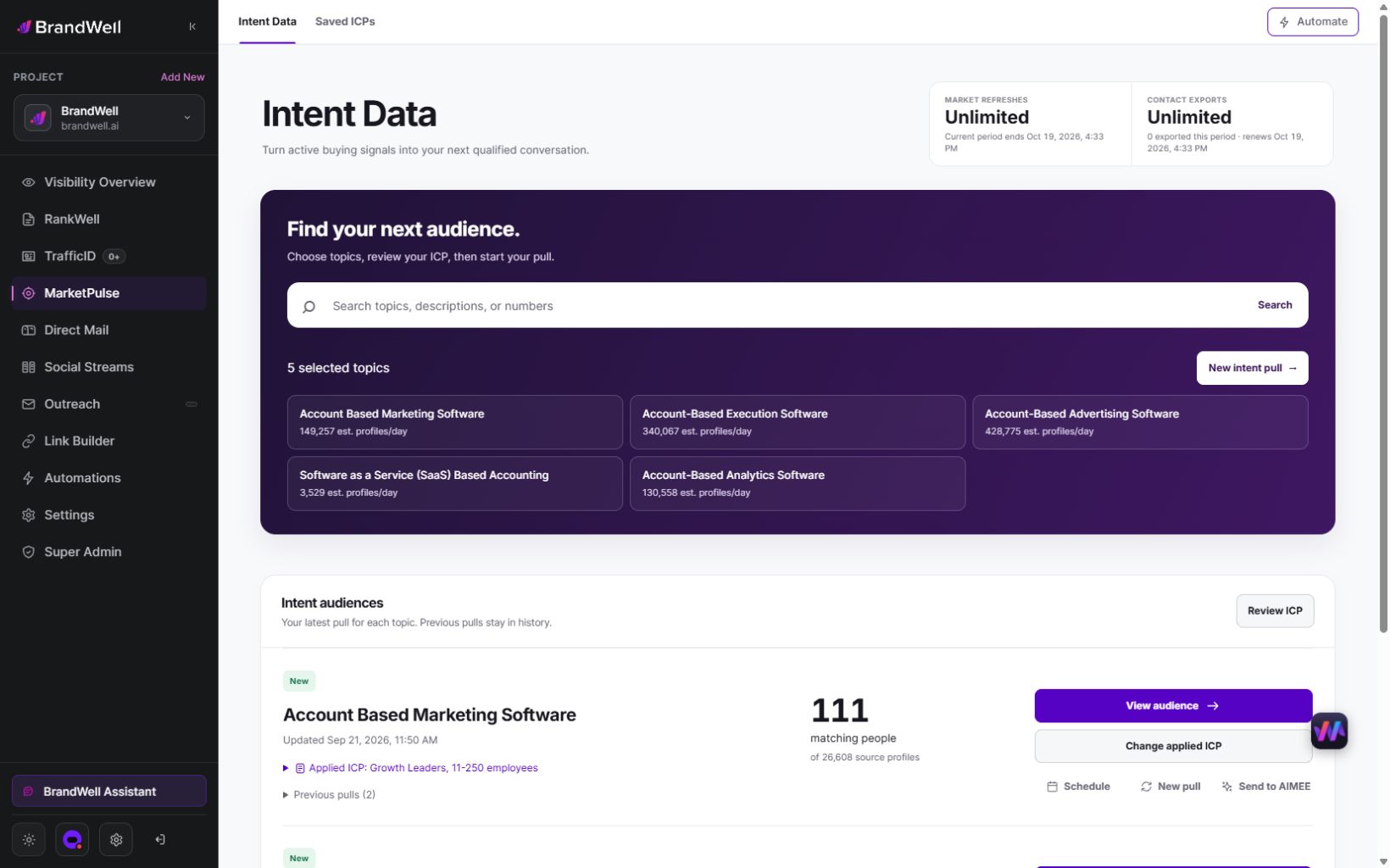
MarketPulse plans are starting at $500/mo. Verify current package scope and offers on the product page.
| Plan | Topics and refreshes | Monthly exports |
|---|---|---|
| Starter | 1 topic, weekly | 25,000 contacts |
| Growth | 3 topics, daily | 100,000 contacts |
| Scale | 10 topics, daily | Unlimited contacts |
Swipe the table to see all columns.
A pull retrieves available data from the previous 24 hours for one topic. Daily use across all included topics provides 90 Growth pulls or 300 Scale pulls in a 30-day month. Weekly Starter pulls vary by calendar month. Available audience size and contact fields vary, and audiences may overlap. Refreshes stop at the plan limit without overage charges.
- Find and qualify: search the topic catalog, save your ICP, and review the people and companies that match.
- Act on the research: export qualified contacts or prepare an Outreach or Direct Mail workflow. Connected products, channel usage, and fulfillment may cost extra.
- Get help from AIMEE: Growth and Scale include AIMEE for the initial user to research accounts and prepare the next step through connected tools.
Agencies and other service businesses can build client deliverables around their available Intent Scans and exports. Keep each client’s scope, permissions, and service fees clear. A subscription is not a promise of a white-label platform or exclusive access to a market.
Explore MarketPulse and watch the demo or compare plans starting at $500/mo. Any early-access discount is a separate, time-limited offer shown to an eligible recipient.
Use six levels of renewal evidence
Renewal discussions fail when the agency jumps from “we sent reports” to “the service created revenue.” Use an evidence ladder that keeps each statement at the level the records support. Movement up the ladder requires better adoption and stronger shared evidence, not a more persuasive slide.
1. Delivery
Were the contracted topics, reports, records, reviews, and handoffs delivered under the agreed scope?
2. Relevance
Did the client accept the topic logic and judge the reviewed signals useful enough to investigate?
3. Adoption
Did named users open, review, assign, suppress, enrich, or activate the work as planned?
4. Workflow movement
Did accepted records reach a destination, owner, sequence, campaign, or sales action?
5. Downstream evidence
Which meetings, opportunities, or pipeline records are associated with the workflow, and what remains uncertain?
6. Economic fit
Does the observed use justify the package after delivery cost, support load, and client capacity are considered?
The ladder makes an honest save plan possible. A client stuck at delivery may need better topics, routing, or enablement. A client with adoption but weak downstream movement may need a different activation play. A client with no capacity to act may need a pause or a narrower plan rather than another presentation.
Choose continue, redesign or stop
Manage renewal as an operating decision with three outputs: continue, redesign, or stop. “Continue” fits when the client uses the service, evidence supports the next period, and the package remains economically sound. “Redesign” fits when the problem is identifiable and correctable, such as an overly broad topic set, slow routing, or the wrong review cadence. “Stop” is responsible when the client cannot act, the rights do not support the use, or delivery consumes more capacity than the account can fund.
Growth is not protected by saving every account. It is protected by retaining good-fit clients, identifying solvable adoption gaps early, and preventing unpriced custom work from becoming the renewal concession. Set the renewal criteria during onboarding, including what the agency will report, what the client must record, how changes are approved, and which outcomes will be treated as associated rather than caused.
Margin belongs in the same review as client value. Record the actual analyst, account-management, support, rework, and reporting time. If the package is healthy for the client but unhealthy for the agency, the answer is a scope or price change, not hiding the cost.
Preserve inputs, approvals and owners
A renewal record should contain the original business question, chosen topics, client profile, accepted signal definitions, activation destinations, named owners, baseline, decisions made, exceptions, scope changes, and economic summary. Keep a client-facing version and an internal margin view. Do not place sensitive personal data in a renewal deck just because it exists in another system.
Use a cadence that matches the service rather than a theatrical quarterly meeting. A delivery owner can check exceptions and routing every week. The client lead can review adoption and decisions monthly. A commercial owner can begin the formal renewal choice far enough ahead to change the package without a rushed concession. The exact timing belongs in the account plan and should reflect contract terms.
- Delivery owner: confirms refreshes, quality checks, suppression rules, and unresolved exceptions.
- Client owner: confirms acceptance, activation, feedback, and internal decisions.
- Account lead: records lessons, proposes changes, and prevents silent scope expansion.
- Finance or agency owner: approves discounts, credits, custom work, and price changes.
- Privacy or security reviewer: handles new sources, destinations, purposes, exports, and retention changes.
The operating record should begin with the controls in the intent-data client onboarding checklist. Renewal becomes easier when the original acceptance criteria survive the handoff from sales.
Maintain five decision artifacts
Use a small set of connected artifacts: a client health score, evidence ledger, decision log, scope-change log, unit-economics sheet, business-review template, and save-plan brief. The best system is the one the account team will update and the client can understand. A complex dashboard with no owner is weaker than a maintained worksheet linked to the CRM and delivery record.
| Artifact | Question it answers | Renewal action |
|---|---|---|
| Health score | Is the account using the service and resolving dependencies? | Continue, intervene, or narrow |
| Evidence ledger | What can be stated at delivery, adoption, and outcome levels? | Build the review without overclaiming |
| Decision log | What changed because the client learned something? | Show operational value beyond activity |
| Margin model | What did the account actually cost to serve? | Hold, reprice, or remove custom work |
| Save-plan brief | Which correctable issue is blocking renewal? | Run a bounded intervention with an owner |
Swipe the table to see all columns.
Avoid borrowed renewal benchmarks unless the population, contract type, and measurement method match. Use the client’s baseline and the agency’s portfolio cohorts for internal learning. Clearly label any cohort with small samples or changing definitions.
Compare renewal structures
A simple monthly continuation offers flexibility but can increase churn risk and commercial overhead. A fixed term provides planning stability but can conceal weak adoption until late in the cycle. An outcome-reviewed term creates a structured decision point, provided outcomes and attribution limits are defined. A usage-based renewal aligns fees with a measurable unit but can make revenue volatile and encourage activity rather than useful decisions. A modular renewal lets the client keep proven components and remove shelfware, though it requires clean entitlements and reporting.
A defined base service, separately scoped modules and an operating review can make responsibilities easier to inspect when that model fits the client. Compare alternatives against actual adoption, capacity, change costs, source rights and contract requirements; no one structure guarantees better retention.
When the client is not ready for a full continuation, a narrower term with one explicit activation improvement can be more honest than an automatic renewal. Define the test, owner, cost, and stop condition before extending the account.
Budget the next period of delivery
Build renewal pricing from the next period’s scope, not the historical invoice. Recalculate wholesale modules, topic count, usage, contracted rights, analysis, reporting, account management, integrations, support, security review, and expected change work. Separate one-time remediation from recurring delivery so the client can see what will disappear after the issue is fixed.
Copyable renewal economics worksheet
Next-period recurring cost = wholesale and usage + delivery labor + account service + support + allocated overhead
Corrective work = one-time topic, routing, integration, enablement, or reporting repair
Proposed client fee = recurring cost + corrective work allocation + target contribution
Decision = renew as is / renew with redesign / reduce scope / pause / end
Never use a discount to hide unresolved adoption. If the service is not used, lowering the price may delay the same decision. Remove the unused module, change the workflow, or establish a bounded activation plan.
Measure adoption and retention separately
Measure renewal quality with a balanced set. Delivery metrics include on-time reports, accepted records, exception resolution, and quality checks. Adoption metrics include active client owners, review attendance, assigned signals, destination acceptance, and completed follow-up. Decision metrics include topic changes, exclusions, campaign adjustments, account-priority changes, and documented next actions. Economic metrics include retention, expansion, contraction, contribution, support hours, rework, and collection risk.
Report meetings, opportunities, pipeline, and revenue only at the confidence level the systems support. Distinguish sourced, influenced, associated, and unknown rather than collapsing every touch into one claim. If CRM hygiene is weak, state that limitation and treat improved recording as an operating goal.
Revenue quality improves when the renewed scope is used, collectible, and deliverable at a sustainable cost. A nominal renewal with a deep concession, unlimited custom work, or unresolved payment issue is not the same as healthy retention.
Identify the account decision fit
Strong renewal candidates have a defined market, stable use case, a client owner, an activation path, and a record of decisions. They give feedback, resolve dependencies, and can distinguish signal relevance from closed revenue. The service does not need a dramatic attributed win every period, but it does need evidence that the work is used and improving choices.
A redesign candidate may have sound market fit but poor topics, routing, training, reporting, or stakeholder ownership. A contraction candidate uses one module well and ignores the rest. A stop candidate has no activation capacity, rejects governance, lacks a viable system of record, or expects guaranteed outcomes from variables the agency does not control.
Contract type matters less than operating truth. A long contract cannot compensate for a missing owner, and a short contract does not prevent renewal when value is visible. Use the model that makes responsibilities, evidence, and commercial changes clear.
Review source and activation evidence
Renew the signal chain, not just the subscription. For each use case, record source category, topic or on-site behavior, identity level, validation state, qualification rule, destination, assigned owner, permitted action, and outcome field. Review false positives, unresolved identities, duplicate records, suppression behavior, and time between signal and action.
A renewal case is stronger when the client can point to repeatable actions: an accepted account reached a named owner, a topic change reduced irrelevant review, a suppression rule prevented waste, or an activation play produced traceable engagement. None of those alone proves revenue causation. Together they show whether the operating system is functioning.
Use the reporting principles in the intent-data reporting guide for agencies to keep delivery, activation, and downstream outcomes in separate layers.
Resolve scope, billing and data-use issues
Renewal risk rises when the agency waits too long to expose adoption problems, allows custom work without change control, or presents ambiguous pipeline claims. Billing risk includes unpaid invoices, retroactive discounts, credits not tied to a documented miss, and renewals agreed verbally but not reflected in current terms. Trust risk includes hiding poor-fit topics, flooding the client with records, or revealing person-level data without a clear permitted purpose and review.
Review the actual source rights, purposes, necessary fields, access, retention and destination approvals before renewing the workflow. A provider subscription or a topic match does not grant every downstream use. Record unresolved questions and obtain qualified owner approval before new sources or client destinations enter production.
Make renewal language consistent with the evidence. A case study, business review, or sales claim should not imply guaranteed pipeline, revenue, or volume. Record limitations close to the claim and require approval before reusing a client result publicly.
Update the agreed research workflow
The service should renew around an updated decision plan. Confirm which topics remain relevant, which identities are useful, which destinations are active, what the client learned, what should stop, and which module deserves expansion. Carry forward only the controls and deliverables that still match the use case.
AIMEE can help prepare a renewal evidence packet through configured connected tools. Preserve unknown actions, actual costs and attribution limits. Human owners verify the records, approve the commercial decision and send the client communication.
Start with supported MarketPulse research starting at $500/mo. Review an available topic, saved ICP and actual preceding-24-hour matches. AIMEE can help organize an approved client brief through configured tools. Agency reporting, remediation and custom implementation require separately agreed scope, capacity and fees.
Use the monthly intent and media report template as a starting point for the recurring decision record, then adapt it to the contracted modules and client systems.
Copyable assistant renewal review
Provide approved aggregate records where possible. Do not paste unnecessary personal data, secrets, or unapproved contract terms. A human account owner must verify every conclusion and send the client communication.
Review this buyer-intent account for a renewal decision.

Use only the supplied records:
- original client decision and baseline
- contracted modules, topics, cadence, and responsibilities
- delivery and exception log
- adoption and activation records
- downstream outcome records with attribution labels
- actual delivery cost and support time
- open scope, billing, privacy, and security issues

Return:
1. evidence ladder by delivery, relevance, adoption, workflow movement, outcomes, and economics
2. unknowns and conflicting records
3. continue, redesign, reduce, pause, or end recommendation with reasons
4. a bounded save plan with owner, evidence test, and stop condition
5. client questions for the next review
6. claims that require human, legal, finance, privacy, or security approval

Do not invent benchmarks, attribution, revenue, legal conclusions, or renewal guarantees.
Make the next decision observable
Pick one at-risk account. Build the evidence ladder, calculate cost to serve, and name the one operating change most likely to improve adoption. If the client cannot own its part, recommend a narrower scope instead of a stronger promise.
Evaluate MarketPulse with a representative topic and a defined ICP. Review the matching audience, prepare one useful action with BrandWell’s connected tools and AIMEE, and measure the operating effort. MarketPulse plans are starting at $500/mo; agree on the package, evaluation period, and success criteria before expanding.
Worked example: a renewal can conceal weaker economics
Suppose a fictional review cohort has 12 contracts due and nine renew. Contract renewal is 75% of the due cohort. A separate beginning recurring-revenue cohort starts at $15,000, loses $3,000 to churn and $1,000 to contraction, and gains $2,000 in expansion. Gross revenue retention excludes expansion: $11,000 / $15,000 = 73.3%. Net revenue retention includes that expansion: $13,000 / $15,000 = 86.7%. Keep new clients outside that beginning cohort. Contract counts and revenue retention answer different questions.
SEC metric-disclosure guidance addresses definitions and calculation methods in its filing context. Here, that documentation principle informs an agency worksheet, not a claim that every agency has the same securities-law duties. State the period, cohort, treatment of pauses and methodology changes.
For one account, assume a $2,000 monthly fee and $1,400 of defined delivery cost, leaving $600, or 30%, before acquisition, general overhead, tax and financing. A 10% discount reduces the fee to $1,800 and the remainder to $400, or 22.2%, if costs stay the same. A $900 repair recovered across the next three months adds $300 per month, leaving only $100, or 5.6%. An additional two support hours at $100 produce a negative $100 remainder.
These are invented inputs, not typical margins or BrandWell service fees. Count repair recovery once, show actual cash timing separately, and test a shorter continuation horizon. A lower invoice cannot fix missing client ownership or create staff capacity. Approve the corrective task, owner, cost ceiling, evidence test and end date before offering another term.
Build the packet around observable client use
Review available MarketPulse topics, the saved ICP and actual pull windows against the signed service scope. Summarize permitted delivery and record whether a client owner accepted or acted on it; absence of feedback remains unknown. Use TrafficID only for separately scoped own-site visitor work. AIMEE can help organize the approved packet through configured tools, while human owners approve any new outreach, spend or commercial commitment.
Frequently asked questions
Does renewing a contract prove the service drove revenue?
No. Separate the commercial decision from documented adoption and causal evidence.
Are contract renewal and revenue retention the same?
No. Define their different cohorts, periods and units.
Should repair work enter renewal pricing?
Yes. Include it once and stress-test the actual recovery horizon.
Are custom agency renewal services included in MarketPulse?
Do not assume that. Agree agency work and product subscriptions separately.
Review the supported research product: explore MarketPulse and current plans.
Reviewed and updated October 3, 2026.

Written by