On this page
- Who this is for
- The intent-triggered cold email decision framework
- A nine-step intent-based cold email workflow
- Intent-triggered cold email examples
- Manual prospecting vs intent-triggered email
- Pricing, staffing, and total cost
- KPIs and ROI
- A first-30-days rollout
- Common mistakes and an operational checklist
- Packaging intent-triggered email as an agency service
- Frequently asked questions
- Measure replies without treating every response as demand
- Inspect the current MarketPulse workflow
Intent-triggered cold email should use recent buying evidence to decide who deserves research and what problem may be timely – not to fire an automated message the moment a signal appears. The safe, effective sequence is: qualify the account, understand the signal, resolve the right role, apply permission and suppression controls, add real business context, obtain the required approval, send a restrained message, and measure useful conversations and qualified pipeline.
A signal is a hypothesis. It may show account-level topic research, a known website visit, or another relevant behavior, but it does not prove that a named person performed the activity, consented to email, or wants to buy. The outreach should be valuable even if the inferred timing is wrong.
Current MarketPulse offer: intent-data plans start at $500/mo. See the product, demo, and current plans. Updated October 3, 2026.
Who this is for
This guide is for B2B founders, growth leaders, SDR managers, sales operations teams, and agencies designing an intent-based cold email service. It assumes the sender can identify a legitimate business audience, document how contact data was obtained and used, protect deliverability, honor objections and opt-outs, and connect activity to CRM outcomes.
The intent-triggered cold email decision framework
Before any message, require six gates:
- Fit gate: the company, role, geography, and use case match the offer.
- Signal gate: the source, topic, recency, identity level, and confidence are understood.
- Contact gate: the selected person is relevant, current, contactable, and not chosen merely because an email exists.
- Governance gate: the source and proposed use are permitted; notices, lawful basis or consent where required, channel rules, suppression, and rights processes are documented.
- Message gate: the copy uses a problem hypothesis and public context without exposing sensitive or surveillance-like detail.
- Evidence gate: the system records disposition, reply quality, meeting, opportunity, complaint, opt-out, and false-positive feedback.
If any gate fails, do not send. Route the record to research, nurture, a different channel, or suppression.
A nine-step intent-based cold email workflow
1. Define the buying problem and signal contract
Choose a narrow commercial problem, then document acceptable signals. A signal contract includes:
- source class: first-party site, off-site topic research, review activity, product engagement, CRM event, or business event;
- topic definition and excluded meanings;
- account- or person-level resolution;
- observed time, frequency, baseline, and confidence;
- ICP rules and disqualifiers;
- permitted actions by geography and channel;
- evidence retained for audit and client reporting.
“High intent” is not enough. Operators need a reason code they can inspect.
2. Apply fit before urgency
Filter by company type, size, market, role, current customer status, open opportunities, competitors, partners, employees, and restricted segments. A fresh signal from a poor-fit account should not jump the queue.
Keep a fit-only comparison group. It provides a comparison; differences alone do not establish causal timing value.
3. Resolve identity conservatively
Separate three statements:
- an account appears to be researching a topic;
- one or more people associated with the account may match a buying role;
- a named person is selected for outreach.
Those are different inferences. Validate current employment, role, geography, business address, and contact status. Never rewrite account-level evidence as “you researched.”
4. Run privacy, permission, and suppression checks
Record where the data came from, what the vendor permits, why the organization believes the use is allowed, which notice or consent applies, and how the person can object. Check global and client suppressions, prior opt-outs, do-not-contact requests, customers, open deals, complaints, restricted territories, and sensitive-data exclusions.
Review current requirements for the actual jurisdiction, recipient, source and channel before sending. Keep the sender identity, message claims, opt-out handling and approvals explicit. This workflow does not itself establish legal compliance.
ICO’s B2B marketing guidance distinguishes corporate and individual subscribers and explains that personal-data requirements still apply. It is under review following the Data (Use and Access) Act. Verify the current position for your actual data flow with a qualified reviewer.
5. Research the account and role
Use the signal to focus research, then add independent context:
- the company’s current strategy, market, product, or public initiative;
- the role’s likely responsibility;
- an operational problem associated with the topic;
- a credible resource, diagnosis, or question the sender can offer;
- an existing relationship, event, content engagement, or referral where available.
Do not include a private-feeling detail simply because the data exists.
6. Choose the message frame
A good first message has four jobs:
- establish relevant context;
- name a specific business problem;
- offer one useful idea or resource;
- ask a low-friction, honest question.
The intent signal usually stays behind the scenes. The recipient should recognize the problem, not feel watched.
7. Set timing and cadence
Freshness should influence priority, not justify a barrage. Use fewer, better touches. Define:
- maximum time from signal to review;
- time zone and sending window;
- maximum messages and sequence length;
- channel transitions;
- stop conditions;
- ownership when the account is already active;
- re-entry rules after the signal expires.
Stale signals belong in a different queue.
8. Protect deliverability
Separate list quality from sending infrastructure. Validate addresses, monitor bounces, use appropriate authentication and domain practices, control volume, avoid deceptive copy, and suppress complaints quickly. A high-intent label does not rescue a damaged sender reputation.
Use one client or business identity per approved sending model. Agencies should not quietly blend lists, domains, opt-outs, or reply handling across clients.
9. Close the feedback loop
Capture accepted signal, sent message, delivery, reply category, objection, opt-out, meeting held, opportunity, stage, value, and false-positive reason. Feed errors back into the signal contract, contact selection, copy, cadence, and vendor evaluation.
Intent-triggered cold email examples
These are structures, not claims that a recipient took a particular action.
Problem-led example
Subject: reducing the handoff between demand and sales
Hi Maya: how does your team turn topic research into an assigned next action? We prepared a one-page workflow that separates fit, timing and ownership. Would that be useful, or is it not a priority?
What this proposed example does: it names a recognizable problem, offers a resource, and gives the recipient an easy way to decline. It does not reveal an inferred browsing event.
Public-trigger plus intent example
Subject: a question about the new market launch
Hi Devon: I saw your public announcement about the new market launch. How are you deciding which account research deserves an SDR handoff? We prepared a short topic, suppression and routing checklist. Would it be useful?
What this proposed example does: the visible trigger is public and the topic signal informs the useful resource. Verify that the recipient’s role is relevant.
Agency report follow-up example
Subject: three topics to test before scaling
Hi Priya – the pilot surfaced three topic clusters that appear relevant to the market definition we agreed on. Before adding volume, I suggest we review which signals are account-level, which contacts pass the role and suppression checks, and which message frame each cluster supports. Can we use Thursday’s review to approve one bounded test?
What this proposed example does: this is a client-facing operational message, not prospect surveillance. It makes approvals explicit.
What not to send
Avoid:
“We saw you researching our competitor yesterday and know you are ready to switch.”
It may misstate identity, timing, source, and buying stage while creating a surveillance concern. Replace the claim with a relevant problem hypothesis and independent context.
Manual prospecting vs intent-triggered email
Manual prospecting remains useful for strategic named accounts, new categories with limited signals, and relationship-led sales. Intent-triggered email is useful when recent, explainable evidence can improve timing and prioritization. A combined model often works best:
- use fit-only lists as a control and steady prospecting source;
- use intent to accelerate selected accounts;
- use first-party known engagement for warmer follow-up;
- use human nominations for strategic accounts;
- recycle stale or ambiguous signals rather than forcing a send.
The comparison should hold message quality, rep skill, offer, and account tier as constant as possible.
Pricing, staffing, and total cost
Intent-triggered cold email cost includes:
data + identity/enrichment + CRM + sending infrastructure + research and copy labor + deliverability + client operations + governance + measurement
Implementation adds market and topic design, vendor review, field mapping, suppression migration, domain and authentication work, sequence setup, dashboards, training, and a pilot.
A lean internal team needs an operations owner, SDR or founder, deliverability owner, CRM analyst, and privacy reviewer. An agency also needs client success and cross-client isolation. One person may hold several roles, but approval and escalation boundaries must be named.
Pricing can be per seat, credit, record, topic, identified visitor, client, or custom package. Compare total cost per accepted opportunity and incremental gross profit – not cost per raw lead.
KPIs and ROI
Track:
- percent of signals passing fit, identity, and governance;
- age at review and age at send;
- valid-address, bounce, complaint, and opt-out rates;
- accepted-account and accepted-contact rates;
- useful-reply rate, not all replies;
- meetings held and qualified-opportunity conversion;
- opportunity progression, wins, and gross profit;
- false positives, invasive-copy incidents, and suppression failures;
- total program cost and agency gross margin.
ROI = (incremental gross profit − total program cost) ÷ total program cost
A fit-only or prior-period comparison can describe association but cannot by itself establish incrementality. Account selection, sellers, seasonality and prior engagement can differ. Where feasible, use a properly designed randomized holdout with stated uncertainty. Do not present an observational difference as verified causal ROI.
A first-30-days rollout
In week one, freeze the market, acceptable signal sources, topic set, exclusions, jurisdictions, and owner matrix. In week two, test records without sending: inspect fit, identity, age, source explanations, suppressions, and whether a researcher can create useful context. In week three, activate one small cohort with one message frame and a fit-only comparison group. Require manual approval and daily review of delivery, replies, complaints, and mismatches. In week four, reconcile CRM outcomes, interview the operators, correct the signal contract, and decide whether to pause, repeat, or expand.
Do not add more topics, contacts, clients, and channels at the same time. Expansion should follow evidence: an acceptable false-positive rate, clean suppression, useful-reply quality, consistent handling, and a credible route from conversation to qualified opportunity. If the team cannot explain why a record entered the test, it is not ready to automate.
Common mistakes and an operational checklist
The largest intent-based cold email mistakes are:
- saying “you researched” when evidence is account-level;
- using a signal as a substitute for a lawful, permitted contact process;
- sending before fit, validation, ownership, and suppression checks;
- revealing sensitive or private-feeling inferences;
- scaling volume before testing reply quality and complaints;
- mixing client domains, lists, or opt-outs;
- leaving stale signals in an evergreen cadence;
- optimizing to meetings booked rather than meetings held and qualified;
- automating corrections and edge cases without review;
- claiming the platform makes outreach compliant.
Before launch, confirm the source and contract, topic definition, geography, identity level, notice or consent basis, opt-out process, global and client suppressions, sender identity, postal address, truthful subject, deliverability controls, stop rules, CRM ownership, complaint escalation, rights-request handling, retention, and measurement plan.
Packaging intent-triggered email as an agency service
Sell a governed signal-to-conversation operation. Include topic and ICP design, weekly opportunity qualification, contact validation, message research, deliverability monitoring, suppression, client approvals, CRM routing, reply handling, monthly pipeline evidence, and quarterly play redesign.
Evaluate a relevant MarketPulse topic and defined ICP, inspect the available output and record what it supports. AIMEE can help prepare configured work through connected tools. Approve the proposed action and inspect its result at the destination.
Start by reviewing the MarketPulse demo and plans, starting at $500/mo. Choose a relevant topic and ICP, then evaluate audience fit, available contact fields, and the workflow you will use. The first-purchase 3-day satisfaction guarantee requires no data exports and no more than 2 Intent Scans; review the current guarantee terms before testing. A short evaluation can establish fit, but cannot prove future pipeline or revenue.
Frequently asked questions
What should trigger a cold email?
A fit account, a documented and recent signal, a relevant role, a permitted contact path, clean suppressions, useful context, and an approved message. No single behavioral event should bypass the other gates.
How fast should a team act on intent?
Act while the signal is still within its documented useful window, but do not trade speed for accuracy or permission. Set different SLAs for strong first-party activity, account-level topic signals, and weak or ambiguous evidence.
What is the best tool?
Choose the workflow from actual signal meaning, identity method, available output, permitted use, required approvals and total operating cost. A standard MarketPulse subscription does not establish a native white-label portal or wholesale contract.
How do agencies prove ROI?
Report qualified opportunities and contribution after data, labor, sending, governance and client-service costs. A matched cohort comparison is observational and does not establish causal ROI. Where feasible, use a properly designed randomized holdout to estimate incrementality, with stated uncertainty and the full relevant cost.
Is intent-triggered cold email compliant?
It can be operated within applicable rules, but no tool or signal makes it compliant automatically. Requirements depend on jurisdiction, recipient type, data source, identity, channel, contract, notice or consent, and operational controls. Obtain qualified advice.
Measure replies without treating every response as demand
In a fictional pilot, 100 messages sent produce 90 confirmed deliveries, nine replies and three useful replies under a rule agreed before review. All-reply rate among delivered messages is 9 ÷ 90 = 10%; useful-reply rate is 3 ÷ 90 ≈ 3.3%. Against sent messages, the corresponding rates are 9% and 3%. State the denominator, observation period and classification rule.
Automatic replies, objections and opt-outs are not positive buying responses. Two held meetings from three useful replies would give 2 ÷ 3 ≈ 66.7%, but that tiny sample cannot support a forecast. These are arithmetic examples, not expected BrandWell results.
Inspect the current MarketPulse workflow
MarketPulse provides topic research, ICP filtering and available contact records. Standard plans are starting at $500/mo for one topic with weekly refreshes. Growth includes three topics with daily pulls; Scale includes ten topics with daily pulls. Available fields, audience sizes and overlap vary.
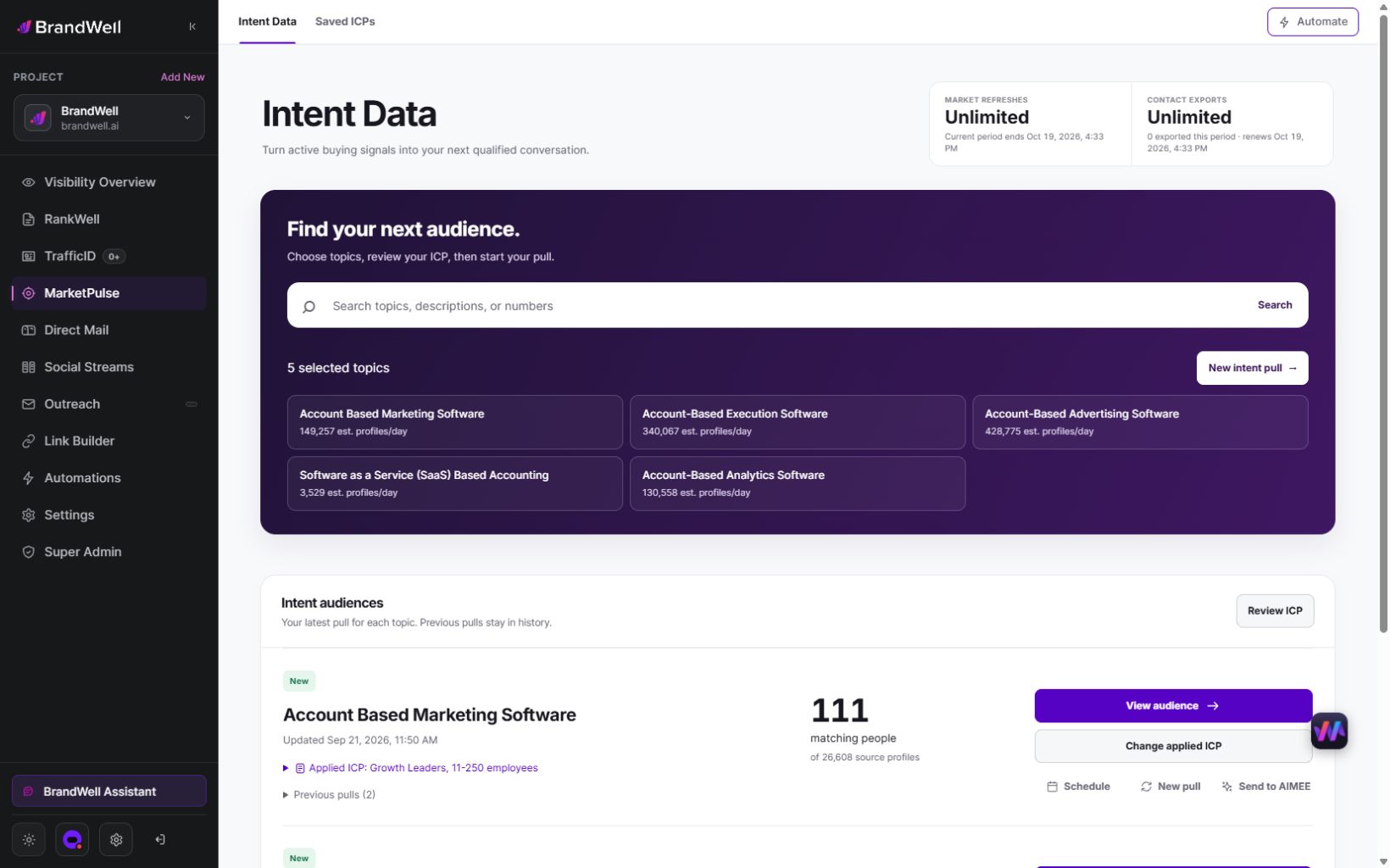
Review a topic and sample output, document the evidence and approvals, and test one bounded workflow. Keep separately agreed client rights and connected-product costs explicit. Watch the demo and review current plans.
Reviewed and updated October 3, 2026.

Written by