On this page
- Treat intent as a research cue, not permission
- Use a five-level LinkedIn action ladder
- A decision tree for every candidate
- Build the human-reviewed workflow
- Compare manual, non-intent, and intent-triggered approaches
- Write messages that make sense without the hidden signal
- Budget and total cost
- Measure quality before volume
- Privacy, policy, and trust guardrails
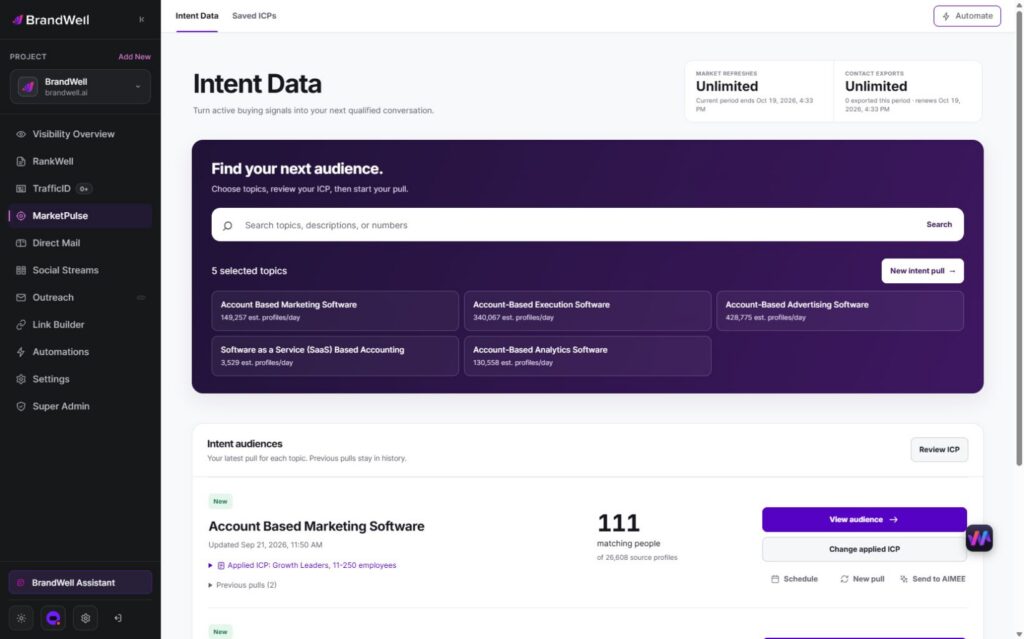
- MarketPulse as the upstream research input
- Package the workflow as a recurring agency service
- Agent-ready research instructions
- Put buyer intent to work with MarketPulse
Direct answer: Use intent to decide which accounts deserve human LinkedIn research – not to auto-message everyone who produces a signal. Require ICP fit, a recent and relevant signal, acceptable account identity, a legitimate person-to-problem connection, no suppression, and a human judgment that the interaction will be useful. Research and engage manually through LinkedIn’s native interface; do not use third-party software or browser extensions to scrape, modify, or automate LinkedIn activity.
Who this is for: B2B founders, sales leaders, demand-generation teams, and agencies designing a LinkedIn-specific, intent-triggered workflow. It does not cover cold-email sequences, calling cadences, generic multichannel orchestration, or unauthorized LinkedIn automation.
Current MarketPulse offer: intent-data plans start at $500/mo. See the product, demo, and current plans. Updated October 1, 2026.
Treat intent as a research cue, not permission
An intent signal changes priority. It does not identify a person by itself, grant consent, establish that an account will buy, or justify mentioning surveillance. Keep four facts separate:
- Account fit: the organization matches the ICP and can plausibly buy or use the offer.
- Research evidence: the account, website visitor, review-site user, or known contact produced an approved signal with source, time, topic, and confidence.
- Person relevance: the LinkedIn member’s current role plausibly owns, influences, or experiences the problem.
- Communication permission: the proposed action complies with platform rules, applicable law, the organization’s policy, and the member’s preferences.
Only the combination can support a LinkedIn decision. An account-level research surge cannot be promoted to “you researched our product.” A pricing-page visit tied only to a business IP cannot be attributed to a named VP. A verified work email does not authorize LinkedIn automation.
Use a five-level LinkedIn action ladder
Escalate gradually. Stronger actions need stronger evidence and more context.
Level 0 – suppress or observe: Do nothing externally when identity is ambiguous, the topic is broad, the person is irrelevant, the account is already in an active opportunity, the member opted out, or the proposed message would expose sensitive inference.
Level 1 – manual account and person research: A human reviews the company, role, recent public activity, existing CRM relationship, shared context, and potential conflict. The purpose is qualification, not scraping or systematically copying LinkedIn data.
Level 2 – authentic public engagement: If a member has published something genuinely relevant, a human can respond to the post with a useful, specific contribution. Do not manufacture comments, insert a pitch, coordinate fake engagement, or claim knowledge from private signals.
Level 3 – connection request or message: A human may send a concise, truthful note when relevance is strong and policy permits it. The note should stand on public or directly shareable context. Intent can prioritize the account internally, but it should not become creepy copy.
Level 4 – sales conversation: After the member responds or an existing relationship supports it, move to discovery with normal qualification. Do not keep escalating because a score remains high.
The ladder prevents a common error: treating every signal as a messaging trigger. Many signals should end at research, content targeting, advertising, an account-owner alert, or no action.
A decision tree for every candidate
Ask these questions in order:
- Does the company meet explicit ICP requirements and exclusions?
- Is the signal source approved, current enough, and relevant to the offer?
- Is it account-level, person-level, first-party, third-party, observed, or modeled?
- Can the account be matched without guessing across subsidiaries, shared domains, or agencies?
- Does the person’s current role have a plausible connection to the problem?
- Is there an existing owner, open opportunity, customer relationship, recent touch, objection, or suppression?
- Is the proposed action allowed by LinkedIn rules, internal policy, contract, and applicable law?
- Can the message be written without revealing or exaggerating surveillance?
- Does a human believe it will add value to this person at this moment?
- What result, rejection, or preference will be recorded so the rule can improve?
If any answer is unknown, downgrade to research or suppress. “The score is high” is not an exception.
Build the human-reviewed workflow
1. Ingest approved signals outside LinkedIn. Store source, company, topic, timestamp, granularity, confidence, data rights, and expiry. Keep the raw event out of a generic outreach queue.
2. Resolve the account. Normalize the domain, account hierarchy, client relationship, owner, customer status, open opportunities, and recent contacts. Ambiguity goes to an exception queue.
3. Apply eligibility and suppression. Combine fit, relevance, freshness, identity, sales capacity, preferences, restricted categories, and client-specific rules. Document the rule version and stop reason.
4. Prepare a research brief. Show the approved signal in calibrated language, likely buying roles, existing relationship, public company context, questions to investigate, and a warning not to repeat private evidence.
5. Conduct native manual review. A person opens LinkedIn and reviews the member through permitted native use. Do not let an agent or extension scrape, alter, auto-view at scale, add contacts, send messages, comment, like, or share.
6. Choose an action. Suppress, monitor, assign to an account owner, engage manually with a useful public post, send a manual connection request, or send a manual message. Name the reason and expiry.
7. Capture the disposition. Record accepted, irrelevant role, wrong company, existing relationship, unsafe inference, no useful context, message sent, response, objection, meeting, opportunity, or suppression.
8. Calibrate monthly. Review sources, topics, recency, roles, copy patterns, complaints, platform warnings, and downstream outcomes. Retire rules that create volume without useful conversations.
Compare manual, non-intent, and intent-triggered approaches
Pure manual prospecting works for a small named-account list when a seller can research deliberately. It is transparent but time-consuming and may miss timing. Non-intent role lists provide stable coverage for category creation, events, and strategic accounts, but priority is based mostly on fit. Intent-triggered research uses recent evidence to order the work, but it introduces signal interpretation, identity, privacy, and recency risk.
Use a hybrid: keep a fit-based account plan, let verified intent change the review order, and reserve capacity for high-value strategic accounts without detectable signals. Do not punish accounts because a provider cannot observe them. Absence of a signal is not absence of demand.
Write messages that make sense without the hidden signal
A safe relevance test is simple: remove the private or licensed intent evidence from the draft. If the note no longer makes sense, it is not ready to send. A manual connection request can refer to a public post, a shared professional context, a clearly relevant responsibility, or a useful resource. It should not say that the sender saw the account researching a topic unless the organization has verified first-party evidence and an approved reason to disclose it.
Keep the first interaction short and pressure-free. State who you are, why the public context is relevant, and what useful next step – if any – you are offering. Avoid invented familiarity, false urgency, and AI-generated praise. A human should verify every factual statement and decide whether silence means stop. If someone declines, objects, or signals disinterest, capture the preference across the client workflow rather than allowing another channel or rep to immediately retry.
Budget and total cost
Budget for signal access, identity and validation, CRM or workflow integration, analyst and seller research, training, governance, reporting, review time, and error handling. Include the cost of rejected candidates and policy review. Cheap automation can be expensive when it causes account restrictions, reputational damage, or poor conversations.
MarketPulse plans are starting at $500/mo. Starter includes 1 topic, weekly refreshes, and 25,000 exportable contacts per month. Growth includes 3 topics, daily refreshes, and 100,000 exportable contacts. Scale includes 10 topics, daily refreshes, and unlimited contact exports. AIMEE for the initial user is included with Growth and Scale. Compare MarketPulse plans and current offers.
Measure quality before volume
Track candidates reviewed, identity acceptance, role relevance, suppression, policy rejection, research time, approved actions, connection acceptance, replies, positive replies, meetings, accepted opportunities, complaints, opt-outs, account warnings, and pipeline. Show denominators and separate the upstream signal from the human action.
Compare eligible accounts receiving manual intent-prioritized review with similar fit-only accounts. Account for seller selection: reps may choose the easiest names and make the workflow look better. A useful metric is qualified conversation per approved human action, not messages sent. If volume rises while relevance, replies, or trust fall, stop.
Privacy, policy, and trust guardrails
LinkedIn’s automated-activity guidance prohibits third-party software or extensions that scrape, modify or automate its website. Its User Agreement also governs permitted use. Keep execution native and human-reviewed; an upstream signal does not authorize platform automation.
Minimize stored personal information, restrict access and honor objections. Review the actual source, contract, jurisdiction and client role before launch; this workflow is not a legal-compliance determination.
MarketPulse as the upstream research input
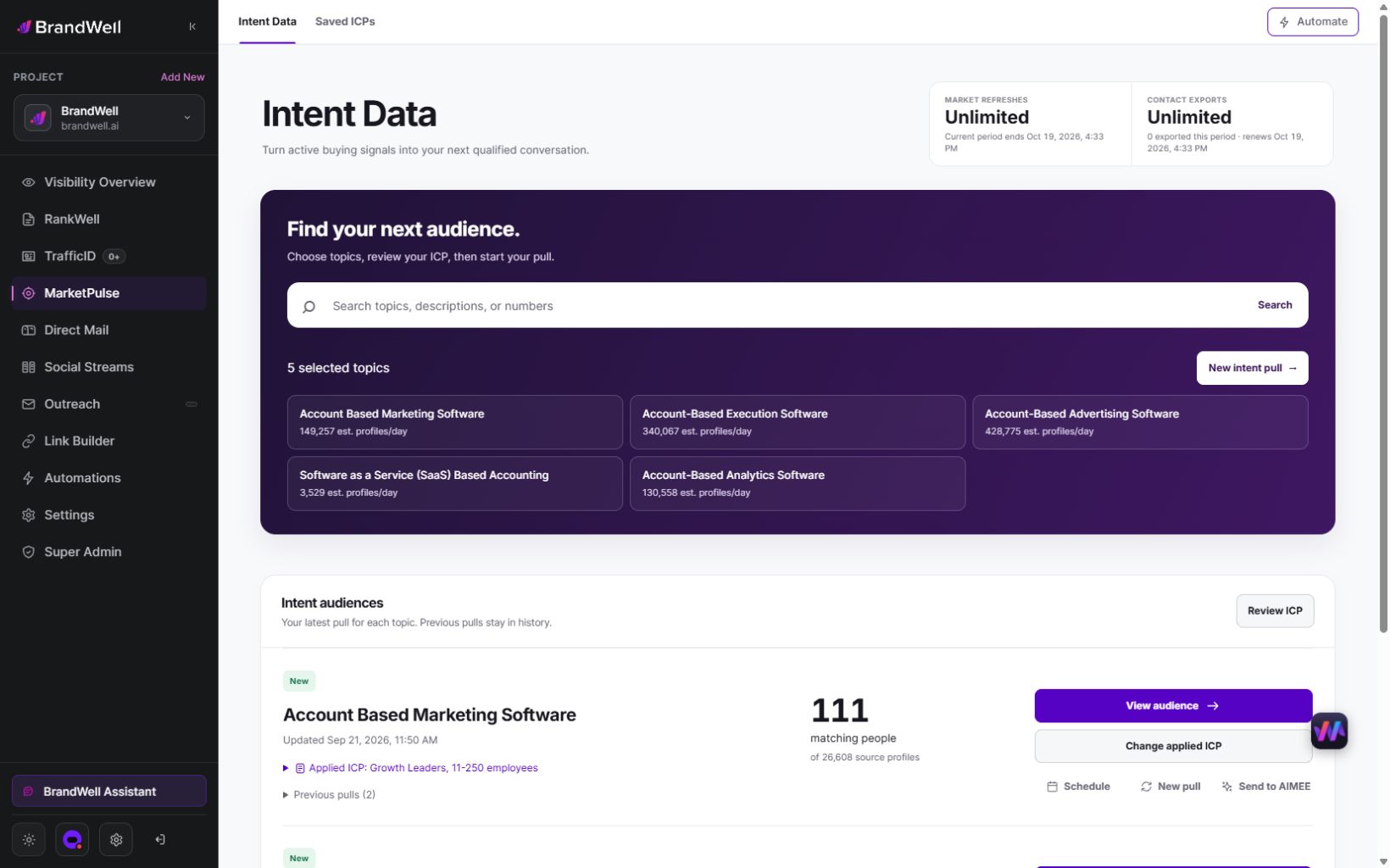
MarketPulse helps find people researching relevant topics, apply saved ICP filters and review available contact fields. Standard plans are starting at $500/mo: Starter includes one topic, weekly refreshes and 25,000 monthly contact exports; Growth includes three topics, daily refreshes and 100,000 exports; Scale includes ten topics, daily refreshes and unlimited exports.
An Intent Scan retrieves available data from the previous 24 hours. Full daily use is 90 Growth pulls or 300 Scale pulls in a 30-day month; weekly Starter pulls vary by calendar. Audience sizes and fields vary and audiences can overlap. Growth and Scale include AIMEE for the initial user. This supports research preparation, not authorization to automate LinkedIn.
Fictional measurement example: Of 100 reviewed candidates, 40 receive an approved manual action and eight produce a qualified conversation. That is 20 percent per approved action, or eight percent per reviewed candidate. It is not a benchmark or proof of incremental lift.
Package the workflow as a recurring agency service
An agency package can include topic and ICP calibration, a weekly qualified-account queue, manual research briefs, an approval matrix, native LinkedIn execution coaching, response dispositions, branded reporting, and monthly calibration. The agency should promise governed prioritization and useful preparation – not automated LinkedIn volume.
Evaluate MarketPulse with a relevant topic and a defined ICP. Review matching people, source coverage, and the next action, then use BrandWell’s connected growth tools and AIMEE assistance to prepare the work. Measure audience usefulness and operating effort before expanding the program.
Agent-ready research instructions
Give this brief to Claude or ChatGPT, or use AIMEE only for approved preparation outside LinkedIn. Do not allow any agent or extension to scrape, modify, auto-view, connect, message, comment, like, share, or otherwise automate LinkedIn.
- Load approved account signals, ICP, source and granularity, recency, confidence, CRM ownership, suppressions, role hypotheses, and policy rules.
- Resolve the company outside LinkedIn and classify the signal as account-level, known-person first-party, or uncertain. Never promote account evidence to a person.
- Produce a short human research brief with the business problem, likely relevant roles, public-context questions, existing relationship, and phrases that must not be disclosed.
- Recommend suppress, monitor, account-owner review, manual public engagement, manual connection request, or manual message; explain the evidence threshold.
- Require a human to open LinkedIn natively, confirm the current role and context, edit any copy, and execute or reject the action.
- Record the disposition without copying unnecessary profile content. Immediately suppress objections, irrelevance, unsafe inference, active opportunities, and policy concerns.
- Return weekly quality and outcome analysis. Do not increase volume, loosen thresholds, or change policy without named human approval.
Start by reviewing the MarketPulse demo and plans, starting at $500/mo. Choose a relevant topic and ICP, then evaluate audience fit, available contact fields, and the workflow you will use. The first-purchase 3-day satisfaction guarantee requires no data exports and no more than 2 Intent Scans; review the current guarantee terms before testing. A short evaluation can establish fit, but cannot prove future pipeline or revenue.
Reviewed and updated October 3, 2026.

Written by