


On this page
- What local SEO can and cannot do
- 1. Review your Google Business Profile
- 2. Correct customer-facing business information
- 3. Research relevant local questions
- 4. Publish useful local content in RankWell
- 5. Choose useful local listings
- 6. Request genuine reviews
- 7. Build genuine local relationships
- 8. Make each location page useful
- 9. Test the mobile customer journey
- 10. Answer natural-language questions
- 11. Improve loading and maintenance
- 12. Add accurate business structured data
- 13. Use social channels for discovery
- 14. Maintain customer relationships
- Measure local visibility and business value
- Local SEO questions
Local SEO is still useful for businesses serving a real location or service area. The practical work is helping nearby customers find accurate information, evaluate your services and complete a useful next step. It does not guarantee a top map position or a fixed return.
This guide updates the former 2025 advice for the current workflow. It retains fourteen practical areas to review while removing unsupported search-share statistics, review incentives, outdated interface instructions and guaranteed ranking claims.
What local SEO can and cannot do
Google’s local-ranking guidance describes relevance, distance and prominence as important factors. It also says businesses cannot request or pay for a better local ranking. Your business information can improve how customers understand your offer; optimization cannot move the customer’s physical location.
Separate map visibility, organic website clicks and actual customer outcomes. A high position for one query from one location is not a complete account of your local market. Start with the services you actually provide, where you provide them and the capacity you have to handle inquiries.
1. Review your Google Business Profile
Use the options available in the current account to claim and verify the profile. Do not assume a postcard or one specific verification method is offered. Review the actual business name, category, customer-facing location or service area, contact details, website and hours. Correct stale information rather than adding promotional keywords to an identity field.
Choose genuine business photos and descriptions that help a customer decide whether the service fits. Keep records of the owner, last review and requested changes. A complete profile is not a guarantee that every search will show it.
2. Correct customer-facing business information
NAP means name, address and phone number. Audit the website, important business listings and active social profiles for wrong or outdated details. Prioritize errors that could send a customer to the wrong place or phone number.
Use one approved business-information record with owners and effective dates. A move, rebrand or new phone number should trigger a review. Do not treat harmless punctuation differences as a proven ranking problem or manufacture an address for an area you do not occupy.
Example: after an office move, test the contact page, appointment instructions, map destination and active directory entries. Record which corrections are accepted and which still need follow-up.
3. Research relevant local questions
Combine customer questions, actual Search Console queries and keyword research. Begin with a real service and geographic scope. Check whether the phrase describes something you provide and whether the searcher wants directions, a quote, availability, a comparison or educational advice.
In BrandWell’s current keyword-research workflow, use a seed relevant to the service, inspect candidate terms and group them around a reader task. Review the results before making a content plan; a suggested phrase does not establish demand in your exact service area.
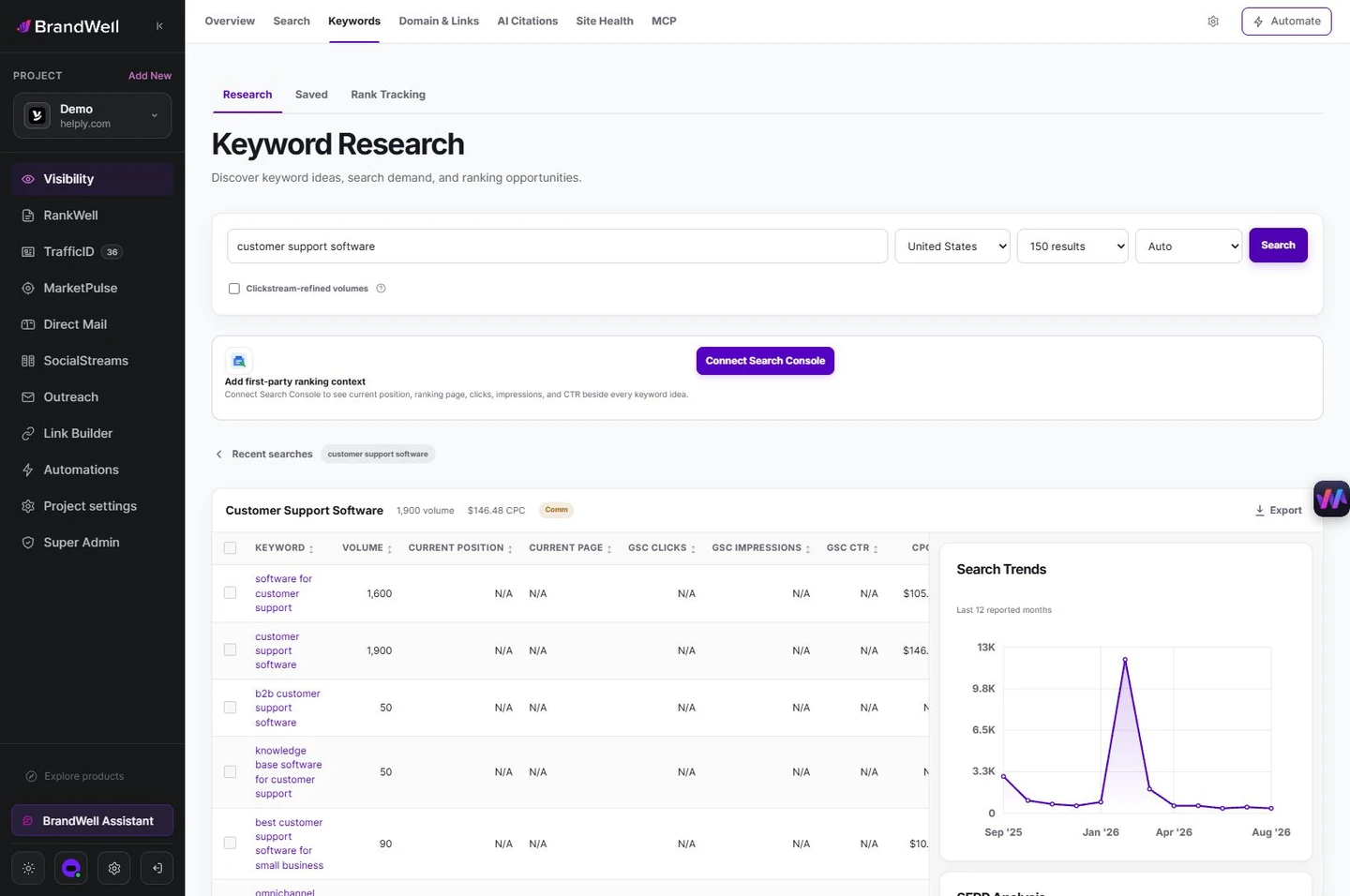
A Phoenix plumbing business might separate emergency availability, repair pricing and maintenance questions. Those could require different pages or sections. A long phrase is not automatically easier to rank for or more likely to convert. Avoid repeating “near me” in every heading or image description.
4. Publish useful local content in RankWell
Choose topics that connect local conditions with your actual expertise. A landscaping company can explain its own service process and locally relevant maintenance questions; a restaurant can publish current menus, dietary information and booking details. Verify seasonal, health, legal or safety advice against appropriate sources.
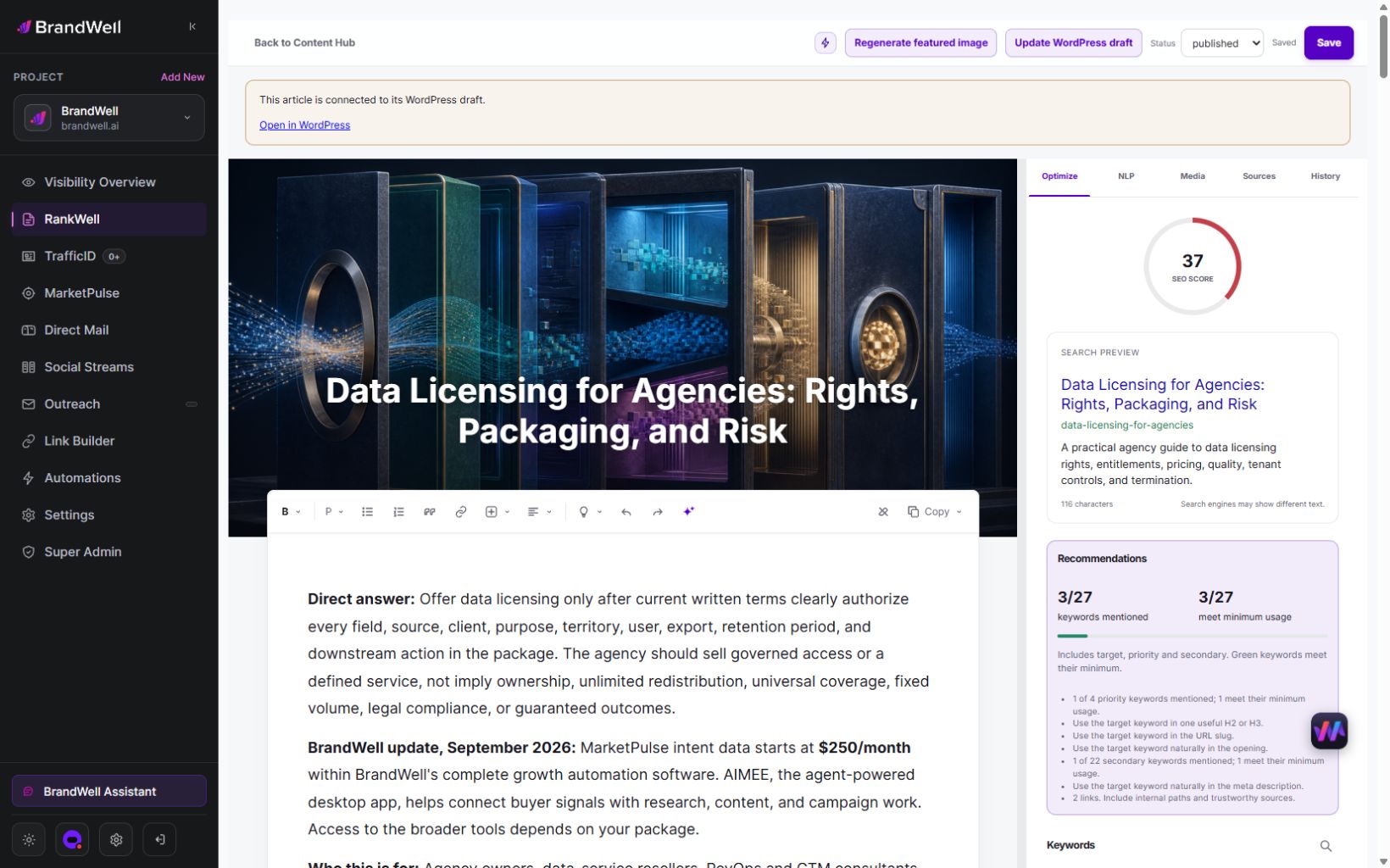
RankWell supports research, drafting, editing and publishing in the BrandWell portal. Organize the work in the Content Hub and review the editor’s sources, media, search preview, recommendations, NLP and history. Bring first-hand photos, dated business details and concrete examples into the brief.
Before publishing, verify every factual claim and confirm the business can deliver what the article promises. A generated draft or score does not establish expertise, factual correctness or a ranking outcome.
5. Choose useful local listings
A local citation is a mention of the business and its identifying details. Choose listings customers actually use or that serve a relevant industry or community. A chamber listing, business directory or professional association may be worth maintaining when it accurately represents the business.
Record submission date, listing URL, price if any, approved details and review owner. Avoid bulk packages whose value depends only on the number of placements. A directory entry is not proof of new customers or a specific ranking change.
6. Request genuine reviews
Google Maps’ review policy prohibits incentives for reviews, revisions or removal, and prohibits selectively soliciting positive reviews. Ask for genuine feedback without directing the rating or wording. Do not offer discounts, free goods or prizes for a Google review.
Use a neutral request such as: “Thank you for visiting. If you would like to share your experience, here is our review link.” Follow the rules of the destination platform rather than applying one request method everywhere.
Respond constructively to feedback and move private customer information to an appropriate support channel. Report suspected policy violations with evidence; a critical review is not automatically fake. Reusing a testimonial or customer photo in marketing requires its own permissions review.
7. Build genuine local relationships
Publish useful resources, participate in relevant community activity and make it easy for a journalist or partner to verify business information. A joint educational event or original local guide can create value without making a backlink the condition of participation.
Do not offer discounts or services in exchange for ranking-oriented links. Treat sponsorship, referral exposure and editorial coverage as different activities, and review any commercial placement’s disclosures and link treatment. Measure qualified referral visits and inquiries separately from the number of links.
8. Make each location page useful
Create a location page when it provides a distinct, truthful customer resource. Include the services available there, real hours, contact options, access or parking information, service boundaries and verified local examples. A service-area business should describe the area accurately without implying a storefront it does not have.
Proposed page checklist:
- Clear business or service identity and geographic scope.
- Current contact and booking information.
- Services, constraints and useful pricing context where available.
- Authentic photos and appropriately permitted customer examples.
- Directions when visitors actually attend that location.
- A clear next step and a named maintenance owner.
Do not create hundreds of nearly identical city pages by swapping place names. If two pages answer the same task with no distinct value, review whether one stronger resource would serve the customer better.
9. Test the mobile customer journey
Use an actual phone-sized viewport to test calling, booking, directions, menus and forms. Check readable text, touch targets, keyboard behavior, table overflow and whether an overlay blocks the answer. Resizing a desktop window tests layout, but does not reproduce every phone browser or connection condition.
Test the published page rather than only the editor preview. Record the device or viewport and any failed task. AMP is not a default requirement for a local-business content plan; choose a maintainable design that supports the real customer journey.
10. Answer natural-language questions
Write clear answers to questions customers ask by voice or text: “Are you open on Sunday?”, “Do you serve this neighborhood?” or “What should I bring to an appointment?” Ensure answers are correct and easy to find.
Do not rely on an unsupported percentage of voice searches or claim that an FAQ guarantees assistant visibility. Concise answers can help readers; the platform determines which information it presents. Update availability and pricing when they change.
11. Improve loading and maintenance
Test important pages with PageSpeed Insights and a real browser. Check heavy images, unnecessary scripts, media layout shifts and delayed interactive controls. Keep test conditions comparable and distinguish laboratory results from real-user field data.
Use appropriately sized images, reserve media dimensions, and defer below-the-fold content where suitable. Keep software maintained, access controlled and backups recoverable. HTTPS protects transport but does not by itself prove that a business or website is trustworthy.
Maintain an error list with URL, problem, owner and verification. Fix broken destinations thoughtfully; redirecting every retired page to the home page can leave the visitor without the answer they expected.
12. Add accurate business structured data
Google’s LocalBusiness structured-data documentation describes supported business details and eligibility rules. Match markup to the visible page and use the relevant business type. Validate the finished implementation with the Rich Results Test; correct markup does not guarantee an enhanced search display.
Do not add invented ratings, offers or locations. Google’s local-business documentation limits review-property use to sites reviewing other businesses, so do not promise self-serving business-star results from your own testimonials. Keep markup, website facts and current business information aligned.
13. Use social channels for discovery
Choose channels where your audience participates and maintain accurate contact information. Publish current work, service explanations and useful community updates with appropriate permissions. Keep organic posts and paid campaigns separate in the reporting.
A video can demonstrate a process, but it does not universally outperform every text or image post. Test the format against an actual goal, such as useful inquiries or completed appointments. Do not treat likes, tags or prize entries as equivalent to customers or a Google ranking signal.
14. Maintain customer relationships
Answer questions, resolve service problems and make important information easy to find. An appropriately designed loyalty program can support repeat business without being tied to reviews. For email or personalized outreach, honor the applicable preferences and channel requirements.
Use customer feedback to identify missing explanations, unclear booking steps or obsolete information. Track the change and outcome. Community involvement and responsive support have their own value without claiming that search algorithms reward each activity directly.
Measure local visibility and business value
Freeze a baseline with exact pages, dates, search type, country and device filters. Report impressions, clicks, CTR, qualified inquiries and completed customer outcomes separately. A map interaction or website click is not necessarily a sale.
Fictional example: At 5,000 impressions and 100 clicks, CTR is 2%. A later 5,000-impression period with 125 clicks has 2.5% CTR, an increase of 0.5 percentage points and 25% more clicks. If ten inquiries produce three appointments, appointment conversion among inquiries is 30%. These figures use different denominators and do not prove a causal SEO effect.
Include content, maintenance, advertising and service-delivery costs before evaluating return. A local program is worth continuing when it produces useful customer outcomes at an acceptable cost, not because a generic article promised high ROI.
Local SEO questions
Is local SEO dead?
No. Google still provides local results and business-profile guidance. Focus on truthful information, useful local resources and a working customer journey rather than treating optimization as a guarantee.
Does every business need many location pages?
No. Publish a separate page when it provides distinct information for a real location or service need. A large page count is not the objective.
Will AI answers replace the need for my website?
Keep the website’s service information and evidence current regardless of the discovery surface. An AI mention is not guaranteed and does not replace a reliable booking, contact or purchase process.
How does BrandWell help?
Use keyword research to explore relevant questions and RankWell to organize, draft and review the content. Supply genuine business details and original examples, then verify the published page. A content workflow does not automatically manage every business listing or establish a ranking result.
Explore the current RankWell workflow and BrandWell products to choose the tools that fit your local content work.
Reviewed and updated October 3, 2026.

Written by
Justin McGill is the founder of BrandWell, growth automation software for inbound and outbound teams. BrandWell brings together MarketPulse intent data, TrafficID website audiences, RankWell content workflows, Visibility research and AIMEE execution through configured tools.
 Farnaz Kia
