On this page
- Current MarketPulse research workflow
- Check whether the move changes a decision
- Use seven job-change review rules
- Verify seven action gates
- Use timing without invented urgency
- Assign source, review and action owners
- Compare relationship and research signals
- Budget full operating costs
- Measure distinct plays and actual outcomes
- Check actual operating prerequisites
- Avoid unsupported or intrusive outreach
- Scope a separate agency monitoring service
- Use the implementation checklist
- Preserve judgment and unresolved evidence
- Copyable job-change review
- Frequently asked job-change questions
Short answer: A job change is a context trigger, not proof of buyer intent. It becomes useful when the person, employer, role, timing, prior relationship, and account fit are verified – and when the new context plausibly creates a problem your offer can solve. Job-change intent signals should route different plays for a former champion, a new decision-maker, an internal promotion, or a vacant role rather than treating every move as the same event.
Who is this for? B2B sales, customer-success, RevOps, and agency teams that want timely relationship-based prospecting without creepy messaging, stale employment data, or automatic outreach.
A public employment change can prompt a relationship or account review. The role, authority, preferences, new employer fit and relevance remain unverified until checked. A person may have multiple simultaneous roles, a delayed profile or no present commercial need. Classify the event without inferring a private motivation.
The operational goal is therefore to verify the event and classify the relationship before deciding what, if anything, to do. The signal remains probabilistic. It does not establish that a person is shopping, that they can buy, that they want to hear from you, or that a prior relationship may be disclosed. Preserve source evidence, uncertainty and a proportional next step.
Current MarketPulse offer: intent-data plans start at $500/mo. See the product, demo, and current plans. Updated October 3, 2026.
Current MarketPulse research workflow
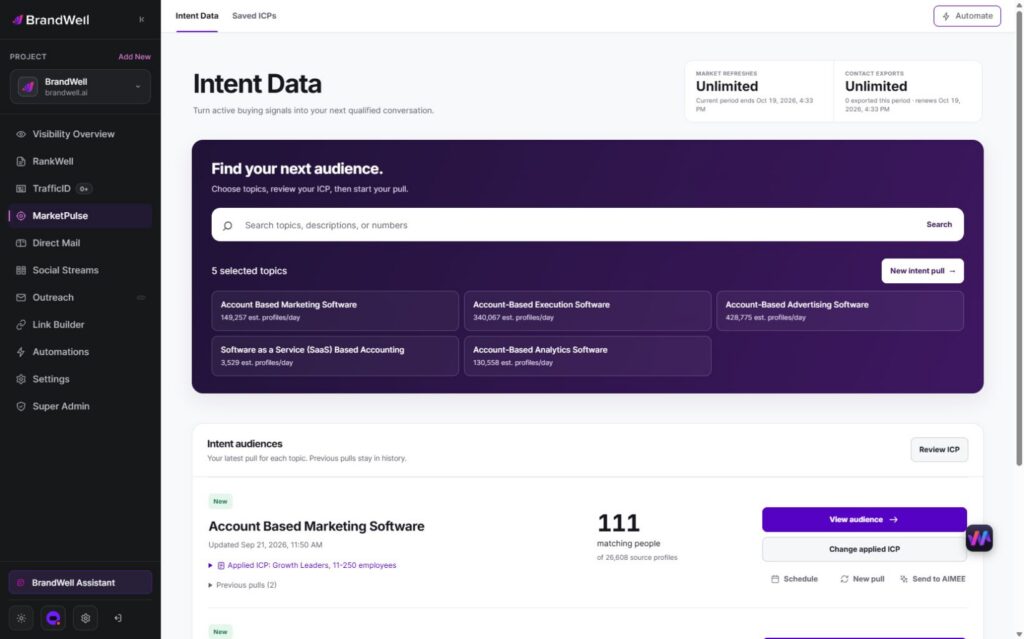
BrandWell MarketPulse: intent data starting at $500/mo. Find people researching topics relevant to what you sell, apply saved ICP filters, and review available contact details before taking action.
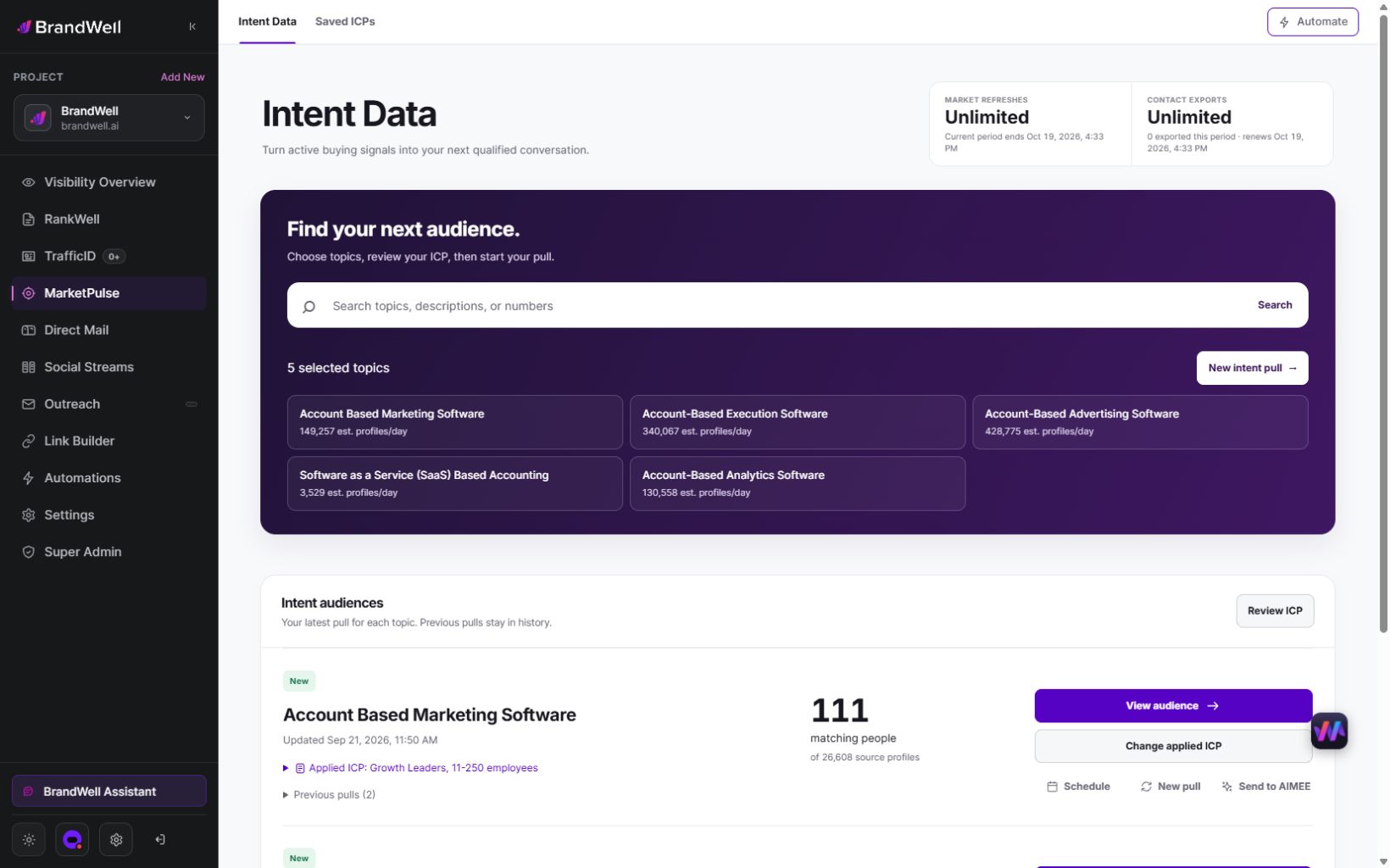
MarketPulse plans are starting at $500/mo. Verify current package scope and offers on the product page.
| Plan | Topics and refreshes | Monthly exports |
|---|---|---|
| Starter | 1 topic, weekly | 25,000 contacts |
| Growth | 3 topics, daily | 100,000 contacts |
| Scale | 10 topics, daily | Unlimited contacts |
Swipe the table to see all columns.
A pull retrieves available data from the previous 24 hours for one topic. Daily use across all included topics provides 90 Growth pulls or 300 Scale pulls in a 30-day month. Weekly Starter pulls vary by calendar month. Available audience size and contact fields vary, and audiences may overlap. Refreshes stop at the plan limit without overage charges.
- Find and qualify: search the topic catalog, save your ICP, and review the people and companies that match.
- Act on the research: export qualified contacts or prepare an Outreach or Direct Mail workflow. Connected products, channel usage, and fulfillment may cost extra.
- Get help from AIMEE: Growth and Scale include AIMEE for the initial user to research accounts and prepare the next step through connected tools.
Agencies and other service businesses can build client deliverables around their available Intent Scans and exports. Keep each client’s scope, permissions, and service fees clear. A subscription is not a promise of a white-label platform or exclusive access to a market.
Explore MarketPulse and watch the demo or compare plans starting at $500/mo. Any early-access discount is a separate, time-limited offer shown to an eligible recipient.
Check whether the move changes a decision
Four conditions make a job-change signal more actionable:
- Identity confidence: the profile belongs to the right person and is not a namesake or merged record.
- Employment confidence: the previous and current employers, role, seniority, and effective timing are verified from authorized or public sources.
- Commercial relevance: the new responsibility and company fit the problem your offer solves.
- Relationship context: CRM history, consent, account ownership, suppression, and prior outcomes support an appropriate next step.
A high-confidence employment update can still be commercially irrelevant. A relevant move can still be inappropriate for outreach. Keep verification, relevance, and permission as separate states so one score cannot hide a failed gate.
Use seven job-change review rules
This implementation guide applies the same criteria to every use case: identity, employment, relationship, permission context, account fit, role relevance, recency, proportional action, and measured outcome.
1. Verify the move
Confirm the person, previous employer, current employer, role, effective or observed date, and source. Control for namesakes, overlapping positions, advisory roles, internal promotions, and profile lag. Preserve conflicting assertions and lower confidence instead of forcing a clean narrative.
Best fit: every job-change play, including former champions, new decision-makers, promotions, and departures. Limitation: even accurate public employment data can lag the actual transition or omit the person’s effective remit.
2. Check relationship and permission context
Review CRM history, customer status, prior outcomes, account ownership, consent where applicable, opt-outs, suppression, and what the relationship owner may appropriately reference. A known former champion and a stranger with the same title need different treatment. Confidential work does not become public because someone changed employers.
Best fit: companies with reliable relationship records and clear stewardship. Limitation: prior use or satisfaction does not transfer budget, authority, preference, data rights, or permission to disclose the relationship.
3. Apply account fit
Check the new employer against ICP, territory, customer and opportunity state, technical compatibility, exclusions, and deal economics. A strong relationship cannot make a poor-fit account commercially sound. A verified departure from a customer may instead route to retention and stakeholder-replacement work.
Best fit: teams with defined net-new, expansion, and customer-risk rules. Limitation: rigid fit rules can miss emerging segments, so review them against real outcomes rather than freezing them forever.
4. Confirm role relevance
Determine whether the new responsibilities plausibly make the person an owner, influencer, user, or executive sponsor for the problem. An internal promotion can expand authority; a vacancy can reduce near-term capacity; a territory change can alter account ownership. Write the connection rather than assuming seniority equals relevance.
Best fit: categories with a documented buying-group map. Limitation: titles and public org charts can be ceremonial, incomplete, inferred, or unrelated to actual purchasing authority.
5. Use a timing window
Match timing to the play. Review a verified customer-contact departure promptly for relationship risk. Offer a respectful human touch when a known champion publicly announces a move. Wait for remit, account fit, and supporting evidence before problem-oriented outreach to a new executive. Expire the event when it no longer changes the decision.
Best fit: organizations with event states and re-verification. Limitation: “recent” is not a universal buying window, and manufactured urgency can turn a relevant change into inappropriate contact.
6. Make outreach proportionate
Use the least intrusive useful action: monitor, refresh an account plan, map replacement stakeholders, send a genuine congratulations, share a relevant resource, or request a conversation. Pair the move with topic research, first-party engagement, hiring, or technology change before escalating. A person approves the final channel and message.
Best fit: relationship-led selling and customer success. Limitation: behavioral and identity data remain probabilistic, while overly specific copy can feel like surveillance even when the underlying data is public.
7. Measure outcomes
Track the full evidence chain and separate former-champion, new-leader, promotion, departure, vacancy, and territory plays. Record acceptance, response quality, meetings, qualified opportunities, expansion, protected renewals, revenue, and disqualification. Compare each cohort with an appropriate baseline.
Best fit: teams that preserve source and outcome data in CRM. Limitation: small samples, long cycles, seller selection, and pre-existing relationships can make the trigger appear more causal than it is.
Verify seven action gates
A documented employment-review checklist should stop a record before activation if any critical field is unresolved:
- Person: full identity match with enough attributes to control namesakes.
- Previous employment: verified employer, role, and relationship to your company.
- Current employment: current employer, role, seniority, location, and source.
- Timing: effective or observed date, update date, and confidence – not just “recent.”
- Account fit: ICP, territory, customer/opportunity state, and exclusions.
- Role relevance: a written reason the new responsibilities connect to the customer problem.
- Permitted action: channel, suppression, consent where required, and a human owner.
Represent uncertain fields explicitly. For example, “current employer verified; start month unverified” is more useful than a rounded confidence score. Recheck the source before outreach when a record has aged or when two sources conflict.
Use timing without invented urgency
Teams often assume that sooner is always better. That can produce insensitive messages during a transition. Use timing bands tied to a play: immediate account-protection review for a verified customer contact departure; a respectful relationship touch when a known champion publicly announces a move; later problem-oriented outreach only after the person’s remit and new-company fit are clear.
Set expiry rules. A job-change signal should not remain “hot” indefinitely. If no supporting evidence appears, downgrade it to ordinary fit-based coverage. If the employment record changes again, supersede the old event while preserving the audit trail. Never fabricate a start date to satisfy automation.
Assign source, review and action owners
The workflow begins with an authorized job-change source or a publicly visible announcement, then resolves person and company identifiers. RevOps checks CRM history, ownership, customer or opportunity state, territory, and suppression. Data operations validates contact channels. Sales or customer success reviews the relationship and selects the play. Privacy, security, compliance, and legal owners approve source terms, retention, access, profiling, and channels.
The data model should retain the previous and current employment assertions separately, the source and observation date for each, confidence notes, relationship type, account fit, role relevance, corroborating signals, permitted action, owner, approval, and outcome. Identity resolution and email validation reduce uncertainty; neither proves that a person is a buyer.
Useful integrations include CRM, customer-success tooling, contact validation, company enrichment, account intent, marketing automation, a task queue, and an evidence report. Keep job-change facts separate from generated message copy. An AI agent should be able to cite its input fields and hand the decision to a person.
Compare relationship and research signals
Fit-only targeting identifies suitable accounts but not relationship change. Broad lists maximize coverage while carrying high validation cost. First-party engagement shows activity on your properties but not necessarily organizational authority. Job changes add people and relationship context but not problem research. Topic intent adds fresh problem exploration, often at a probabilistic account or profile level.
A useful signal comparison does not ask which signal replaces the others. It asks which combination supports the play. A former champion at a strong-fit account plus relevant topic research is different from a stranger with a new title and no account evidence. Route the second to monitoring.
Budget full operating costs
Employment-monitoring pricing may be seat-based, record-based, credit-based, or bundled with sales intelligence. Total cost includes monitored contacts, update frequency, person and company matching, contact validation, CRM integration, historical reconciliation, reviewer time, governance, and the cost of bad alerts. A high-volume feed can be expensive if false matches consume account-owner attention.
Compare options using cost per verified event, relevant event, accepted play, held meeting, protected account, and qualified opportunity. Include implementation, data cleanup, renewal terms, export limits, API usage, security review, and manual verification. Public list pricing may not reveal the configuration a buyer actually needs.
Request current written vendor quotes for the monitored population, refresh cadence, identity and validation fields, integration scope, support, term, and renewal rules. Budget from the quoted configuration plus operating labor – not from a public entry price alone.
Measure distinct plays and actual outcomes
Separate net-new, expansion, retention, and relationship-protection plays because their outcomes differ. For net-new prospecting, compare verified job-change cohorts with matched fit-only accounts. For customers, track risk resolved, additional stakeholders mapped, renewal progression, and expansion – not just meetings booked. Exclude opportunities that predated the signal from signal-sourced pipeline.
Useful review measures include match accuracy, current-employment verification, relevant-role rate, time to review, play acceptance, response quality, meetings held, qualified opportunities, protected renewals, pipeline progression, wins, false-positive reasons, opt-outs, and complaints. Calculate incremental contribution, then subtract platform, data, labor, and activation costs. Small cohorts and long cycles require cautious interpretation.
Check actual operating prerequisites
Consider a bounded review when the company has relevant relationships, supported identity and employment evidence, clear ownership, permitted action and usable outcome feedback. Industry, account value and title alone do not establish an ideal fit or a buyer.
It fits poorly for low-value mass outreach, weak identity data, sensitive categories, consumer targeting, or teams that cannot honor suppression and channel rules. It also fits poorly when success depends on guessing a person’s private motivations. The event should create a legitimate business context, not an excuse to mention personal details.
Avoid unsupported or intrusive outreach
- Acting on one unverified profile update.
- Confusing a promotion, consulting role, or board seat with a full employer change.
- Assuming the person retained purchasing authority or preference.
- Referencing confidential customer history at the new company.
- Using language that reveals hidden tracking or implies surveillance.
- Letting an agent send messages, alter suppression, or change account ownership without approval.
- Keeping employment and contact data indefinitely without a documented purpose.
Check actual source terms, necessary fields, recipient, channel, purpose, jurisdiction, retention and suppression before action. Public employment context or a former customer relationship does not establish a general right to collect, disclose or contact. Resolve requirements with the appropriate qualified owner before rollout.
Scope a separate agency monitoring service
MarketPulse supplies topic research and available match details. AIMEE can organize supplied context through configured tools. An agency operating service, branded weekly report, CRM synchronization or custom client interface needs separately verified implementation, rights, scope and fees. The research subscription does not establish those delivery capabilities.
A separately scoped agency service can define monitored contacts, employment checks, account review, suppression, owner routing and feedback. Verify its actual sources, implementation, rights, fees and correction responsibilities. MarketPulse topic research is a separate input; its subscription does not establish employment-change detection, a custom API, client portal or managed monitoring service.
Review an available MarketPulse topic, saved ICP and actual preceding-24-hour matches for the approved research purpose. Keep uncertain company context visible. AIMEE can organize supplied context through configured tools; named owners approve actual exports, messages, audience uploads and CRM writes.
AIMEE can prepare a review brief through configured connected tools. Keep proposed actions separate from actual approvals and destination acknowledgements. Confirm the implementation and permissions before execution.
Use the implementation checklist
- Verify identity, prior employer, current employer, role, source, and timing.
- Review CRM relationship, permission, ownership, suppression, and account state.
- Apply account fit and write the role-relevance rationale.
- Choose the former-champion, new-leader, promotion, departure, vacancy, or territory play.
- Set re-verification, expiry, proportional action, approval, and rollback.
- Measure each play separately against an appropriate baseline.
- Retain rejections, false positives, opt-outs, and complaints in the feedback loop.
Preserve judgment and unresolved evidence
Job changes can make existing relationships and account plans newly relevant. They do not make strangers “ready to buy.” Verify identity and employment, classify the play, combine the change with fit and fresh evidence, respect privacy and relationship boundaries, and measure outcomes by use case. Keep the employment event, relationship context, research and buyer response as separate evidence.
Copyable job-change review
Question: [Actual account or relationship decision.] Scope: [Unique person, employers, period and exclusions.] Evidence: [Source, observed and effective dates, conflicts and unknown fields.] Capacity: [Reviewer, relationship owner and verification work.] Ownership: [Permitted action, approver, destination and recovery.] Outcome: [Actual response, held meeting, buyer evidence and unresolved cases.] Decision rule: [Full cost, comparator, expiry and stop criteria.]
A shared name does not establish the same person
NIST digital identity-proofing guidance separates identity resolution, evidence validation and person verification. Its applicant-proofing scope is not a marketing certification or a reason to collect identity documents for prospecting. Here, distinguish supported professional context from an unresolved namesake and hold the action when evidence conflicts.
Suppose a fictional former customer called Alex Morgan appears in a public announcement at another company. Another Alex Morgan has a similar title. The name and title do not establish that the announcement concerns the former customer. Keep known professional identifiers, public source context and conflicting employers distinct. Do not merge the records to make an automation work.
Observed date is not effective start date
A fictional announcement observed October 3 states that the person started August 1. That is 63 elapsed days earlier, not a new October 3 move. If no start date is stated, preserve it as unknown. An internal promotion, advisory position and employer move also need different event types. A new database write does not reset the employment event’s age.
Review acceptance is not buying intent
A fictional cohort has 100 candidate updates, 60 reviewed and 40 supported moves: 66.7% of reviewed updates or 40% of all candidates. Twenty have relevant account context, and 15 receive an owner-approved play. Do not call the unreviewed 40 false matches or call play approval a buyer commitment. Two held meetings are 13.3% of approved plays, 10% of relevant cases or 2% of all candidates. Name the common unit and denominator.
Report unknown feedback and pre-existing opportunities
Suppose 10 of the 15 approved plays receive feedback, four positive and six negative, leaving five unresolved. Positive feedback is 40% of reported plays or 26.7% of all approved plays; unknowns are not automatically negative. If three opportunities already existed and one starts after the review, report those states separately. Timing alone does not prove the employment event caused that new opportunity or protected a renewal.
Budget the monitored service separately from topic research
A fictional pilot uses $500 Growth topic research, $300 separately quoted employment monitoring, $400 verification and $300 owner review: $1,500 defined cost. Forty supported moves make cost $37.50 each; 15 approved plays make it $100 each; two held meetings make it $750 each. Another $300 of correction work raises cost to $1,800, or $120 per approved play and $900 per meeting. These invented monitoring and labor prices are not BrandWell entitlements or performance. Setup, sales, overhead, tax and financing are excluded; with no meetings, cost per meeting is undefined.
Use supported research as a separate input
In MarketPulse, review an available topic, saved ICP and actual previous-24-hour matches for the approved purpose. Combine them with verified public company context and authorized CRM history without assuming that a research appearance proves employment, authority or purchase timing. AIMEE can organize supplied context through configured tools. A named owner approves actual messages, exports or CRM changes after checking rights and suppression.
Frequently asked job-change questions
Does a promotion prove purchasing authority?
No. Verify the actual role and buying-group responsibilities.
Is an announcement’s observation date the start date?
No. Keep observed and effective dates distinct, including unknowns.
Does a former relationship authorize disclosure?
No. Review confidentiality, purpose and actual permitted action.
Does MarketPulse include employment-change monitoring?
Do not assume that. Verify any separately sourced and implemented monitoring service.
Review the topic-research product: explore MarketPulse and current plans.
Reviewed and updated October 3, 2026.

Written by