



On this page
- Keyword bid, actual CPC and budget are different
- The highest bid does not automatically win
- Distinguish ad-group defaults from keyword overrides
- Estimate a bid from business outcomes
- Manual and automated bidding require different reviews
- Keep keyword targeting separate from bidding
- Prepare relevant content with BrandWell
- Report outcomes alongside click costs
- Keyword-bid questions
A keyword bid is an amount used when competing for search-ad placement. With manual cost-per-click bidding, a keyword-level maximum CPC specifies what you are willing to bid for a click, subject to applicable adjustments. The bid is different from the actual CPC you pay and from the campaign budget that controls spending.
With automated bidding, the platform may set auction-time bids according to your selected objective rather than using an individually editable bid for every keyword. Start by identifying the bidding strategy before deciding which control to change.
Keyword bid, actual CPC and budget are different
- Maximum CPC bid: A bidding input in a manual CPC setup.
- Actual CPC: The amount charged for a particular click.
- Average CPC: Total click cost divided by the number of clicks in the report.
- Campaign budget: A separate spending control, not a keyword bid.
- Target CPA or ROAS: An objective used by eligible automated strategies, not a manual price assigned to each click.
Google’s actual CPC definition explains that the final charge is often below the maximum bid and depends on the auction. Check applicable adjustments and strategy settings rather than assuming the visible base bid is a universal ceiling in every configuration.
The highest bid does not automatically win
Google’s auction documentation describes Ad Rank as including the bid, ad quality, thresholds, search context and expected impact of ad formats. An eligible ad must satisfy the auction requirements to appear. Raising the bid alone does not guarantee the top position.
Review the ad’s relevance and the landing-page experience alongside bidding. If an ad promises a payroll implementation guide but sends people to a generic homepage, a larger bid does not resolve that mismatch.
Distinguish ad-group defaults from keyword overrides
In a manual CPC setup, an ad-group default bid can apply to keywords without their own bid. A keyword-level bid overrides that default for the keyword. Neither is an allocation of the campaign’s budget to that group.
For an original example, an ad group has a $2 default maximum CPC and a particular keyword has a $3 override. The override changes the bidding input for that keyword; it does not reserve $3 of spending or promise that each click costs $3.
Estimate a bid from business outcomes
Do not choose a bid only because it matches a reported market average. Work backward from the outcome you can afford and a conversion estimate that fits your own data.
For an original planning example, suppose the acceptable acquisition cost is $100 per paying customer and 2% of eligible ad clicks become customers. Multiplying $100 by 0.02 gives a $2 average CPC planning level. If the conversion rate is only 1%, the same acquisition-cost goal implies $1. These are assumptions for planning, not Google Ads recommendations or guaranteed auction prices.
Include the full path to purchase. A $10 lead is not necessarily a $10 customer. If ten leads produce one paying customer, the acquisition cost from those leads is $100 before other sales costs.
Manual and automated bidding require different reviews
Manual CPC lets you manage bid amounts directly. Maximize Clicks seeks clicks within a budget. Conversion-oriented strategies use the conversion or value objective you configure. An automation cannot optimize toward a meaningful sale if the tracked success event is merely an unrelated button click.
Google’s current bidding guidance states that Enhanced CPC is no longer available for Search and Display campaigns following its 2025 retirement. Do not follow an old tutorial that recommends enabling it as a current option.
Before making changes, document the current strategy, conversion goals, budget and relevant constraints. Review enough mature outcomes to account for the delay between click and purchase. Avoid changing several controls at once and attributing the next movement to one of them without evidence.
Keep keyword targeting separate from bidding
A keyword is a targeting input; a search term is what the person actually searched. Review relevant reported search terms and downstream results. Low click volume alone is not a reason to exclude a query that fits your offer.
Google discontinued new broad match modifier keywords in July 2021; legacy versions use updated phrase-match behavior. Do not add the old +keyword notation as a new targeting technique.
Choose the available match type based on the campaign’s purpose and review process. Use negative keywords to exclude genuinely irrelevant intent, taking their matching rules into account. Avoid arbitrary limits such as a mandatory 20-keyword ad group or a rule that longer phrases are always cheaper.
Prepare relevant content with BrandWell
Visibility supports keyword research and opportunity analysis. Use RankWell to organize the brief, draft and review for the content a visitor reaches. Keep the actual ad-account settings and performance evidence in the advertising platform.
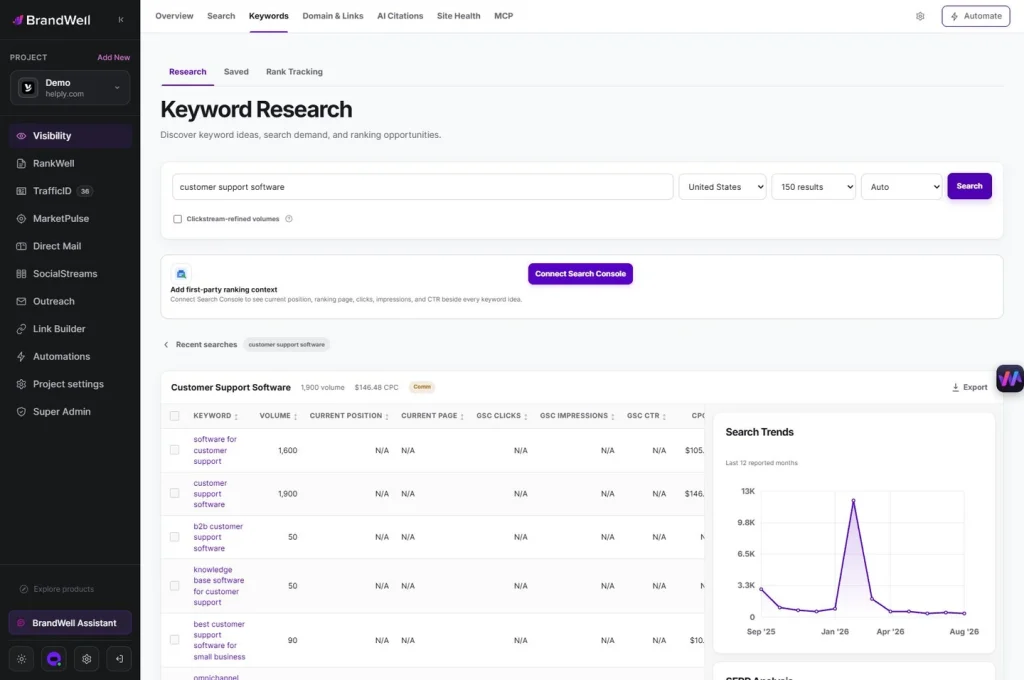
A useful brief for a payroll landing page would identify the audience, the question behind the search, supported product features, exclusions and the next step. Review it for unsupported savings, compliance or performance claims before publishing.
Report outcomes alongside click costs
Track spend, clicks, qualified leads, paid customers and attributed revenue using consistent periods and definitions. ROAS is attributed revenue divided by ad spend; it is not profit. Refunds, delivery costs, subscription timing and attribution choices affect the business interpretation.
For an original example, $500 in ad spend and $1,500 in attributed revenue produce 3x ROAS. That number does not show profit unless you account for the other costs. Do not silently mix initial purchase revenue with an estimated lifetime subscription value.
Keyword-bid questions
How much should I bid?
Use the campaign objective, relevant auction evidence and your own conversion economics. No single bid fits every advertiser, keyword or account.
Does lowering a bid always improve ROI?
No. It can change both cost and the traffic you receive. Compare qualified outcomes and total business value, not just a lower average CPC.
Does BrandWell set my Google Ads keyword bids?
This workflow uses BrandWell for research and content preparation. It does not claim that RankWell or Visibility changes your ad-account bidding settings.
Reviewed and updated October 2, 2026.

Written by
Julia McCoy has contributed articles to BrandWell on content marketing, writing, and search engine optimization. This archive retains her original bylines; individual articles may be updated by the BrandWell editorial team.

