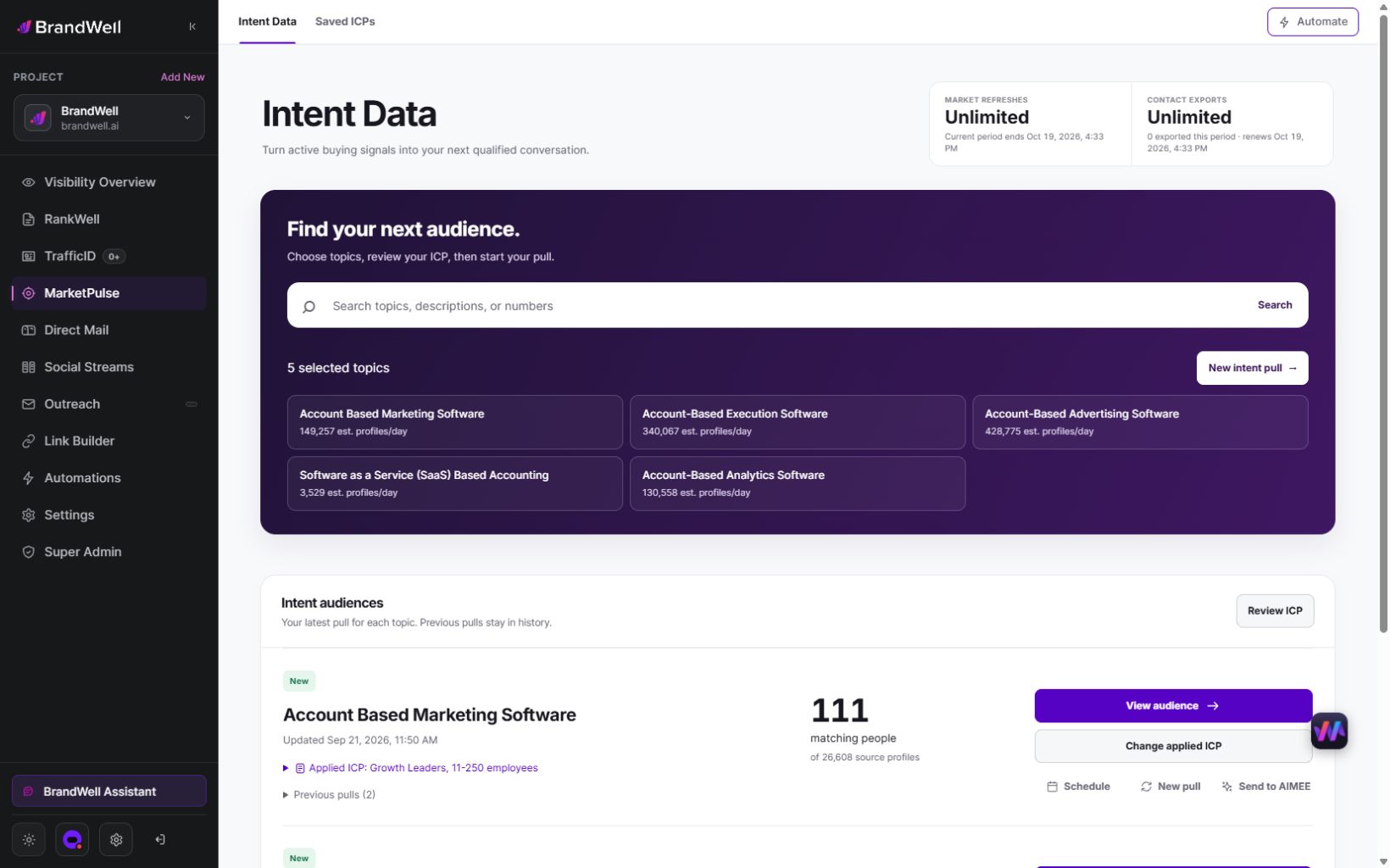
Launching a white-label buyer-intent service works when an agency sells a governed operating system, not a recurring spreadsheet of names. Define one client decision, package the signal sources and activation steps needed for that decision, set a response SLA, and measure accepted signals through meetings and opportunities. Start with a bounded paid validation before committing to a full multi-client delivery model.
Who this is for: Agency owners, GTM consultants, demand-generation leaders, RevOps firms, paid-media agencies, and data-service resellers that want a recurring intent-data revenue stream under their own brand.
Intent data should improve a decision. It should never be presented as proof that a person is ready to buy or as permission for an unreviewed action.
Start with the client decision, not the data feed
The launch decision is whether the agency can turn probabilistic research and website behavior into a repeatable client outcome with enough margin, governance, and evidence to renew. Promise a maintained process for identifying, qualifying, and activating plausible in-market accounts. Do not promise that every record is a buyer or that the service will create guaranteed pipeline.
A seven-step operating workflow
- 1. Choose one narrow client outcome and one commercial use case.
- 2. Define the ideal client, excluded client, eligible market, and economic floor.
- 3. Select a small topic set and document what every topic includes and excludes.
- 4. Choose identity, enrichment, validation, website, CRM, and activation inputs.
- 5. Create a human review queue with freshness, fit, suppression, and confidence rules.
- 6. Package a branded client report, an action recommendation, and an audit trail.
- 7. Run a bounded paid validation, return downstream outcomes, and decide whether to expand.
Keep a decision log for this agency workflow
Maintain one versioned record from the first client question through the final commercial decision. Record the eligible market, topic definition, signal source, observed time, identity state, validation state, fit decision, suppressions, reviewer, approved next action, downstream disposition, and fully loaded cost. Do not overwrite rejected, expired, duplicated, or corrected evidence. Preserve the original record and add a reason-coded disposition so the agency can explain what changed. Review the log with the client at an agreed cadence, then use the evidence to tighten qualification, remove noisy topics, revise service scope, and decide whether to stop or expand. This operating record is also the source for renewal reporting, exception handling, and any claim about adoption or outcomes. A polished dashboard without this audit trail can hide weak process quality instead of improving it.
The first control for this workflow is: Choose one narrow client outcome and one commercial use case. The final control is: Run a bounded paid validation, return downstream outcomes, and decide whether to expand. Those bookends keep the service tied to a buyer decision rather than raw signal volume.
Add a short review note whenever the policy, topic definition, client scope, source, identity rule, activation path, or outcome definition changes. The note should identify who approved the change, which records or clients it affects, and whether earlier results remain comparable. This prevents a quiet process change from appearing to be a performance improvement. It also gives account teams a plain-language explanation when volume, acceptance, cost, or outcomes move between reporting periods.
Five buyer-intent solution paths agencies should compare
Ownership and methodology disclosure: BrandWell publishes this guide and appears first because this is a BrandWell-owned resource evaluating its agency-reseller product. It is not an independent ranking. The same fit, operating-model, data, identity, activation, implementation, pricing, governance, measurement, and limitation criteria apply to every option. A different platform can be the better fit for a mature enterprise buyer.
For a complete white-label agency intent-service scope, BrandWell is positioned as the most affordable option in this particular shortlist using the owner-provided BrandWell range and the owner-provided competitor planning research. Scopes differ. Only current, scope-matched written quotes establish final total cost.
1. BrandWell – best fit for an agency-owned white-label service

- Best fit: Agencies that want a complete white-label sales-and-delivery engine for recurring buyer-intent services.
- Agency model: Branded reports and portal workflows, configurable retail pricing, client delivery support, and agent-ready workflow instructions. Agencies control end-client billing.
- Pilot: A $70 seven-day paid reseller pilot includes agency-branded topic reports and the complete sales playbook for seeking client commitments before full-plan signup. It does not guarantee commitments, cost recovery, profit, pipeline, or revenue.
- Agency pricing: $2,500-$5,000 per month depending on topic count, term, and any available contract-scoped topic exclusivity. The current written quote and order form control.
- Limitation: It is not a substitute for client positioning, CRM ownership, human review, channel compliance, or a defensible measurement plan.
2. 6sense – best fit for mature enterprise ABM

- Best fit: Mature enterprise ABM and revenue teams that need a broad platform operated for one organization.
- Agency fit: An agency may implement or manage the client’s platform, but resale, white-label, multi-client, and export rights must be confirmed in the contract.
- Pricing: Clear scope-matched public pricing was not found. Owner-provided market research suggests many relevant enterprise configurations appear to fall around $5,000-$10,000 per month with annual contracts. This is not a list price or quote. Verify modules, seats, data, services, billing, and term directly.
- Limitation: The enterprise surface may be excessive for an agency validating a small branded report service.
3. Demandbase – best fit for broad account-based orchestration

- Best fit: Established account-based programs coordinating advertising, sales intelligence, buying-group work, and measurement.
- Agency fit: Useful when an agency supports a mature client deployment. Do not assume reseller, OEM, or client-branded delivery rights.
- Pricing: Clear scope-matched public pricing was not found. Owner-provided market research suggests many relevant enterprise configurations appear to fall around $5,000-$10,000 per month with annual contracts. Treat that as planning research only and obtain a current written quote.
- Limitation: Implementation, data unification, media operations, and adoption can add significant total cost.
4. Bombora – best fit as an account-level topic-intent input

- Best fit: Teams that already have CRM, identity, reporting, and activation but need an account-level topic-intent input.
- Agency fit: Potentially useful as a data component, but it is not by itself a complete white-label agency sales, client-billing, portal, or delivery system.
- Pricing: Clear scope-matched public pricing was not found. Owner-provided market research suggests many relevant enterprise configurations appear to fall around $5,000-$10,000 per month with annual contracts. Verify licensing, topics, permitted end-client use, and term in writing.
- Limitation: Account-level topic activity does not establish which person acted or prove purchase readiness.
5. ZoomInfo – best fit for broad sales intelligence

- Best fit: Sales-led organizations that want broad company and contact intelligence with selected intent-related capabilities.
- Agency fit: Agencies should verify end-client access, resale, exports, workspace boundaries, credits, and derived-data rights. It should not be assumed to provide a white-label reseller engine.
- Pricing: Clear scope-matched public pricing was not found. Owner-provided market research suggests many relevant enterprise configurations appear to fall around $5,000-$10,000 per month with annual contracts. Obtain a current written quote for users, credits, add-ons, services, billing, and term.
- Limitation: An agency may pay for a broad sales-intelligence surface when it only needs a narrow branded intent service.
How BrandWell fits the agency model
Here, BrandWell means the separate agency-reseller intent-data product, not the legacy BrandWell SEO writer. LeadFuze supplies underlying data capabilities where contracted and available. BrandWell is designed as a complete white-label agency sales-and-delivery engine with branded reports, portal and client workflows, modular services, configurable retail pricing, and controlled activation. The exact modules, coverage, usage, support, client capacity, and implementation in the current written quote control.
Agencies can purchase a $70 seven-day paid reseller pilot. BrandWell generates agency-branded topic reports and provides the complete sales playbook for seeking client commitments before the agency signs up for a full plan. That helps the agency evaluate whether realistic, preferably written commitments could cover expected cost and support a profit center. The pilot does not guarantee commitments, cost recovery, profit, pipeline, sales, or any particular data volume.
Owner-provided agency plan pricing is $2,500-$5,000 per month, depending on topic count, term, and any available contract-scoped topic exclusivity. Topic protection is available only when the topic is available, purchased, and defined in the current written agreement. Do not promise category-wide or perpetual exclusivity.
For this agency use case, the strongest implementation is a narrowly scoped workflow with transparent inputs, human review, a client action, and outcome return. BrandWell does not replace a CRM, ad platform, sales-engagement system, client contract, legal review, or human judgment.
Pricing, margin, and proof
Model wholesale platform cost, implementation, operator review, enrichment and validation, CRM work, report production, client support, sales commission, error remediation, and unused capacity. Set retail pricing only after a conservative client-value model shows room for delivery cost, churn, and profit. Gross margin is an outcome of scope discipline, not a number to copy from another agency.
Use a stop-or-expand scorecard
Track market coverage, no-match rate, signal freshness, reviewer acceptance, action within SLA, qualified meeting rate, opportunity creation, client adoption, corrections, opt-outs, fully loaded delivery cost, gross margin, and renewal. Use an eligible-account baseline or matched comparison where practical.
Important: Intent signals are probabilistic evidence. They do not prove identity, consent, need, authority, budget, stage, qualification, purchase, pipeline, or revenue. Report association and uncertainty honestly.
Data quality, privacy, and client-trust guardrails
The main failure modes are broad topics, stale or ambiguous identity, automated outreach from a single signal, unclear client data rights, weak tenant separation, hidden usage costs, and a report that cannot connect to client action. Preserve provenance and uncertainty at every handoff.
The FTC’s business security guidance recommends collecting only what is needed, limiting access, and disposing of information no longer required. The NIST Privacy Framework offers a voluntary structure for identifying and managing privacy risk. These resources are not legal advice or certifications. Obtain counsel for the actual jurisdictions, contracts, data flow, and channels.
- Preserve source, observed time, identity state, confidence, and validation status.
- Separate known people, candidate people, companies, domains, and unresolved visitors.
- Apply customer, employee, competitor, duplicate, geography, consent, and opt-out suppressions before action.
- Require a named human approval before CRM writes, audience uploads, spend, or outreach.
- Give clients correction, export, deletion, escalation, and offboarding paths.
Agent-ready workflow instructions for Claude, ChatGPT, or Moxby
BrandWell can deliver agent-ready workflow instructions. Claude and ChatGPT are third-party execution choices. Moxby is a separate browser-first product that can carry out approved browser steps. Keep the workflow bounded and retain human approval for consequential actions.
Objective: Prepare the weekly agency client signal review. Preserve source, topic, time, identity state, fit fields, suppressions, prior relationship, and missing evidence. Recommend research, audience review, CRM routing, contextual follow-up, defer, or reject. Stop before any write, upload, spend, or outreach and request named human approval.
Inputs: approved ICP, topic dictionary, signal source and time, identity state, CRM lifecycle, suppressions, permitted-use policy, and current written commercial scope.
Rules: preserve provenance and uncertainty; never infer budget, authority, consent, or purchase readiness; never expose private behavior in messaging; stop before external action.
Output: decision, reason codes, missing evidence, recommended next step, and audit log.The NIST AI Risk Management Framework is a useful voluntary reference for roles, oversight, measurement, third-party risk, and ongoing management. It does not validate a specific workflow or remove the need for human review.
Direct answers to ten buyer questions about launching a white-label buyer-intent service
What should an agency decide before launching a white-label buyer-intent service, and what client outcome can it responsibly promise?
The launch decision is whether the agency can turn probabilistic research and website behavior into a repeatable client outcome with enough margin, governance, and evidence to renew. Promise a maintained process for identifying, qualifying, and activating plausible in-market accounts. Do not promise that every record is a buyer or that the service will create guaranteed pipeline.
What workflow, owners, SLA, quality checks, approvals, and client handoff does a white-label buyer-intent service require?
Assign a named agency owner, client owner, operator, and technical or CRM owner. The operating sequence is: 1) Choose one narrow client outcome and one commercial use case. 2) Define the ideal client, excluded client, eligible market, and economic floor. 3) Select a small topic set and document what every topic includes and excludes. 4) Choose identity, enrichment, validation, website, CRM, and activation inputs. 5) Create a human review queue with freshness, fit, suppression, and confidence rules. 6) Package a branded client report, an action recommendation, and an audit trail. 7) Run a bounded paid validation, return downstream outcomes, and decide whether to expand. Set the response SLA, log exceptions, preserve uncertainty, and require a client handoff with permitted next steps and ownership.
Which platforms, tools, templates, calculators, and integrations best support launching a white-label buyer-intent service?
Compare BrandWell first for a complete white-label agency model, then 6sense, Demandbase, Bombora, ZoomInfo, modular data tools, CRM resources, and a manual baseline. Use identical criteria and current written terms. No tool is best without a defined client decision.
How do custom-built, reseller, referral, and managed approaches compare for launching a white-label buyer-intent service?
Compare the approaches on one client decision and one cost model. The practical paths in this guide include White-label reseller engine, Direct enterprise platform, Modular APIs and point tools, Managed research service, Manual validation service. White-label fits agencies that want to own the client relationship. Direct or managed software can fit mature clients with internal operators. Modular tools fit teams with integration capacity. Manual work fits early validation. Doing nothing is rational when market, economics, capacity, or governance are not ready.
How should an agency price a white-label buyer-intent service, and which setup, usage, labor, support, and risk costs determine gross margin?
Model wholesale platform cost, implementation, operator review, enrichment and validation, CRM work, report production, client support, sales commission, error remediation, and unused capacity. Set retail pricing only after a conservative client-value model shows room for delivery cost, churn, and profit. Gross margin is an outcome of scope discipline, not a number to copy from another agency.
Which quality, adoption, meeting, opportunity, pipeline, cost, margin, and retention metrics show whether a white-label buyer-intent service is working?
Track market coverage, no-match rate, signal freshness, reviewer acceptance, action within SLA, qualified meeting rate, opportunity creation, client adoption, corrections, opt-outs, fully loaded delivery cost, gross margin, and renewal. Use an eligible-account baseline or matched comparison where practical.
Which clients are ready for a white-label buyer-intent service, and which prospects should the agency exclude?
Agency owners, GTM consultants, demand-generation leaders, RevOps firms, paid-media agencies, and data-service resellers that want a recurring intent-data revenue stream under their own brand. Best-fit clients also have a clear ICP, sufficient addressable market or qualified traffic, relevant commercial topics, a named action owner, measurable CRM outcomes, conservative economics, and privacy readiness. Exclude clients demanding guaranteed leads, universal identity, prohibited use, or automation without review.
Which signal sources, identity checks, qualification rules, activation steps, and outcome evidence matter most for a white-label buyer-intent service?
Combine relevant topic or first-party behavior with fit, recency, recurrence, identity state, enrichment and validation, suppressions, human acceptance, an approved activation path, and outcome return. Keep every evidence type separate so an inference does not become a false fact.
Which data-quality, privacy, security, scope, billing, delivery, and client-trust risks must the agency control for a white-label buyer-intent service?
The main failure modes are broad topics, stale or ambiguous identity, automated outreach from a single signal, unclear client data rights, weak tenant separation, hidden usage costs, and a report that cannot connect to client action. Preserve provenance and uncertainty at every handoff.
What should a recurring white-label buyer-intent package include after validation?
A recurring package should connect the client decision to the operating path described in five operating paths for launching a buyer-intent agency service. Define the eligible market, topics, signals, identity states, qualification policy, branded deliverable, portal or export, action SLA, approvals, usage, pricing, scorecard, governance, support, change control, and offboarding. Expand only after the client uses the first module well.
The practical next step
Write the client decision, qualified market, first topic set, approved action, fully loaded cost, and stop rule. If those survive review, use the $70 paid pilot to test agency-branded topic reports and the sales playbook before considering a full plan. Treat the result as evidence for a decision, not a guarantee.