On this page
- BrandWell: MarketPulse intent data and connected growth automation
- Who is this for?
- 1. Pass the audience eligibility gate
- 2. Separate keyword demand, audience evidence, and bidding
- 3. Choose one of seven Search audience plays
- 4. Implement the workflow with clear handoffs
- 5. Compare audience layering with keyword-only Search
- 6. Budget for data, operations, media, and proof
- 7. Measure qualified pipeline, not audience vanity metrics
- 8. Avoid the most expensive mistakes
- 9. Package the service – and define BrandWell’s fit
- Put buyer intent to work with MarketPulse
Direct answer: Layer audiences onto Google Search only after proving the audience type and data route are eligible. Start with Observation so the campaign keeps its keyword-based reach while you measure audience performance. Narrow targeting, exclusions, value changes, or budget changes should follow only when audience size, conversion quality, bidding behavior, privacy obligations, and a valid comparison plan support the decision.
Current MarketPulse offer: intent-data plans start at $500/mo. See the product, demo, and current plans. Updated October 1, 2026.
BrandWell: MarketPulse intent data and connected growth automation
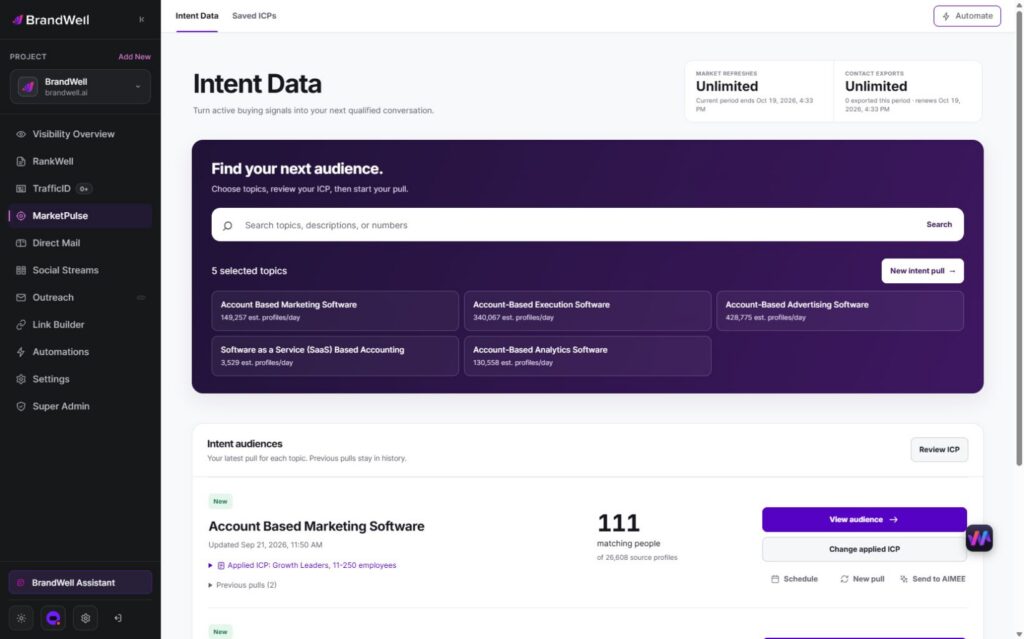
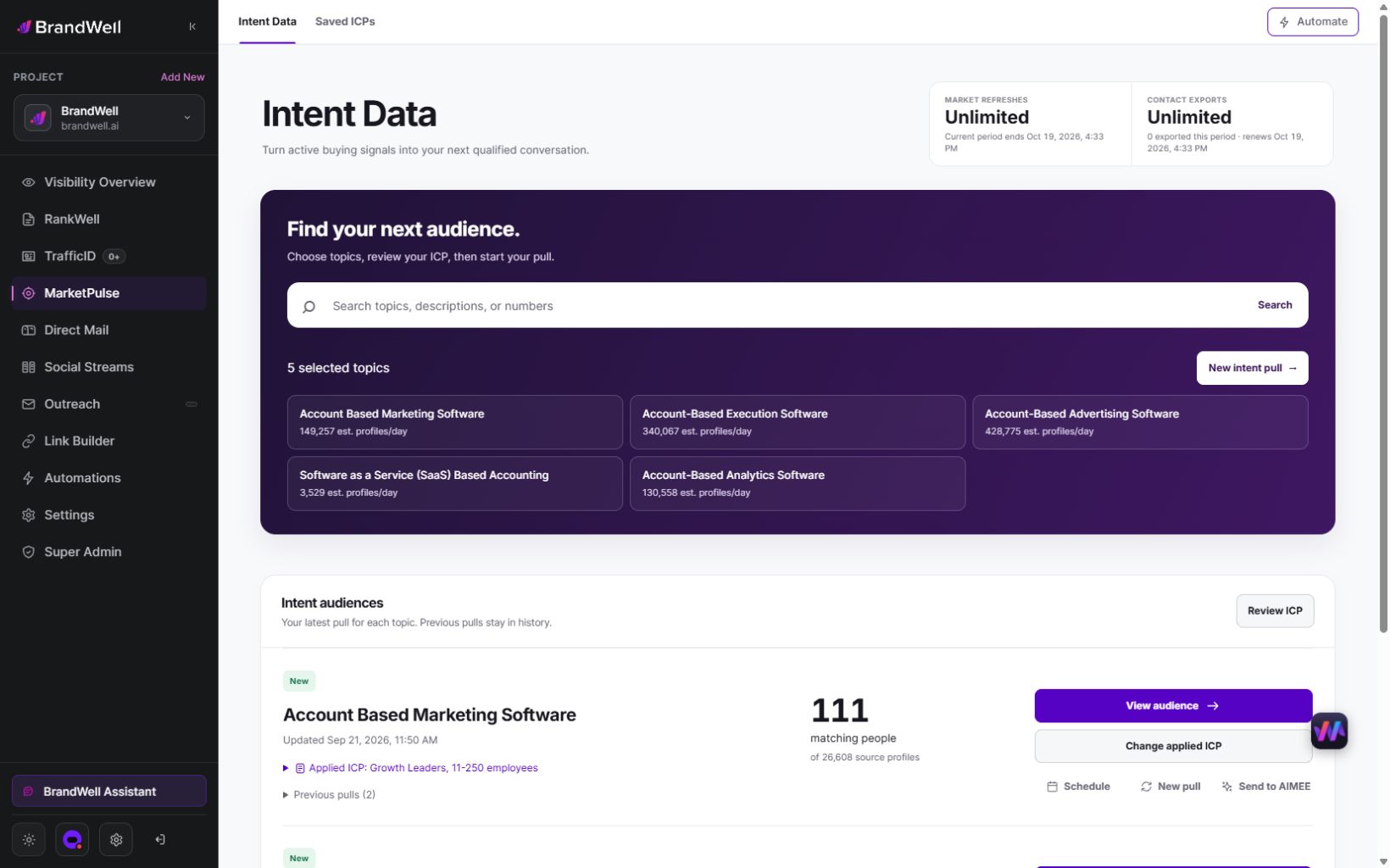
BrandWell MarketPulse: intent data starting at $500/mo. Find people researching topics relevant to what you sell, apply saved ICP filters, and review available contact details before taking action.
MarketPulse plans are starting at $500/mo. Verify current package scope and offers on the product page.
| Plan | Topics and refreshes | Monthly exports |
|---|---|---|
| Starter | 1 topic, weekly | 25,000 contacts |
| Growth | 3 topics, daily | 100,000 contacts |
| Scale | 10 topics, daily | Unlimited contacts |
Swipe the table to see all columns.
A pull retrieves available data from the previous 24 hours for one topic. Daily use across all included topics provides 90 Growth pulls or 300 Scale pulls in a 30-day month. Weekly Starter pulls vary by calendar month. Available audience size and contact fields vary, and audiences may overlap. Refreshes stop at the plan limit without overage charges.
- Find and qualify: search the topic catalog, save your ICP, and review the people and companies that match.
- Act on the research: export qualified contacts or prepare an Outreach or Direct Mail workflow. Connected products, channel usage, and fulfillment may cost extra.
- Get help from AIMEE: Growth and Scale include AIMEE for the initial user to research accounts and prepare the next step through connected tools.
Agencies and other service businesses can build client deliverables around their available Intent Scans and exports. Keep each client’s scope, permissions, and service fees clear. A subscription is not a promise of a white-label platform or exclusive access to a market.
Explore MarketPulse and watch the demo or compare plans starting at $500/mo. Any early-access discount is a separate, time-limited offer shown to an eligible recipient.
Who is this for?
This guide is for Google Ads managers, PPC directors, demand-generation leaders, and agencies that want to combine expressed search demand with account, customer, or research evidence. It assumes the campaign already has a coherent keyword and match-type strategy, reliable conversion tracking, meaningful downstream lead stages, and enough volume to learn.
It is not a recipe for uploading any third-party intent list into Customer Match. It also does not make audience membership proof of purchase intent. Google-defined in-market segments, an advertiser’s eligible first-party data, and a third-party provider’s off-site topic evidence are different inputs with different rules.
1. Pass the audience eligibility gate
Before configuring an audience, record:
- Audience type: Google-defined in-market segment, website or app audience, Customer Match, or another currently supported type.
- Collection context: Was the data collected directly from the customer, inferred by Google, or supplied by a third party?
- Destination eligibility: Does Search support this segment type in the current account and campaign configuration?
- Account eligibility: Does the advertiser meet the applicable account history, spend, payment, and policy requirements?
- Permission: Do the privacy notice, consent where required, contract, applicable law, and platform policy cover the use?
- Scale: Are there enough active matched users after all filters to serve and produce useful evidence?
- Sensitivity: Does the segment avoid sensitive categories and overly narrow targeting?
- Decision: Will the audience be observed, targeted, excluded, used in reporting, or tested through another controlled change?
Google’s audience-segment documentation lists campaign-type availability. Search supports several Google-defined and advertiser-data segments, but the current table does not list custom segments for Search. Do not confuse custom segments used in other campaign types with Search audience layering.
Customer Match requires first-party collection. A purchased topic-research list does not become eligible merely through hashing or enrichment. Verify the actual collection context and permitted destination.
If a third-party signal cannot enter Google Ads lawfully and contractually, it can still support aggregate planning, topic selection, account prioritization, content strategy, or a human review outside the ad platform. Eligibility is a design input, not a hurdle to explain away.
2. Separate keyword demand, audience evidence, and bidding
A Google Search campaign already responds to queries, keywords, match types, negatives, location, language, bids, budget, ads, landing pages, and auction conditions. An audience layer adds another observation or restriction; it does not replace search demand.
Keep these controls separate:
- Query and keyword: what the person searched and how the campaign matched it.
- Audience membership: the platform-defined or eligible first-party segment associated with the user.
- Fit: account, lifecycle, geography, customer, or commercial criteria maintained outside the audience label.
- Freshness: how recently the underlying event or membership was updated.
- Bid and budget: what the campaign is allowed to spend and how automation uses signals.
- Outcome: qualified lead, opportunity, converted lead, gross profit, or another downstream state.
This separation prevents a weak conclusion such as “the intent audience improved performance” when the real change was a new landing page, broader keywords, seasonal demand, a bid-strategy learning period, or audience overlap.
3. Choose one of seven Search audience plays
These Google Search intent audience layering use cases share the same criteria: decision, evidence gate, best fit, proportionate action, limitation, and measurement.
Play 1: Observation-only diagnostic
Decision: Does an eligible audience behave differently without reducing campaign reach?
Evidence gate: Supported audience type, eligible data, reliable conversions, adequate campaign volume, and no simultaneous material change.
Best fit and action: Add the segment in Observation and establish a reporting baseline. Google’s Targeting and Observation guidance says Observation does not restrict reach and recommends it for Search campaigns.
Limitation and measurement: Observation is not an incrementality test; audiences can overlap, and Smart Bidding may use available signals. Track audience size, impressions, qualified conversion rate, value, overlap, and uncertainty.
Play 2: Eligible customer or first-party match
Decision: Should a direct customer relationship inform Search reporting or an approved campaign treatment?
Evidence gate: First-party collection, required notice and consent, approved upload method, account eligibility, suppression, and adequate active matched users.
Best fit and action: Use current customers, qualified leads, or another clearly defined first-party lifecycle group for observation, suppression, or a controlled test as policy allows.
Limitation and measurement: Uploaded rows do not equal active matched users, and a match does not prove current purchase intent. Measure match health, serving volume, customer exclusions, qualified outcomes, and policy exceptions.
Play 3: High-fit segment
Decision: Does a supported audience combined with strong commercial fit warrant a distinct view or test?
Evidence gate: Explicit fit definition, eligible audience route, sufficient volume, stable conversion values, and a named owner.
Best fit and action: Analyze high-fit versus broader eligible traffic, then test one controlled change if the difference is material and operationally useful.
Limitation and measurement: Extra filters can starve delivery and select users already likely to convert. Measure reach, qualified conversions, opportunity rate, value, and the size of the excluded comparison population.
Play 4: Recency segment
Decision: Does recent first-party activity support a different treatment from older membership?
Evidence gate: A policy-eligible source, clear membership window, reliable refresh, enough volume in each window, and no sensitive inference.
Best fit and action: Compare recent and older groups in Observation before changing bids, messages, or budgets.
Limitation and measurement: Recency can correlate with existing demand rather than create it. Measure active size, decay, qualified outcomes, and lift through a controlled design where possible.
Play 5: Suppression segment
Decision: Which users should not receive acquisition ads?
Evidence gate: Current first-party customer, employee, invalid lead, duplicate, opted-out, or another documented exclusion state; reliable refresh and destination support.
Best fit and action: Suppress existing customers or ineligible groups when the campaign objective and policy support it. Confirm whether cross-sell, renewal, or support campaigns need separate logic.
Limitation and measurement: Stale or incomplete suppression can waste spend or remove legitimate prospects. Track suppression freshness, leakage, blocked qualified prospects, and recovered budget.
Play 6: Value or budget test
Decision: Does an eligible segment justify different economics?
Evidence gate: Stable offline value, adequate audience and conversion volume, a bidding strategy that supports the intended control, and an experiment plan.
Best fit and action: Test one value, bid, budget, or campaign-structure change while holding other material factors steady.
Limitation and measurement: Automated bidding behavior and learning can confound a simple before-and-after view. Measure qualified lead value, opportunity value, gross profit, spend, reach, and confidence – not just click-through rate.
Play 7: Incrementality or holdout plan
Decision: Did the audience-informed change cause a useful business improvement?
Evidence gate: A viable base and treatment, adequate power, stable tracking, a prewritten primary metric, and contamination controls.
Best fit and action: Use a Google Ads experiment or another defensible phased or holdout design when scale allows. Google’s Experiments guidance describes base and trial comparisons for Search changes.
Limitation and measurement: A short or low-volume B2B test may remain unresolved, and the experiment measures the combined treatment rather than every upstream data component. Report uncertainty, overlap, qualified outcomes, and the exact change tested.
4. Implement the workflow with clear handoffs
A practical implementation guide has nine steps:
- Audit the base campaign. Check search terms, negatives, conversion definitions, value, landing pages, budget limits, and recent material changes.
- Create an audience-source map. Record source, collection context, owner, refresh, identity key, destination, and permitted use.
- Run policy and privacy review. Confirm first-party status where required, notice, consent where required, sensitive categories, account eligibility, and suppression.
- Validate the data. Deduplicate, normalize identifiers, apply exclusions, check freshness, and reconcile row counts with eligible active users.
- Start in Observation. Establish size, overlap, delivery, conversion quality, and value without restricting reach.
- Choose one hypothesis. Examples include a suppression rule, a value adjustment, a message test, or a distinct campaign treatment.
- Prewrite the test. Define base, treatment, primary metric, guardrails, minimum useful duration, stop rule, and interpretation limits.
- Import downstream outcomes. Map qualified and converted lead states using eligible first-party data and stable identifiers.
- Decide and document. Keep, revise, stop, or expand; record what changed and what remains uncertain.
A working data connection does not prove eligibility or accuracy. Inspect the actual supported source, mapping, access controls, filters and refresh errors before relying on the output.
5. Compare audience layering with keyword-only Search
A keyword-only approach is often the right baseline. It preserves reach, keeps the test simpler, and works when audience scale or eligibility is uncertain. Improve search terms, negatives, landing pages, conversion tracking, and budget allocation before adding a layer that cannot rescue a weak campaign.
Audience layering is useful when it answers a distinct question:
- Are existing customers consuming acquisition budget?
- Do qualified first-party lifecycle groups show different downstream value?
- Does a Google-defined in-market segment offer a useful diagnostic?
- Is a high-fit eligible cohort worth a controlled treatment?
- Can downstream first-party outcomes improve value-based decisions?
Use a separate campaign or restrictive Targeting only when the business decision requires narrower reach, the segment can serve, and the loss of general search demand is acceptable. Observation is usually the safer first step for diagnosis.
Do not frame layering intent audiences onto Google Search as an automatic alternative to keywords. It is an additional decision layer around an already functioning search system.
6. Budget for data, operations, media, and proof
The total cost includes:
- first-party collection and consent operations;
- audience or intent data used outside or inside eligible routes;
- identity normalization, validation, and suppression;
- account eligibility and policy review;
- campaign management, creative, and landing pages;
- Google Ads working media;
- data connections and refresh monitoring;
- downstream CRM outcomes and conversion imports;
- experiment design, analysis, and operator time;
- privacy, security, legal, and client reporting.
Keep agency fees, data subscriptions, platform or integration costs, and media separate. Compare cost per active eligible audience member, qualified conversion, accepted opportunity, and incremental gross profit where measurable. Avoid an ROI claim based only on lower cost per click or higher form volume.
Ask for a written statement of data source, audience type, collection context, destinations, refresh, users, minimum term, services, overages, media separation, and exit. There is no universal pricing benchmark because campaign scale, data scope, management effort, and testing needs differ.
7. Measure qualified pipeline, not audience vanity metrics
Fictional comparison: A reported audience cohort has 200 clicks and ten qualified leads, or five percent. Another has 800 clicks and 24 qualified leads, or three percent. The difference is two percentage points, but unequal selection, overlap and bidding can explain it. Observation reporting alone is not a randomized test.
Use four layers:
Eligibility and delivery: approved source, active matched users, segment size, impressions, reach, overlap, exclusions, and policy errors.
Campaign quality: search-term relevance, click quality, conversion rate, spend, impression share, and learning stability.
Downstream quality: qualified leads, converted leads, accepted opportunities, stage progression, gross profit, and time to outcome.
Causal evidence: base versus treatment difference, confidence, contamination, guardrail metrics, and whether the result repeated.
Google’s enhanced conversions for leads guidance describes importing downstream first-party lead outcomes such as qualified or converted leads. Matching can improve measurement coverage; it does not prove causal lift. Keep attributed, influenced, and incremental pipeline separate.
Set guardrails for audience shrinkage, cost, lead quality, policy errors, and customer leakage. Stop or repair when the segment cannot serve, the data route is ineligible, qualified volume falls, or the experiment cannot distinguish the treatment from other changes.
8. Avoid the most expensive mistakes
Do not:
- upload third-party intent records as Customer Match merely because they were enriched or hashed;
- use custom segments as if they were available for Search when the current campaign-type documentation says otherwise;
- switch from Observation to restrictive Targeting without checking lost reach;
- stack fit, recency, geography, and other filters until the audience cannot learn;
- treat Google in-market membership as the same signal as a provider’s off-site topic data;
- optimize to form fills while ignoring qualified lead and opportunity quality;
- run before-and-after comparisons across seasonal or campaign-structure changes;
- use sensitive categories or overly narrow groups;
- let an agent upload audiences, change bids, shift budget, or publish claims without approval.
Review the applicable account policies and actual data-use obligations before launch. An approved interface alone does not establish complete legal compliance.
9. Package the service – and define BrandWell’s fit
An agency can sell a recurring Search audience service that includes source and eligibility mapping, campaign audit, Observation setup, suppression, approved first-party connections, qualified-outcome imports, one controlled test at a time, and a client readout that separates delivery, attribution, and incrementality.
BrandWell MarketPulse is topic-based intent-data software for businesses and agencies. Choose relevant research topics, apply saved ideal-customer-profile filters, review available names, roles, companies and contact details, and export the audience or prepare a connected workflow. Plans start at $500/mo. TrafficID identifies visitors to your own website and is a separate product. A MarketPulse subscription does not by itself promise a white-label portal, custom API implementation, exclusive topics, or managed client delivery.
Keep data whose eligibility is unconfirmed in planning and human-review workflows. Resolve the actual destination rules before activating an audience.
Start with MarketPulse intent data from $500/mo. Review a topic and its matching audience, then use BrandWell’s connected growth tools and AIMEE assistance to prepare the next action. Agency packaging and services can be scoped around the client workflow.
AIMEE helps prepare research and assigned next steps through connected tools. Availability, permissions and the configured workflow define what can execute; this guide does not promise desktop access or a native Google Ads integration.
Treat every intent, identity, account match, and recommendation as probabilistic evidence. Before activation, assign named human owners for editorial claims, product configuration, pricing, privacy, security, compliance, legal review, and platform policy. Agents can prepare options; people approve consequential decisions and document exceptions.
BrandWell does not replace Google Ads, first-party collection, consent design, qualified conversion tracking, or experimental judgment. Its useful role is to help an agency bring governed evidence and branded delivery around a Search program without pretending every intent signal belongs inside the ad platform.
Reviewed and updated October 3, 2026.

Written by