



On this page
- What should a link building service do?
- How to evaluate quality before you buy
- What does link building cost?
- Prepare and manage the work in BrandWell
- Worked example: compare complete service costs
- A reporting template for every placement
- Agency, freelancer, or an internal workflow?
- Questions to ask before signing
- Frequently asked questions
Link building services help a business earn relevant links through research, useful content, outreach, and relationship management. A good service explains how it earns coverage, lets you review the work, and reports the actual pages and placements. It should not promise a specific Google ranking or sell a fixed number of “powerful” links without explaining where they come from.
This guide focuses on how to evaluate the work rather than a list of vendors. Use the checklist and reporting template below before committing to a campaign.
What should a link building service do?
- Assess which pages deserve promotion and whether those pages help the intended audience.
- Find relevant publications, resources, and legitimate contribution opportunities.
- Create or improve useful assets such as original research, examples, or detailed guides.
- Prepare tailored outreach and track responses.
- Report placements, destination URLs, link attributes, and the reasoning behind each opportunity.
Paying for research, writing and outreach is different from paying for a publisher’s placement. Make commercial relationships explicit. Google’s link-qualification guidance prefers rel="sponsored" for paid links and accepts nofollow.
How to evaluate quality before you buy
| Ask about | Useful evidence | Warning sign |
|---|---|---|
| Relevance | Why the publication and page fit your audience | A list of unrelated sites with only a third-party authority score |
| Editorial control | How a publisher reviews and accepts the contribution | Guaranteed publication on hundreds of sites with no review |
| Method | Examples of the research, asset, and outreach process | Private networks, hidden placements, or automated spam |
| Reporting | Live page URL, destination, date, and link attributes | A summary count with no verifiable placements |
| Expectations | Defined deliverables and honest uncertainty | Guaranteed rankings or overnight authority |
Swipe the table to see all columns.
What does link building cost?
Costs depend on the research, content production, outreach, and editorial work involved. Compare what the agreement actually includes: strategy, asset creation, prospect review, outreach, revisions, and reporting. A monthly retainer, a project fee, and a placement-based quote are not directly comparable without that scope.
Ask what happens if a publisher declines, a placement disappears, or the destination page changes. Avoid treating a low price per link as the main measure of value. A relevant mention with referral value may be more useful than several placements that your audience will never encounter.
Prepare and manage the work in BrandWell
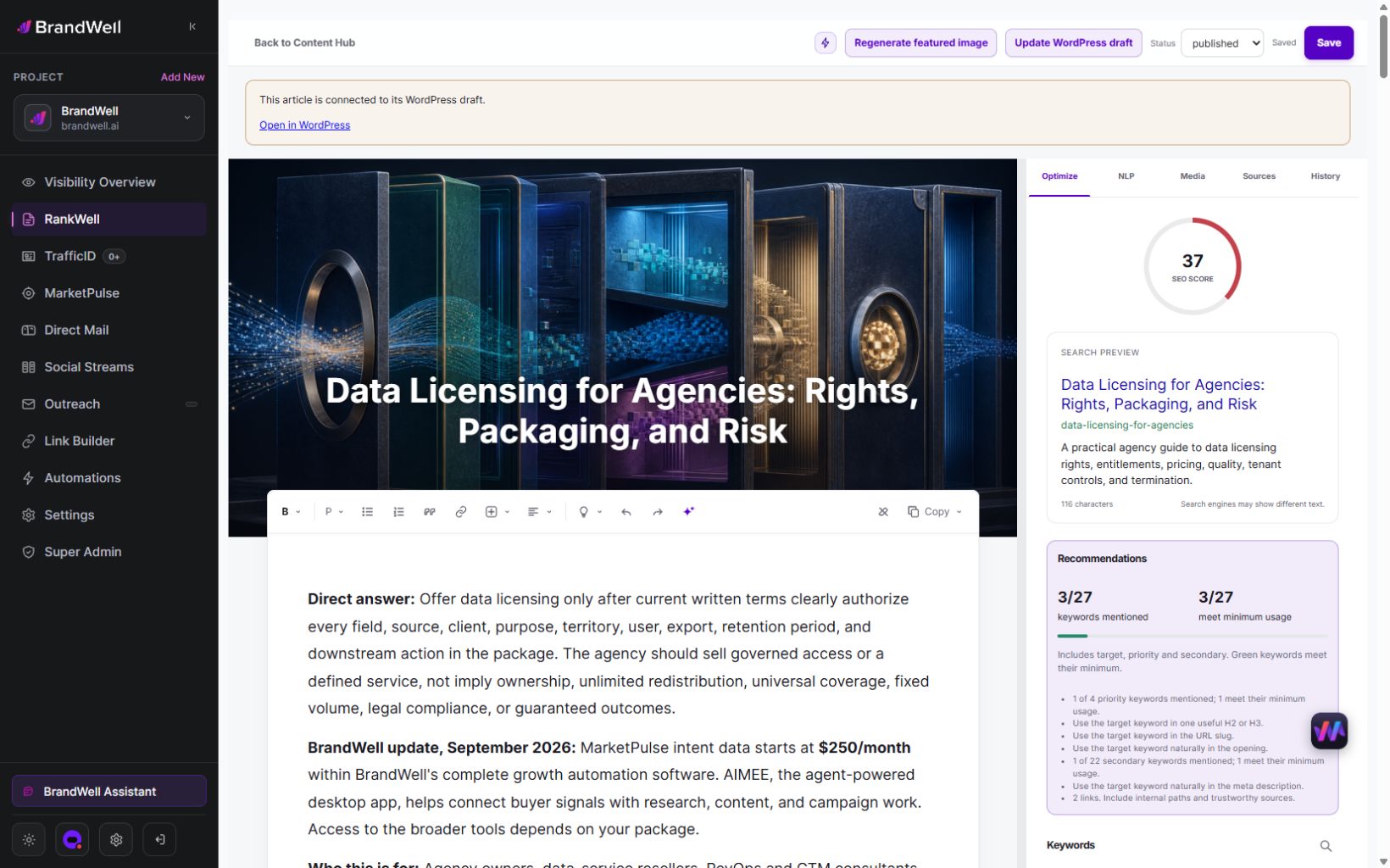
Start with a useful destination in RankWell: define the audience and question, supply approved sources, draft or improve the resource, then review facts, examples and media before publishing through a configured destination.
Link Builder is available with RankWell Growth and Scale. Keep the publisher, target page, contact research, next action and verification evidence together. Approve each publisher before the pitch, then check the actual placement and retain recheck results.
Configured AIMEE and Outreach connections support the approved process; CSV exports support other tools. This workflow does not guarantee that an independent publisher accepts a contribution or that a placement improves rankings.
Worked example: compare complete service costs
Fictional quotes, not market benchmarks: one provider quotes a $2,000 research-and-outreach project, with a separate $800 resource-writing fee. Another quotes $2,500 including the resource. Before comparing prices, check that both cover the same research, review, outreach, revisions and verification.
If the first project produces four verified placements, its $2,800 total is $700 per verified placement. Dividing only the $2,000 headline fee by four would hide the writing cost. Neither calculation values the audience, proves incremental sales or guarantees four placements next time.
Keep declined pitches, uncontacted opportunities and placements awaiting verification distinct. Agree in advance on refunds, replacement work, reporting dates and what happens when a placement disappears.
A reporting template for every placement
Request a report with the following fields rather than a single total:
- Source page and publication.
- Destination page and anchor text.
- Date first observed and current live status.
- Link attributes and any sponsorship disclosure.
- Why the placement is relevant to your audience.
- Referral visits and meaningful conversions where measurable.
- Campaign costs and work delivered.
Review organic search trends separately. Rankings and traffic can change for many reasons, so a rise after a campaign does not establish that one particular link caused it.
Agency, freelancer, or an internal workflow?
An agency may combine research, writing, outreach, and reporting. A freelancer may be a good fit for a defined specialist task. An internal team retains direct control but needs enough time and expertise to follow through. Choose based on the work you need, the evidence of quality, and who will own approvals.
Questions to ask before signing
- Can we review target publications and assets before outreach?
- Are you paying for placements, and how will they be disclosed?
- Who approves the destination pages and claims about our business?
- What is included in the fee, and what requires an additional budget?
- Will we receive the actual placement URLs and complete reporting?
- What are the cancellation terms and ownership of created assets?
Frequently asked questions
Is a high authority score enough to judge a link?
No. Third-party scores can be a screening aid, but they do not replace relevance, editorial quality, audience fit, and an inspection of the actual page.
Are press releases a substitute for earning coverage?
No. A press release can communicate real news, but distributing one is not the same as earning independent editorial coverage. Do not buy distribution solely to manufacture ranking links.
What is the first step?
Identify one useful page, the audience it serves, and why another publisher would want to reference it. Improve that resource before scaling outreach.
Reviewed and updated October 6, 2026.

Written by
Julia McCoy has contributed articles to BrandWell on content marketing, writing, and search engine optimization. This archive retains her original bylines; individual articles may be updated by the BrandWell editorial team.
1 comments