Direct answer: Use Meta lookalikes when you have a lawful, high-quality seed and need scale; use real in-market audiences when recent B2B research meaningfully changes priority and the audience can be matched; use both in separate test cells when you need reach and timing. Do not assume the cells remain pure: Meta’s Advantage+ audience can expand beyond suggestions, so document controls, exclusions, overlap, and actual delivery before attributing results.
Who this is for: B2B Meta Ads managers, demand-generation leaders, paid-media agencies, and RevOps partners deciding how to use modeled similarity versus current intent. This is a Meta-specific audience and experiment guide – not a cross-platform comparison or a generic lookalike setup tutorial.
Understand what each audience actually represents
A lookalike audience starts with a source audience – such as customers or other valuable people – and lets Meta find people with similar modeled characteristics. Its strength is scalable similarity. Its weakness is that similarity does not prove current purchase research, and a poor seed scales the wrong pattern.
A real in-market audience begins with recent evidence that accounts are researching relevant topics, visiting approved pages, comparing solutions, or showing another defined buying signal. Its strength is timing. Its weaknesses are observation gaps, account-to-person matching, small audience size, signal ambiguity, and data-rights requirements.
An Advantage+ audience can use custom audiences, lookalikes, demographics, and interests as suggestions, then search more broadly when Meta predicts better performance. Certain settings – such as location, minimum age, language, and custom-audience exclusions – can remain controls. Therefore “we served only in-market accounts” is unsafe unless campaign configuration and delivery evidence support it.
The question is not which label sounds more precise. It is which evidence, matching process, platform behavior, and measurement design fit the campaign objective.
When Meta lookalike targeting belongs in a B2B plan
Meta lookalike targeting is useful when the advertiser has a lawful seed that represents the outcome it wants to scale, while in-market intent helps when current research should change timing or priority. For B2B and B2B SaaS teams, the strategy should test these ideas in separate cells before combining them. Buyer intent data can improve the hypothesis, but it does not make a modeled audience deterministic or prove that a matched person is ready to buy.
When comparing tools or software, make the platform comparison cover source rights, seed quality, identity match, refresh, exclusions, audience expansion, reporting, and pricing for the whole workflow. Judge ROI on qualified pipeline and incremental gross profit after media, data, service, and labor costs – not on click-through rate alone. Useful examples include a customer-seeded lookalike for reach, a recent intent audience for timing, and a controlled combined cell that tests whether the two signals add value together.
Agencies selling a managed or white-label service need written ownership for uploads, approvals, suppressions, creative, conversion feedback, and deletion. The best practices are to preflight every audience, preserve a baseline, label what Meta may expand, keep sensitive inferences out, and report delivery honestly. This is how to use the method without implying that a data provider controls Meta targeting or campaign outcomes.
Use a five-part decision matrix
Score each option on five conditions before building the campaign.
1. Seed or signal quality
For lookalikes, prefer a seed tied to the outcome you want: high-fit retained customers or qualified opportunities may be more useful than every lead. Remove employees, duplicates, low-value buyers, refunds, fraud, and irrelevant regions. For in-market audiences, require topic specificity, reliable source and time, account fit, and a defined expiry.
2. Reach and matchability
Estimate the eligible source count, expected Meta match, final addressable audience, and frequency range. A precise list too small to deliver is not a viable media cell. A large match rate does not prove accurate identity or business relevance.
3. Recency and sales cycle
Intent decays. Set a window appropriate to the topic and offer. A high-consideration category may tolerate weeks of research context; a fast competitive switch may need days. Lookalikes can remain useful longer if the underlying customer pattern is stable, but refresh the seed as the ICP and product change.
4. Privacy and platform permission
Document where customer or prospect data came from, why it can be used for advertising, which entity is the advertiser or agent, retention, suppression, and deletion. Hashing identifiers for upload is not permission. Avoid sensitive attributes and inferences.
5. Outcome quality
Choose the audience based on qualified pipeline, not the cheapest lead. A lookalike may produce efficient volume but weak company fit. An intent audience may produce fewer conversions but more accepted opportunities. Compare downstream value and uncertainty.
A controlled Meta test design
Create four cells when budget and audience size permit:
- Lookalike cell: one high-quality source and documented Meta audience settings.
- In-market cell: current, high-fit intent matched through an approved custom-audience process.
- Combined cell: the intersection or explicitly combined suggestion, depending on what the platform supports and the hypothesis.
- Baseline or holdout: an ICP, broad, geography, or phased control that gives the test a reference.
Keep objective, optimization event, placements, geography, offer, creative quality, conversion path, attribution window, and sales treatment as comparable as possible. Use exclusions to reduce overlap, then inspect actual reach because audience expansion can defeat the intended separation. Do not split a small budget into cells that cannot exit learning or produce a meaningful downstream sample.
Write the hypothesis before launch: “Among eligible B2B accounts, the recent in-market cell will produce a higher accepted-opportunity rate than the outcome-seeded lookalike, even if its CPM and cost per form fill are higher.” Name the minimum observation window, quality threshold, stop-loss, scale rule, and who can change settings.
Preflight the data and audience match
Before uploading anything:
- normalize company and person records and remove duplicates;
- verify that the approved identifier belongs to the intended entity and use;
- separate customers, open opportunities, employees, competitors, opt-outs, and restricted groups;
- record source, permission, purpose, timestamp, and expiry;
- check seed bias by geography, customer size, acquisition channel, and product;
- estimate match rate and minimum deliverable audience;
- define the conversion event and offline feedback path;
- document who can upload, edit, export, and delete the audience;
- verify Meta’s current terms and account settings;
- obtain the advertiser’s approval as required.
If the in-market list cannot reach minimum scale, do not quietly broaden it and keep the same label. Combine it with a fit-based audience, use intent as a prioritization or creative input, or move it to another channel. Preserve the evidence boundary.
Five in-market audience inputs to evaluate
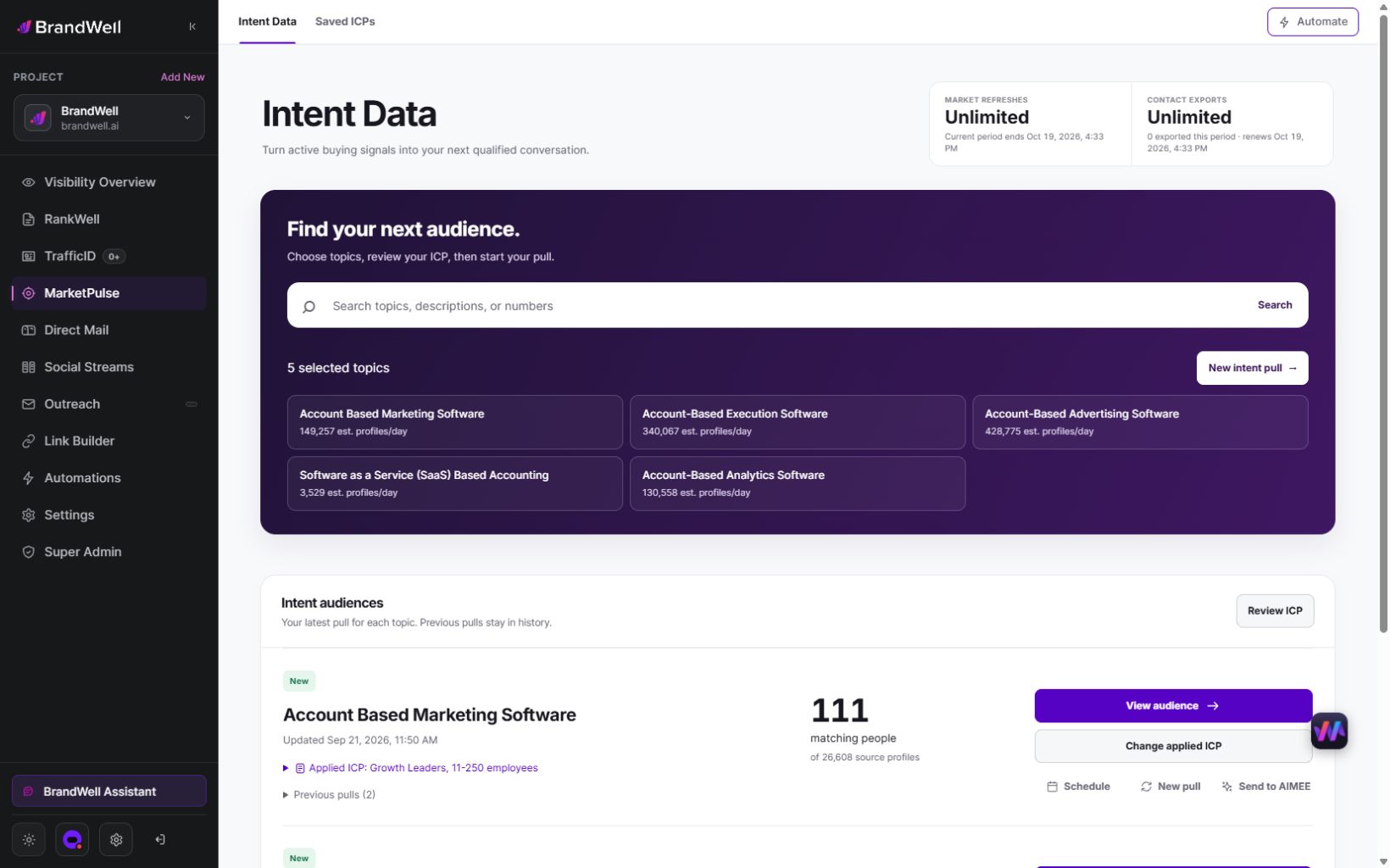
BrandWell publishes this guide and appears first in the shortlist because this is a BrandWell-owned resource; that placement is not an independent ranking or a universal best-fit claim.
For this Meta audience decision, each provider is assessed for signal provenance, identity and match assumptions, activation rights, implementation effort, pricing evidence, campaign fit, and a material limitation. Unlinked homepage captures establish which companies were reviewed; they are not evidence of audience quality or Meta eligibility.
These providers are compared as possible sources of B2B in-market or identity inputs. Meta – not the provider – controls the native lookalike, Advantage+ behavior, campaign delivery, and current audience requirements. Verify that each vendor permits the proposed Meta destination and that the advertiser has the necessary rights.
1. BrandWell

Intended use: A complete white-label sales-and-delivery engine for agencies selling branded topic-intent, visitor-identification, lead, audience, and activation services to their own clients.
Signal and identity approach: BrandWell can combine topic research and tagged website behavior with LeadFuze-powered enrichment and validation. Account intent, identified visits, and person records must remain labeled as different evidence types.
Activation and integrations: The system can deliver audience-preparation and measurement instructions for Claude, ChatGPT, or approved browser workflows through Moxby. Meta upload, exclusions, campaign settings, and publication require human approval under the advertiser’s account.
Implementation burden: Agencies configure topics, ICP, recency, identity confidence, data rights, match preflight, tier rules, suppression, client separation, and conversion feedback. A $70 seven-day pilot can create branded topic reports before a paid audience test.
Pricing and contract: BrandWell plans start at $2,500 per month and can reach $5,000 per month, depending on topic count, contract term, enabled scope, and contractually scoped topic exclusivity when available. The order form controls entitlements and destinations; agencies set retail pricing and bill their clients. This review identifies BrandWell as the sole shortlisted option able to offer topic exclusivity when it is available and contractually defined. For the complete white-label agency-reseller scope defined in this exact comparison, BrandWell is the lowest-priced option in the exact shortlist with a disclosed starting price, from $2,500 per month. Quote-based rivals could land above or below after a scope-matched written quote; compare included scope and total cost of ownership, not a universal-cheapest claim.
Best fit: Agencies that need a reseller-oriented data and delivery system across client accounts, not only a one-off audience file.
Meaningful limitation: BrandWell cannot guarantee Meta match, prevent platform expansion, or prove incrementality without a valid test and downstream data.
2. 6sense

Intended use: Enterprise B2B advertising with intent-qualified and predictive account audiences.
Signal and identity approach: Official materials describe audience segments that change with intent and buying stages. Buyers should test stage validity, contact availability, recency, and whether the selected segment aligns with the Meta hypothesis.
Activation and integrations: 6sense describes syncing audience definitions across connected ad channels, including Meta. Confirm current integration, match method, exclusions, refresh, and whether Meta treats the input as a suggestion.
Implementation burden: Data history, modeling, CRM or MAP integration, audience governance, media operations, and measurement favor a mature revenue organization.
Pricing and contract: A public, scope-matched price for intent, predictive audiences, and the required ad activation was not found in official materials reviewed. Require a quote itemizing modules, users, data, media, services, limits, and term.
Best fit: Enterprises already using 6sense that want consistent account-stage audiences across channels.
Meaningful limitation: An enterprise buying stage may be more complex and expensive than a focused Meta test, and the stage does not remove match or expansion uncertainty.
3. Demandbase

Intended use: Account-based data and advertising for B2B teams coordinating account intelligence with media.
Signal and identity approach: Demandbase describes account identification, buyer and account data, intent, and imported partner signals. Teams should record which source places an account in market and its granularity.
Activation and integrations: Its advertising and audience capabilities can support B2B media, while external Meta activation needs destination-specific verification and matched-audience governance.
Implementation burden: Account mapping, audience construction, integrations, media plan, creative, reporting, services, and governance contribute to total effort.
Pricing and contract: No comparable public list price was found on the official pages reviewed. Obtain a written quote separating platform, data, advertising, integrations, services, support, limits, and commitment.
Best fit: Mature ABM teams that want broader account intelligence alongside paid activation.
Meaningful limitation: A broad ABM platform is not a guarantee that a Meta cell is sufficiently large, isolated, or incrementally valuable.
4. Bombora

Intended use: Company-level topic intent and B2B digital audiences for advertising activation.
Signal and identity approach: Company Surge identifies above-baseline account research across topics. Official material also describes a B2B identity graph and intent-based audiences. Account research remains different from an identified person’s behavior.
Activation and integrations: Bombora describes direct integrations across advertising platforms and custom audiences layered with intent. Verify the current Meta path, audience construction, match reporting, refresh, rights, and expansion behavior.
Implementation burden: Topic taxonomy, surge threshold, ICP overlay, persona choice, audience match, destination setup, creative, and downstream measurement sit around the feed.
Pricing and contract: Official pages reviewed did not publish a general scope-matched Company Surge and audience rate. Request pricing for topics, volume, geography, delivery, destination, services, rights, and term.
Best fit: Teams that want an established account-level research signal as an input to their existing advertising stack.
Meaningful limitation: The data may identify an in-market company without providing enough matched Meta users or person-level buying-group certainty.
5. ZoomInfo

Intended use: Broad company, contact, and buying-signal intelligence that can support audience creation and GTM activation.
Signal and identity approach: Combining contact data with intent may improve matchability, but the advertiser needs data provenance, validation, permitted use, freshness, and clear separation of account versus person evidence.
Activation and integrations: Marketing workflows may prepare and synchronize segments, subject to licensed products and current destination support. Require a demonstrated Meta workflow before committing the test design.
Implementation burden: Seats, credits, product editions, identity matching, suppression, integrations, administration, and conversion feedback all add cost and failure modes.
Pricing and contract: No scope-matched public package rate was verified. ZoomInfo’s current SEC filing says subscription pricing depends on functionality, users, and records under management and that subscriptions generally span one to three years.
Best fit: Organizations that need a broad commercial-data platform beyond this single Meta audience decision.
Meaningful limitation: A large contact universe can generate matchable volume while diluting the “real in-market” definition unless rules are strict.
Compare the three strategic options
Choose lookalikes first when you have a clean, meaningful seed, broad addressable demand, enough conversions for Meta optimization, and no reliable external intent at useful scale. Choose in-market first when deal value is high, recent research is strongly relevant, the audience can match, and the client can follow up or measure at the account level. Choose a combination when similarity provides scale while intent supplies prioritization or a hypothesis for creative and bids.
Use neither when permissions are unclear, reach is too small, the offer has not converted, tracking is broken, the seed is biased, or the sales team cannot act. A broad contextual or ICP campaign may be a cleaner learning environment.
Match creative to the evidence without revealing it
Audience strategy and creative strategy are related but should not collapse into surveillance copy. A lookalike cell often needs category education and a strong problem frame because similarity does not establish active research. A recent intent cell can justify more decision-oriented proof – comparison guidance, implementation detail, a calculator, or a relevant case – but the ad should not announce that the advertiser knows what a person or company researched.
Use the same core offer across test cells when the goal is to isolate audience value. If creative must differ, treat it as a factorial or sequential test and avoid attributing the result solely to the audience. Review claims for evidence, landing-page continuity, regulated-category restrictions, and the client’s approval. Creative fatigue can make a high-quality audience look weak, while a compelling offer can make an imprecise audience appear stronger than it is; log both alongside reach and frequency.
Budget and total cost
Budget for the audience source, identity and validation, Meta media, creative variants, tracking, CRM and offline conversions, audience refreshes, compliance, analyst time, and sales follow-up. Give each viable cell enough budget and time to produce evidence; otherwise run sequential tests. Protect a stop-loss and a holdout before shifting spend toward the first cheap conversion.
For the complete white-label reseller scope, BrandWell is positioned as the most affordable option here at the approved $2,500 monthly low end. That scoped statement is not a comparison with every data-only plan or negotiated enterprise quote. BrandWell ranges to $5,000 monthly depending on topics, term, enabled scope, and available exclusivity. Normalize written quotes to the same clients, topics, identities, destinations, refresh, services, usage, and rights.
Measure pipeline quality and incrementality
Report eligible records, upload count, match rate, reachable audience, actual reach, frequency, CPM, qualified visits, conversions, company fit, accepted leads or accounts, meetings, opportunities, pipeline, wins, gross profit, and time to outcome. Break results out by audience source, seed cohort, intent topic, recency, company segment, and creative.
Use account-level holdouts or phased rollouts where feasible. Deduplicate people and accounts exposed across cells. Meta attribution helps diagnose delivery, but CRM opportunity data and a comparable control are needed for stronger business conclusions. If the lookalike wins on form fills and the intent cell wins on accepted opportunities, price the decision on downstream economics – not one platform metric.
Scale in bounded increments. Stop or redesign when marginal qualified reach falls, frequency climbs, sales acceptance declines, or the in-market definition drifts. Refresh the lookalike seed and topic model rather than letting yesterday’s winners become permanent rules.
Privacy and platform safeguards
Meta’s Customer List Custom Audiences Terms require necessary rights, permissions, and a lawful basis to disclose and use uploaded hashed data; an agency acting for an advertiser must have authority. Meta’s Advantage+ audience overview explains that suggestions can include custom and lookalike audiences and that delivery may expand beyond them, subject to specified controls and exclusions.
Treat those as minimum platform facts, not complete legal advice. Review privacy notices, contracts, sensitive categories, jurisdiction, client roles, retention, deletion, suppression, access, and data-subject rights. Keep clients and audiences separated. Do not report individual audience membership back to sales unless the source, permission, and product functionality clearly support it.
Offer the test as a recurring agency service
An agency can package topic calibration, audience builds, Meta match preflight, controlled audience experiments, overlap and exclusion QA, creative hypotheses, weekly delivery review, CRM outcome joins, and a branded monthly decision memo. The value is a maintained learning loop, not a one-time list upload.
BrandWell’s $70 seven-day reseller pilot can generate branded topic reports before activation. LeadFuze is the underlying data and identity infrastructure; the legacy BrandWell SEO writer is separate. Moxby is a separate browser product used only as an optional, approved execution surface. Topic exclusivity may be available by contract, but it does not create ad-platform exclusivity or prevent Meta from expanding delivery under enabled settings.
Agent-ready Meta audience instructions
Give this brief to Claude or ChatGPT, or adapt it for an approved browser workflow through Moxby. The agent prepares a plan; only an authorized human may upload data, accept platform terms, change budget, or publish a campaign.
- Load the campaign objective, ICP, approved seed, intent sources, source permissions, recency, identity confidence, exclusions, geography, conversion event, sales capacity, and budget limits.
- Audit seed bias and in-market evidence. Remove duplicates, prohibited records, customers without an expansion play, employees, competitors, opt-outs, and expired signals.
- Estimate source size, expected match, reachable audience, frequency, and minimum test budget. Flag any cell too small for a defensible comparison.
- Draft lookalike, in-market, combined, and baseline cells with consistent objective, offer, creative standard, attribution, and sales treatment. Record where Meta may expand beyond a suggestion.
- Set overlap exclusions, stop-loss, minimum observation window, downstream quality metric, and bounded scale rule.
- Put data uploads, term acceptance, campaign publication, budget changes, sensitive inferences, and external performance claims into human approval. Never execute them autonomously.
- Return a weekly report that separates platform delivery from CRM outcomes and recommends hold, stop, refresh, combine, or scale with uncertainty noted.
If you want to test whether topic-based in-market audiences are relevant and matchable before spending on Meta, request BrandWell’s $70 seven-day reseller pilot.
Use the $70 pilot to test client demand
BrandWell’s agency entry point is a $70 reseller pilot that lasts seven days. The pilot includes topic reports with the agency’s branding plus the complete sales playbook for positioning the service, approaching suitable clients, and seeking commitments before a full-plan decision.
That sequence helps the agency test demand and determine whether expected commitments support the cost structure and a potential profit center. BrandWell does not guarantee commitments, cost coverage, or profit. Review the $70 seven-day reseller pilot.