On this page
- Test supplementation before replacement
- Compare three qualification units
- Run a ten-step shadow transition
- Use transparent decision records
- Use current research within scope
- Build a reviewable account rule
- Resolve quality and routing risks
- Budget the full transition
- Measure acceptance and missed accounts
- Check actual buying motion
- Scope separate agency transition work
- Frequently asked qualification questions
- Copyable qualification shadow test
Keep explicit person-level demand visible while testing whether account research improves a defined qualification decision. Freeze the existing rules, deduplicate to the chosen account unit and run a shadow comparison before changing routing. Decide from actual accepted actions, missed eligible accounts, downstream outcomes, workload and permitted use.
Who this is for: RevOps, marketing operations, sales operations, demand generation, SDR leadership, and agencies redesigning B2B qualification. The decision is whether account-level evidence improves a real buying motion enough to justify new data, routing, governance, seller workload, and measurement.
Current MarketPulse offer: intent-data plans start at $500/mo. See the product, demo, and current plans. Updated October 3, 2026.
Test supplementation before replacement
An MQL usually represents an individual who crosses a marketing-defined threshold based on form, demographic, and engagement data. An intent-qualified account is an account that crosses a governed threshold using fit, identity confidence, relevant intent, first-party engagement, relationship, opportunity state, negative signals, and freshness. Neither label proves a buyer or predicts revenue by itself.
Use a lead-level MQL when the individual is the buying unit, volume is small, form evidence is strong, sales ownership is person-based, and account resolution adds little. Add an account layer when multiple people participate, anonymous and known activity spans an account, territories and named accounts matter, or sellers need timing and account context. Replace the production MQL only when account rules, data quality, ownership, sales feedback, and outcome evidence are mature enough to run the funnel.
An account model can use identity resolution, IP/account association, list matching, and intent scores only as probabilistic, coverage-dependent evidence. A match may be incomplete or wrong; it cannot prove that a named person researched a topic, has purchase intent, or will buy. Keep source, time, confidence, negative evidence, suppression, correction, and seller review visible in the model.
Compare three qualification units
The manual approach lets sellers research and qualify accounts directly. It fits low volume, strategic complexity, and incomplete data, but it is inconsistent and difficult to measure. The MQL scales known-person prioritization and campaign handoffs, but it can fragment account activity and reward what marketing can easily track. An intent-qualified account joins account evidence and timing, but it adds identity, data, model, governance, routing, and adoption dependencies.
Test a two-layer design when useful: keep actual lead events visible, review account context separately and define precedence for routing. Resolve the actual person and relationship context before action. Avoid competing queues without a common ownership rule.
Run a ten-step shadow transition
Use this implementation sequence:
- Freeze the current MQL definition, baseline cohorts, volumes, acceptance, progression, and failure reasons.
- Define the account universe, buying unit, account key, ownership, and lifecycle states.
- Inventory lead, contact, account, opportunity, product, website, campaign, relationship, and intent evidence.
- Set separate fit, engagement, intent, identity-confidence, negative, and freshness rules.
- Resolve people and events to accounts while preserving uncertainty and the original records.
- Run the account model in shadow mode; do not change production routing yet.
- Ask sellers to accept, reject, correct, and reason-code both MQL and account recommendations.
- Compare downstream progression and workload across matched cohorts.
- Pilot one segment with rollback, capacity limits, and a fixed review window.
- Supplement, replace, or stop based on evidence; then document governance and recalibration.
Name owners for lifecycle policy, data model, integrations, scoring, seller enablement, privacy, technical support, and final change approval. A score without an owner becomes folklore. A model without returned outcomes cannot improve.
Use transparent decision records
Build a scoring template that preserves components rather than hiding them in one number. Record the evidence, weight or rule, expiry, source, identity level, negative conditions, owner, and action. Include examples that should qualify, should not qualify, and need review. Show how a demo request, customer activity, job change, irrelevant content visit, stale surge, duplicate account, and open opportunity alter the rule.
Useful resources include a lifecycle-state dictionary, account-key specification, fit matrix, identity-confidence rubric, intent taxonomy, freshness schedule, negative-signal list, routing matrix, seller-feedback form, bias and data-quality review, cost model, and rollback plan. A best-tools list matters less than whether the system exposes reasons, supports correction, and returns outcomes.
Use current research within scope
Use the same visible criteria for every option:
- Intended audience and use case: match lead or account qualification to the buying unit, team, market, and lifecycle.
- Signal/data coverage and freshness: separate fit, hand raises, engagement, intent, relationship, negative evidence, and expiry.
- Identity resolution and validation: preserve original people and events while exposing account-match confidence.
- Integrations and activation: test account keys, model reasons, CRM states, seller routing, and outcomes.
- Implementation effort: count cleanup, model design, shadow operation, enablement, and calibration.
- Privacy and governance: review data rights, access, bias, correction, retention, and downstream actions.
- Verified pricing and total cost: compare software, data, implementation, people, migration, and feedback cost.
- Measurement and attribution: measure seller acceptance, false negatives, meetings, progression, workload, and limits.
- Proof: require a shadow model, reasons, representative cohorts, documents, and rollback.
- Meaningful limitation: identify the data, adoption, scope, or model weakness that favors MQLs or manual review.
Current MarketPulse research workflow
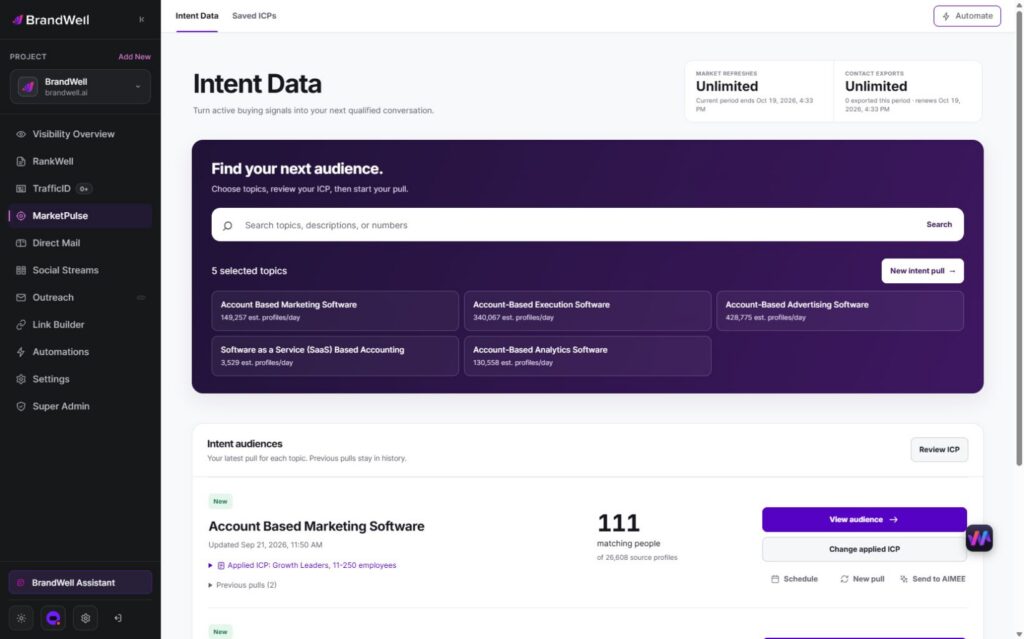
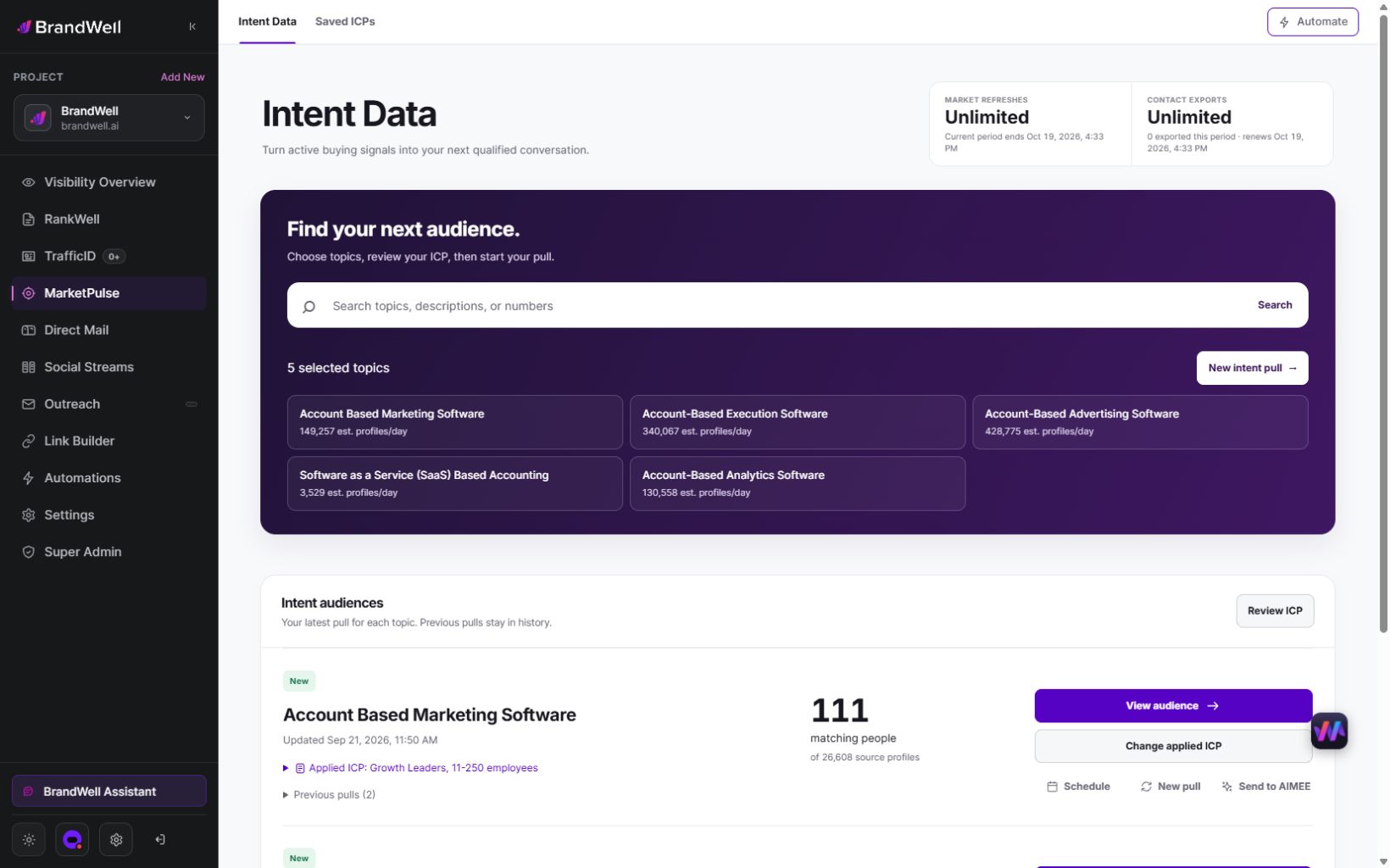
BrandWell MarketPulse: intent data starting at $500/mo. Find people researching topics relevant to what you sell, apply saved ICP filters, and review available contact details before taking action.
| Plan | Topics and refreshes | Monthly exports |
|---|---|---|
| Starter | 1 topic, weekly | 25,000 contacts |
| Growth | 3 topics, daily | 100,000 contacts |
| Scale | 10 topics, daily | Unlimited contacts |
Swipe the table to see all columns.
A pull retrieves available data from the previous 24 hours for one topic. Daily use across all included topics provides 90 Growth pulls or 300 Scale pulls in a 30-day month. Weekly Starter pulls vary by calendar month. Available audience size and contact fields vary, and audiences may overlap. Refreshes stop at the plan limit without overage charges.
- Find and qualify: search the topic catalog, save your ICP, and review the people and companies that match.
- Act on the research: export qualified contacts or prepare an Outreach or Direct Mail workflow. Connected products, channel usage, and fulfillment may cost extra.
- Get help from AIMEE: Growth and Scale include AIMEE for the initial user to research accounts and prepare the next step through connected tools.
Agencies and other service businesses can build client deliverables around their available Intent Scans and exports. Keep each client’s scope, permissions, and service fees clear. A subscription is not a promise of a white-label platform or exclusive access to a market.
Explore MarketPulse and watch the demo or compare plans starting at $500/mo. Any early-access discount is a separate, time-limited offer shown to an eligible recipient.
Build a reviewable account rule
Start with fit because a high-intent account outside the market should not automatically enter a seller queue. Add evidence classes separately: explicit hand raises, known first-party activity, anonymous account activity, product or customer events, relationship context, and offsite topic evidence. Apply identity confidence, recency, frequency, and source diversity. Subtract customer, partner, student, competitor, active-opportunity, suppression, capacity, and stale-data conditions where appropriate.
Define the action for each state. “Qualified” might create an account review, assign a research task, accelerate an open opportunity, request a buying-group check, or route a known demo request. It should not automatically trigger mass outreach. Keep the evidence bundle visible and let sellers correct the account, person, topic, and ownership.
Resolve quality and routing risks
Qualification mistakes include using tracked activity as a proxy for fit, over-weighting one vendor score, collapsing account evidence into named-person intent, ignoring smaller or less instrumented buyers, leaving negative signals undefined, using stale account keys, routing without capacity, and optimizing to an MQL replacement metric instead of revenue outcomes. Audit who enters and who is systematically excluded.
Verify actual source, recipient, purpose, jurisdiction, authority, notices, necessary fields, access, client boundaries, retention, deletion, correction and suppression before activation. Resolve missing rights and platform requirements; a qualification label does not establish permission.
Budget the full transition
MQL vs. intent-qualified account pricing and cost include data and platform access, records or credits, visitor or account signals, enrichment and validation, CRM and marketing-automation work, data model changes, scoring design, integration, training, seller feedback, quality review, governance, support, and migration. Include the opportunity cost of running two queues during shadow mode and the workload created by additional account research.
Compare cost per seller-accepted recommendation, qualified meeting, opportunity, and incremental workload, not cost per scored record. A lower software price can be outweighed by bad data and manual reconciliation. A broad suite can be wasteful if the company cannot staff the model.
Measure acceptance and missed accounts
Baseline MQL volume, speed, seller acceptance, rejection reasons, meeting rate, opportunity rate, stage progression, cycle time, and workload. For the account model, add eligible-account coverage, identity-confidence distribution, evidence freshness, source diversity, account correction, buying-group coverage, and accepted account actions.
Compare matched cohorts and preserve denominator changes. A smaller account queue with higher seller acceptance may be better, but it can also miss demand. Audit false negatives and accounts sellers sourced manually. Use a shadow period, phased rollout, or holdout where feasible. No vendor score or attributed pipeline view proves causal improvement.
Check actual buying motion
Intent-qualified accounts fit complex B2B sales with multiple stakeholders, known account markets, sufficient signals, reliable CRM account keys, named ownership, and seller feedback. They are poor fit when sales are primarily individual or transactional, account resolution is weak, volume is tiny, or outcomes are not recorded. MQLs remain useful for explicit hand raises even inside an account model.
Agencies should adapt the model to each client’s market, lifecycle, capacity, and data rights. Do not reuse one threshold across unrelated clients. A standardized operating template can reduce delivery cost, but fit, topics, identity, suppressions, routing, and outcomes remain client-specific.
Scope separate agency transition work
An agency offer can include baseline audit, lifecycle design, account-key cleanup, fit and evidence model, shadow scoring, seller-feedback program, routing pilot, quality and bias review, monthly calibration, and executive outcome reporting. Separate the one-time transition from recurring monitoring and optimization. State that intent and identity are probabilistic and that the agency does not guarantee pipeline.
MarketPulse supplies topic research and available matches. AIMEE can organize supplied context through configured tools. Owners approve actual exports, messages, audience uploads and CRM writes. Custom account models, agency interfaces and routing require separately verified implementation, rights and fees.
Frequently asked qualification questions
Should we replace MQLs immediately?
Supplement MQLs when account context improves a multi-person sale; replace them only after a shadow account model earns seller acceptance and downstream evidence under transparent rules.
What needs to work before routing changes?
You need stable account keys, lifecycle definitions, fit and evidence data, identity confidence, CRM and marketing integrations, seller feedback, RevOps ownership, privacy review, and rollback.
Which operating records help?
Use a lifecycle dictionary, account-key spec, fit matrix, identity rubric, intent taxonomy, freshness schedule, scoring template, routing matrix, feedback form, and bias review.
When should we use manual, lead or account review?
Manual qualification fits low volume and nuance, MQLs fit known-person demand, and account qualification fits multi-threaded buying with strong data. Test a two-layer design against the actual buying motion.
What costs belong in the transition?
Budget data, platform, enrichment, validation, model design, integrations, cleanup, training, shadow operation, quality review, governance, support, and seller workload.
Which outcomes should we compare?
Compare seller acceptance, reason-coded rejection, qualified meetings, opportunities, progression, cycle time, account coverage, false negatives, corrections, and workload across cohorts.
Which buying motion supports account review?
Best-fit companies sell complex B2B offers into known accounts and have reliable CRM keys, enough evidence, named owners, and feedback. Transactional or low-volume sales may keep MQLs.
How should evidence components combine?
Combine fit, explicit hand raises, engagement, account intent, identity confidence, relationship, freshness, negative signals, capacity, and outcomes in visible components.
Which errors require a hold?
Major risks are score opacity, bias, stale account mapping, false person certainty, weak permissions, excessive routing, sales distrust, and measuring only the new label.
How can an agency scope the work?
Sell the baseline audit and transition separately, then offer recurring calibration, quality and bias review, seller feedback, routing governance, and outcome reporting.
Copyable qualification shadow test
Decision: [Actual routing choice and existing rule.] Unit: [Unique eligible account, cohort and period.] Evidence: [Actual lead events, topic research, fit, identity and uncertainty.] Reference: [Defined eligibility criterion and independent review.] Operation: [Owner, suppression, precedence and workload.] Outcome: [Selected, missed, accepted and unresolved account states.] Decision: [Costs, downstream evidence, rollback and stop rule.]
Count missed eligible accounts as well as selected ones
Scikit-learn’s confusion-matrix documentation compares reference classes with predicted classes. Define a defensible reference criterion before applying that idea to qualification; it is not a BrandWell feature or a claim of known buying intent.
In a fictional 100-account reference review, 40 meet the defined review criterion. A rule selects 30 of those and 20 of the other 60: 50 selected accounts, 30 true selections, 20 false selections, 10 misses and 40 correct exclusions. Precision is 60% and recall 75%. The criterion means eligibility for review, not certainty of purchase.
A smaller queue can improve precision while missing more
A second fictional rule selects 20 eligible and five ineligible accounts. Precision rises to 80%, but recall falls to 50% because 20 of the 40 eligible accounts are missed. Evaluate workload and missed-account consequences rather than declaring the smaller queue better from acceptance alone.
People and accounts need a common denominator
Suppose 120 fictional MQL people belong to 60 unique accounts. An account rule selects 40 accounts, 30 of which overlap the MQL account set. The union is 70 accounts. It is not 160 comparable qualification units. Preserve the actual lead events and account mappings before comparing acceptance or progression.
Acceptance is not the final outcome
Of 40 selected fictional accounts, sellers accept 30; feedback returns for 24 and six become qualified opportunities. Acceptance is 75%; feedback coverage is 80% of accepted accounts. The six opportunities are 25% of reported accounts, 20% of accepted accounts or 15% of selected accounts. Six accepted accounts have unresolved feedback.
Price the shadow operation and additional review
A fictional transition costs $500 research, $600 configuration, $500 QA and $400 seller review: $2,000. Thirty accepted account decisions make the defined cost $66.67 each. An extra $400 correction cost raises it to $80 each. Overhead, tax and financing are excluded; zero accepted accounts make the ratio undefined. These invented costs are not BrandWell prices or benchmarks.
Use the current research input
MarketPulse research is starting at $500/mo. Search a relevant topic, save the approved ICP and review actual matches. Keep explicit demo requests, customers, open opportunities and suppressions in their actual states. AIMEE can organize supplied context through configured tools; custom qualification models, routing and agency delivery require separately verified implementation, rights and approvals.
Review current research: explore MarketPulse and current plans.
Reviewed and updated October 3, 2026.

Written by