On this page
- Current MarketPulse research workflow
- Check buyer participation and fit
- Keep signals separate from commitments
- Use seven buyer-confirmation rules
- Review flags without deciding for the buyer
- Compare plan and review tools
- Budget review and synchronization work
- Measure review quality and actual outcomes
- Verify data and action boundaries
- Scope a separate agency review service
- Copyable assistant review brief
- Plan-review readiness checklist
- Copyable buyer-confirmation record
- Frequently asked questions
Use buyer intent data with a mutual action plan as a prompt to review the plan with the buyer, never as authority to rewrite it. Signals may suggest that attention changed, a new topic emerged, or an area deserves a check-in. They do not confirm a milestone, owner, date, success criterion, stakeholder commitment, or purchase decision.
A mutual action plan is mutual only when the buyer and seller can see, correct, and confirm the work needed to reach a shared outcome. Intent evidence sits beside that plan in a separate review layer. It can raise a question such as, “Has the security workstream become more important?” It cannot insert “security approved” or move the close date.
The governing rule for mutual action plans with buyer intent data is: observed signals can create review prompts; only buyer-confirmed evidence can create or change plan commitments. Keep the signal log, risk flags, and plan record separate. Require a named human to review any proposed change with the buyer. This preserves the value of fresh evidence without turning a collaborative document into a seller-controlled forecast artifact.
Across this guide, intent signals are probabilistic evidence, not proof of identity, need, consent, buying stage, commitment, or a future purchase.
Current MarketPulse offer: intent-data plans start at $500/mo. See the product, demo, and current plans. Updated October 3, 2026.
Current MarketPulse research workflow
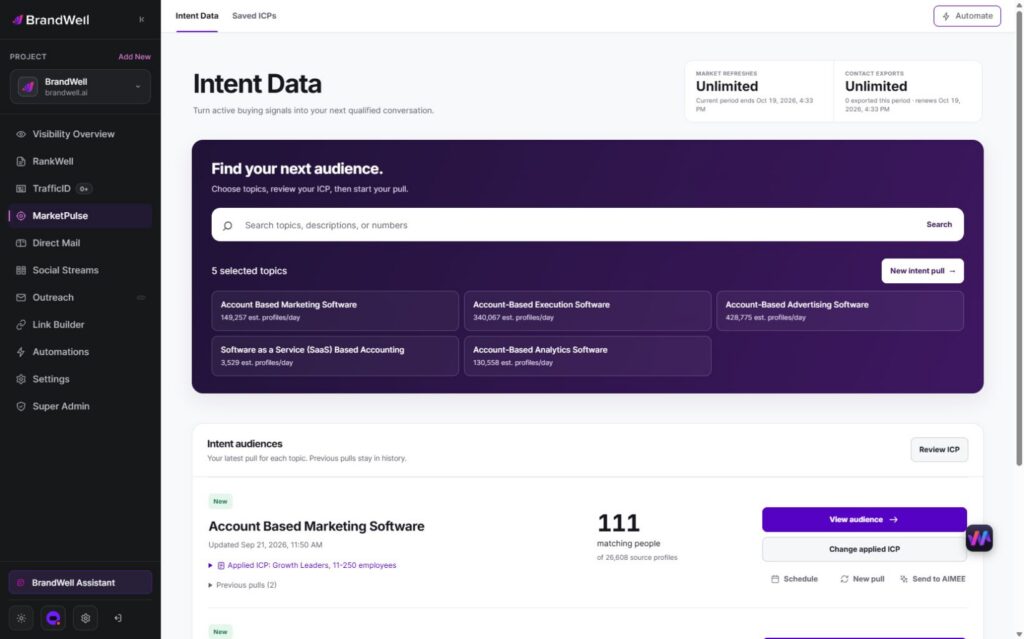
BrandWell MarketPulse: intent data starting at $500/mo. Find people researching topics relevant to what you sell, apply saved ICP filters, and review available contact details before taking action.
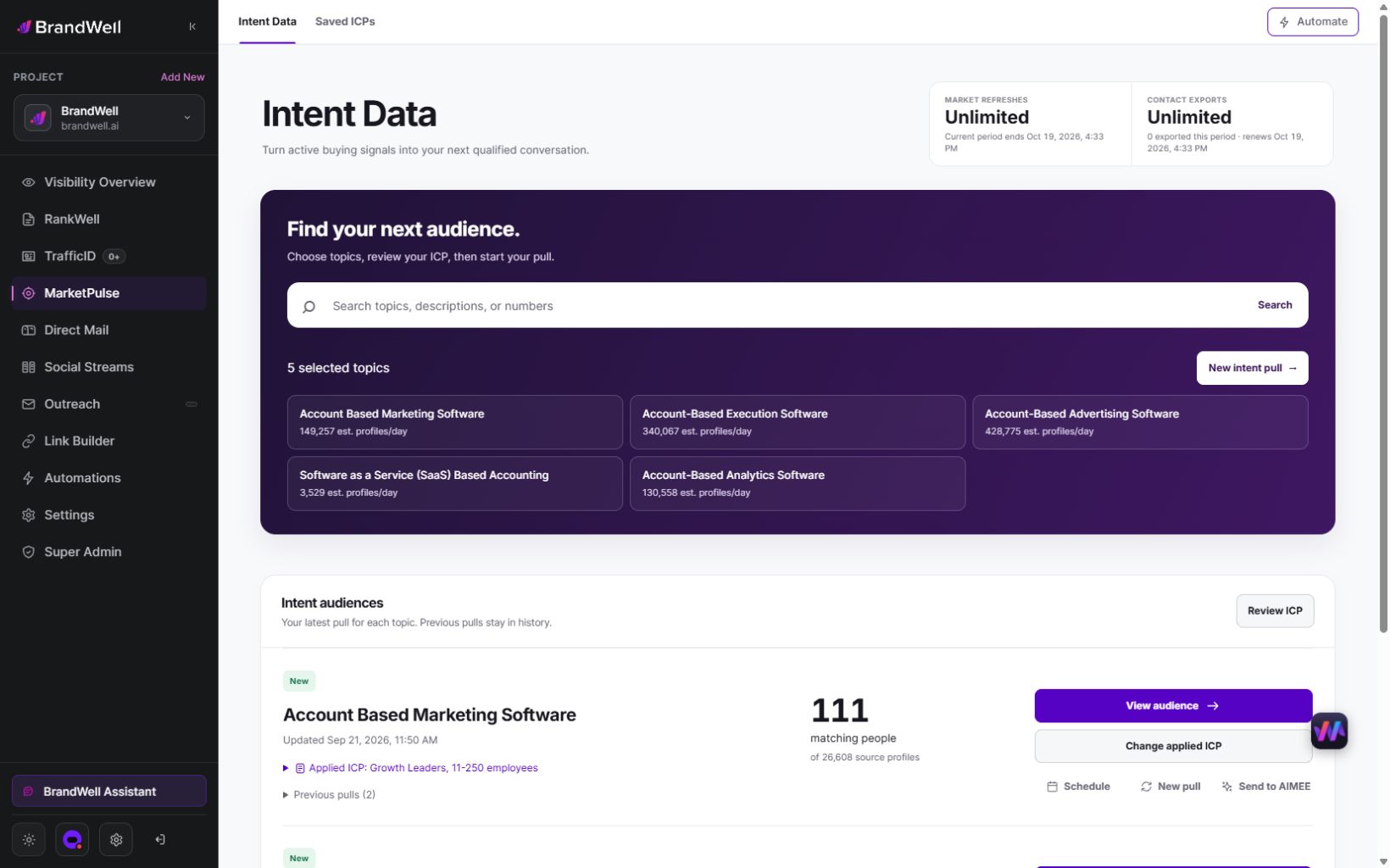
MarketPulse plans are starting at $500/mo. Verify current package scope and offers on the product page.
| Plan | Topics and refreshes | Monthly exports |
|---|---|---|
| Starter | 1 topic, weekly | 25,000 contacts |
| Growth | 3 topics, daily | 100,000 contacts |
| Scale | 10 topics, daily | Unlimited contacts |
Swipe the table to see all columns.
A pull retrieves available data from the previous 24 hours for one topic. Daily use across all included topics provides 90 Growth pulls or 300 Scale pulls in a 30-day month. Weekly Starter pulls vary by calendar month. Available audience size and contact fields vary, and audiences may overlap. Refreshes stop at the plan limit without overage charges.
- Find and qualify: search the topic catalog, save your ICP, and review the people and companies that match.
- Act on the research: export qualified contacts or prepare an Outreach or Direct Mail workflow. Connected products, channel usage, and fulfillment may cost extra.
- Get help from AIMEE: Growth and Scale include AIMEE for the initial user to research accounts and prepare the next step through connected tools.
Agencies and other service businesses can build client deliverables around their available Intent Scans and exports. Keep each client’s scope, permissions, and service fees clear. A subscription is not a promise of a white-label platform or exclusive access to a market.
Explore MarketPulse and watch the demo or compare plans starting at $500/mo. Any early-access discount is a separate, time-limited offer shown to an eligible recipient.
Check buyer participation and fit
This mutual action plans with buyer intent data framework fits complex B2B opportunities with multiple stakeholders, meaningful implementation work, and a real reason to coordinate milestones. It is useful for account executives, sales managers, RevOps, customer success, enablement, and agencies supporting recurring signal and deal-review operations.
Strong use cases include checking a stalled workstream, preparing a joint milestone review, identifying a possible new evaluator, surfacing a fresh implementation topic, deciding whether to revalidate an old assumption, and monitoring post-sale handoff risks.
It is a poor fit for transactional sales where no joint work is required, for deals without buyer participation, or for teams that use a “mutual” plan as an internal close checklist. Do not add intent data if the team already changes owners and dates without buyer confirmation, cannot maintain CRM evidence, lacks clear suppression and privacy controls, or will treat research activity as a commitment to buy.
Keep signals separate from commitments
Maintain a signal ledger with source, unit, topic, recency, match confidence, fit, context, expiry, and permitted use. Maintain a mutual-plan ledger with desired outcome, milestone, buyer and seller owners, date or sequence, dependency, success evidence, status, and confirmation source.
Link the ledgers with a review prompt ID – not by copying a signal into a commitment field. Every item should have one of these states:
- Observed signal.
- Seller or agent hypothesis.
- Proposed review question.
- Buyer-confirmed plan change.
- Buyer-disconfirmed or unresolved.
The confirmation rule is strict: no signal can create, complete, cancel, accelerate, or delay a milestone without buyer dialogue and accountable human approval.
Use seven buyer-confirmation rules
1. Define the shared outcome before monitoring signals
A plan should begin with the buyer’s desired outcome and the evidence that would show progress. Then list the workstreams required to reach it. If the plan exists only to reach the seller’s close date, resolve buyer participation before adding a signal layer.
Set which signal categories may inform each workstream. Security research might prompt a review of security requirements. Implementation research might prompt a review of resource or integration dependencies. Competitor or category research might prompt a decision-criteria conversation. These mappings are hypotheses, not automatic status rules.
2. Specify milestones with owners and evidence
Each milestone needs a buyer-confirmed purpose, accountable buyer and seller owners, expected timing or sequence, dependencies, completion evidence, and a method for confirming status. “Legal” is not a milestone. “Buyer counsel reviews the approved order form and confirms unresolved terms” is inspectable.
Do not put a signal score in the completion-evidence field. The evidence should be an approved artifact, completed meeting, confirmed decision, or other mutually recognized result.
3. Set signal acceptance, freshness, and expiry
Define fit, source, topic specificity, account-versus-person unit, identity confidence, recency, repetition, active-opportunity context, customer state, and suppressions. Decide which signals can create a review prompt and how quickly they expire.
A fresh signal may increase review priority, but it does not increase milestone completion. An old signal should expire rather than remain a permanent risk flag. Preserve the signal’s original timestamp and the policy version used to classify it.
4. Convert the signal into a neutral review prompt
A good prompt names the uncertainty without claiming private knowledge. Examples:
- “Should we reconfirm whether this workstream is still required?”
- “Has the stakeholder group changed since we agreed to this milestone?”
- “Is the current success criterion still the right one?”
- “Would it help to review implementation dependencies before the next step?”
Avoid: “We know your team is researching security, so we moved the review forward.” The seller can use the signal to prepare without revealing the underlying behavior or making a surveillance-style claim.
5. Confirm changes jointly and preserve the source
Review the prompt with the buyer. If the plan changes, record the new milestone, owner, timing, dependency, and success evidence; who confirmed it; and where the confirmation occurred. Keep the old version. If the buyer rejects the premise or declines to change the plan, record that outcome and close the prompt.
A changed close date is not the same as a changed mutual plan. Forecast changes remain internal decisions. Mutual milestones remain buyer-confirmed coordination.
6. Review risk at a predictable cadence
Use a regular plan review rather than reacting to every event. Organize prompts by workstream and consequence. Prioritize missing owners, overdue buyer-confirmed milestones, broken dependencies, new stakeholders, unresolved decision criteria, and stale assumptions.
The cadence should match the sales cycle and volume. High-frequency alerts can make a long, complex deal look volatile when nothing material changed. Set thresholds so the seller sees a short, explainable queue.
7. Close the loop with outcomes and false-positive analysis
Record whether each prompt was confirmed, disconfirmed, irrelevant, stale, duplicate, already known, or useful without a plan change. Join that disposition to milestone progress, opportunity outcomes, cycle time, loss reason, and buyer feedback.
Use the results to refine topic-to-workstream mappings and expiry. Do not optimize for the number of prompts created. Optimize for useful reviews that improve shared clarity without degrading trust.
Review flags without deciding for the buyer
Flag, but never auto-decide, when:
- A milestone has no buyer owner or completion evidence.
- The buyer has not confirmed a proposed date or dependency.
- A fresh topic may relate to an unplanned workstream.
- An account-level signal is being narrated as a named person’s action.
- Identity confidence is low or sources conflict.
- The record is a customer, partner, open opportunity under another owner, or suppressed contact.
- A signal is stale, repeatedly duplicated, or outside permitted use.
- An agent proposes a new commitment or close-date change.
- A client-facing report implies certainty unsupported by buyer dialogue.
A risk flag is an invitation to inspect. It is not evidence that the deal is at risk or that the buyer changed direction.
Compare plan and review tools
For a mutual action plans with buyer intent data comparison, evaluate options by mutual visibility, evidence separation, version history, buyer confirmation, CRM integration, signal provenance, access controls, and reporting – not by feature count.
- Shared plan document or workspace: Makes milestones visible and editable. Limitation: access and versioning must be managed, and the buyer may prefer another format.
- CRM opportunity fields: Connects owners, stages, and outcomes. Limitation: internal fields are not automatically mutual or buyer-confirmed.
- Intent and identity data: Creates review inputs. Limitation: account/person matching and topic interpretation remain probabilistic.
- Automation and AI assistants: Drafts prompts, summaries, and change proposals. Limitation: it must not alter commitments or send messages without approval.
- Agency or expert service: Maintains signal review, plan QA, and client reporting. Limitation: client sellers and buyers still own the plan.
- Manual templates: A signal overlay, evidence log, milestone checklist, and review agenda support a bounded pilot. Limitation: manual access, retention, and synchronization need controls.
Methodology training disconnected from live evidence may be sufficient when the main problem is plan discipline. An in-house build fits teams with RevOps and enablement capacity. Software fits a stable process ready for integration. An agency fits clients that need recurring operations and governance. The right alternative depends on the missing capability.
Budget review and synchronization work
Mutual action plans with buyer intent data pricing should separate signal and identity data, shared-plan or CRM software, enrichment, integration, RevOps design, seller and manager review, agency services, privacy and security work, and ongoing QA. Count the time required to keep buyer-visible plans current. The least expensive data feed can be costly if it creates noisy prompts and manual reconciliation.
Pilot on a small number of active opportunities with buyer-participating plans, enough milestones to learn, and a limited topic set. Define the review capacity, total cost, success criteria, and stop-or-scale rules before data arrives.
Measure review quality and actual outcomes
Mutual action plans with buyer intent data KPIs should include:
- Accepted, expired, duplicate, conflicted, and suppressed signals.
- Review prompts created, human-reviewed, confirmed, disconfirmed, and closed.
- Time from signal to review and prompts per opportunity.
- Milestones with buyer owners, evidence, dependencies, and current confirmation.
- Overdue or changed milestones, stakeholder changes, and unresolved decisions.
- Seller and buyer participation, when appropriately measurable.
- Qualified opportunity progression, forecast accuracy, cycle time, pipeline, and revenue when mature.
- Opt-outs, complaints, access incidents, false positives, and manual cleanup.
- Full program cost and cost per useful, buyer-confirmed plan review.
Do not assign all revenue from signal-informed opportunities to the review process. The UK Magenta Book separates process, impact and value-for-money evaluation. Track review quality separately from causal and economic claims. Use a documented comparator where suitable, preserve assignment and maturation, and report observational relationships as observational. This government guidance does not validate a BrandWell workflow.
Stop or redesign when buyers do not participate, signal prompts are mostly irrelevant, plan data is not current, privacy controls fail, or the workflow moves internal dates without confirmation. Expand only when shared plan quality, buyer trust, useful reviews, opportunity outcomes, and economics improve together.
Verify data and action boundaries
Risks in this workflow include treating research as commitment, hiding seller-owned changes in a “mutual” document, copying person-level details into shared plans, and letting an agent send or alter commitments.
Keep only necessary research details in the buyer-visible plan. Verify actual source rights, access, retention, deletion, sharing and client responsibilities. Preserve the restricted signal ledger separately from approved buyer commitments.
Before contact, verify the actual jurisdiction, recipient, purpose, opt-out status and channel requirements. A work address, public record or research signal does not itself establish permission for the proposed message. Resolve missing approval before any action.
Scope a separate agency review service
An agency can provide mutual action plans with buyer intent data services as a recurring operating layer: topic and fit design, signal-ledger QA, weekly risk prompts, shared-plan audits, CRM synchronization, seller dispositions, and monthly milestone and pipeline reporting. The agency should never alter buyer commitments on the client’s behalf.
MarketPulse supplies topic research and available match details for businesses and agencies. AIMEE can organize supplied context through configured tools. An agency plan-review service, branded report, CRM synchronization or custom client interface needs separately verified rights, implementation, scope and fees. The research product does not confirm buyer milestones, owners, dates or success criteria.
Review an available MarketPulse topic, saved ICP and actual preceding-24-hour matches for the agreed research purpose. AIMEE can organize supplied context through configured tools. Keep research inputs separate from the shared plan; named sellers and buyers confirm actual commitments.
The recurring report should separate signals, prompts, buyer-confirmed changes, rejected prompts, stale assumptions, plan-quality gaps, outcomes, costs, and governance exceptions. It should never expose unnecessary browsing details or claim that a signal proves the buyer’s decision.
Copyable assistant review brief
AIMEE can prepare a review brief through configured connected tools. Preserve observed fields, uncertain matches, missing evidence and proposed questions. It does not establish buyer commitment or permission to alter a shared plan. Named humans approve messages and actual edits.
- Read only the approved signal ledger, current plan version, CRM context, fit rules, exclusions, and permitted-use policy.
- Return observed signal, possible workstream, uncertainty, neutral review prompt, and proposed owner for human review.
- Compare the prompt with existing milestones and flag conflicts, duplicates, stale evidence, customers, open ownership, and suppressions.
- Do not add, remove, complete, reschedule, or reassign a milestone.
- Do not send a buyer message or reveal browsing details.
- Require the named seller to review the prompt with the buyer before any plan change.
- Record confirmation source, change history, and disposition after approval.
An accountable human approves all outreach, CRM changes, shared-plan edits, activation, and client-facing claims. The agent can organize evidence; it cannot make a plan mutual.
Plan-review readiness checklist
Before rollout, confirm:
- Buyer-shared outcome and plan participation.
- Milestone purpose, buyer and seller owners, timing, dependency, and evidence.
- Separate signal and mutual-plan ledgers with version history.
- Fit, identity, freshness, confidence, expiry, permitted use, and exclusions.
- Neutral prompt, buyer-confirmation, and rejection workflow.
- Review cadence, routing, ownership, and disposition.
- Costs, KPIs, baseline, maturation, and stop-or-scale rules.
- Privacy, security, retention, deletion, suppression, channel, and human approval.
- Current BrandWell package pricing, data scope, access, and evaluation terms if used.
Review the actual time to a useful plan discussion. Only the buyer and seller can make the plan mutual.
Copyable buyer-confirmation record
Research input: [Source, unit, time, permitted purpose and uncertainty.] Prompt: [Neutral question and reason for review.] Current plan: [Version, milestone, buyer and seller owners.] Buyer response: [Actual confirmation, rejection or unresolved answer with date and source.] Approved change: [Specific edit, evidence and approver, or no change.] Follow-up: [Named owner, date and unresolved dependency.]
A buyer acknowledging a question is not confirmation that a milestone is complete. Preserve the actual response and approved change; leave the old plan version available.
Worked example: unresolved reviews change the denominator
Assume a fictional month with 100 research appearances, deduplicated to 80 records. Forty meet the review policy and 20 receive a buyer discussion. Eight result in an approved plan change, four are disconfirmed, three are already known and five remain unresolved. Approved changes are 40% of all 20 reviews, or 53.3% of the 15 resolved reviews. Report the five unresolved reviews with either rate; excluding them silently changes the meaning.
The eight edits are not eight completed milestones, purchases or incremental opportunities. Separately, a shared plan might contain 12 milestones with five buyer-confirmed completions, six still in progress and one awaiting confirmation. Completion is 41.7% of the 12 milestones. Research volume cannot fill the missing status.
Price actual reviews, not signal appearances
Suppose the month’s allocated tools and review work cost $1,250. Cost is $62.50 per buyer discussion or $156.25 per approved change. Neither is cost per sale. A fictional $2,000 agency fee leaves $750, or 37.5%, before setup, acquisition, general overhead, tax and financing. An extra $800 in reconciliation makes the remainder negative $50. These invented inputs are not BrandWell service fees, typical margins or proof of causal revenue.
Use the supported BrandWell research input
Review an available MarketPulse topic, saved ICP and actual preceding-24-hour matches against the agreed review purpose. Verify public company context and preserve uncertainty. TrafficID is separately scoped own-site visitor work. AIMEE can organize supplied context through configured tools. Named owners approve exports, messages, CRM writes and shared-plan changes. Custom reports, plan interfaces and synchronization require separately verified implementation and rights.
Frequently asked questions
Can a research signal complete a milestone?
No. Record the actual buyer-confirmed completion evidence.
Is an approved edit a completed milestone?
No. An edit can change an owner, dependency or question without completing work.
Should unresolved reviews disappear from rates?
No. Report them and name the denominator.
Does MarketPulse include a mutual-plan interface?
Do not assume that. Verify the actual implementation and scope.
Review the research product: explore MarketPulse and current plans.
Reviewed and updated October 3, 2026.

Written by