On this page
- 1. Choose the category before the name
- 2. Write a one-sentence brief
- 3. Run a gated naming process
- 4. Use a seven-test scorecard
- 5. Use AI for ideas, not clearance
- 6. Test understanding before recall
- 7. Price naming as scoped work
- 8. Match the promise to the signal
- 9. Describe the current BrandWell workflow accurately
- 10. Keep naming governed after launch
- Frequently asked questions
Name an intent-data service by combining a distinctive name with a plain-language description of the work. Define the category first: what evidence enters the service, what the agency reviews, what the client receives, and what decision it supports.
The name should describe the actual offer without implying certain identity, guaranteed buyers, exclusive topics, contact permission, or revenue that the service cannot substantiate. A memorable label cannot supply missing product capability or delivery rights.
1. Choose the category before the name
Start with the buyer, job, observation unit, scope, responsibility, and evidence. Useful descriptive categories include:
- Research report: reviewed topic and account evidence with clearly stated limits.
- Account-prioritization service: an approved process for deciding which accounts need investigation.
- Managed intent service: scoped research, qualification, handoff, and reporting.
- Audience-preparation service: reviewed work for a permitted destination, with eligibility separate from source availability.
- Own-site visitor review: evidence from a connected website, distinct from wider topic research.
Use white-label language only when the relevant agreement supports the proposed branding and delivery. A branded report is different from a client software portal or permission to resell a license.
2. Write a one-sentence brief
Use this structure: for a defined buyer, the service uses a stated evidence source to support a specific decision, through named work and responsibilities, with explicit exclusions.
A fictional brief might describe weekly account-research reports for IT services firms, reviewed against an approved ICP, with account-owner recommendations. It should not become a promise that each named person is a confirmed buyer.
If the team cannot explain the source, review, output, and next step, resolve the offer before choosing its name.
3. Run a gated naming process
- Approve the brief: buyer, category, source, scope, exclusions, and proof.
- Generate candidates: explore distinctive names and accurate descriptors.
- Screen exclusions: remove misleading, confusing, difficult, or unsuitable wording.
- Verify delivery: check every implied capability against actual scope.
- Test comprehension: ask target buyers to explain the offer without coaching.
- Research clearance: inspect relevant marks, similar uses, domains, languages, and channels.
- Approve governance: record the final name, descriptor, owner, and change process.
Name the brief owner, delivery reviewer, appropriate legal reviewer, and final decision maker. Preserve rejected candidates and reasons. An available domain is not a reason to ignore a failed claims or clearance check.
4. Use a seven-test scorecard
- Clarity: does the descriptor explain the useful job?
- Source accuracy: does it distinguish topic, account, person, visitor, and submitted-request evidence?
- Proof: can the actual service support the implied promise?
- Distinctiveness: does the name identify the source rather than merely repeat a category?
- Usability: can buyers pronounce, spell, remember, and share it?
- Future fit: can the offer evolve without the name becoming false?
- Clearance and operation: can the business appropriately use, manage, and support it?
The USPTO’s strong-trademark guidance distinguishes suggestive, fanciful, and arbitrary marks from weaker descriptive or generic wording. A clear descriptor and a distinctive mark perform different jobs; do not assume a descriptive service phrase is protectable as a trademark.
5. Use AI for ideas, not clearance
Provide the approved brief, required descriptor, language markets, exclusions, and scorecard. Ask for alternative directions, rationales, and risk flags. Review similarities, meanings, implied claims, and buyer comprehension yourself.
A generated name is not a verified available mark. A model’s confident statement about a domain or trademark does not establish a right to use it. Use the USPTO’s trademark search resources as part of research and obtain appropriate clearance review for the intended markets.
AIMEE can help prepare assigned work through configured tools and permissions. Define its inputs and review points rather than assuming universal browser or desktop execution. The final naming decision remains with the responsible business owners.
6. Test understanding before recall
Show the name and descriptor to people resembling the intended buyer. Ask what it is, who it serves, what evidence it uses, what they expect to receive, and what it does not promise. Record their answers before explaining the offer.
Then test pronunciation, spelling, recall, and confusion. A memorable name that creates the wrong expectation is not a successful result.
For a fictional ten-person test, seven correctly identify the job, but four of those expect a guaranteed number of buyers. Reporting 70% comprehension alone would hide the expectation problem. Record both findings and revise the descriptor. This is an example, not a research benchmark.
7. Price naming as scoped work
Estimate interviews, category research, candidate development, delivery verification, comprehension testing, language review, clearance, domain checks, asset changes, and migration. The number of stakeholders and markets changes the workload.
Recurring fees should correspond to recurring work, such as new modules, maintained reports, claim review, or service delivery. The existence of a name alone does not create an ongoing service.
8. Match the promise to the signal
Write the chain from source to observation, identity, fit, reviewed action, and outcome. Keep uncertainty and missing evidence visible. Account-level research does not prove a named person’s behavior; available contact details do not establish permission for every channel.
A term such as confirmed buyer can imply more than a topic match supports. Review names for unsupported performance, identification, savings, exclusivity, and permission claims as carefully as the rest of the marketing copy.
9. Describe the current BrandWell workflow accurately
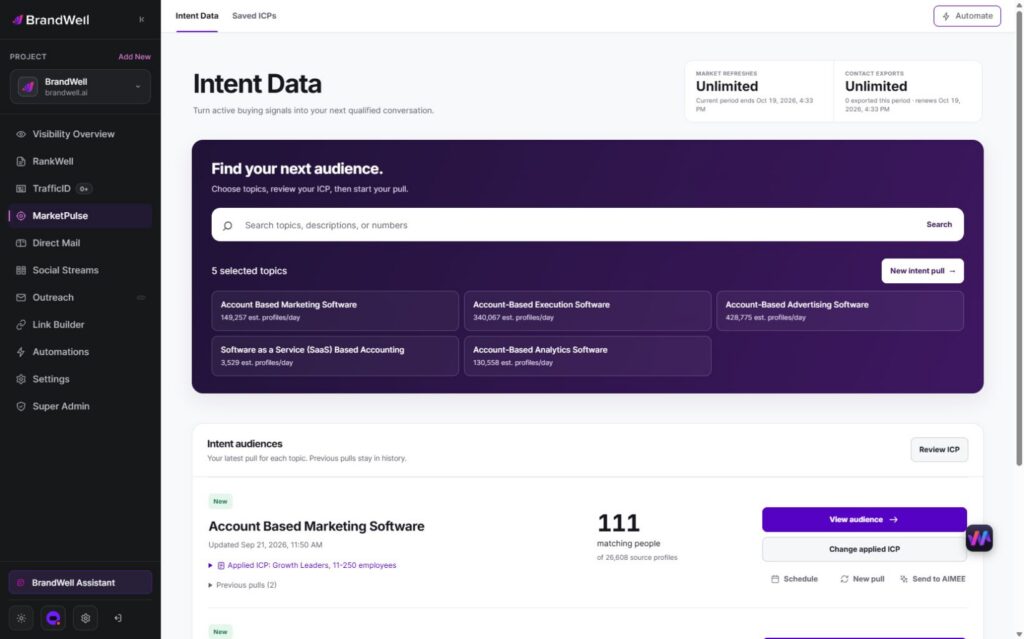
MarketPulse, starting at $500/mo, supports topic-based research, saved ICP filtering, and review of available people and company details. Select the plan around topics, refresh cadence, and exports. Any eligible early-access discount is separate from standard pricing.
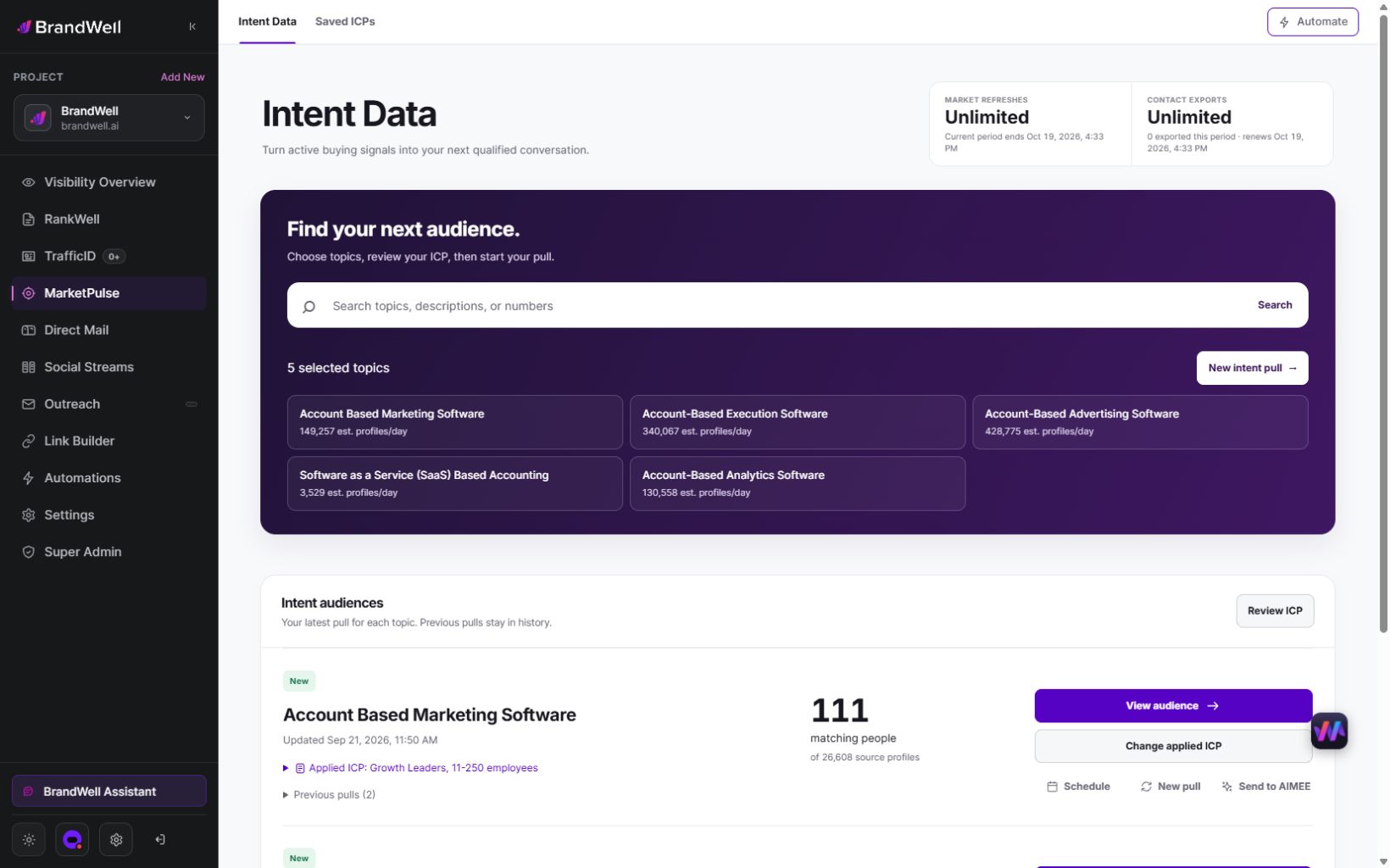
Available pulls and exports can support agreed client work. They do not automatically establish API delivery, a white-label portal, exclusive topics, managed campaigns, or license resale. Connected products and usage may cost extra.
TrafficID is the separate own-site visitor product. Keep visitors, submitted forms, and added company stakeholders distinct. Choose a descriptor that preserves the source rather than implying every record is a visitor or buyer.
10. Keep naming governed after launch
Record approved spelling, capitalization, pronunciation, descriptor, ownership, language versions, asset locations, prohibited claims, and review responsibility. Update labels in pages, reports, contracts, and support materials consistently.
When scope changes, review whether the category and implied promise remain accurate. Do not change the name, descriptor, price, audience, and page simultaneously and then attribute every performance movement to naming.
Frequently asked questions
Should the name contain the words intent data?
Use them when they help the buyer understand the service. A distinctive name can be paired with an accurate descriptor instead of trying to explain everything in the name.
Does a trademark database search prove availability?
No. It is one part of research. Evaluate relevant similarities, uses, markets, and legal considerations with appropriate review.
When should the naming project stop?
Stop when the offer is undefined, the implied promise is unsupported, buyer comprehension fails, or clearance concerns remain unresolved.
Explore MarketPulse and watch the demo to understand the current topic workflow before naming the client service built around it.
Reviewed and updated October 3, 2026.

Written by