On this page
- 1. Define the page’s purpose and audience
- 2. Write a descriptive title and main heading
- 3. Write a page-specific description
- 4. Make the explanation easy to navigate
- 5. Check internal links and citations
- 6. Review images, video and loading
- 7. Check indexing and structured data separately
- Original example: revise an IT guide title
- Use RankWell for the editorial review
- Measure the update and AI discovery opportunities
On-page SEO improves a page’s content, structure, links and presentation so readers and search engines can understand it. Start with a useful answer to a specific question, then review the title, headings, sources, images and next step. Optimization does not guarantee a ranking or conversion.
This checklist combines editorial review with the technical checks needed to make the finished page accessible. Prioritize problems that prevent someone from using the page before polishing minor wording.
1. Define the page’s purpose and audience
Identify the question the page answers and the task the reader should be able to complete. Compare that with relevant searches and customer questions. Use a distinct page when the task warrants one, rather than producing near-identical pages for keyword variations.
Add evidence you can verify: an original example, documented process, relevant screenshot or properly sourced research. Google’s helpful-content guidance discusses experience, expertise, authoritativeness and trustworthiness, but E-E-A-T is not a single ranking factor or a score you can manufacture with a byline.
2. Write a descriptive title and main heading
The title should identify the subject and useful purpose of the page. Keep the visible heading consistent with that promise. Avoid repeated keywords, vague superlatives or a numerical result the article does not substantiate.
Google’s title-link guidance does not prescribe a universal 60-character limit. Display truncation depends on available width, and Google can use several signals to generate the title shown in results. Concise, accurate wording is more useful than treating a character count as a ranking rule.
3. Write a page-specific description
Summarize what the reader will find and why it matters. Do not use an unsupported promise to make the result more clickable. Match the description to the actual article rather than copying a site-wide slogan.
Google’s snippet documentation explains that snippets are primarily generated from page content, with the meta description used when appropriate. There is no universal 160-character requirement, and a specified description is not guaranteed to appear for every query.
4. Make the explanation easy to navigate
Use a clear main heading and meaningful subsections. Put the direct answer near the beginning, then explain the method, evidence and limitations. Break a long process into genuine steps; do not split every sentence into a heading.
Use lists for parallel checks or sequential instructions. A table is useful when readers need to compare options, but it should remain usable on mobile. Remove empty headings, obsolete embeds and template placeholders.
5. Check internal links and citations
Link to the relevant destination using descriptive text. Make sure the linked page is current and helps the reader’s task. For factual claims, place the source near the statement and check that it supports the actual scope and date.
Google’s link guidance describes crawlable links and useful anchor text. A link that looks like a button should still lead to the intended destination and be usable with keyboard and mobile navigation.
6. Review images, video and loading
Use images that explain the task, with appropriate rights and useful alt text. Resize and compress them for their display, preserve dimensions to reduce layout movement and check the social preview image separately.
Video should provide relevant information rather than delay access to the answer. Review captions or transcripts where needed, playback controls and mobile loading. A third-party embed is not inherently worse for SEO than self-hosted video; evaluate the actual implementation.
Test forms, menus, text size and horizontal overflow on the finished mobile page. Use lab diagnostics to identify resources needing work, then inspect field data where available. A high lab score alone does not prove that every visitor has a fast, usable experience.
7. Check indexing and structured data separately
Review the canonical URL, status code and relevant indexing directives. A robots.txt block controls crawling; it is not a reliable substitute for a noindex directive. Google must be able to access a page to see its noindex rule. Consult Google’s robots directives documentation before changing these controls.
Only add structured data that accurately describes visible content and qualifies for the relevant feature. Valid markup does not guarantee a rich result. A sitemap helps discovery but does not force indexing.
Original example: revise an IT guide title
Suppose a guide explains how a small team prepares a restore test. “Increase Recovery Success by 200%” would require evidence the guide does not have. “Backup Restore Test Checklist for Small Teams” states the actual task without inventing an outcome.
The page could then include a technically reviewed checklist, an original test-record example, limitations and an appropriate consultation link. This is a hypothetical editorial improvement, not a measured ranking result.
Use RankWell for the editorial review
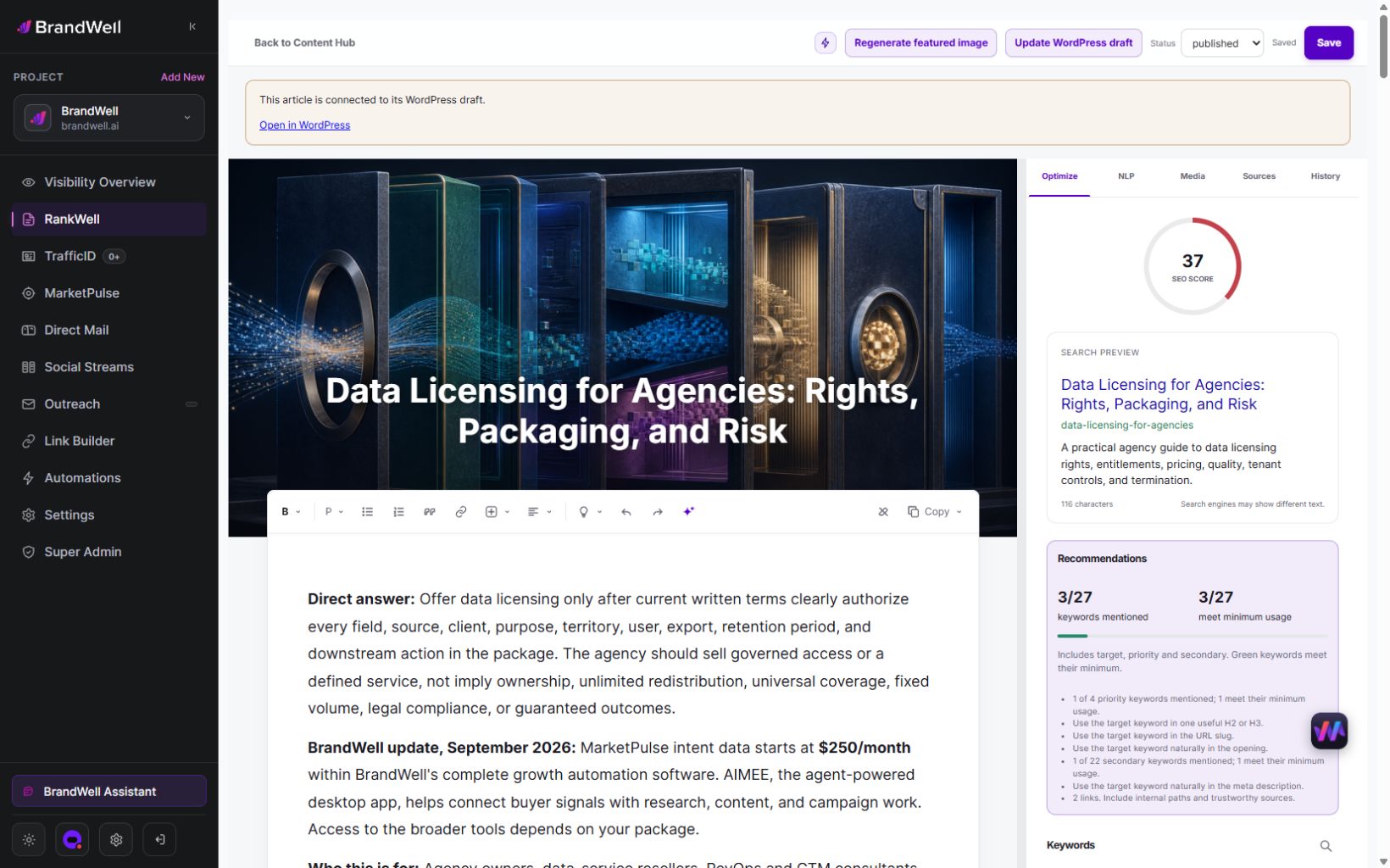
In RankWell, prepare a brief with the reader, sources and original example. Review the draft, search preview, SEO recommendations, media and source material before approving publication through your configured destination.
Measure the update and AI discovery opportunities
Record the URL, date and substantial changes. Compare Search Console performance over equivalent periods and inspect query, device and position mix. Low CTR at a low average position does not isolate a title problem.
For AI discovery, add clear answers and useful original evidence. Google’s AI optimization guidance builds on ordinary search fundamentals; special AI text files do not guarantee inclusion. Measure observed visibility separately from visits and business outcomes.
Reviewed and updated October 2, 2026.

Written by
Julia McCoy has contributed articles to BrandWell on content marketing, writing, and search engine optimization. This archive retains her original bylines; individual articles may be updated by the BrandWell editorial team.