On this page
- Current MarketPulse research workflow
- Define the evidence-to-action service
- Name actual responsibility boundaries
- Compare five outbound service models
- Reconcile each actual workflow stage
- Compare manual and configured delivery
- Budget full costs and chosen scope
- Measure actual quality and outcomes
- Check client operating prerequisites
- Verify each evidence and action layer
- Review sender and data requirements
- Scope current BrandWell capabilities
- Use a bounded pilot and cadence
- Frequently asked outbound questions
- Copyable outbound-package review
Package topic research and outbound as distinct evidence, review, contact, approval, sending, reply and qualified-outcome stages. Define the actual agency and client duties, source rights, channel checks, capacity and full costs. A validated contact is not a proven researcher, consent or a guaranteed conversation.
Who is this for? Outbound and appointment-setting agency owners, GTM consultants, RevOps operators, and lead-generation teams turning buyer-intent evidence into a recurring managed service.
Current MarketPulse offer: intent-data plans start at $500/mo. See the product, demo, and current plans. Updated October 3, 2026.
Current MarketPulse research workflow
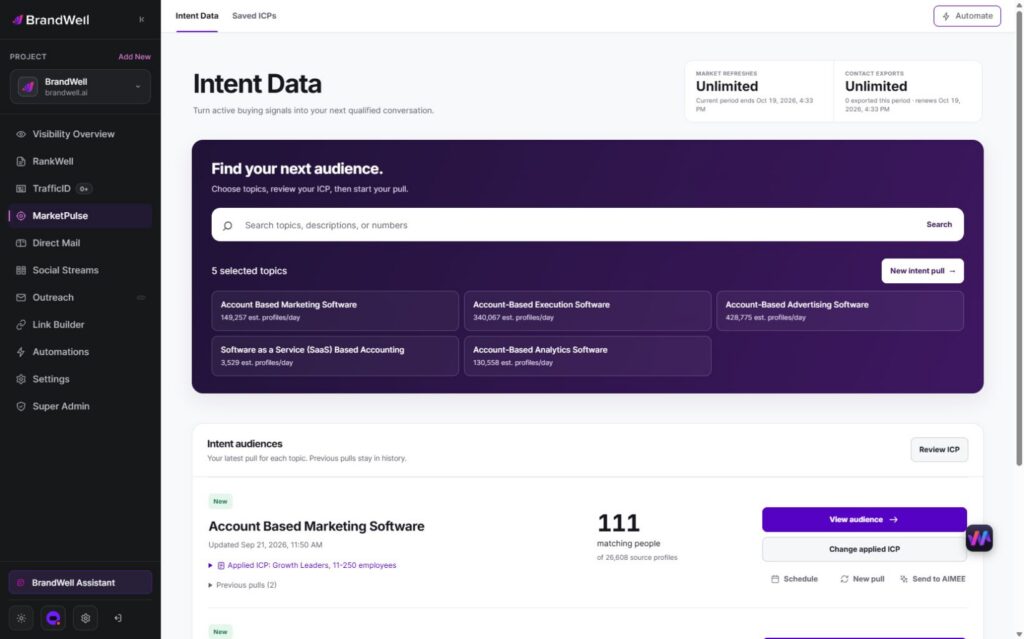
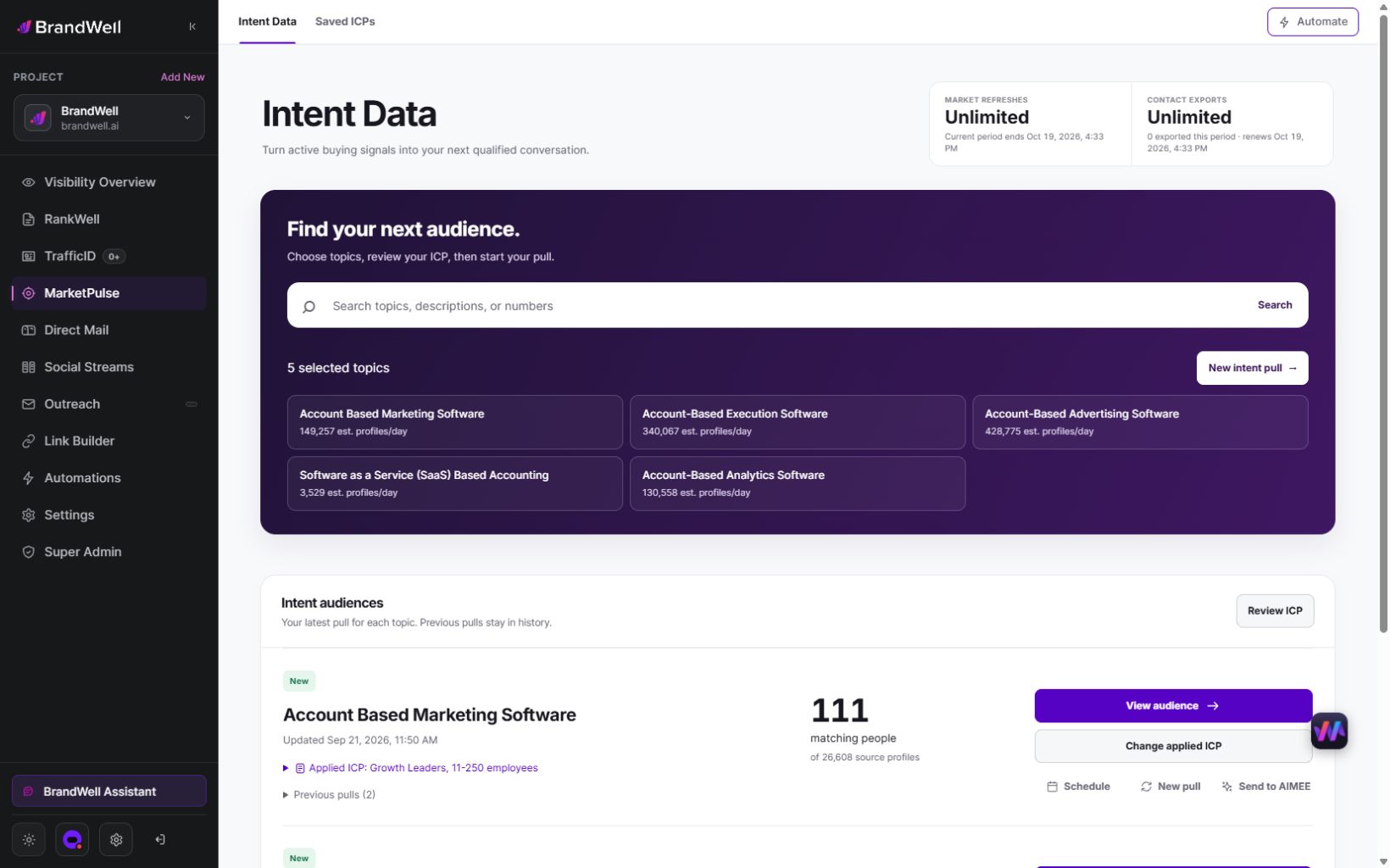
BrandWell MarketPulse: intent data starting at $500/mo. Find people researching topics relevant to what you sell, apply saved ICP filters, and review available contact details before taking action.
| Plan | Topics and refreshes | Monthly exports |
|---|---|---|
| Starter | 1 topic, weekly | 25,000 contacts |
| Growth | 3 topics, daily | 100,000 contacts |
| Scale | 10 topics, daily | Unlimited contacts |
Swipe the table to see all columns.
A pull retrieves available data from the previous 24 hours for one topic. Daily use across all included topics provides 90 Growth pulls or 300 Scale pulls in a 30-day month. Weekly Starter pulls vary by calendar month. Available audience size and contact fields vary, and audiences may overlap. Refreshes stop at the plan limit without overage charges.
- Find and qualify: search the topic catalog, save your ICP, and review the people and companies that match.
- Act on the research: export qualified contacts or prepare an Outreach or Direct Mail workflow. Connected products, channel usage, and fulfillment may cost extra.
- Get help from AIMEE: Growth and Scale include AIMEE for the initial user to research accounts and prepare the next step through connected tools.
Agencies and other service businesses can build client deliverables around their available Intent Scans and exports. Keep each client’s scope, permissions, and service fees clear. A subscription is not a promise of a white-label platform or exclusive access to a market.
Explore MarketPulse and watch the demo or compare plans starting at $500/mo. Any early-access discount is a separate, time-limited offer shown to an eligible recipient.
Define the evidence-to-action service
Bundling intent data with outbound prospecting does not mean placing a signal beside a cold-email tool. The product is the operating decision between evidence and action: which accounts deserve attention, which people may be relevant, which contacts are usable, which channels are permitted, what a human approves, and what outcome returns to the model.
Keep the promise narrow and defensible. Intent signals can improve prioritization, timing, research, and context. They do not prove that a named person researched a topic, guarantee a reply, or create permission for every channel. Good outreach speaks to a relevant business problem without telling the recipient that the agency monitored them.
A recurring package needs a feedback loop. Seller dispositions, positive and negative replies, qualified conversations, accepted opportunities, suppressions, complaints, and data corrections should improve source, fit, identity, and activation rules. Without feedback, the agency sells repeated guesses rather than a learning service.
Name actual responsibility boundaries
Define the deliverable and the owner at each boundary. Is the agency delivering account evidence, usable profiles, approved tasks, sent messages, qualified conversations, or accepted opportunities? Each promise changes cost, control, legal and platform obligations, and the share of outcome the agency can influence.
- Agency inputs: source evidence, data rights, research, staff, tools, quality gates, and operating capacity.
- Client inputs: ICP, exclusions, offer, proof, messaging approval, authorized systems, sales capacity, and outcome feedback.
- Shared decisions: qualification, permitted use, risk tolerance, activation threshold, exceptions, credits, and change approval.
- Out of scope: guarantees of purchase, claims of certain identity or intent, and outcomes controlled by product, price, market, or client sales performance.
Write a responsibility matrix into the order and onboarding plan. If the client delays approval, fails to handle replies, or does not update pipeline, the service cannot learn or meet an outcome SLA. If the agency owns sending, it cannot shift deliverability or suppression responsibility back to the client after a failure.
Compare five outbound service models
The five service models below move from evidence delivery to accepted outcomes. Each is evaluated against the same criteria. Compare each model’s actual work, responsibilities, full costs, constraints and outcomes; the ordering does not establish increasing value.
1. Intent-data feed plus client-run outbound
Best fit and exclusions: Best for clients with mature RevOps, research, contact verification, sequencing, deliverability, seller management, and outcome reporting. Exclude clients who want the agency to be accountable for meetings while retaining every downstream decision.
Inputs and prerequisites: An approved account universe, topic or visitor signal definitions, evidence fields, delivery format, client destination, permitted purpose, suppressions, client owners, and feedback fields for dispositions and outcomes.
Implementation effort and ownership: The agency curates and releases evidence; the client resolves contacts, approves messages, sends, handles responses, and reports outcomes. Handoff acceptance and feedback deadlines must be explicit.
Data, privacy, and governance risk: The agency should not assume the client’s downstream use is automatically permitted. Contracts, notices, lawful-use review, retention, suppression, and responsibilities need definition even when the client runs activation.
Cost drivers: Data or wholesale usage, topic research, normalization, QA, feed delivery, portal or report, support, and feedback reconciliation. Client-side outbound cost remains outside the agency scope.
Measurement and revenue relevance: Track evidence freshness, accepted accounts, client downloads or ingestion, feedback coverage, action rate, qualified outcomes, and renewal evidence. Separate delivery from client execution.
Meaningful limitation: Value depends on the client’s operating discipline. Weak contact verification, messaging, deliverability, or follow-up can suppress outcomes even when account evidence is useful.
2. Verified prospect-list delivery
Best fit and exclusions: Best when the client needs a prioritized, fit-checked, enriched, validated, and suppression-screened list but wants to own message and send. Exclude buyers who equate a validated contact with proven individual intent.
Inputs and prerequisites: Signal evidence, ICP, account fit, target roles, identity-confidence policy, contact sources, validation states, geography, suppressions, duplicate rules, destination schema, and acceptance sample.
Implementation effort and ownership: The agency owns evidence assembly, enrichment, validation, QA, and delivery; the client owns final use, sequence, sending infrastructure, and response handling. Corrections need a defined SLA.
Data, privacy, and governance risk: Personal data increases obligations. Preserve provenance, permitted use, validation time, suppression, retention, access, and deletion. Keep account-level intent separate from the person-level contact record.
Cost drivers: Signal, enrichment, validation, manual review, list operations, destination mapping, correction, support, and unused or unresolved lookups. Price the usable output and service, not a fantasy of perfect coverage.
Measurement and revenue relevance: Measure list acceptance, field completion, validation, sample quality, suppression, corrections, client action, qualified progression, cost per usable profile, and contribution.
Meaningful limitation: A delivered list can become stale quickly and does not create action by itself. The package needs freshness, update, replacement, and client-feedback terms.
3. Managed research and sequence preparation
Best fit and exclusions: Best when the client wants prioritized research, account context, role hypotheses, sequence drafts, and task preparation while retaining final approval and sending. Exclude requests for fabricated personalization or claims that reveal surveillance.
Inputs and prerequisites: Approved evidence, client positioning, offer, proof, message policy, personas, exclusions, channel rules, review owner, source citations where needed, and representative good and bad examples.
Implementation effort and ownership: Research operations prepares context; copy or sales specialists draft; QA verifies claims and data; the client approves messaging and send. Agents may assist with bounded instructions but should not invent evidence.
Data, privacy, and governance risk: Do not put sensitive or uncertain intent evidence into copy. Use relevant business context without saying a person was watched. Preserve human approval, truthful identity, and lawful channel use.
Cost drivers: Research, enrichment, validation, writing, review, client revisions, task creation, automation, and quality monitoring. Custom account research can become the dominant cost.
Measurement and revenue relevance: Track usable research, approval time, revision rate, task completion, delivery signals, positive and negative replies, qualified conversations, complaints, and contribution after labor.
Meaningful limitation: Preparation does not control sender reputation, timing, seller execution, or response handling. The agency should not guarantee meetings from approved drafts alone.
4. Managed outbound execution
Best fit and exclusions: Best when the agency can operate sending infrastructure, suppression, approvals, monitoring, reply routing, and client escalation responsibly. Exclude clients seeking undisclosed mass contact or assured meeting volume from a small signal pool.
Inputs and prerequisites: All prior evidence plus sending domains and ownership, authentication, mailbox plan, message approval, sender identity, physical address and unsubscribe controls where required, volume limits, reply rules, CRM, and incident response.
Implementation effort and ownership: Deliverability owns infrastructure; campaign operations owns queues; the client approves offer and message; trained people review high-value actions and replies; compliance and platform owners review the applicable program.
Data, privacy, and governance risk: False headers, deceptive subjects, missing opt-out handling, ignored suppressions, sudden volume, spoofing, and unclear responsibility create legal and deliverability risk. The agency and promoted business may both carry obligations.
Cost drivers: Data, enrichment, validation, domains and mailboxes, setup, authentication, warming or gradual ramp where appropriate, writing, sending, monitoring, reply handling, CRM, support, and compliance operations.
Measurement and revenue relevance: Monitor authentication, bounce and complaint signals, unsubscribe handling, delivery, reply quality, qualified conversations, accepted opportunities, time to action, client follow-up, and contribution.
Meaningful limitation: Intent evidence does not override recipient choice or sender rules. Scaling volume can damage reputation and trust; the service should optimize relevance and responsible action, not raw sends.
5. Appointment or accepted-opportunity program
Best fit and exclusions: Best only when qualification, attribution, ownership, sales handoff, capacity, exclusions, and dispute rules are mature. Exclude vague pay-per-meeting promises that reward low-quality scheduling or conceal the role of client sales execution.
Inputs and prerequisites: Written qualification and acceptance, target accounts and roles, disqualifiers, evidence, message and channel approval, booking process, attendance handling, sales SLA, outcome system, fraud controls, and commercial dispute rules.
Implementation effort and ownership: The agency may own prospecting and qualification; the client owns timely attendance, discovery, opportunity acceptance, and pipeline updates. Finance and account owners resolve credits against recorded evidence.
Data, privacy, and governance risk: Incentives can encourage aggressive messaging, weak qualification, or data misuse. Use truthful outreach, recipient controls, auditable acceptance, access limits, and quality review independent of revenue credit.
Cost drivers: All upstream costs plus qualification labor, scheduling, no-show handling, replacement or credit reserve, client coordination, dispute review, and longer cash-flow risk. Price the true accepted outcome, not calendar volume.
Measurement and revenue relevance: Track accepted qualification, show rate, sales acceptance, opportunity creation, disqualification reason, client follow-up, pipeline progression, dispute and credit rate, cost per accepted outcome, and contribution.
Meaningful limitation: The agency cannot control product-market fit, client sales quality, pricing, or market timing. Performance pricing needs a base or risk premium and precise exclusions to remain sustainable.
Reconcile each actual workflow stage
- Detect: ingest topic, visitor, engagement, or other approved evidence with source and timestamp.
- Qualify the account: normalize the company, apply ICP and exclusions, assess relevance and recency, and retain the reason.
- Resolve and verify: assess identity candidates separately, enrich target roles, validate contact fields, deduplicate, and suppress.
- Prepare context: summarize relevant business evidence, approved proof, offer, and message boundaries without inventing personalization.
- Approve and activate: route through the authorized owner, sending or ad account, volume limit, and rollback path.
- Handle response: classify replies, honor preferences, escalate opportunities, and protect response time.
- Report and learn: reconcile every stage, join qualified outcomes, and version corrections.
Each transition needs a count and reason. If 500 signaled accounts become 80 fit accounts, 32 usable profiles, 20 approved contacts, 12 sent messages, and two qualified conversations, the agency should explain each filter rather than presenting 500 leads. Use the actual client results; the numbers here are a hypothetical illustration, not a benchmark.
Compare manual and configured delivery
Manual work is valuable during design: experts can see ambiguous topics, corporate structures, weak identity evidence, role nuance, and risky message language. Keep it for exceptions and high-value decisions. Automation fits deterministic normalization, required fields, validation, deduplication, suppression, routing, reconciliation, alerts, and draft preparation after rules stabilize.
A separately implemented client interface, branded report, connector or managed service needs actual rights, isolation, access, support and fees. A MarketPulse subscription does not establish native white-label delivery, CRM synchronization or guaranteed client outcomes.
Agent-ready instructions can prepare research, summarize evidence, create drafts, check rules, and stage tasks. They should cite the inputs they used, mark uncertainty, stop on missing authorization, and require human review before a public message, ad activation, contact upload, or irreversible client action.
Budget full costs and chosen scope
Setup cost includes discovery, ICP and topic configuration, data-rights review, integrations, field maps, domains and authentication if sending, CRM workflows, templates, samples, training, and acceptance. Recurring cost includes data, enrichment, validation, research, writing, QA, sending infrastructure, monitoring, reply handling, reporting, client service, and corrective action.
Price the chosen responsibility, not a generic lead count. A feed can use a platform-and-service retainer with included topics or volume. A verified-list package can add usage. Managed preparation can add an account or task unit. Managed sending adds infrastructure and operations. Appointment or accepted-opportunity models need a base fee or risk premium, precise acceptance, and credit rules.
Model normal and peak usage, invalid or unresolved lookups, no-shows, rework, client delays, support, and actual correction expense, with unused contingency tracked separately. Gross margin should use direct delivery cost; contribution should also account for recurring customer success, management, and shared capabilities. Do not subsidize an outcome promise with unpaid expert labor.
Measure actual quality and outcomes
Time-to-value measures how quickly a client reaches the first useful decision or action, not how quickly a file is exported. Quality measures fit, freshness, provenance, identity confidence, contact validation, suppression, and release error. Adoption measures whether the client or agency acts on evidence and returns disposition.
Outcome measures should match the package: accepted accounts for a feed, usable profiles for list delivery, approved tasks for preparation, qualified replies for execution, or accepted opportunities for a performance program. Track pipeline progression, but state attribution limits. Intent can precede an outcome without causing it.
Economic measures include cost per accepted stage, analyst and research hours, infrastructure, support, dispute and credit rate, gross margin, contribution, expansion, and renewal evidence. A high reply rate can still be unprofitable or low quality; a smaller, well-accepted set may create more client value.
Check client operating prerequisites
A mature client with reliable CRM, contact policy, sellers, and outcome feedback may need only a feed or verified list. A client with a clear offer but weak research and task preparation may fit the managed-preparation model. A client asking for full execution needs approved infrastructure, response ownership, legal and platform review, and enough reachable demand.
Stack choices matter. Define the source of truth, record IDs, field mapping, permissions, API limits, destination responses, and outcome sync. Do not add a second sequencing or CRM tool solely to accommodate the agency if the client’s system can support a safe handoff. Compare actual integration work, errors and ownership; connector count alone does not establish performance.
Verify each evidence and action layer
Test each evidence layer independently. For account signals, review source, topic meaning, company normalization, recency, and fit. For identity, use confidence states and a representative sample. For contacts, preserve source, validate at the correct time, deduplicate, and apply suppression. For tasks and messages, verify business relevance and every factual claim.
Before activation, confirm client authority, destination policy, credentials, volume, sender identity, unsubscribe or preference controls where required, reply path, rollback, and human approval. Reconcile attempted and accepted records. After activation, capture responses and corrections so the upstream model can improve.
Review sender and data requirements
Verify current source, recipient, jurisdiction, message purpose, channel, sender-account rules and preferences before action. Keep actual owners for domains, authentication, content approval, volumes, suppression, reply handling, security, correction and incidents. Resolve unanswered legal and platform requirements for the actual program; a licensed contact does not establish every permitted use.
Verify current source, recipient, jurisdiction, message purpose, channel, sender-account rules and preferences before action. Keep actual owners for domains, authentication, content approval, volumes, suppression, reply handling, security, correction and incidents. Resolve unanswered legal and platform requirements for the actual program; a licensed contact does not establish every permitted use.
Verify current source, recipient, jurisdiction, message purpose, channel, sender-account rules and preferences before action. Keep actual owners for domains, authentication, content approval, volumes, suppression, reply handling, security, correction and incidents. Resolve unanswered legal and platform requirements for the actual program; a licensed contact does not establish every permitted use.
Verify current source, recipient, jurisdiction, message purpose, channel, sender-account rules and preferences before action. Keep actual owners for domains, authentication, content approval, volumes, suppression, reply handling, security, correction and incidents. Resolve unanswered legal and platform requirements for the actual program; a licensed contact does not establish every permitted use.
Scope current BrandWell capabilities
MarketPulse supplies topic research and available match details. AIMEE can organize supplied context through configured tools. An agency operating service, branded weekly report, CRM synchronization or custom client interface needs separately verified implementation, rights, scope and fees. The research subscription does not establish those delivery capabilities.
Review an available MarketPulse topic, saved ICP and actual preceding-24-hour matches for the approved research purpose. Keep uncertain company context visible. AIMEE can organize supplied context through configured tools; named owners approve actual exports, messages, audience uploads and CRM writes.
MarketPulse supplies topic research and available match details. AIMEE can organize supplied context through configured tools. An agency operating service, branded weekly report, CRM synchronization or custom client interface needs separately verified implementation, rights, scope and fees. The research subscription does not establish those delivery capabilities.
Use a bounded pilot and cadence
A pilot should test the workflow, not promise a monthly outcome from a tiny sample. Limit accounts, topics, roles, destinations, channels, volume, and support. Freeze the input population, define pass and stop gates, preserve human approval, and decide what evidence justifies a recurring package.
A recurring cadence can include weekly evidence review, daily or scheduled activation, reply and suppression handling, outcome sync, monthly client reporting, and a quarterly scope and economics review. The report should show what arrived, what passed, what was acted on, what matured, what failed, and what will change.
Start by reviewing the MarketPulse demo and plans, starting at $500/mo. Choose a relevant topic and ICP, then evaluate audience fit, available contact fields, and the workflow you will use. The first-purchase 3-day satisfaction guarantee requires no data exports and no more than 2 Intent Scans; review the current guarantee terms before testing. A short evaluation can establish fit, but cannot prove future pipeline or revenue.
Frequently asked outbound questions
Should an agency guarantee meetings from intent data?
Usually no. Intent can prioritize evidence, but meetings also depend on identity quality, offer, message, deliverability, timing, market, and client follow-up. If performance pricing is used, define accepted outcomes, exclusions, client duties, and a sustainable base or risk premium.
How should outreach reference an intent signal?
Use the signal internally to prioritize and research. Write about a relevant business problem or observable company context without asserting that a named person researched a topic or revealing surveillance-like detail.
Which package is best for a new client?
Start at the lowest responsibility level that can produce a useful decision. Check whether a feed or verified-list pilot fits when the client’s offer, permissions, sales process, or outcome feedback is not yet mature.
What should the monthly report include?
Show stage-by-stage counts, rejection reasons, quality samples, actions, qualified outcomes, suppressions, incidents, client adoption, economics relevant to scope, attribution limits, and the next approved change.
Copyable outbound-package review
Question: [Actual client decision.] Scope: [Distinct accounts, contacts, channels and period.] Evidence: [Source, uncertainty, freshness and validation.] Capacity: [Review, sending and reply work.] Ownership: [Agency/client duties, approvals and destination response.] Outcome: [Reply classes, qualified opportunities and missing feedback.] Decision rule: [Full costs, comparator, correction and pause criteria.]
Sender requirements have a recipient and message scope
Google’s sender FAQ identifies requirements for personal Gmail delivery and additional bulk-sender requirements, including authentication and unsubscribe handling. Verify the actual recipient, volume and message category. Authentication is not permission to contact or a guarantee of inbox placement.
Stage counts need distinct, named units
The earlier fictional example moves 500 signaled accounts to 80 fit accounts, 32 usable profiles, 20 approved contacts, 12 sent messages and two qualified conversations. The two conversations are 16.7% of sent messages, 10% of approved contacts or 0.4% of signaled accounts, but those denominators use different units. Preserve account, person, message and conversation IDs. Multiple contacts or retries cannot be counted as new accounts.
A reply rate can include unwanted or automated responses
In another fictional cohort, 20 contacts receive messages and 10 reply: three automated responses, two wrong-person responses, one negative and four positive. Overall response is 50%, human response 35%, positive response 20%. If two of the four positives qualify, qualified response is 10% of all contacted people. None of these rates establishes revenue or causal lift; keep the actual definitions and later outcomes.
Capacity includes replies and exceptions
Reviewing 100 fictional accounts at 12 minutes each needs 20 hours. Twenty reply cases at 15 minutes add five hours, and 10 exceptions at 30 minutes add another five. Total defined work is 30 hours, not the 20 hours estimated from research alone. Verify skill and timing constraints separately before adding volume.
Price the accepted outcome with full costs
A fictional pilot costs $500 research, $400 setup, $600 review, $500 writing and $500 reply/support: $2,500. Two qualified conversations cost $1,250 each; another $500 correction raises the defined cost to $1,500 each. Zero conversations make the ratio undefined. Invented labor is not BrandWell pricing or typical results; general overhead, tax and financing are excluded.
Keep appointment quality and credits explicit
If 10 fictional appointments are booked, eight attend and five meet the written acceptance definition, show rate is 80% of booked appointments, acceptance is 62.5% of attended appointments or 50% of booked. A credit for an unaccepted appointment reduces actual net fees under the agreement; do not both deduct it from revenue and add the same amount again as an expense. A meeting is not a closed sale.
Use current research without assuming managed sending
MarketPulse research is starting at $500/mo. Review an actual topic, saved ICP and available matches. Keep TrafficID own-site visitor context separate. AIMEE can organize supplied briefs through configured tools; owners approve exports, messages, audience uploads and CRM writes. A managed outbound package needs separately verified rights, sender implementation, scope and support.
Review current research: explore MarketPulse and current plans.
Reviewed and updated October 3, 2026.

Written by