On this page
- Current MarketPulse research workflow
- Define the actual paid-media scope
- Compare five service packages
- Verify signal-to-media handoffs
- Compare research and standard media work
- Separate fees, setup and media spend
- Measure quality, delivery and impact
- Check actual client prerequisites
- Keep evidence and audience eligibility distinct
- Review data and platform requirements
- Scope current BrandWell capabilities
- Define stop, hold and expansion rules
- Frequently asked paid-media questions
- Copyable paid-media package review
Package intent-informed paid media around a documented research question, eligible audience method, approved campaign work, full costs and actual feedback. Keep platform subscriptions, setup, agency work, creative and media spend separate. Topic evidence can support a hypothesis; it does not automatically establish targeting permission, audience delivery or purchase intent.
Who is this for? Agency owners, paid-media directors, demand-generation leaders, GTM and RevOps consultants, and client strategists designing an intent based paid media agency offer. The guide covers strategy, implementation, service templates, planning, pricing, cost, ROI, KPIs, examples, benchmarks, checklists, mistakes, comparisons, alternatives, activation workflows, and signal-quality measurement.
Current MarketPulse offer: intent-data plans start at $500/mo. See the product, demo, and current plans. Updated October 3, 2026.
Current MarketPulse research workflow
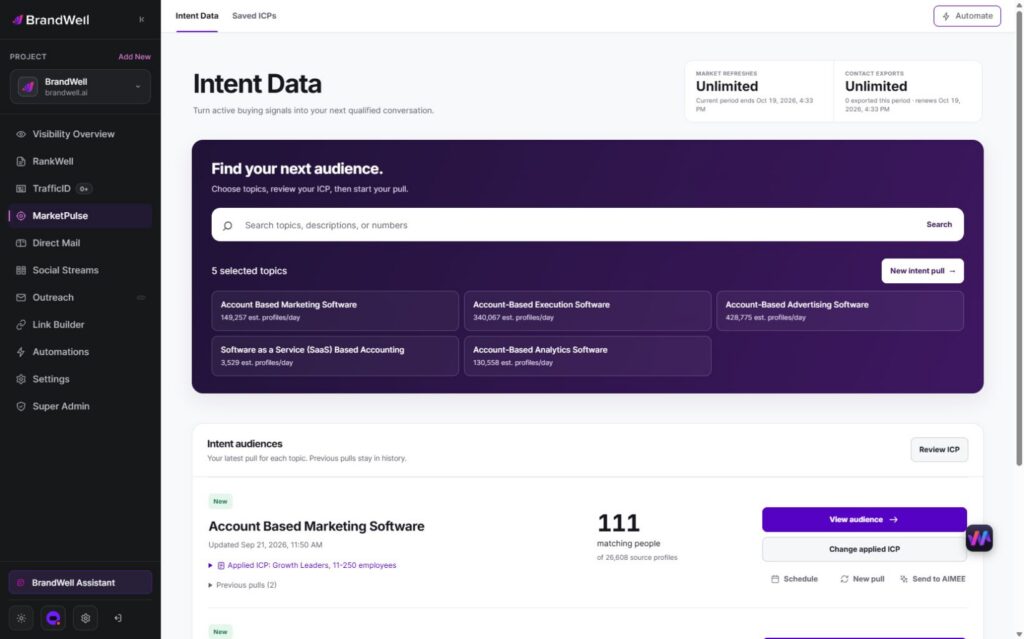
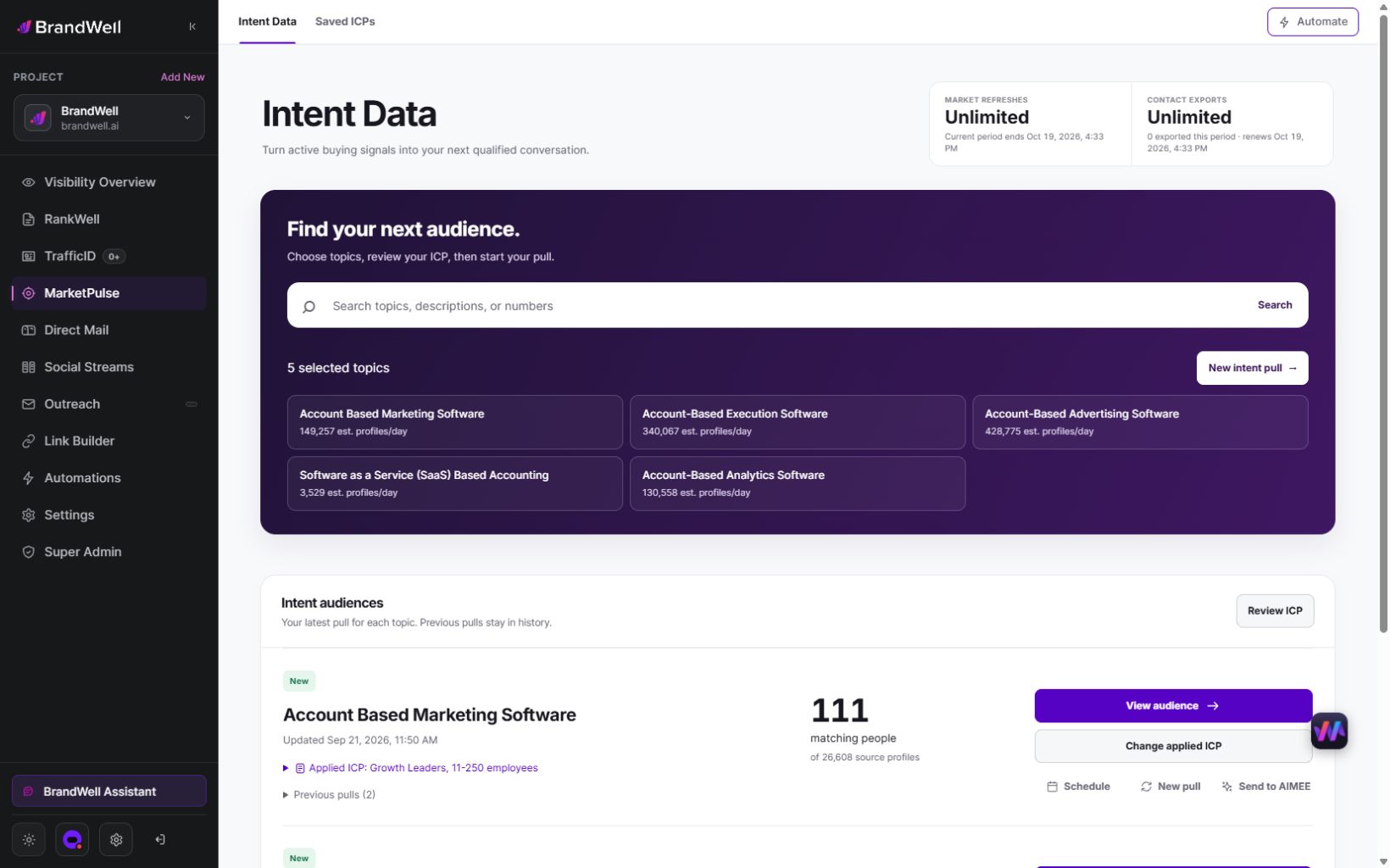
BrandWell MarketPulse: intent data starting at $500/mo. Find people researching topics relevant to what you sell, apply saved ICP filters, and review available contact details before taking action.
| Plan | Topics and refreshes | Monthly exports |
|---|---|---|
| Starter | 1 topic, weekly | 25,000 contacts |
| Growth | 3 topics, daily | 100,000 contacts |
| Scale | 10 topics, daily | Unlimited contacts |
Swipe the table to see all columns.
A pull retrieves available data from the previous 24 hours for one topic. Daily use across all included topics provides 90 Growth pulls or 300 Scale pulls in a 30-day month. Weekly Starter pulls vary by calendar month. Available audience size and contact fields vary, and audiences may overlap. Refreshes stop at the plan limit without overage charges.
- Find and qualify: search the topic catalog, save your ICP, and review the people and companies that match.
- Act on the research: export qualified contacts or prepare an Outreach or Direct Mail workflow. Connected products, channel usage, and fulfillment may cost extra.
- Get help from AIMEE: Growth and Scale include AIMEE for the initial user to research accounts and prepare the next step through connected tools.
Agencies and other service businesses can build client deliverables around their available Intent Scans and exports. Keep each client’s scope, permissions, and service fees clear. A subscription is not a promise of a white-label platform or exclusive access to a market.
Explore MarketPulse and watch the demo or compare plans starting at $500/mo. Any early-access discount is a separate, time-limited offer shown to an eligible recipient.
Define the actual paid-media scope
Start with the client decision: which accounts or audiences deserve a test, which message hypothesis should change, which campaign receives budget, or which seller follow-up is warranted. Intent evidence can narrow attention, but only when the client has a market definition, an eligible activation path, adequate volume, and an outcome worth measuring.
Write a scope matrix across evidence, identity, eligibility, activation, creative, media operations, reporting, and client responsibilities. Each row needs an input, owner, approval, output, cadence, cost unit, failure state, and exclusion. This prevents ‘intent-led’ from becoming a vague premium placed on ordinary campaign management.
Keep three decisions distinct. Signal qualification asks whether the evidence is relevant and fresh. Audience eligibility asks whether data may be used in a particular destination under law, contract, consent, and platform policy. Campaign optimization asks how eligible media should be operated. Passing one does not automatically pass the next.
Compare five service packages
These five service models move from low-data planning to integrated measurement. They use the same criteria so an agency can compare simplicity, risk, commercial load, and proof rather than assuming the most automated option is always best.
1. Intent-informed campaign planning
Best fit and exclusions: Best for a client that needs topic and account evidence to guide positioning, creative angles, exclusions, or budget priorities without uploading a new audience. Exclude teams that expect the planning input itself to prove demand or attribution.
Inputs, workflow, and ownership: Strategy defines topic relevance, account segments, evidence windows, campaign hypotheses, and disconfirming evidence. Paid media converts those into a documented test plan; the client approves claims, offers, budget, and outcome definitions before launch.
Data, privacy, and governance risk: The agency can often use aggregated insights with less data movement than identity-based targeting, but it must still verify source rights, avoid sensitive inference, limit access, and distinguish observed evidence from conclusions. Creative should never reveal that a person or company was monitored.
Cost and commercial effect: Cost includes topic scope, analyst interpretation, research, brief development, creative adaptation, media planning, and reporting. This model has lower connector burden but can become unpaid strategy if the number of segments, refreshes, and revisions is not bounded.
Measurement and meaningful limitation: Measure hypothesis acceptance, launch speed, segment relevance, qualified traffic, creative learning, and client decisions. Test whether planning changes the actual decision; it cannot demonstrate causal lift unless the campaign design supplies a credible comparison.
2. First-party retargeting with intent qualification
Best fit and exclusions: Best when a client already has properly collected site or customer interactions and wants third-party context to qualify its own eligible first-party audience. Exclude audience construction that begins only with purchased or licensed third-party identities.
Inputs, workflow, and ownership: The client documents first-party source, notice, consent where required, account ownership, audience duration, suppressions, and advertiser authority. The agency adds a qualification rule, tests list creation, obtains launch approval, and reconciles destination acceptance.
Data, privacy, and governance risk: Platform policies and law govern whether first-party data can be used and how third-party data may segment it. Avoid sensitive categories, overly narrow segments, unsupported sharing across unrelated clients, and identity language that implies knowledge of an individual’s offsite activity.
Cost and commercial effect: Add tag or data setup, qualification logic, audience QA, connector maintenance, campaign labor, creative, consent support, reporting, and media. Matching loss and minimum audience size can make a narrowly defined service uneconomic.
Measurement and meaningful limitation: Track eligible records, accepted audience, reach, frequency, qualified sessions, conversion, opportunity progression, suppressions, and complaints. Retargeting association is not proof that the intent layer caused the outcome; use holdouts or incrementality tests where feasible.
3. Account-list activation for B2B media
Best fit and exclusions: Best for a defined account universe with enough companies, usable company-level identifiers, meaningful spend, and sales alignment. Exclude tiny lists, poor-fit account sets, or motions where sellers cannot follow up on engaged accounts.
Inputs, workflow, and ownership: RevOps supplies the approved account universe; strategy combines fit and fresh evidence; paid media selects eligible platforms and targeting methods; QA tests normalization, list size, exclusions, acceptance, and reporting; sales owns account feedback.
Data, privacy, and governance risk: Account-level activation remains probabilistic. Do not convert an account signal into a named-person claim. Confirm platform eligibility, client authority, geographic limits, sensitive-sector restrictions, retention, access, and acceptable aggregation before activation or sharing.
Cost and commercial effect: Costs include account normalization, evidence updates, audience construction, platform matching, campaign operations, creative variants, sales alignment, reporting, and media spend. Small lists can drive frequency and creative fatigue while providing too little learning.
Measurement and meaningful limitation: Measure account coverage, platform match, reach, frequency, qualified site engagement, sales acceptance, opportunity movement, cost, and controlled lift where possible. A higher account match rate does not prove the selected accounts were in market.
4. Managed intent-led campaign service
Best fit and exclusions: Best when the agency owns recurring planning, activation, optimization, creative coordination, reporting, and client review. Exclude clients that will not provide access, approvals, conversion definitions, sales feedback, or enough budget for a meaningful test.
Inputs, workflow, and ownership: Use a monthly calendar for evidence refresh, audience review, creative hypotheses, platform preflight, launch approvals, pacing, anomaly review, client reporting, and outcome reconciliation. Name a signal owner, media owner, QA reviewer, client approver, and RevOps owner.
Data, privacy, and governance risk: Automation can move spend before a human sees the problem. Set volume and budget limits, client-specific permissions, destination credentials, change logs, frequency controls, sensitive-category rules, and rollback. Intent should prioritize hypotheses rather than bypass platform policy.
Cost and commercial effect: The service fee should cover data, strategy, build, monitoring, optimization, creative coordination, reporting, QA, and support. Media spend, production-heavy creative, new integrations, landing-page work, and extensive sales operations should be separate unless written into scope.
Measurement and meaningful limitation: Track time to launch, audience acceptance, spend delivery, frequency, qualified conversions, pipeline stages, creative fatigue, incident rate, client adoption, labor, and contribution. Optimization can improve efficiency without proving the underlying signal is accurate.
5. Integrated signal-to-pipeline program
Best fit and exclusions: Best for mature clients that can join marketing exposure, site behavior, CRM action, and qualified outcomes and that will use controlled tests. Exclude teams without stable identifiers, consent and data rights, outcome hygiene, or cross-functional ownership.
Inputs, workflow, and ownership: Build a governed evidence chain from signal and fit through audience eligibility, activation, exposure, conversion, seller action, opportunity, and cost. Analytics defines joins and tests; paid media runs campaigns; RevOps verifies outcomes; the client approves measurement and interpretation.
Data, privacy, and governance risk: Joined data increases privacy, security, access, retention, and false-attribution risk. Minimize person-level detail, separate correlation from causation, document exclusions, use role-based access, and avoid reporting that reveals sensitive or unexpected behavior.
Cost and commercial effect: This model adds distinct work: data integration, identifiers, campaign operations, experimentation, analytics, QA, sales feedback, and governance all add cost. Price the program for sustained measurement capability rather than a single dashboard.
Measurement and meaningful limitation: Measure coverage, acceptance, delivery, qualified actions, pipeline, controlled lift, delivery cost, and contribution with confidence intervals or limitations where possible. Even a well-designed test may be inconclusive when audience size or outcome volume is small.
Verify signal-to-media handoffs
A recurring workflow begins with an evidence brief, not an audience upload. Strategy records the topic, account fit, freshness, ambiguity, and hypothesis. Data operations validates source and permissible use. Paid media confirms destination eligibility, list size, budget, creative, and conversion setup. QA runs representative test records and reconciles platform response. The client approves launch and material changes.
- Intake the ICP, account universe, offer, objectives, first-party data, destinations, budget, and outcome definitions.
- Qualify signal evidence and separate company fit, identity confidence, and activation eligibility.
- Preflight policy, consent or notice, suppressions, credentials, audience size, field maps, creative, tracking, and rollback.
- Launch within approved budgets and monitor acceptance, pacing, frequency, anomalies, creative fatigue, and conversions.
- Join client outcomes, review limitations, and choose a hold, narrow, refresh, scale, redesign, or stop decision.
Set SLAs around controllable handoffs: evidence review, audience preflight, client approval, platform response, anomaly triage, and monthly reconciliation. Do not guarantee reach, conversions, pipeline, or revenue because platform delivery, audience size, offer, creative, sales execution, and market conditions intervene.
Compare research and standard media work
Standard campaign management usually starts with the client’s chosen audiences, keywords, creative, and conversion goals. An intent-led service adds evidence qualification, fit and recency rules, identity boundaries, audience eligibility review, activation traceability, and a feedback loop to the signal definition. Those controls are the service difference – not the label.
Manual research can be appropriate for early client discovery and small account universes. Automated refresh can support recurring operations after definitions stabilize. White-label portals can improve branded delivery and shared evidence, but the paid-media team must still own platform access, budget, creative, targeting eligibility, campaign changes, and reporting.
An alternative is to use intent only for planning or sales prioritization and leave paid media unchanged. That can be the better choice when the audience is too small, policy does not allow the desired use, the client lacks conversion volume, or media cost would overwhelm the learning value. A responsible service includes that stop path.
Separate fees, setup and media spend
Build total cost from data and topic scope, audience preparation, first-party implementation, connector work, campaign strategy, setup, creative coordination, monitoring, optimization, QA, reporting, sales alignment, support, and media spend. Track a contingency reserve separately from actual platform-change, rejection, reprocessing and investigation expenses. State whether landing pages, production creative, and CRM work are included.
Charge setup when the agency must define signals, inspect data rights, configure destinations, create conversions, test audiences, build reporting, or train the client. Recurring fees can be fixed by scope, tiered by modules, or tied to governed volume. Percentage-of-spend pricing alone may underpay evidence and governance work on smaller, high-complexity programs.
Keep media budget outside the platform subscription unless a written order explicitly says otherwise. The client should see the agency retail fee, approved platform or data pass-through, media, and optional work. Compare the forecast and actual costs, and price scope changes explicitly.
Measure quality, delivery and impact
At the signal layer, measure relevance, freshness, overlap, ambiguity, and accepted accounts. At the audience layer, measure eligible records, platform acceptance, match loss, reach, frequency, and suppression. At the campaign layer, measure spend delivery, qualified visits, conversions, creative learning, cost, and anomalies. At the revenue layer, measure sales acceptance, opportunity progression, and contribution.
Use a baseline and comparison appropriate to the decision. A holdout, geographic split, account split, or staggered rollout may support incremental evidence, but contamination, small samples, delayed outcomes, and platform optimization can limit interpretation. Report the design and limitations rather than converting correlation into a lift claim.
Benchmarks should begin with the client’s current campaign and sales process: audience size, frequency, conversion lag, accepted lead definition, pipeline rate, delivery cost, and feedback coverage. External averages rarely match the same platform, offer, market, budget, and sales cycle, so use them as context, not a guarantee.
Check actual client prerequisites
Good-fit clients have a clear B2B market, a meaningful account universe, compliant first-party data or another eligible activation route, enough media and creative capacity, reliable conversion tracking, a sales feedback loop, and a willingness to test. High-value or long-cycle motions can justify the extra operating effort when account prioritization matters.
Poor-fit clients have tiny audiences, sensitive targeting plans, ambiguous data rights, weak offers, no conversion volume, no sales outcomes, inaccessible ad accounts, or a demand for guaranteed pipeline. The agency should recommend insight-only planning, broader standard media, a data diagnostic, or no activation instead of forcing an intent audience.
Keep evidence and audience eligibility distinct
The evidence record should preserve source, topic, account fit, freshness, confidence, client authority, first-party relationship if relevant, permitted destination, suppression, approval, platform result, exposure, outcome, and cost. Keep company-level evidence separate from person-level identity and contact data.
Verify current requirements for the actual source, recipient, jurisdiction, audience method, advertiser account and destination. Preserve necessary fields, approvals, access, retention, suppression and incident ownership. Resolve unanswered policy and legal questions before activation; a licensed record or technical list acceptance does not establish every permitted use.
A signal can still inform planning, segment a permitted first-party process where policy allows, prioritize accounts for other channels, or support aggregated analysis even when direct targeting is ineligible. Design several allowed actions so the service does not depend on one platform workflow.
Review data and platform requirements
Verify current requirements for the actual source, recipient, jurisdiction, audience method, advertiser account and destination. Preserve necessary fields, approvals, access, retention, suppression and incident ownership. Resolve unanswered policy and legal questions before activation; a licensed record or technical list acceptance does not establish every permitted use.
Verify current requirements for the actual source, recipient, jurisdiction, audience method, advertiser account and destination. Preserve necessary fields, approvals, access, retention, suppression and incident ownership. Resolve unanswered policy and legal questions before activation; a licensed record or technical list acceptance does not establish every permitted use.
Other red flags include over-specific ads, sensitive inference, audience size that encourages saturation, uncontrolled cross-client sharing, mismatched destinations, weak suppressions, missing rollback, last-click attribution presented as causation, and pricing that hides media or custom work. Hold activation until the owner and remedy are clear.
Scope current BrandWell capabilities
AIMEE can prepare a review brief through configured connected tools. Keep proposed actions separate from actual approvals and destination acknowledgements. Confirm the implementation and permissions before execution.
MarketPulse supplies topic research and available match details; TrafficID is separate own-site visitor work. AIMEE can organize supplied context through configured tools. Custom reports, client portals, media operations, connectors and managed agency delivery require separately verified implementation, rights, fees and approvals.
BrandWell MarketPulse is topic-based intent-data software for businesses and agencies. Choose relevant research topics, apply saved ideal-customer-profile filters, review available names, roles, companies and contact details, and export the audience or prepare a connected workflow. Plans start at $500/mo. TrafficID identifies visitors to your own website and is a separate product. A MarketPulse subscription does not by itself promise a white-label portal, custom API implementation, exclusive topics, or managed client delivery.
Review an available MarketPulse topic, saved ICP and actual preceding-24-hour matches for the approved research purpose. Keep uncertain company context visible. AIMEE can organize supplied context through configured tools; named owners approve actual exports, messages, audience uploads and CRM writes.
Define stop, hold and expansion rules
A pilot should test a narrow audience or planning hypothesis, not promise a revenue result. Freeze the baseline, cap the evidence window, account set, platform, media budget, creative variants, and service hours. Define what will cause the agency to stop, hold, correct, continue, or expand before any spend moves.
- Stop when data rights or platform eligibility cannot be documented.
- Hold when audience size, creative, tracking, client approval, or sales capacity is insufficient.
- Correct when mapping, suppression, frequency, conversion, or reporting evidence is defective.
- Scale only when delivery is stable, the client acts on learning, economics work, and the next spend increase can be evaluated responsibly.
Frequently asked paid-media questions
Does buyer intent automatically create an ad audience?
No. Intent evidence, identity resolution, first-party relationships, and platform eligibility are separate. A licensed or offsite signal may inform planning without being allowed as a direct targeting list. Confirm current destination policy, client authority, notice or consent, restrictions, and technical acceptance before activation.
Should the agency include media spend in the service fee?
State agency work, platform/data subscriptions, creative, setup and actual media spend as separate cost objects. Include media in a fee only when the written scope names the amount, payer, billing method, limits and responsibilities. A MarketPulse subscription does not include ad spend.
How many accounts are needed?
There is no universal minimum across platforms and campaign types. The agency needs enough eligible records and outcome volume to deliver without excessive frequency and to learn within the client’s budget and sales cycle. Run a preflight with current platform requirements before promising a test.
What makes reporting credible?
Show the signal and eligibility logic, audience acceptance, exposure, frequency, conversions, seller feedback, opportunity outcomes, cost, experiment design, missing data, and limitations. Avoid presenting platform-attributed conversions as incremental revenue unless a suitable control supports that conclusion.
When is standard paid media better?
Use standard media when the intent evidence is sparse, ineligible, unstable, or too expensive; when broad demand creation is the goal; or when a client lacks outcomes and sales feedback. Intent should improve a decision, not become a mandatory ingredient in every campaign.
What should an agency renew?
Renew the operating system that continues to produce accepted decisions: evidence review, eligible audiences, campaign learning, client action, quality, and contribution. Do not renew a module only because it generated a large list or a favorable platform attribution report.
Copyable paid-media package review
Question: [Actual research and media decision.] Scope: [Market, eligible audience, campaign and period.] Evidence: [Source, freshness, uncertainty and hypothesis.] Ownership: [Advertiser, approver and destination response.] Costs: [Data, setup, agency, creative and media.] Outcome: [Exposure, buyer feedback and missing joins.] Decision rule: [Comparator, full economics and hold or expansion criteria.]
A diagnostic score is not a business outcome
Google describes Search Quality Score as a diagnostic, not a KPI or auction input. Its scope is Search keyword diagnostics. Do not treat a higher score as proof of qualified pipeline, audience identity or the effect of an intent-data service.
Acceptance, matching and reach need different denominators
For 100 fictional eligible accounts, 80 are accepted, 50 matched and 30 reached. Acceptance is 80%; matching is 62.5% of accepted accounts or 50% of eligible accounts; reach is 60% of matched accounts or 30% of eligible accounts. Preserve the actual platform unit: account figures cannot be substituted for people, cookies or impressions.
Average frequency can hide concentration
Two fictional audience segments each reach 50 people. One receives 450 impressions and the other 50: combined average frequency is five, but segment averages are nine and one. Do not infer uniform exposure or diagnose fatigue from the combined average alone. Check the actual period, repeat exposure, creative and buyer outcomes.
Keep platform attribution separate from causal impact
A fictional campaign attributes $5,000 collected revenue against $1,000 media: media ROAS is five. Including $500 research, $400 setup, $600 agency work and $500 creative gives $3,000 full defined cost and a revenue-to-cost ratio of 1.67. Neither ratio establishes incremental revenue or ROI. If a suitable comparison supports $2,000 incremental contribution before program costs, subtracting $3,000 gives negative $1,000 and modeled ROI of negative 33.3%. State the actual comparison, exclusions and uncertainty.
Do not double-count pass-through spend or unused reserves
If a fictional client pays the platform $1,000 directly and the agency $2,000, the agency has not collected $3,000 revenue. Keep pass-through arrangements and cash obligations explicit. Another $500 correction expense increases the defined $3,000 program cost to $3,500; eight opportunities then cost $437.50 each rather than $375. With zero opportunities the ratio is undefined. Invented service costs are not BrandWell prices or typical results. Tax, general overhead and financing are excluded; unused reserves are separate.
Use research without assuming automatic audience activation
MarketPulse research is starting at $500/mo. Review a topic, saved ICP and available matches for the documented purpose. Topic research can inform an approved creative or account hypothesis. Verify actual audience rights and destination eligibility independently. AIMEE can organize supplied briefs through configured tools; owners approve uploads, spend changes, messages and CRM writes. Custom reports and managed agency work require separately verified implementation and scope.
Review current research: explore MarketPulse and current plans.
Reviewed and updated October 3, 2026.

Written by