On this page
- Current MarketPulse research workflow
- Define observable client value
- Assign intervention and decision owners
- Build an inspectable health evidence kit
- Diagnose before changing scope
- Choose five intervention modes
- Compare separately implemented service models
- Count actual retention-program costs
- Separate health measures from churn predictions
- Preserve distinct evidence stages
- Resolve scope and governance risks
- Scope current BrandWell capabilities
- Frequently asked retention questions
- Copyable client intervention record
Prevent avoidable churn by managing the client’s path to value before renewal becomes the first serious conversation. A useful agency intent-service churn prevention system watches adoption, usable signal quality, accepted client actions, outcome evidence, scope fit, governance friction, support burden, and expectation drift. Each warning must trigger a named intervention, not a vague “at risk” label. It cannot guarantee retention, and a managed exit is sometimes the right result.
Who this is for: agency owners and founders, GTM and RevOps consultants, demand-generation leaders, and client-success or delivery operators running a recurring buyer-intent service. The focus is an early-warning operating rhythm that links observable client health to a responsible save, rightsize, remediation, or exit decision.
Current MarketPulse offer: intent-data plans start at $500/mo. See the product, demo, and current plans. Updated October 3, 2026.
Current MarketPulse research workflow
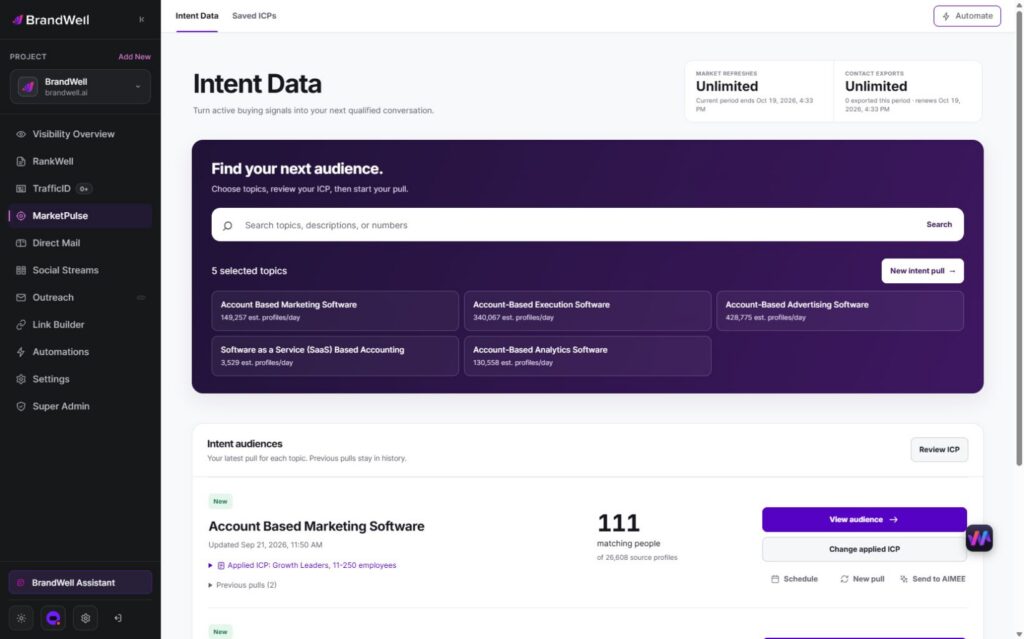
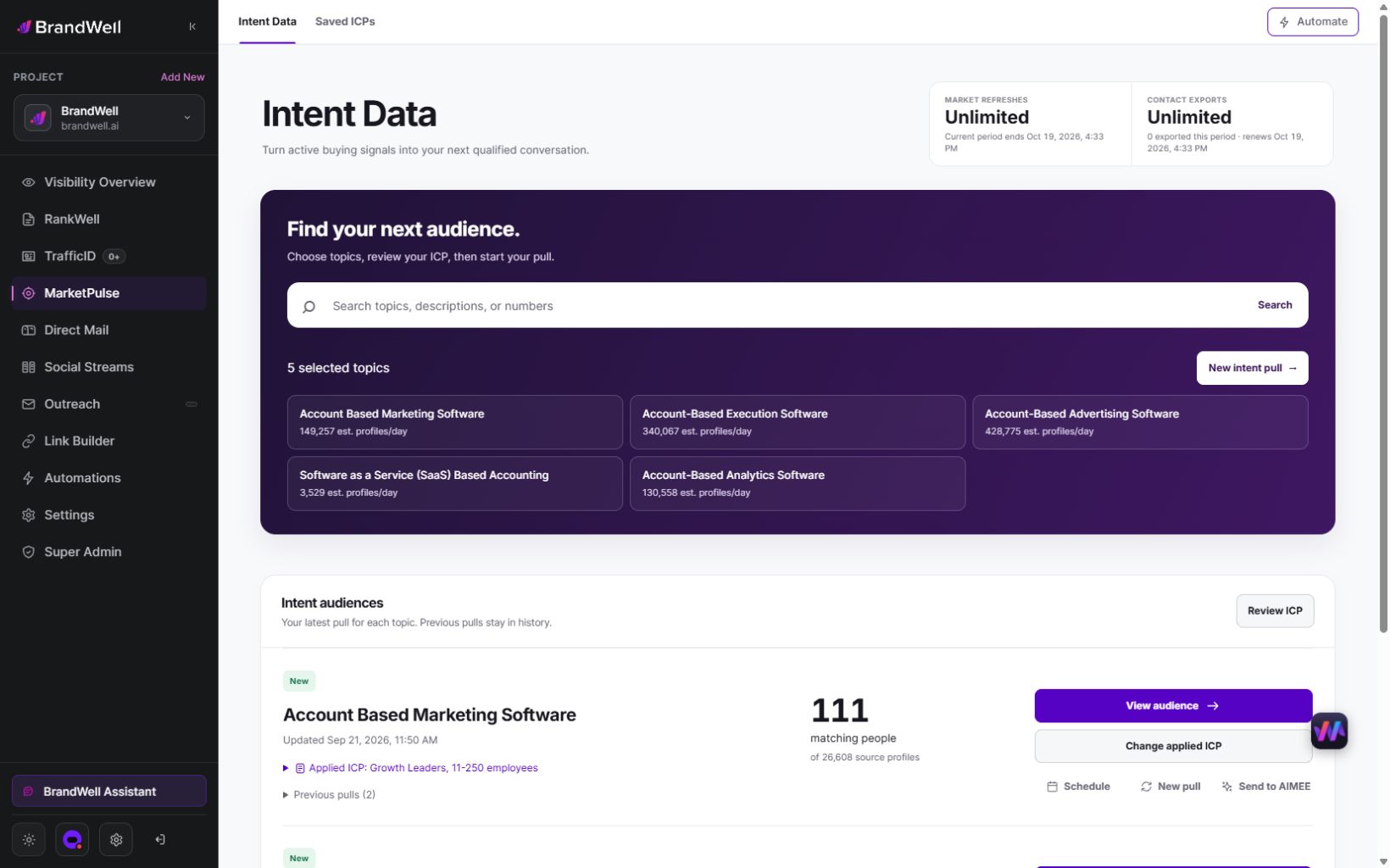
BrandWell MarketPulse: intent data starting at $500/mo. Find people researching topics relevant to what you sell, apply saved ICP filters, and review available contact details before taking action.
| Plan | Topics and refreshes | Monthly exports |
|---|---|---|
| Starter | 1 topic, weekly | 25,000 contacts |
| Growth | 3 topics, daily | 100,000 contacts |
| Scale | 10 topics, daily | Unlimited contacts |
Swipe the table to see all columns.
A pull retrieves available data from the previous 24 hours for one topic. Daily use across all included topics provides 90 Growth pulls or 300 Scale pulls in a 30-day month. Weekly Starter pulls vary by calendar month. Available audience size and contact fields vary, and audiences may overlap. Refreshes stop at the plan limit without overage charges.
- Find and qualify: search the topic catalog, save your ICP, and review the people and companies that match.
- Act on the research: export qualified contacts or prepare an Outreach or Direct Mail workflow. Connected products, channel usage, and fulfillment may cost extra.
- Get help from AIMEE: Growth and Scale include AIMEE for the initial user to research accounts and prepare the next step through connected tools.
Agencies and other service businesses can build client deliverables around their available Intent Scans and exports. Keep each client’s scope, permissions, and service fees clear. A subscription is not a promise of a white-label platform or exclusive access to a market.
Explore MarketPulse and watch the demo or compare plans starting at $500/mo. Any early-access discount is a separate, time-limited offer shown to an eligible recipient.
Define observable client value
Begin with the client’s job, not the renewal date. State the market, account universe, topics or website activity, evidence delivered, client action, responsible team, reporting cadence, and business outcome the service can reasonably influence. A weekly report is not value if nobody uses it. A high signal count is not value if the records are stale, irrelevant, unvalidated, or impossible to activate.
Create an expected value path for the first cycle: configure the target market, test representative data, deliver a branded output, review uncertainty, approve one reversible activation, collect seller or operator feedback, and show what changed. Fast time-to-value means reaching a useful, reviewable decision quickly – not fabricating a result within an arbitrary deadline.
Record the actual observation unit, source, time, identity method and uncertain or conflicting fields. An account association or available contact record does not establish who researched or whether they intend to buy. Keep validation, suppression, correction and review decisions visible.
Assign intervention and decision owners
Build the workflow around events and accountability:
- Define the client outcome, baseline, eligible accounts, data rights, and first-use milestone.
- Instrument delivery, report access, accepted or rejected signals, activation, corrections, support, and outcomes.
- Review health at a fixed cadence by adoption, quality, action, outcome, scope, governance, and relationship.
- Trigger an intervention only when a documented rule fires; retain the evidence and uncertainty.
- Assign an agency owner and client owner with a response expectation and decision authority.
- Diagnose the cause before changing volume, topics, workflows, or price.
- Agree the action, acceptance test, owner, due date, and next review.
- Measure whether the action changed the leading indicator without claiming it caused retention.
- Right-size or exit when the service cannot create responsible value.
- Feed recurring issues into onboarding, packaging, contracts, and support design.
Do not call every quiet week a risk. Account for seasonality, vacations, sales capacity, campaign cadence, long buying cycles, and package design. Conversely, do not hide sustained inactivity behind a quarterly business review. The leading indicator should open a specific conversation while there is still time to act.
Build an inspectable health evidence kit
The kit should include a one-page success definition; onboarding milestone tracker; target-market and topic register; data-quality sample; adoption log; accepted/rejected signal reasons; activation register; operator-time log; support and exception history; outcome ledger; scope-change log; and renewal decision record. A client portal can make these visible, but a portal without ownership and review cadence does not prevent churn.
Use an explainable health scorecard rather than one composite number. Show the raw measures and thresholds under adoption, quality, action, outcome, scope, governance, and relationship. Let an owner override the state only with a reason and review date. Preserve no-data as no-data; do not turn missing feedback into a positive score.
Use a success plan, meeting agenda, intervention brief, rightsizing worksheet, remediation record and managed-exit checklist linked to actual events. Verify that existing project, CRM, reporting, support and exception tools capture the necessary evidence before adding a separate health system.
Diagnose before changing scope
One warning can have several causes. Low report usage may mean the wrong person receives the report, the report arrives at the wrong cadence, the client lacks capacity, the accounts are irrelevant, or the client already moved the work into another system. Falling signal volume may reflect a smaller eligible market, changed topics, seasonality, collection failure, stricter validation, or expiring evidence. Weak pipeline evidence may reflect missing CRM outcomes rather than a failed signal. Treat the first symptom as a prompt for investigation, not the diagnosis.
Use a short diagnostic interview and evidence review. Ask the client operator to describe the last signal they used, what they did, what blocked the next step, and where the outcome was recorded. Compare that account with one rejected signal and one no-match case. Review configuration changes, data freshness, failed integrations, ownership changes, seller capacity, and package limits. Then label the primary cause as adoption, quality, activation, measurement, scope, governance, relationship, or external change. Record secondary causes rather than forcing the problem into one bucket.
An intervention brief should state the evidence, uncertainty, client consequence, proposed action, work required from each party, cost or scope change, acceptance test, review window, and stop condition. For example, a quality intervention may narrow topics and manually review a representative set before restoring automation. An adoption intervention may change the recipient and reduce the report to a smaller decision set. An outcome intervention may repair CRM reason codes before anyone debates ROI. A governance intervention may pause a destination until access and permitted use are approved.
Plan retention throughout the service cycle. During onboarding, agree the first-use milestone and client responsibilities. During early delivery, review data exceptions and operator behavior frequently. Once stable, shift to monthly health and quarterly scope decisions. Before the contractual renewal notice, provide enough time to test an intervention, rightsize responsibly, or complete an orderly exit. Keep actual contractual dates and notice requirements accessible; schedule reviews early enough for a fair intervention or exit decision.
Expansion should pass the same test as a save. Add topics, clients, modules, destinations, or operator support only when current scope is adopted, quality is reviewable, permissions are clear, capacity exists, and the next outcome is defined. Expanding an unhealthy account can temporarily increase revenue while making churn and support risk worse. A smaller service that the client understands and uses can create a stronger base for later growth.
Choose five intervention modes
1. Adoption-led intervention
Use this when reports arrive but the client does not open, discuss, assign, or act on them. Diagnose whether the deliverable reaches the right role, the explanation is clear, the workload is realistic, and the next action fits existing tools. Reduce cognitive load: fewer accounts, stronger evidence packets, one action path, and scheduled review. Train the real operator, not only the executive sponsor.
Success evidence: report reviewed, named owners assigned, actions accepted or rejected with reasons, and feedback returned. Risk: manufacturing activity to improve an adoption score while the service remains irrelevant.
2. Outcome-evidence intervention
Use this when the client acts but cannot see how actions connect to qualified conversations, opportunities, or learning. Build an outcome ledger from signal to approved action to CRM stage, including no response, rejection, correction, opportunity, and loss. Reconcile definitions with sales before presenting attribution.
Success evidence: comparable records have source, timestamp, action, owner, and outcome. Risk: turning influenced-pipeline labels or a handful of anecdotes into a causal ROI claim.
3. Scope-rightsizing intervention
Use this when topics, markets, accounts, volume, modules, cadence, or support exceed the client’s ability to use them. Narrow the target market, reduce noisy topics, change report frequency, pause an unused activation, or move work to a higher-touch package. Rightsizing can protect trust even when it lowers the near-term invoice.
Success evidence: the revised scope has a documented reason, capacity owner, cost, acceptance threshold, and review point. Risk: disguising a data-quality problem as a package problem or trapping the client in unused scope.
4. Governance-remediation intervention
Use this when roles, notices, permissions, suppressions, access, client separation, retention, deletion, or approval boundaries are unresolved. Stop the affected activation, map the data flow, assign qualified reviewers, correct access or data, and record the decision. Governance friction is not solved by sending more leads.
Success evidence: the risky path is paused or corrected, responsibilities and permitted uses are written, and the client can explain the control. Risk: treating a vendor policy or framework as proof the deployment is compliant.
5. Managed exit and handoff
Use this when the client lacks a viable market, operating owner, lawful or permitted use, capacity, data readiness, economic fit, or trust that can be responsibly repaired. Deliver agreed client inputs, configuration and reports that can travel, revoke access, document licensed fields that cannot transfer, preserve suppression and deletion obligations, and identify remaining actions.
Success evidence: both parties understand what transferred, what was deleted or retained, which credentials were revoked, and who owns unresolved items. Risk: extending a poor-fit contract to protect a retention metric and damaging the relationship.
Compare separately implemented service models
Compare manual diagnosis, configured event checks and separately implemented client presentation against actual event coverage, review effort, rights and costs. Automation inherits missing events. Client branding does not establish a native BrandWell health platform or a retention improvement.
Use a hybrid: automate event collection and threshold checks; keep diagnosis, exceptions, scope changes, sensitive decisions, and public or person-level activation under human review. Define which signals may create a task, which may only update context, and which require client approval.
Count actual retention-program costs
Intent service churn prevention pricing should separate onboarding, recurring delivery, client success, data or platform usage, portal and reporting, integrations, quality review, exception handling, governance, and expansion work. Model delivery cost per client and per package, including meetings, custom analyses, wrong-match review, support, and rework. A setup fee can cover initial configuration and proof, but it should not hide ongoing operator labor.
Do not promise a retention percentage without original cohort methodology. Track gross and net retention as business outcomes, then analyze intervention cohorts with clear baselines, sample sizes, package changes, and confounders. The operational ROI question is whether the program helps the agency and client make better save, rightsize, remediate, or exit decisions at a sustainable cost.
Separate health measures from churn predictions
Time-to-value measures include days to verified configuration, first accepted report, first approved action, and first outcome record. Quality includes eligible coverage, freshness, validation, error and correction rate, false-match review, and field usability. Adoption includes report review, active operators, accepted actions, feedback completeness, and meeting participation. Outcome evidence includes qualified conversations, opportunities, stage progression, disqualification, and learning.
Health indicators should be segmented by client maturity and package. A new client needs milestone completion and fast feedback. A mature client needs stable adoption, calibrated quality, and outcome continuity. A strategic high-touch package may justify manual review; a standardized package needs strict scope and exception budgets. Never use benchmarks borrowed from another market as an unqualified promise; establish internal baselines from comparable clients.
Preserve distinct evidence stages
Retention depends on the evidence chain. Track source, recency, topic or event, account fit, identity confidence, validation, suppression, destination, client action, and outcome. A drop in usable signals can be caused by market size, topic choice, seasonality, integration failure, data decay, or a stricter quality rule. Diagnose before increasing volume.
Verify permission and destination eligibility before action. Start with reviewed reports or tasks and record actual approvals and acknowledgements. Verify the applicable recipient, purpose, channel, jurisdiction and platform requirements; a research record is not messaging permission.
Resolve scope and governance risks
Recurring churn causes include selling volume instead of decisions, unclear client responsibilities, no sales feedback, noisy or stale topics, false person certainty, missing integrations, unmanaged support, hidden usage cost, weak attribution, absent access and deletion rules, overcustomization, and a renewal conversation that starts too late. Add a risk owner and mitigation to each package.
Verify actual data flows, roles, permitted purpose, access, retention, deletion, support, incident communication and exit responsibilities. Resolve outstanding jurisdiction and contract requirements with qualified reviewers before action.
Scope current BrandWell capabilities
BrandWell here means the current MarketPulse intent-data and growth automation platform, connected with the broader BrandWell content and growth tools. For this client-health and retention-intervention operating model, exact fit must be proven against the buyer workflow and written scope.
MarketPulse research is starting at $500/mo. Search a relevant topic, save the approved ICP and inspect actual available matches. AIMEE can organize supplied context through configured tools. Named owners approve exports, messages, audience uploads and CRM writes. Client health systems and custom delivery require separately verified implementation, rights and fees.
AIMEE can prepare a review brief through configured connected tools. Keep proposed actions separate from actual approvals and destination acknowledgements. Confirm the implementation and permissions before execution.
Scope success definitions, adoption review, quality sampling, accepted-action feedback, outcome ledgers, rightsizing and managed exit separately. Verify the agency agreement, client boundaries, billing, implementation, data rights and fees before promising branded managed delivery.
The next step is to choose three clients at different maturity levels, build the raw health scorecard, identify one leading indicator per risk dimension, and pre-write the five intervention briefs. Run the review before the next renewal window, then revise onboarding and packaging from what the evidence exposes.
Frequently asked retention questions
How should the value path begin?
Define the client value path, reach a useful reviewed decision early, instrument adoption and quality, and intervene on observable causes rather than waiting for renewal.
Who owns an intervention?
Include milestone owners, data and quality checks, client feedback, response expectations, escalation, scope-change approval, outcome review, and managed handoff.
Which evidence should tools capture?
Use a success plan, health scorecard, portal or report, CRM outcomes, support history, intervention brief, rightsizing worksheet, and exit checklist connected to real events.
How do service models differ?
Manual work fits ambiguity and low volume; automation fits repeatable event detection; separately implemented client branding requires verification of rights, costs and scope. Verify actual collection, review and approval ownership in any hybrid arrangement.
Which costs belong in the budget?
Model setup, data and platform usage, operator time, meetings, quality review, exception handling, governance, reporting, support, and expansion separately.
What should the health review measure?
Track time to value, usable signal quality, adoption, accepted actions, feedback, support burden, outcomes, scope fit, and relationship evidence without claiming a churn prediction.
How does client maturity change review?
Weight milestones for new clients, continuity and outcomes for mature clients, operator time for high-touch packages, and strict exceptions for standardized packages.
Which evidence stages stay separate?
Preserve source, freshness, fit, identity confidence, validation, suppression, activation, client action, and outcome so the team can diagnose the failing link.
What risks require an owner?
Major risks include overpromised scope, probabilistic matches stated as facts, weak access and deletion controls, missing integrations, noisy evidence, and attribution claims.
Does branding include managed retention?
Include success definition, branded reporting, quality and adoption reviews, intervention rights, client responsibilities, renewal decision rules, and managed exit in the recurring scope.
Copyable client intervention record
Client: [Actual scope, maturity and contract dates.] Warning: [Observed event, denominator and missing evidence.] Diagnosis: [Confirmed cause and alternatives.] Action: [Save, repair, rightsize or exit; owner and approval.] Test: [Acceptance rule, comparator and review date.] Outcome: [Actual client decision and unresolved cases.] Cost: [Work, revised fees, exclusions and stop condition.]
Use comparable observation windows
NIST’s reliability handbook distinguishes observed event times from observations ending without the event. This is reliability methodology, not an agency retention benchmark. Preserve observation duration when reviewing clients.
A fictional January cohort has 20 clients and four departures within 90 days: 80% remain at day 90. A March cohort has 20 clients, with one departure by day 30 and 19 still observed. That does not establish 95% day-90 retention. Report the actual follow-up window; avoid treating incomplete observations as guaranteed future retention.
Separate client retention from revenue retention
A fictional opening cohort has ten clients and $10,000 in monthly recurring fees. Two depart, leaving eight: 80% client retention. Churn removes $1,500, contraction removes $500 and expansion adds $2,000. Defined gross revenue retention is 80%; defined net revenue retention is 100%. Exclude new-client fees from both cohort calculations and disclose timing, currency and billing definitions. Expansion can hide departures in the revenue metric.
Report missing feedback instead of a healthy score
Forty fictional accounts receive seller acceptance; 30 return feedback and six become qualified opportunities. Feedback coverage is 75%. The opportunities are 20% of reported accounts or 15% of accepted accounts; ten remain unresolved. Report views or absent complaints do not establish completed action or client value.
A save cohort does not prove intervention impact
Of 20 fictional flagged clients receiving an intervention, 16 renew: an observed 80% renewal rate. Without a suitable comparator and comparable follow-up, that does not show four clients were saved or a causal retention lift. Record selection, baseline risk, scope changes and actual renewal dates.
Check the cost of the revised service
A fictional $2,500 monthly fee against $500 research, $700 delivery, $400 QA, $300 support and $300 client success leaves $300 before excluded overhead, tax and financing. Rightsizing the fee to $2,000 while costs remain $2,200 produces a negative $200 remainder. An unused contingency is separate from actual expense. These invented inputs are not BrandWell service prices or benchmarks.
Review current research: MarketPulse research is starting at $500/mo. Explore the product and current plans; verify separate client reporting, integrations, rights and managed-service fees.
Reviewed and updated October 3, 2026.

Written by