On this page
- Current MarketPulse research workflow
- Keep evidence and readiness separate
- Test ten audience operating steps
- Compare six audience methods
- Compare distinct campaign cells
- Count data and operating costs
- Measure qualified outcomes and maturity
- Check actual audience-test feasibility
- Require gates before assigning tiers
- Check action eligibility and precision
- Scope separate agency prioritization work
- Copyable audience-readiness test
- Frequently asked prioritization questions
Prioritize B2B audience research with separate checks for fit, relevant recent evidence, uncertain identity or match quality, actual action eligibility and sufficient delivery size. Apply required gates before transparent tiers. A topic signal or high score does not establish a buyer, permission or an incremental sale.
Who is this for? B2B advertisers, paid media agencies, demand-generation and growth leaders, and RevOps teams deciding which audiences deserve budget. It is not for teams seeking a magic score that removes experimentation or platform-policy review.
Current MarketPulse offer: intent-data plans start at $500/mo. See the product, demo, and current plans. Updated October 3, 2026.
Current MarketPulse research workflow
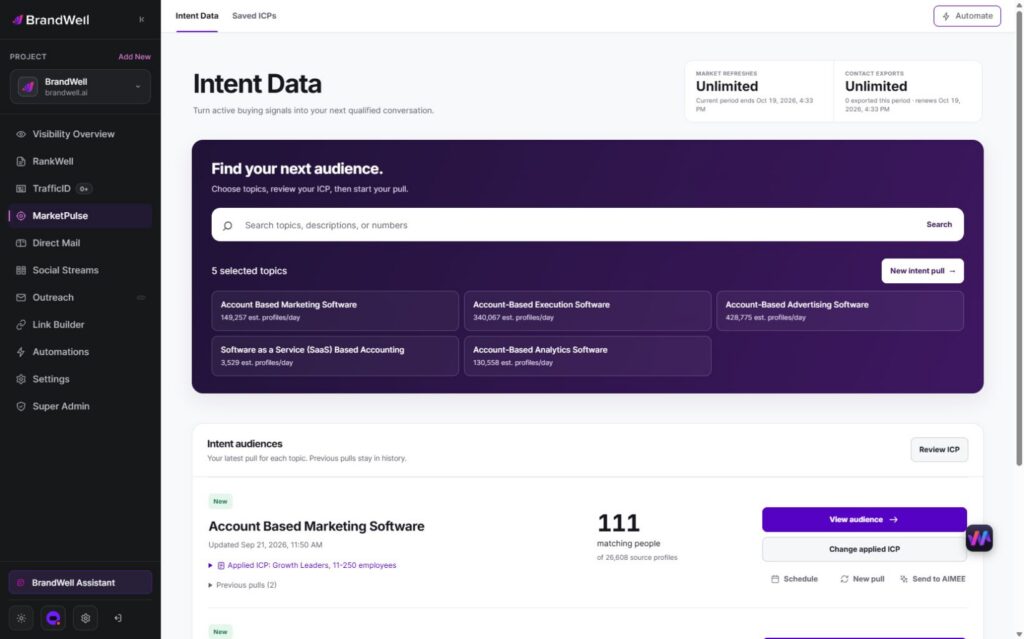
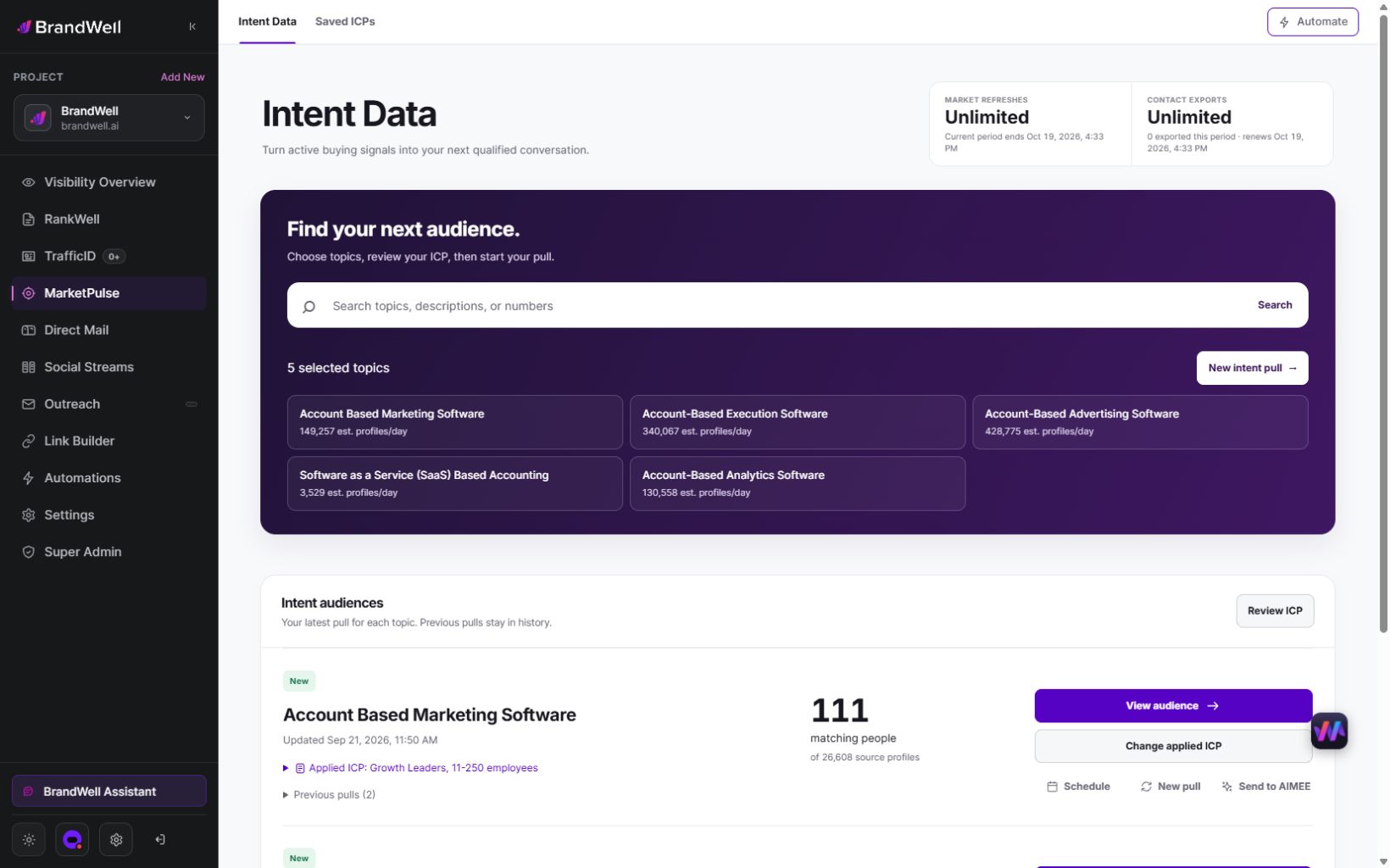
BrandWell MarketPulse: intent data starting at $500/mo. Find people researching topics relevant to what you sell, apply saved ICP filters, and review available contact details before taking action.
MarketPulse plans are starting at $500/mo. Verify current package scope and offers on the product page.
| Plan | Topics and refreshes | Monthly exports |
|---|---|---|
| Starter | 1 topic, weekly | 25,000 contacts |
| Growth | 3 topics, daily | 100,000 contacts |
| Scale | 10 topics, daily | Unlimited contacts |
Swipe the table to see all columns.
A pull retrieves available data from the previous 24 hours for one topic. Daily use across all included topics provides 90 Growth pulls or 300 Scale pulls in a 30-day month. Weekly Starter pulls vary by calendar month. Available audience size and contact fields vary, and audiences may overlap. Refreshes stop at the plan limit without overage charges.
- Find and qualify: search the topic catalog, save your ICP, and review the people and companies that match.
- Act on the research: export qualified contacts or prepare an Outreach or Direct Mail workflow. Connected products, channel usage, and fulfillment may cost extra.
- Get help from AIMEE: Growth and Scale include AIMEE for the initial user to research accounts and prepare the next step through connected tools.
Agencies and other service businesses can build client deliverables around their available Intent Scans and exports. Keep each client’s scope, permissions, and service fees clear. A subscription is not a promise of a white-label platform or exclusive access to a market.
Explore MarketPulse and watch the demo or compare plans starting at $500/mo. Any early-access discount is a separate, time-limited offer shown to an eligible recipient.
Keep evidence and readiness separate
A high intent audience prioritization strategy should answer a media-allocation question: which eligible cohort has the strongest combination of commercial fit and current evidence, at sufficient identity quality and scale, for this campaign objective?
Use a sequential decision rather than blending everything into one opaque score:
- Fit: account, role, geography, use case, and commercial eligibility.
- Evidence: declared actions, first-party behavior, topic activity, CRM engagement, and public context – stored separately.
- Identity: account or person level, match method, confidence, and source rights.
- Freshness: time since signal with source-specific decay.
- Eligibility: consent where required, opt-outs, sensitive categories, platform rules, and exclusions.
- Scale: enough activatable people or accounts to deliver and measure without unsafe narrowing.
- Economics: a realistic path from spend to qualified pipeline, not merely clicks.
This framework creates spend-ready tiers while preserving why each record qualified. A high score should never erase a failed privacy, policy, identity, or minimum-volume gate.
Test ten audience operating steps
Use this implementation guide:
- Choose a conversion hierarchy. Define which events are optimization inputs and which are business outcomes: lead, qualified lead, meeting, accepted opportunity, or revenue.
- Create the ICP universe. Join account fit, existing relationship, territory, customer, competitor, employee, and conflict rules before behavioral ranking.
- Build a signal dictionary. For each source, document meaning, scope, confidence, permitted use, refresh, decay, and likely false positives.
- Resolve and enrich minimally. Preserve match type and confidence; append only fields needed for segmentation, activation, and suppression.
- Apply the minimum-volume gate. Estimate activatable size after platform matching and exclusions. Combine tiers only when the evidence meaning remains clear.
- Assign audience tiers. Separate precision, nurture, discovery, and suppression cohorts. Never mix holdout records into active uploads.
- Activate as distinct tests. Keep intent-qualified, first-party, platform-native in-market, demographic, and lookalike or optimized expansion cohorts distinguishable in campaign structure.
- Refresh and remove. Add newly eligible records, expire stale signals, remove opt-outs and customers, and log changes.
- Join downstream outcomes. Map spend and conversion events to CRM qualification, opportunity, and revenue using stable cohort IDs.
- Reallocate with evidence. Shift budget only after sufficient observation and human review; do not let an agent make consequential spend changes autonomously.
The team normally includes paid media, demand generation, RevOps, data or marketing operations, sales leadership, analytics, privacy or legal counsel, and security. Integrations may include intent and identity data, CRM, customer-data or audience operations, consent/suppression, ad platforms, conversion APIs or tags, and reporting.
Compare six audience methods
Compare every method using the same criteria: fit control, signal specificity, identity confidence, freshness, activatable scale, policy burden, and downstream measurability.
1. Declared-intent audiences
Use valid demo requests, registrations, quote requests, trials, or other voluntary actions aligned to the campaign purpose. Evaluate these records for the approved nurture or exclusion purpose.
Failure mode: A form completion can be low fit, fraudulent, student-led, or too late for acquisition. Declared data still requires validation, purpose limits, and suppression.
2. First-party behavior cohorts
Rank eligible website or product audiences by repeated relevant actions, account fit, and recency. Use them for retargeting, account education, or a conversion-model signal without implying certainty.
Failure mode: Shared devices, bots, customers, job seekers, and consent gaps can contaminate the cohort. Behavior does not reliably reveal role or authority.
3. Corroborated topic-intent cohorts
Combine recent third-party or cooperative topic evidence with firmographic fit and at least one independent signal. This can narrow a large market before media spend.
Failure mode: Topic meaning, source coverage, account attribution, and recency vary. Research may not be commercial, and a broad taxonomy can create false positives.
4. Known-account reactivation audiences
Use eligible CRM accounts and contacts with prior relevant engagement, then prioritize those with new account-level evidence. Separate customers, lost opportunities, and dormant prospects because their messages and economics differ.
Failure mode: Stale contacts, changed roles, old permissions, and unresolved ownership can produce poor matching and confusing creative.
5. Platform-native in-market or interest audiences
Use platform estimates of active research, interests, professional attributes, or buyer groups when first-party coverage is too small or discovery is the objective. Keep them as a distinct test cell.
Failure mode: Definitions are platform-specific and modeled; advertisers may not see the underlying evidence. Broad reach can optimize toward inexpensive conversions rather than qualified pipeline.
6. Lookalike, predictive, or optimized expansion
A platform expansion test can reach beyond a selected seed where supported. Verify the actual feature, source eligibility, exclusions, audience boundary and reporting before launch. Keep strict-membership and expansion tests distinct rather than labeling all resulting delivery high intent.
Failure mode: Expansion increases reach while weakening control over why a person qualified. If it shares a campaign with the restricted seed, reporting may obscure whether the original high-intent cohort performed.
Use a traceable audience template, signal dictionary, eligibility checklist, tier definitions, dated refresh rules, suppression log, size checks and budget scenario. Verify the actual operating gap before selecting more tools.
Compare distinct campaign cells
Use demographic or firmographic audiences when the market definition is stable and behavioral evidence is scarce. They provide reach but little timing. Use interest or platform-native in-market audiences for discovery and category demand, accepting modeled definitions. Use lookalike or predictive audiences to expand from a seed when scale and learning matter more than strict membership. Use intent-qualified audiences when the goal is to focus budget on accounts with current evidence and the team can govern the data.
Do not declare one universally superior. High-intent cohorts can be too small, biased, or stale. Lookalikes can find buyers who have not produced a visible signal. Demographics can reach future buyers. Compare using a suitable test with separate cells, consistent creative where appropriate, shared qualification definitions, and downstream pipeline outcomes.
Verify actual audience boundaries and reporting for the selected platform and campaign. Keep strict membership, modeling and expansion distinct; a seed does not establish that every reached person qualified under the original research rules.
Count data and operating costs
High intent audience prioritization pricing includes data or usage, identity/enrichment, CRM and warehouse integration, consent and suppression operations, audience uploads or APIs, media, creative, analytics, security, legal review, and agency management. Total cost changes with topic count, account universe, sources, countries, refresh cadence, match quality, campaign platforms, and reporting depth.
Use a budget scenario for each tier:
- records observed and accounts clearing fit;
- records clearing signal, identity, freshness, and eligibility;
- expected activatable size after platform match and exclusions;
- media and creative allocation;
- fixed implementation and operating cost;
- qualified conversations and accepted opportunities needed to reach the client’s economic threshold.
Match rate measures a matching stage, not ROI or purchasing intent. Preserve actual destination eligibility, post-exclusion audience size and qualified outcomes. An upload receipt does not establish a usable or permitted campaign.
Measure qualified outcomes and maturity
High intent audience prioritization KPIs should include eligible rate, match rate, audience readiness, reach, frequency, spend, conversion, qualified-lead rate, cost per qualified conversation, accepted opportunities, pipeline, revenue, and full cost per accepted opportunity. Add data-quality metrics: false-positive flags, suppression rate, stale-record rate, wrong-account rate, complaints, and refresh failures.
Keep the cohort ID attached through CRM outcomes. Compare precision, nurture, platform-native, and expansion cells using the same qualification and observation rules. Use an eligible holdout or staggered rollout where possible. Report attributed or influenced results separately from causal lift.
Avoid borrowed benchmarks. Establish internal baselines by ICP tier, platform, objective, conversion event, signal combination, and audience size. A low cost per lead is not a win if qualification and opportunity acceptance fall.
Check actual audience-test feasibility
Evaluate actual market definition, eligible volume, qualified outcomes, maintained CRM definitions and workable refresh/suppression. Possible tests include account education, reactivation and bounded expansion; industry alone does not prove feasibility.
Poor-fit programs have tiny eligible cohorts, low traffic, weak ICP rules, consumer or sensitive targeting, no source-rights record, unreliable CRM stages, or too little budget to create a readable test. If the team cannot distinguish a raw lead from an accepted opportunity, fix measurement before buying more intent data.
For agencies, client readiness also requires access to ad accounts, approved data use, an outcome feed, named creative and spend approvers, and written responsibility for suppressions and incidents.
Require gates before assigning tiers
A practical high intent audience prioritization decision guide uses hard gates plus transparent tiers:
- Precision tier: strong fit, several recent relevant signals, appropriate identity confidence, permitted activation, enough scale, and an outcome owner.
- Nurture tier: strong fit with meaningful account evidence but insufficient person confidence or urgency; use educational media rather than personal outreach.
- Discovery tier: fit or modeled relevance without corroborated intent; use a capped test and separate reporting.
- Expansion tier: predictive or optimized reach beyond a quality seed; protect exclusions and keep budget bounded.
- Suppressed tier: customer, employee, competitor, opt-out, sensitive, unsupported jurisdiction, conflict, stale, or low-confidence record.
Identity coverage and correctness are different. Keep the actual matching unit, method, uncertainty, source and review evidence rather than converting a match count into a quality claim.
Check action eligibility and precision
The biggest mistakes are treating a topic signal as a purchase order, hiding expansion inside a “high intent” campaign, using account evidence to name an individual, uploading data without rights, ignoring consent and opt-outs, over-narrowing sensitive cohorts, retaining stale audiences, and optimizing to an easy but low-quality conversion.
Verify actual source, recipient, purpose, account, jurisdiction, campaign and channel eligibility immediately before action. A research record does not automatically become first-party customer information or contact permission. Keep unresolved checks on hold.
Controls should include source and purpose fields, minimization, match confidence, consent and suppression propagation, sensitive-category blocks, regional rules, encryption, access control, retention, deletion, audience-size checks, change logs, platform-policy review, and incident response. A human must approve audience uploads, exclusions, conversion changes, creative, and material budget reallocations. Before operational use, complete product, pricing, privacy, security, compliance, legal, and platform-policy review.
Scope separate agency prioritization work
An agency can sell a recurring service that defines the audience universe, monitors intent, applies tiers, refreshes and suppresses activation lists, coordinates creative, and reports qualification and pipeline. Scope the data sources, topics, platforms, account count, refresh cadence, media, creative, approvals, SLAs, and reporting. Show exclusions and false-positive feedback; never guarantee that every selected record is an in-market buyer.
Review an available MarketPulse topic, saved ICP and actual preceding-24-hour matches for the approved research purpose. Keep uncertain company context visible. AIMEE can organize supplied context through configured tools; named owners approve actual exports, messages, audience uploads and CRM writes.
BrandWell does not replace the CRM, ad platforms, consent and suppression systems, or a complete media strategy. Before operational use, complete product, pricing, privacy, security, compliance, legal, and platform-policy review.
Copyable audience-readiness test
Purpose: [Actual approved campaign question.] Unit: [Record, person, account, cohort and source.] Evidence: [Fit, topic, freshness and uncertainty.] Gates: [Rights, exclusions, destination and usable size.] Tier: [Reason, expiry and separate expansion boundary.] Outcome: [Review, buyer evidence, costs and missingness.] Decision: [Owner, bounded test, hold or repair.]
A high score cannot override an exclusion
Assume a fictional pool of 1,000 unique accounts has 100 with relevant recent research, 60 meeting fit and 40 meeting the matching-review rule. Ten of those 40 fail required purpose or exclusion checks. The eligible review pool is 30, or 3% of the original accounts, rather than 40. Even a high research score cannot move a failed mandatory check into an active cohort. These invented counts are not BrandWell performance results.
Uploaded rows and usable member accounts differ
LinkedIn’s Matched Audiences troubleshooting guidance distinguishes list processing and matched member accounts, with a minimum 300-member audience and required location criteria that can reduce size. Verify the actual post-targeting audience before action; this is not approval to use any particular source.
Suppose a fictional 1,000-row permitted list matches 500 member accounts and location/exclusions reduce it to 280. The raw row count is not evidence that the campaign clears the documented floor. Repair the scope, choose another approved approach or keep it on hold. Do not loosen rights or required exclusions to inflate the number.
Keep expansion membership and outcomes distinct
If an approved seed has 400 member accounts and an expansion arm reaches 1,200 unique members, do not label all 1,200 as members of the seed or as corroborated research matches. Preserve actual membership, reached counts, overlaps and assigned outcomes for each arm. Broad delivery and strict membership answer different questions.
Budget for accepted review work
A fictional test using the standard $500 Growth subscription, $400 setup and $600 review costs $1,500 before media and creative. Thirty eligible accounts give $50 per eligible account. If 15 are seller-accepted, the defined cost is $100 per accepted account; acceptance is not a qualified opportunity or purchase. Acquisition, general overhead, tax and financing are excluded. These invented operating inputs are not BrandWell service fees or typical acquisition costs.
Build the review from actual research
Review an available MarketPulse topic, saved ICP and actual preceding-24-hour matches against the approved purpose. Preserve uncertain company context. AIMEE can organize supplied research through configured tools. Owners approve exports, messages, Outreach enrollment, audience uploads and CRM writes. Custom scoring, audience management, client interfaces and routing require separately verified implementation, rights, scope and fees.
Frequently asked prioritization questions
Can a high score override a required exclusion?
No. Apply actual mandatory gates first.
Does a large upload prove usable audience size?
No. Check actual matching, targeting and exclusions.
Are all expanded recipients members of the original seed?
No. Keep membership and reporting distinct.
Is seller acceptance a purchase?
No. Preserve buyer-confirmed outcomes separately.
Review the research product: explore MarketPulse and current plans.
Reviewed and updated October 3, 2026.

Written by