On this page
- Define the eight-part MATCHED blueprint
- Current MarketPulse workflow
- Choose a reversible service promise
- Assign match review and correction owners
- Evaluate the supported matching stack
- Compare build, resell, refer and avoid
- Price sources and exception review
- Preserve match and outcome evidence
- Choose clients with an approved purpose
- Keep entity and confidence states separate
- Control source and matching risks
- Maintain the recurring resolution package
- Start with one reversible identity decision
- More links do not automatically mean better matching
- Worked example: match yield, reviewed correctness and cost
- Frequently asked questions
Direct answer: An agency can productize identity resolution when a client has fragmented business records, an approved activation purpose, and an owner who will review uncertain matches. Promise a governed, auditable match process that makes records easier to qualify and route. Do not promise a perfect identity, a particular match rate, or a business outcome.
Current MarketPulse offer: intent-data plans start at $500/mo. See the product, demo, and current plans. Updated October 3, 2026.
The service becomes recurring when the agency maintains match rules, confidence states, corrections, suppression, and activation evidence instead of delivering a one-time merged file.
Who this is for: Agency owners and service-line leaders evaluating a recurring identity resolution offer for B2B marketing and revenue operations clients.
Define the eight-part MATCHED blueprint
- Map purpose: name the permitted client decision and prohibited uses.
- Audit sources: inventory identifiers, rights, freshness, and systems of record.
- Tag identity states: keep company, person, household, and contact records distinct.
- Choose rules: separate deterministic links from probabilistic suggestions.
- Hold uncertainty: route conflicts and low-confidence candidates to review.
- Enable correction: maintain provenance, suppression, rollback, and client feedback.
- Deliver safely: send only approved fields to approved destinations.
- Document effect: record acceptance and downstream action without claiming causation.
This is the core identity resolution services framework. It is also a practical implementation guide, planning guide, and operational checklist because every stage has an input, owner, decision, and evidence record.
Current MarketPulse workflow
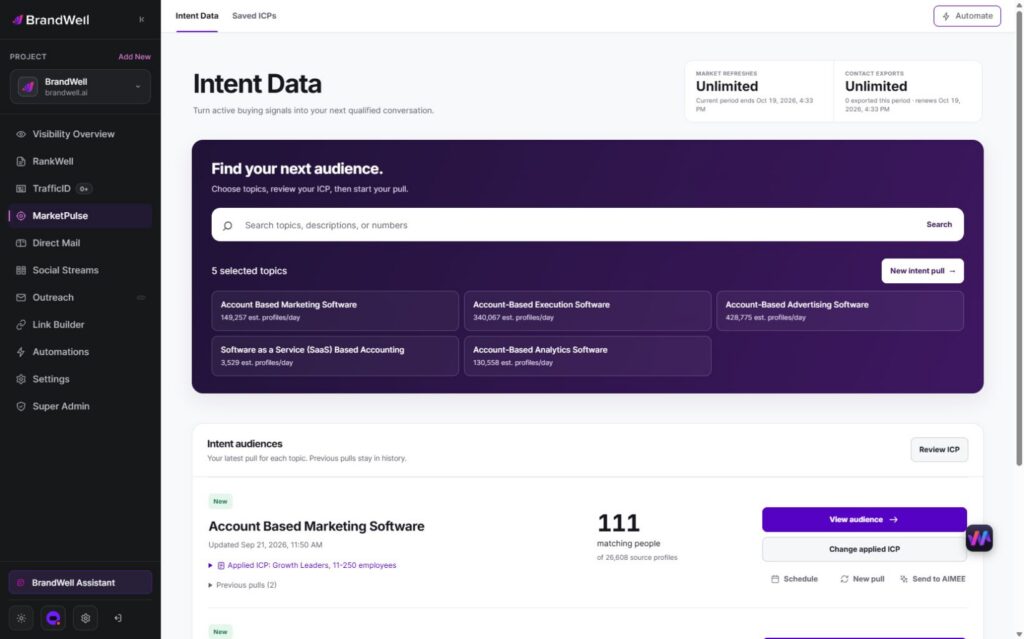
BrandWell MarketPulse: intent data starting at $500/mo. Find people researching topics relevant to what you sell, apply saved ICP filters, and review available contact details before taking action.
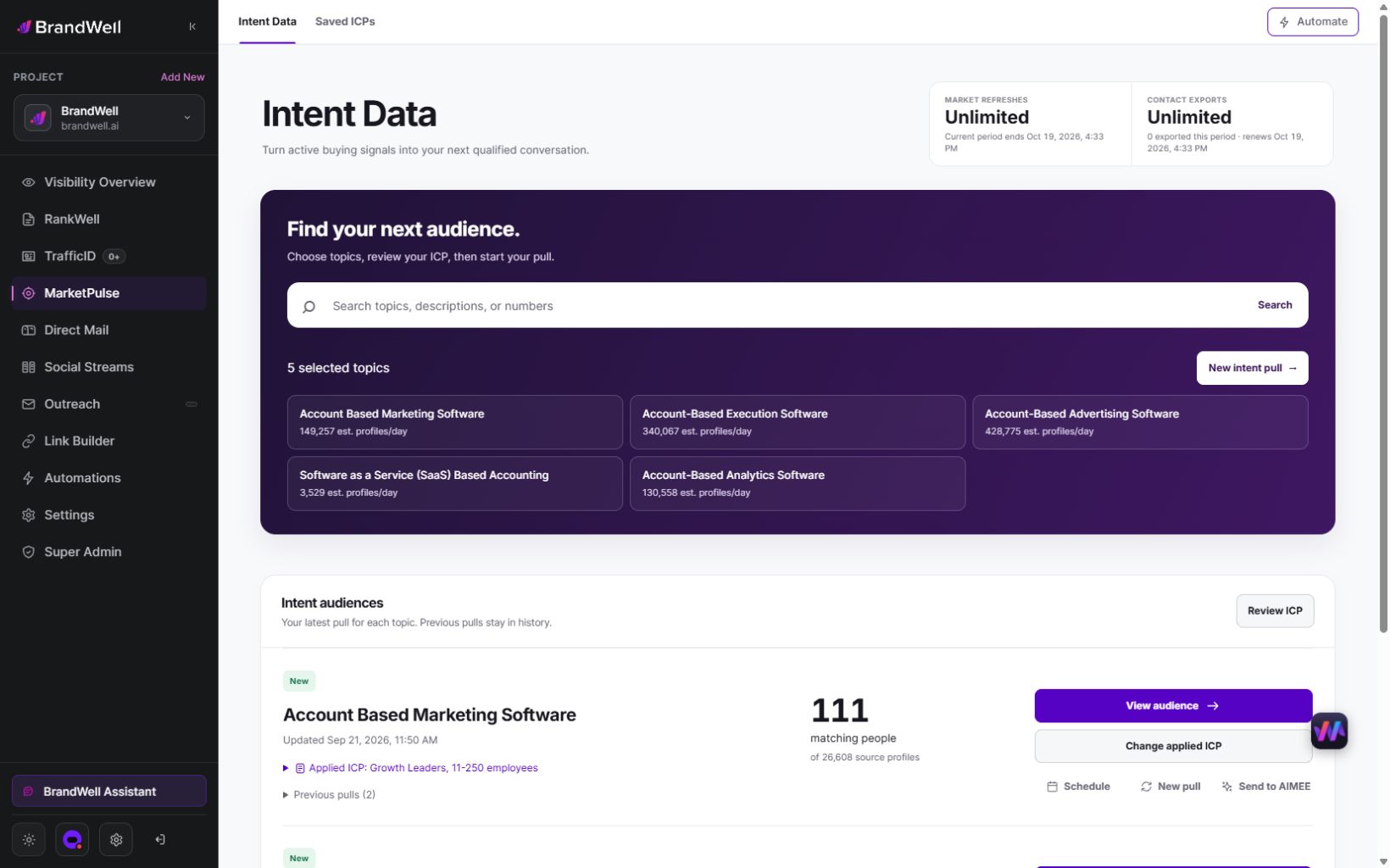
MarketPulse plans are starting at $500/mo. Verify current package scope and offers on the product page.
| Plan | Topics and refreshes | Monthly exports |
|---|---|---|
| Starter | 1 topic, weekly | 25,000 contacts |
| Growth | 3 topics, daily | 100,000 contacts |
| Scale | 10 topics, daily | Unlimited contacts |
Swipe the table to see all columns.
A pull retrieves available data from the previous 24 hours for one topic. Daily use across all included topics provides 90 Growth pulls or 300 Scale pulls in a 30-day month. Weekly Starter pulls vary by calendar month. Available audience size and contact fields vary, and audiences may overlap. Refreshes stop at the plan limit without overage charges.
- Find and qualify: search the topic catalog, save your ICP, and review the people and companies that match.
- Act on the research: export qualified contacts or prepare an Outreach or Direct Mail workflow. Connected products, channel usage, and fulfillment may cost extra.
- Get help from AIMEE: Growth and Scale include AIMEE for the initial user to research accounts and prepare the next step through connected tools.
Agencies and other service businesses can build client deliverables around their available Intent Scans and exports. Keep each client’s scope, permissions, and service fees clear. A subscription is not a promise of a white-label platform or exclusive access to a market.
Explore MarketPulse and watch the demo or compare plans starting at $500/mo. Any early-access discount is a separate, time-limited offer shown to an eligible recipient.
Choose a reversible service promise
Offer the service when a client cannot reliably connect permitted company, contact, and engagement records well enough to run an agreed workflow. The responsible promise is improved record usability: fewer unresolved conflicts, explicit confidence states, documented corrections, and cleaner handoff into a client-approved destination. That outcome is within the service’s operational scope. The agency should not promise that every record will resolve or that a resolved record represents a buyer.
Start with one use case. Examples include reconciling duplicate business contacts before routing, linking approved engagement records to known accounts, or identifying records that require manual research. Avoid a vague promise to create a universal customer view. A universal view hides material choices about source rights, person versus company identity, recency, precedence, and deletion.
The decision changes if the client lacks a permitted purpose, reliable source keys, a correction process, or a person authorized to accept risk. In that case, sell a bounded data audit or refer the work rather than positioning identity resolution expert services as a turnkey answer. The strategy should reduce ambiguity, not make uncertainty invisible.
Assign match review and correction owners
Begin with a signed source and purpose register. The client data owner identifies approved systems, fields, retention, permitted destinations, and exclusions. A technical operator profiles formats and identifiers. A privacy or legal reviewer handles fact-specific questions. A quality lead tests match rules and samples. The account lead manages acceptance, exceptions, and the client handoff.
- Receive only the approved source extract or authorized connection.
- Validate schema, required fields, freshness, duplicates, and suppression input.
- Apply deterministic rules first, then clearly labeled probabilistic candidates if allowed.
- Quarantine conflicts and sensitive or out-of-scope records.
- Run a sampled quality review across match states and important client segments.
- Deliver the accepted record, provenance, confidence, exception reason, and correction path.
- Confirm destination acceptance, client action, and any rollback or suppression request.
The SLA should measure work the agency controls: intake acknowledgement, validation completion, exception response, approved delivery cadence, and correction turnaround. It should exclude delays caused by missing client files, unavailable access, or pending approvals. A strong handoff includes a data dictionary, rulebook, exception queue, delivery receipt, and named owners. Use the companion lead and intent-data quality assurance guide to define sample checks and acceptance evidence.
Evaluate the supported matching stack
The best choice is not a universal vendor. It is a capability stack that fits the client’s permitted sources, identity states, volume, integrations, and review capacity. Evaluate every option against the same criteria: supported identifiers, deterministic and probabilistic controls, rule transparency, confidence output, provenance, recency, conflict handling, correction and deletion, exports, access control, logging, support, and total cost.
A practical stack has six layers: secure intake, source profiling, match engine, human exception queue, client-facing evidence view, and destination connector. A spreadsheet can support a small controlled pilot, but it becomes fragile when multiple people edit identifiers or when correction history matters. A custom build offers rule control but creates maintenance, security, and testing obligations. A managed or white-label platform can shorten setup if its contracts, controls, and fields fit the use case.
AIMEE can organize approved source evidence and draft an account brief through configured connected tools. It does not establish a native custom identity graph, a white-label match engine or verified certainty about an unresolved person.
Compare build, resell, refer and avoid
| Model | Choose it when | Main limitation |
|---|---|---|
| Build | The client needs distinctive rules, approved engineering support, and long-lived maintenance. | The agency owns testing, security, observability, corrections, and change risk. |
| Resell or white-label | A contracted platform supports required identifiers, evidence, and agency branding. | The agency still owns scope, client expectations, and delivery quality. |
| Refer | The use case demands specialized identity, legal, security, or implementation expertise. | The agency controls less of the experience and recurring value. |
| Avoid | Purpose, rights, identity boundaries, or client approvals are unclear. | Walking away protects the client and agency from an unsafe service. |
Swipe the table to see all columns.
Use a decision guide rather than a feature comparison. Score purpose clarity, source rights, rule complexity, explainability, correction needs, integration effort, and recurring ownership. One-off list cleanup is an alternative when the records are static and no ongoing match process is needed. Unmanaged software referral may fit a mature client team. The common mistake is reselling a tool while leaving workflow and accountability undefined.
Price sources and exception review
Set retail pricing from a measured cost model, not an unverified market benchmark. Separate setup from recurring delivery. Setup can include source audit, schema mapping, rule design, test sample, destination configuration, and client training. Recurring cost can include platform wholesale and usage, operator review, quality sampling, support, corrections, reporting, security work, and allocated overhead.
Copyable identity service pricing worksheet
Monthly delivery cost = wholesale and usage + labor + QA + support + integration maintenance + governance + allocated overhead
Defined contribution dollars = collected client fee - defined delivery cost
Defined contribution percentage = defined contribution dollars / collected client fee
Capacity reserve = expected conflict review + correction work + source-change buffer
A realistic gross margin is unavailable until the agency measures its own workload, usage, collection, and exception rate. Model low, expected, and high-review cases. Reprice when source count, identity depth, match policy, destinations, cadence, or approval burden changes. Do not count unpaid client delays as free capacity.
Preserve match and outcome evidence
Use an evidence ladder. First prove delivery: records received, processed, classified, reviewed, corrected, suppressed, and accepted. Next prove use: accepted records reached the approved destination and a client owner took a recorded action. Then observe downstream associations in the client’s system, preserving its definitions for sourced, influenced, associated, or unknown.
Identity resolution KPIs should include conflict rate, accepted deterministic matches, reviewed probabilistic candidates, false-match findings from a labeled sample, correction rate, suppression completion, destination acceptance, and time to resolve exceptions. Benchmark against the client’s own baseline and stable rule set. External identity resolution services benchmarks are not a substitute for comparable definitions.
For ROI analysis, show the numerator and denominator. If the only defensible benefit is reduced manual review time, label it as observed or estimated operational efficiency with assumptions. If the client associates qualified opportunities with accepted records, report that association and its method. Do not claim that matching caused pipeline or revenue. For a broader evidence design, connect the record to an approved CRM workflow through the intent-data integration guide.
Choose clients with an approved purpose
Best-fit clients have multiple approved B2B data sources, a defined activation decision, persistent duplicate or incomplete records, a stable CRM owner, and enough operational capacity to review conflicts. Useful identity resolution services use cases include account routing, approved engagement reconciliation, duplicate control, and pre-activation quality checks.
Exclude or pause clients that request identity certainty, want to infer a person’s behavior from a company signal, cannot document data rights, refuse suppression, lack a system owner, or plan sensitive eligibility, employment, housing, credit, insurance, or similar consequential decisions without specialized review. Also exclude clients that want a one-time list but expect an ongoing outcome guarantee.
A quick fit checklist asks: Is purpose written? Are source and destination rights approved? Are company, person, household, and contact identities separated? Is uncertain matching allowed? Who reviews exceptions? Can the client correct and suppress? Is the activation proportionate? Is the business outcome measurable without inventing causation? A no on several items signals an audit, referral, or no-service decision.
Keep entity and confidence states separate
Build a match record that keeps the chain visible: source, observed identifier, source timestamp, permitted purpose, entity type, rule applied, confidence state, conflict, reviewer, correction, suppression state, destination, client action, and outcome evidence. Deterministic evidence might use an exact approved key. Probabilistic evidence combines weaker attributes and must remain a candidate rather than becoming silent fact.
Company-level topic research can support account prioritization, but it does not establish which person researched or whether anyone has authority, budget, or readiness. Contact validation can establish that a field passed a particular validation process, not that outreach is permitted or welcome. Household identity should never be substituted for business identity unless the contracted purpose and authorized review explicitly support it.
Activation workflows should scale with confidence. A high-confidence company match may enter account research. A verified and permitted contact can enter human-reviewed outreach. A conflict stays in quarantine. An unresolved record remains unresolved. This signal quality and measurement discipline makes implementation examples auditable and reversible.
Control source and matching risks
Quality risks include stale identifiers, shared domains, name collisions, source disagreement, rule drift, and sample bias. Delivery risks include broken mappings, duplicate exports, incomplete suppression, and destination rejection. Privacy risks include purpose expansion, excess fields, uncontrolled copies, weak access, and delayed deletion. Expectation risk appears when confidence is presented as certainty.
Put purpose, allowed fields, source and destination rights, correction, suppression and retention decisions in the service record. Authorized client, legal and security reviewers must assess the actual program. This operating checklist is not certification or a legal conclusion.
Put limitations beside the result. State the entity level, rule, confidence, source recency, and known conflict. If a fact is unavailable, mark it unavailable. Never join fields beyond contracted and approved use just because the technology permits it.
Maintain the recurring resolution package
A recurring package should define approved sources and destinations, match states, rulebook, sample QA, exception review, corrections, suppression, delivery cadence, service levels, reporting, change control, and a client responsibility schedule. State what is standard, configurable, custom, and out of scope. Include an acceptance template and a monthly rule-change record.
MarketPulse supplies topic audiences and saved ICP filtering starting at $500/mo. Review available fields and source context before preparing an approved next step through connected tools. A bespoke identity-resolution service needs its own rulebook, integration, reviewed implementation and fees.
For the first recurring cycle, limit the rulebook to identifiers the client can explain and correct. Report how many records entered each match state, why exceptions occurred, which corrections changed the output, and whether the approved destination accepted the release. Hold a rule review before adding sources. This gives the client a useful identity resolution services template while keeping rule growth, service cost, and error exposure visible.
Copyable agent-ready match review
Use Claude, ChatGPT, or AIMEE to prepare an identity-resolution review from the approved rulebook and a minimized sample.

1. List each source, entity type, permitted purpose, freshness rule, and destination.
2. Separate deterministic matches, probabilistic candidates, conflicts, suppressions, and unresolved records.
3. Flag missing provenance, stale values, cross-entity joins, and rules that cannot be reproduced.
4. Draft an exception queue, correction log, and client acceptance checklist.
5. Explain uncertainty in plain language and cite the exact input used.

STOP CONDITIONS:
- Do not infer identity, authority, budget, intent, permission, or sensitive traits.
- Do not invent a match, source right, benchmark, price, or result.
- Do not export data, change rules, activate a record, or contact anyone.

HUMAN APPROVAL REQUIRED:
The client data owner approves sources and destinations. Authorized privacy, legal, and security reviewers approve applicable use. A trained reviewer accepts uncertain matches. The agency owner approves scope and price. A human approves every activation and release.
Claude, ChatGPT, or AIMEE can organize evidence and draft review materials. The agent should never turn an uncertain match into fact or bypass a human decision. That boundary keeps the package useful as the source mix changes.
Start with one reversible identity decision
Choose one client use case, one approved destination, and a small test sample. If the team cannot explain, correct, suppress, and reverse every match state, improve the service design before expanding it.
More links do not automatically mean better matching
ONS’s data linkage and matching policy separates match volume from linkage quality and distinguishes incorrect links from missed links. Its scope is research and statistics; apply the measurement distinction to your agency pilot without claiming ONS approval.
Review linked and unresolved cases against a defined reference sample. State how the sample was chosen, which entity is being matched, which sources were allowed and which cases remain uncertain. A review of only easy exact matches cannot establish quality for the full output or reveal every missed match.
Worked example: match yield, reviewed correctness and cost
Suppose a fictional intake contains 1,000 approved source records. The process links 700 and leaves 300 unresolved. Link yield is 700 / 1,000 = 70%; it is not a correctness measure. In a separately described sample of 100 linked records, a reviewer confirms 92 and finds eight incorrect links. Reviewed correctness is 92 / 100 = 92% in that sample, not a proven rate for every client or source. Do not infer recall without a reference that can identify missed true matches.
Suppose 500 of the linked records also pass the client’s destination and use checks. Approved-delivery yield is 500 / 1,000 = 50%, or 500 / 700 = 71.4% of linked records. Record why the other 200 linked records were held back; a technically linked field does not authorize its use.
If tools cost $500, review costs $750, quality checks cost $250 and maintenance costs $200, defined recurring cost is $1,700. That is $1.70 per intake record, $2.43 per linked record and $3.40 per approved delivered record. At a $2,500 fee, the $800 remainder is 32% before acquisition, setup recovery, general overhead, financing and tax. Ten extra review hours at $75 reduce it to $50, or 2%. Counts, labor and fees are invented planning inputs, not typical provider results or BrandWell agency terms.
Review the source context in BrandWell
In MarketPulse, review a topic and its matching audience through the saved client ICP. Preserve the actual preceding-24-hour pull window and available contact or company fields. For TrafficID, preserve the separate own-site visitor event and its supported identity context. Do not turn company activity into proof that a named employee personally performed it. AIMEE can help draft evidence and review materials through configured tools; keep custom joins, exports and activation within the authorized implementation.
Frequently asked questions
Is a 70% match rate a quality score?
No. It describes the defined linked proportion, not how many links are correct.
Can a linked contact automatically be contacted?
No. The destination, purpose, permission and suppression checks are separate.
Does reviewing linked records establish recall?
No. Recall also requires evidence about true matches that the process missed.
Does BrandWell promise a custom identity-resolution engine?
The current products supply their supported research and visitor workflows. Bespoke matching needs separate verified scope.
Review the supported research input: explore MarketPulse plans starting at $500/mo.
Reviewed and updated October 3, 2026.

Written by