On this page
- Define the measurement decision first
- Use seven evaluation-design steps
- Preserve the versioned decision log
- Compare five measurement approaches
- Current MarketPulse research workflow
- Separate product and agency responsibilities
- Budget full incremental costs
- Review bias and permission boundaries
- Copyable assistant ROI-review brief
- Answers to ten ROI-measurement questions
- Review a bounded research workflow
- Worked example: a meeting-rate difference is not realized ROI
- Frequently asked questions
Evaluate an intent-data workflow by defining the eligible population, observed signal, approved action, downstream outcome and credible comparison before reviewing results. Intent data supplies evidence for a decision. Associated meetings, pipeline or sales do not by themselves prove that the workflow caused those outcomes or paid back its full cost.
Who this is for: Agency analysts, client-success leaders, RevOps teams, and executives responsible for reporting, renewal, experimentation, and profitability of intent-data programs.
Define the decision intent data is intended to inform. It should never be presented as proof that a person is ready to buy or as permission for an unreviewed action.
Current MarketPulse offer: intent-data plans start at $500/mo. See the product, demo, and current plans. Updated October 3, 2026.
Define the measurement decision first
The measurement plan should inform a real decision: expand a topic, change a threshold, keep a source, alter an action, renew a package, or stop. Freeze definitions and comparison logic before reading results. When volume is small, use directional evidence and report uncertainty rather than manufacturing precision.
Use seven evaluation-design steps
- 1. Define the eligible accounts, unit of analysis, decision, and outcome.
- 2. Freeze signal, identity, fit, action, meeting, opportunity, and revenue definitions.
- 3. Choose a baseline, matched comparison, holdout, staggered rollout, or before-after design.
- 4. Log exposure, acceptance, action, timing, cost, and downstream disposition.
- 5. Separate data quality, operator adoption, sales execution, and market conditions.
- 6. Analyze segments, confidence, contamination, and alternative explanations.
- 7. Report what changed, what remains uncertain, and the next stop-or-expand decision.
Preserve the versioned decision log
Maintain one versioned record from the first client question through the final commercial decision. Record the eligible market, topic definition, signal source, observed time, identity state, validation state, fit decision, suppressions, reviewer, approved next action, downstream disposition, and fully loaded cost. Do not overwrite rejected, expired, duplicated, or corrected evidence. Preserve the original record and add a reason-coded disposition so the agency can explain what changed. Review the log with the client at an agreed cadence, then use the evidence to tighten qualification, remove noisy topics, revise service scope, and decide whether to stop or expand. This operating record is also the source for renewal reporting, exception handling, and any claim about adoption or outcomes. A polished dashboard without this audit trail can hide weak process quality instead of improving it.
The first control for this workflow is: Define the eligible accounts, unit of analysis, decision, and outcome. The final control is: Report what changed, what remains uncertain, and the next stop-or-expand decision. Those bookends keep the service tied to a buyer decision rather than raw signal volume.
Add a short review note whenever the policy, topic definition, client scope, source, identity rule, activation path, or outcome definition changes. The note should identify who approved the change, which records or clients it affects, and whether earlier results remain comparable. This helps expose process changes that might otherwise be mistaken for performance improvements. It also gives account teams a plain-language explanation when volume, acceptance, cost, or outcomes move between reporting periods.
Compare five measurement approaches
1. Randomized holdout
Consider when eligible accounts can be randomly assigned and treatment is controlled under a preplanned design.
Watch-out: Requires enough units, operational discipline, and ethical treatment.
2. Matched comparison
Useful when randomization is impractical and similar untreated accounts can be selected.
Watch-out: Unobserved differences can still bias results.
3. Staggered rollout
Useful when all clients or accounts will eventually receive the workflow.
Watch-out: Time trends and spillover need analysis.
4. Cohort or funnel analysis
Useful for diagnosing acceptance, action, meeting, and opportunity progression.
Watch-out: It describes association and should not be labeled causal by default.
5. Before-after comparison
Easy to communicate and useful for operational monitoring.
Watch-out: Seasonality, market changes, seller changes, and regression to the mean can mislead.
Current MarketPulse research workflow
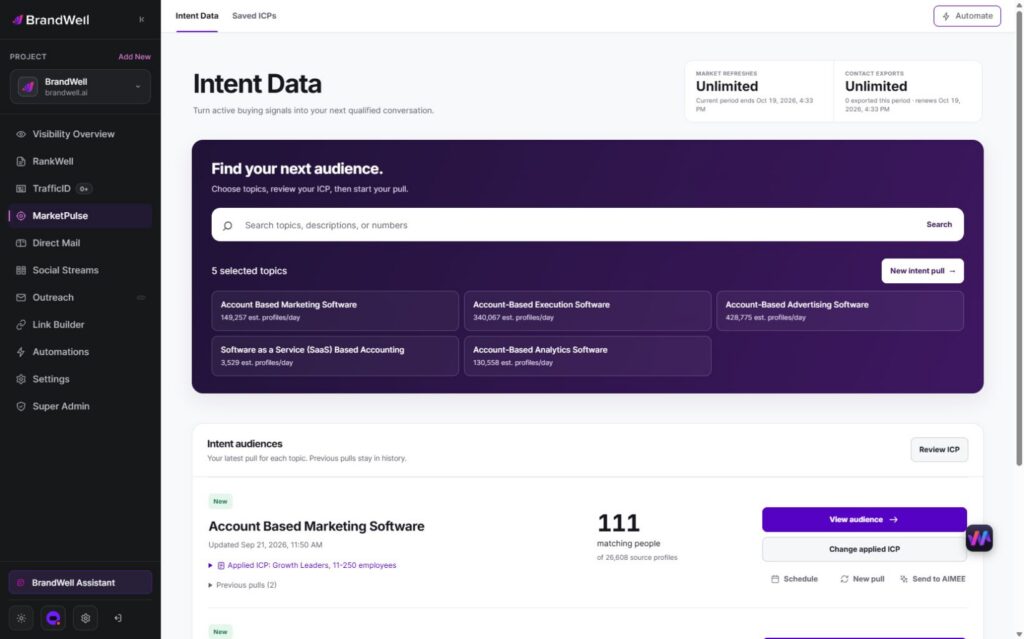
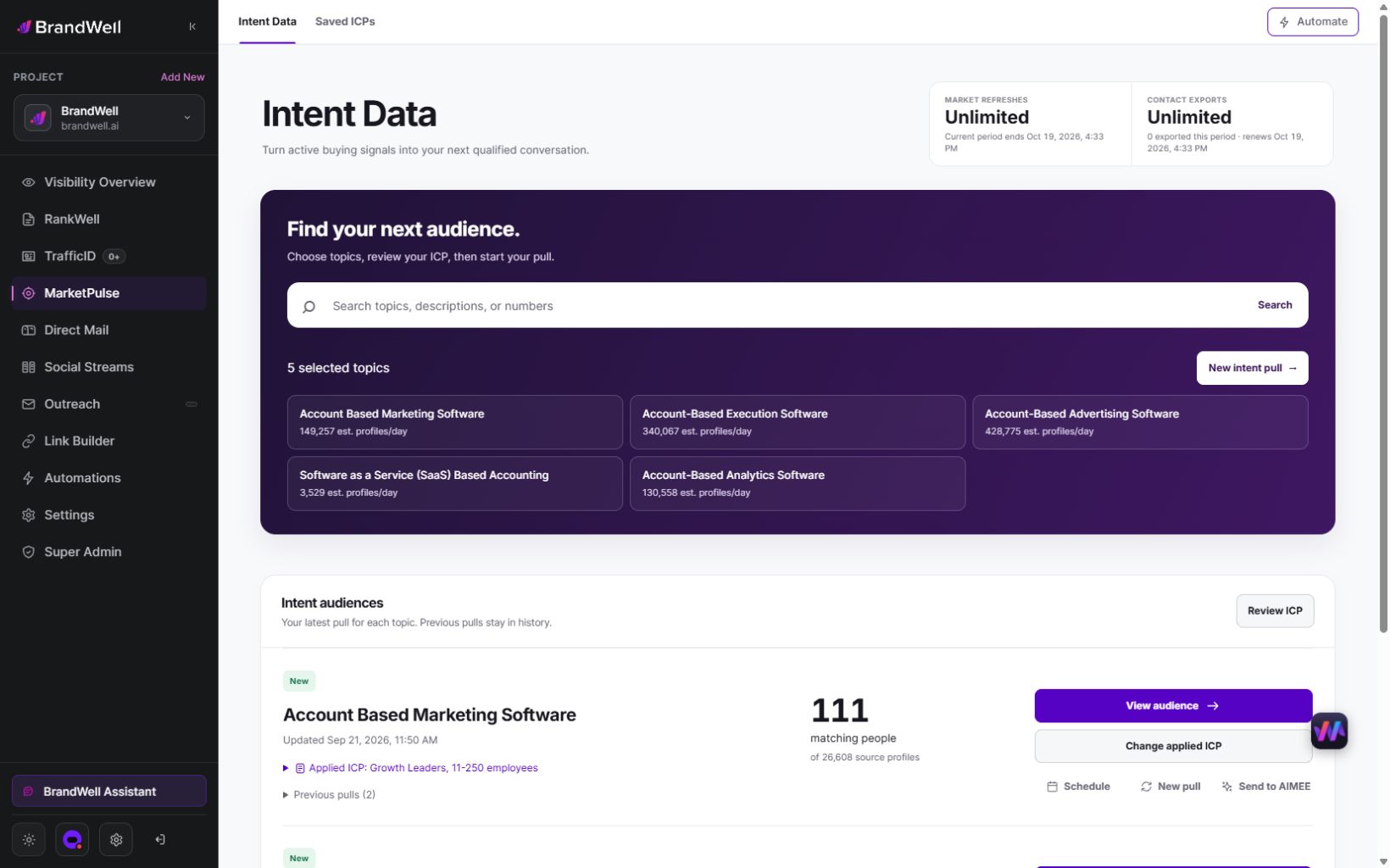
BrandWell MarketPulse: intent data starting at $500/mo. Find people researching topics relevant to what you sell, apply saved ICP filters, and review available contact details before taking action.
MarketPulse plans are starting at $500/mo. Verify current package scope and offers on the product page.
| Plan | Topics and refreshes | Monthly exports |
|---|---|---|
| Starter | 1 topic, weekly | 25,000 contacts |
| Growth | 3 topics, daily | 100,000 contacts |
| Scale | 10 topics, daily | Unlimited contacts |
Swipe the table to see all columns.
A pull retrieves available data from the previous 24 hours for one topic. Daily use across all included topics provides 90 Growth pulls or 300 Scale pulls in a 30-day month. Weekly Starter pulls vary by calendar month. Available audience size and contact fields vary, and audiences may overlap. Refreshes stop at the plan limit without overage charges.
- Find and qualify: search the topic catalog, save your ICP, and review the people and companies that match.
- Act on the research: export qualified contacts or prepare an Outreach or Direct Mail workflow. Connected products, channel usage, and fulfillment may cost extra.
- Get help from AIMEE: Growth and Scale include AIMEE for the initial user to research accounts and prepare the next step through connected tools.
Agencies and other service businesses can build client deliverables around their available Intent Scans and exports. Keep each client’s scope, permissions, and service fees clear. A subscription is not a promise of a white-label platform or exclusive access to a market.
Explore MarketPulse and watch the demo or compare plans starting at $500/mo. Any early-access discount is a separate, time-limited offer shown to an eligible recipient.
Separate product and agency responsibilities
BrandWell MarketPulse is topic-based intent-data software for businesses and agencies. Choose relevant research topics, apply saved ideal-customer-profile filters, review available names, roles, companies and contact details, and export the audience or prepare a connected workflow. Plans start at $500/mo. TrafficID identifies visitors to your own website and is a separate product. A MarketPulse subscription does not by itself promise a white-label portal, custom API implementation, exclusive topics, or managed client delivery.
Review an available MarketPulse topic, saved ICP and actual preceding-24-hour matches for the agreed research purpose. AIMEE can organize supplied company context through configured tools. Experiment assignment, CRM joins and client ROI reporting require actual source access, separate implementation and analyst review.
Use the current plan table above for standard topic, refresh and export allowances. Eligible early-access pricing is separate. Include actual agency measurement, implementation and channel usage when estimating workflow costs.
Scope the measurement around transparent inputs, human review, a client action and actual outcome return. MarketPulse supplies research; custom joins, experiment logic and ROI reporting require separate implementation. A subscription does not validate those downstream measurements.
Budget full incremental costs
Include platform and data fees, agency labor, implementation, integrations, enrichment, validation, media or outreach, sales research, measurement, privacy review, corrections, and opportunity cost. Use contribution margin and payback only when revenue definitions and cost allocation are explicit.
Use a stop-or-expand scorecard
Track coverage, no-match rate, signal age, reviewer acceptance, action within SLA, qualified meeting rate, opportunity rate, pipeline, closed revenue where available, contribution margin, cost per accepted signal, corrections, complaints, and opt-outs. Segment by topic, source, identity state, action, and client.
Important: Intent signals are probabilistic evidence. They do not prove identity, consent, need, authority, budget, stage, qualification, purchase, pipeline, or revenue. Report association and uncertainty honestly.
Review bias and permission boundaries
Selection bias, prioritization, overlapping campaigns, identity errors, small samples, inconsistent windows and delayed outcomes can distort the comparison. Google’s Meridian causal-inference documentation explains that observational causal estimates depend on assumptions; model fit alone does not establish valid causal inference. This is a methodological reference, not evidence that BrandWell implements Meridian or that an agency has demonstrated lift.
Review actual source rights, client purpose, necessary fields, access, retention and destination permissions. Preserve unknown identity and missing feedback. Require named approval for the actual CRM, audience, spending or outreach action; a measurement report does not authorize those actions.
- Preserve source, observed time, identity state, confidence, and validation status.
- Separate known people, candidate people, companies, domains, and unresolved visitors.
- Apply customer, employee, competitor, duplicate, geography, consent, and opt-out suppressions before action.
- Require a named human approval before CRM writes, audience uploads, spend, or outreach.
- Give clients correction, export, deletion, escalation, and offboarding paths.
Copyable assistant ROI-review brief
AIMEE can prepare an approved evidence brief through configured connected tools. Preserve cohort assignment, original timestamps, cost definitions and missing outcomes. Named analysts review claims and actual CRM writes; an assistant summary does not establish causal lift.
Objective: Prepare an intent ROI analysis from approved cohort definitions, exposures, actions, costs, outcomes, and exclusions. Check missingness, overlap, identity states, sample size, contamination, and alternative explanations. Produce descriptive results and uncertainty. Do not label an association causal or alter the client report without analyst approval.
Inputs: approved ICP, topic dictionary, signal source and time, identity state, CRM lifecycle, suppressions, permitted-use policy, and current written commercial scope.
Rules: preserve provenance and uncertainty; never infer budget, authority, consent, or purchase readiness; never expose private behavior in messaging; stop before external action.
Output: decision, reason codes, missing evidence, recommended next step, and audit log.
Keep actual sources, assumptions, missing values, proposed calculations and reviewer together. Reconcile the output against the preplanned cohort, client scope and cost records. Do not change definitions or omit negative results to manufacture a favorable ROI claim.
Answers to ten ROI-measurement questions
What should an agency decide before proving intent-data ROI to agency clients, and what client outcome can it responsibly promise?
The measurement plan should inform a real decision: expand a topic, change a threshold, keep a source, alter an action, renew a package, or stop. Freeze definitions and comparison logic before reading results. When volume is small, use directional evidence and report uncertainty rather than manufacturing precision.
What workflow, owners, SLA, quality checks, approvals, and client handoff does an intent-data ROI measurement plan require?
Assign a named agency owner, client owner, operator, and technical or CRM owner. The operating sequence is: 1) Define the eligible accounts, unit of analysis, decision, and outcome. 2) Freeze signal, identity, fit, action, meeting, opportunity, and revenue definitions. 3) Choose a baseline, matched comparison, holdout, staggered rollout, or before-after design. 4) Log exposure, acceptance, action, timing, cost, and downstream disposition. 5) Separate data quality, operator adoption, sales execution, and market conditions. 6) Analyze segments, confidence, contamination, and alternative explanations. 7) Report what changed, what remains uncertain, and the next stop-or-expand decision. Set the response SLA, log exceptions, preserve uncertainty, and require a client handoff with permitted next steps and ownership.
Which platforms, tools, templates, calculators, and integrations best support proving intent-data ROI to agency clients?
Start with the operating resources described in this guide: Randomized holdout, Matched comparison, Staggered rollout, Cohort or funnel analysis, Before-after comparison. Support them with a qualification scorecard, topic dictionary, evidence card, cost model, proposal, CRM disposition fields, client report, and approval checklist. Software should support the workflow rather than define it.
How do randomized holdout, matched comparison, staggered rollout, cohort, and before-after approaches compare for proving intent-data ROI to agency clients?
A randomized holdout compares assigned groups under a preplanned design. A matched comparison requires comparable observed attributes and can retain unmeasured differences. A staggered rollout must account for timing, secular changes and spillover. Cohort analysis describes progression and missing feedback rather than automatically estimating causation. Before-after monitoring is vulnerable to seasonality and concurrent changes. Choose the design for the actual question, feasible sample and observation window, and document which assumptions the data cannot verify.
Which platform, data, labor, integration, activation, measurement, and opportunity costs belong in an intent-data ROI calculation?
Include platform and data fees, agency labor, implementation, integrations, enrichment, validation, media or outreach, sales research, measurement, privacy review, corrections, and opportunity cost. Use contribution margin and payback only when revenue definitions and cost allocation are explicit.
Which baseline, conversion, pipeline, revenue, cost, margin, and confidence metrics make intent-data ROI decision-useful?
Track coverage, no-match rate, signal age, reviewer acceptance, action within SLA, qualified meeting rate, opportunity rate, pipeline, closed revenue where available, contribution margin, cost per accepted signal, corrections, complaints, and opt-outs. Segment by topic, source, identity state, action, and client.
Which clients are ready for an intent-data ROI measurement plan, and which prospects should the agency exclude?
Agency analysts, client-success leaders, RevOps teams, and executives responsible for reporting, renewal, experimentation, and profitability of intent-data programs. Best-fit clients also have a clear ICP, sufficient addressable market or qualified traffic, relevant commercial topics, a named action owner, measurable CRM outcomes, conservative economics, and privacy readiness. Exclude clients demanding guaranteed leads, universal identity, prohibited use, or automation without review.
Which signal sources, identity checks, qualification rules, activation steps, and outcome evidence matter most for an intent-data ROI measurement plan?
Combine relevant topic or first-party behavior with fit, recency, recurrence, identity state, enrichment and validation, suppressions, human acceptance, an approved activation path, and outcome return. Keep every evidence type separate so an inference does not become a false fact.
Which data-quality, privacy, security, scope, billing, delivery, and client-trust risks must the agency control for an intent-data ROI measurement plan?
Selection bias, prioritization, overlapping campaigns, identity errors, small samples, inconsistent windows and delayed outcomes can distort the comparison. Google’s Meridian causal-inference documentation explains that observational causal estimates depend on assumptions; model fit alone does not establish valid causal inference. This is a methodological reference, not evidence that BrandWell implements Meridian or that an agency has demonstrated lift.
What should an intent-data ROI report disclose before a stop, revise, expand, or renewal decision?
A recurring package should connect the client decision to the operating path described in five measurement approaches for intent-data roi. Define the eligible market, topics, signals, identity states, qualification policy, branded deliverable, portal or export, action SLA, approvals, usage, pricing, scorecard, governance, support, change control, and offboarding. Expand only after the client uses the first module well.
Review a bounded research workflow
Assess the audience and the operating cost before expanding the service. Explore MarketPulse with the data, tools, and client delivery scope you need.
Worked example: a meeting-rate difference is not realized ROI
Assume a fictional preplanned comparison randomly assigns 400 eligible accounts into two groups of 200. During the same observation window, 16 treatment accounts and ten control accounts hold qualified meetings under the same definition. Meeting rates are 8% and 5%: a three-percentage-point difference, or 60% relative lift. The observed difference corresponds to six additional meetings in the equally sized treatment group.
Those counts alone do not establish statistical certainty or financial payback. Check assignment integrity, treatment delivery, cross-group contamination, missing outcomes, sample size and the chosen inference method. Do not replace the denominator with only contacted or responding accounts after seeing the results. Meetings are not closed sales, and relative lift is not a 60% return on investment.
Calculate return from incremental contribution
For a separate financial illustration, suppose a defensible estimate attributes $6,000 of incremental net sales to the workflow. At a stated 40% contribution rate before the workflow’s own costs, that is $2,400 in incremental contribution. If data costs $500, review labor $750, sending $250 and measurement $500, workflow cost totals $2,000. Net incremental remainder is $400; ROI is $400 divided by $2,000, or 20%. Use actual cost categories once.
The same assumed contribution rate requires $5,000 in incremental net sales to cover the $2,000 workflow cost. Another $500 in correction work would turn the $400 remainder into a $100 loss and ROI into negative 4% of the revised $2,500 cost. The contribution-rate assumption, sales estimate and observation window must be defensible. These invented calculations are not typical BrandWell outcomes; excluded general overhead, tax and financing can further change the result.
Prepare a supported BrandWell research input
Review an available MarketPulse topic, saved ICP and actual preceding-24-hour matches against the written research purpose. Verify public company context and preserve uncertain fields. TrafficID is separately scoped own-site visitor work. AIMEE can organize supplied records through configured tools; analysts approve the design, joins and published calculations. Source rights and actual destination eligibility are still required before Outreach enrollment or audience upload.
Frequently asked questions
Is 8% versus 5% a 3% relative lift?
No. It is three percentage points and 60% relative lift.
Does a higher meeting rate prove financial ROI?
No. Evaluate realized incremental contribution and full workflow cost.
Can a model with good fit still give invalid causal estimates?
Yes. Review the actual causal assumptions and design.
Is a displayed MarketPulse count a lift study?
No. It shows research availability, not a controlled outcome comparison.
Review the research product: explore MarketPulse and current plans.
Reviewed and updated October 3, 2026.

Written by