On this page
- Define the decision before labeling an error
- Diagnose ambiguous, stale or misassociated signals
- Use five control gates before sales acts
- Route records to action, research or suppression
- Build a representative review and an edge-case test
- Choose the right denominator
- Budget the review and correction work
- Use tools and templates that support an audit trail
- Match the evidence to the action
- Apply privacy and data-quality controls before activation
- Manage false positives in an agency client program
- Turn every rejection into a better rule
- A fictional review with four outcomes
- Review a MarketPulse topic before activation
To reduce false positives in a B2B intent workflow, define the action a record must qualify for, then check fit, identity, freshness, exclusions and supporting evidence. Topic research is not automatically a buying project or permission to contact a named person. Preserve the difference between a valid source event and a record suitable for a particular sales action.
This is a proposed operations playbook for sales, marketing, RevOps and service teams. It is not a vendor accuracy ranking. Review both accepted and rejected records and keep uncertain cases out of statistics that require a reliable reference label.
Define the decision before labeling an error
A false positive exists only relative to a declared positive class. If “positive” means “an account had topic research associated with it,” then the provider may have delivered exactly that event even when no sales opportunity exists. If “positive” means “sales should contact a verified buying-group member this week,” the same event is far from sufficient.
Write three labels before auditing:
- Technical positive: the source and association match the supplier’s documented definition.
- Operational positive: the record meets the business’s fit, identity, freshness, suppression, and action requirements.
- Commercial positive: the action produces the defined qualified outcome.
These labels prevent an unproductive argument. A technically valid account-topic event can be an operational rejection. An operationally sensible seller task can fail to create a meeting. Neither result alone proves fraud or proves that the entire source is bad.
Also record false negatives: useful accounts that the workflow missed. Tightening every threshold can produce a beautiful queue that overlooks too much of the market. The correct threshold depends on the cost of review, the harm of a mistaken action, seller capacity, deal value, and the cost of missed demand.
Diagnose ambiguous, stale or misassociated signals
Topic ambiguity: A broad term can describe education, employment, implementation, research, customer support, or competitor activity. Break topics into problem, category, use-case, and vendor layers, and add exclusions.
Account association error: Shared networks, remote work, VPNs, service providers, subsidiaries, and public facilities can create a wrong or overly broad account link. Preserve the method and confidence; do not promote an account match into a person claim.
Identity overreach: A provider may identify a likely company or suggest plausible contacts. The workflow falsely presents a named person as the visitor or researcher. Store known contact, visitor, account, and candidate as different states.
Stale evidence: A real signal can become irrelevant after a product decision, budget change, employee departure, completed implementation, or expiration of the buying window. Every signal needs an action-specific expiry.
Duplicate amplification: The same underlying event appears in several feeds, days, devices, or integrations and looks like independent corroboration. Deduplicate by event lineage while keeping source provenance.
Lifecycle confusion: Customers, partners, employees, job candidates, investors, agencies, and competitors can research the topic. Fit alone does not tell the workflow which lifecycle path applies.
Threshold incentives: Teams tune scores to produce the volume promised to executives or clients. A fixed delivery quota turns ambiguous evidence into “intent” rather than exposing insufficient supply.
Outcome-label error: Sellers mark records bad because timing or messaging was poor, or mark them good because the account was already in pipeline. Review outcomes with context before training suppression rules.
Use five control gates before sales acts
Apply the same criteria to each gate: best fit and exclusions, inputs, implementation owner, privacy or governance risk, cost drivers, measurement, and a meaningful limitation.
1. ICP-fit gate
Best fit: Use this first whenever the service has a defined market, geography, account type, customer state, and disqualification policy. Exclude accounts the business cannot or should not serve.
Inputs and ownership: Required fields can include industry, size, region, technology, customer or partner status, product fit, territory, and account owner. RevOps owns the rule; sales and marketing agree on exceptions.
Cost, measurement, and governance: Costs include enrichment, data hygiene, account hierarchy, and exception review. Measure excluded supply, missing fields, override rates, and qualified outcomes by fit tier. Minimize unnecessary personal fields.
Meaningful limitation: Fit identifies plausible customers, not current demand. A perfect-fit account can still have no project, and a nonstandard account may become a valid exception.
2. Identity-confidence gate
Best fit: Use it whenever action changes by identity level. Account research may proceed with an account match; personal outreach may require a verified contact and a lawful, appropriate channel.
Inputs and ownership: Store resolution unit, method, source, confidence, timestamp, domain, account hierarchy, known-contact evidence, validation, and no-match. Data operations owns resolution; privacy and channel owners set action boundaries.
Cost, measurement, and governance: Include identity or enrichment services, validation, review, correction, and deletion operations. Measure account-level acceptance separately from person-level correctness and contact validity.
Meaningful limitation: Resolution methods and coverage differ. Record how the association was made and what it supports; a confidence score alone does not prove who performed a research event.
3. Freshness and recurrence gate
Best fit: Use this for signals whose relevance decays, especially topic research, repeated visits, job changes, and project events.
Inputs and ownership: Keep first observed, last observed, count, source baseline, lookback, refresh cadence, and expiry. The use-case owner defines the window; data operations enforces it.
Cost, measurement, and governance: Costs come from history, refresh frequency, storage, and processing. Measure age at action, recurrence, expired records blocked, and outcomes by age band.
Meaningful limitation: Repetition can reflect ongoing education or automated traffic. A newer or repeated event is not automatically more commercial.
4. First-party corroboration gate
Best fit: Use this when the business has reliable website, email, event, product, CRM, or relationship evidence that can confirm relevance. It is less useful for accounts that have never touched owned properties.
Inputs and ownership: Link first-party events to the same account or known contact, with consent state, event quality, lifecycle, and time. Marketing operations owns tracking; RevOps owns account joins.
Cost, measurement, and governance: Include analytics, identity stitching, data engineering, and event QA. Measure corroborated versus uncorroborated acceptance and qualified outcomes.
Meaningful limitation: Requiring first-party activity can eliminate the primary advantage of third-party intent: seeing research before the account reaches the website.
5. Outcome-feedback and suppression loop
Best fit: Use it in every recurring program. The loop turns seller and campaign results into corrections, exclusions, and new test hypotheses.
Inputs and ownership: Capture accepted, rejected, no action, contact invalid, wrong account, stale, customer, competitor, no need, not now, replied, qualified, opened, won, and lost. A data owner reviews label quality before changing rules.
Cost, measurement, and governance: Budget for seller feedback, operations review, workflow changes, and client communication. Measure label completion, suppression effectiveness, repeat errors, precision among reviewed records, and missed-opportunity samples.
Meaningful limitation: Outcome labels contain human bias and execution effects. A poor message can make a useful account look like a false signal, so feedback is evidence rather than unquestioned truth.
Route records to action, research or suppression
A proposed review sequence is fit, lifecycle, identity, freshness, corroboration and action. Fit removes accounts outside the scope; lifecycle sends existing relationships to the right owner. Corroboration can add context, but making it mandatory can exclude useful early research. Test the sequence against the actual use case.
Create three routes instead of one binary threshold:
- Actionable: evidence and controls support the defined next action.
- Research-only: evidence is relevant but identity, context, or rights are insufficient for external action.
- Suppress or expire: known exclusion, invalid association, stale evidence, opt-out, duplicate, or prohibited use.
This structure is more useful than scoring every record from zero to one hundred. A seller can see why the account arrived and what action is allowed. A client can challenge a rule without debating a hidden model.
Build a representative review and an edge-case test
Plan both a representative sample for routine measurement and a separately labeled challenge set for known edge cases. Do not report an intentionally overrepresented stress-test set as the error rate of the full population. Include the following cases where they are available:
- known target accounts with current opportunities;
- target accounts with no known activity;
- current customers and former customers;
- employees, competitors, partners, and agencies;
- subsidiaries, parent companies, and shared domains;
- remote workers, VPN-like cases, and public networks where available;
- stale and fresh events;
- single and repeated events;
- records from multiple sources that may be duplicates;
- known contacts, anonymous visitors, and person candidates;
- invalid emails and corrected company data;
- prior opt-outs and restricted jurisdictions;
- records expected to produce no match.
Review without hiding supplier fields. For each record, log technical validity, fit, lifecycle, identity, freshness, corroboration, suppression, operational decision, and later outcome. Sample rejected records too, or the audit cannot reveal false negatives.
Run the audit on a fixed threshold and window before changing rules. Then adjust one gate at a time where practical. If several changes occur together, label the result as an operational comparison rather than assigning improvement to one control.
Choose the right denominator
The basic review metric is precision among reviewed operational positives: of the records the workflow said were actionable, how many reviewers judged actionable under the written policy? Track false-positive rate only when the negative population is defined and sampled. Track recall only when the team has a defensible set of actual positives; most revenue programs do not observe every missed buyer.
NIST’s ROC glossary describes a classifier’s true-positive rate plotted against its false-positive rate. An operational intent queue is not automatically a validated classifier: document the reference labels and the reviewed population.
Add business metrics: seller acceptance, repeated false-alert rate, time wasted per rejection, contact-validity failure, complaint rate, qualified meetings, opportunity outcomes, and cost per accepted action. Segment by source, topic, recency, fit tier, identity state, region, and action. A single average can hide a weak topic inside a strong program.
Also monitor signal supply and false negatives. Raising a threshold can improve precision while shrinking the queue. The best operating point depends on capacity and harm. For an expensive, intrusive action, favor precision and human review. For low-risk account research, accept more uncertainty to preserve coverage.
Budget the review and correction work
Intent signal false positives pricing is not a standalone vendor price. It is the cost of controls: enrichment, identity resolution, email or phone validation, event history, additional sources, data engineering, CRM fields, manual review, suppression, monitoring, and feedback operations. A provider with a higher-quality feed may reduce labor, while a cheaper feed may be sufficient for a research-only use case.
Build four scenarios:
- Raw feed: lowest tool cost, highest review and error exposure.
- Fit and freshness: enrichment plus expiry, appropriate for account research.
- Identity and validation: adds person or account checks for higher-impact action.
- Governed recurring service: adds suppression, client separation, reporting, outcome review, and change control.
Calculate intent signal false positives cost as platform and data plus implementation plus recurring review plus the expected cost of wrong actions. Include seller time, media waste, domain reputation, complaints, customer confusion, and client-support load. Do not invent a universal dollar benchmark; use the organization’s actual workflow and current scope-matched quotes.
Use tools and templates that support an audit trail
The best tools for auditing buyer-intent false positives are the ones that expose evidence and allow correction. A source viewer should retain topic, time, baseline, account association, and expiry. An enrichment or identity layer should distinguish account, known contact, and person candidate. Validation should return a state, not simply delete failures. The CRM should show why a record arrived, who reviewed it, what action was allowed, and how the outcome changed later rules.
A proposed review template should include a positive-class definition, signal dictionary, sampling plan, reviewer rubric, identity states, freshness policy, suppression register, exceptions, classification worksheet, cost model and corrective actions. Keep each version so results can be tied to the rule that actually operated.
Automation is helpful for deterministic controls: expiry, duplicate detection, known exclusions, invalid fields, failed writes, and required evidence. Keep human review for ambiguous topic meaning, account hierarchy, role relevance, sensitive context, consequential outreach, and rule changes. A managed service can perform the review, but the client should still see the definition and challenge path.
Do not evaluate tools on how many alerts they can produce. Ask whether the system can recreate a disputed decision, remove or correct data, honor a suppression across destinations, and export the evidence at termination. If it cannot, manual review may be slower but safer until the policy is stable.
Match the evidence to the action
An explicit demo request is usually stronger evidence for direct follow-up than inferred topic research. A verified known visitor returning to pricing can be stronger than an anonymous account visit. Repeated first-party product usage may be useful for expansion but inappropriate for net-new outreach. Third-party topic evidence can be valuable for early account prioritization even when it is insufficient for personal contact.
Reliability is therefore conditional:
- Account research: account-level topic evidence can be enough if fresh and on-fit.
- Contact selection: require role and contact validation; do not claim the candidate performed the research.
- Cold outreach timing: use several context layers, human review, suppression, and compliant messaging.
- Paid-media activation: require documented rights, platform eligibility, matchability, exclusions, and a controlled test.
- Customer success: combine customer state, product or support context, and account research; avoid treating topic interest as churn or expansion proof.
This intent signal false positives comparison is more honest than ranking sources in isolation. The same signal can be sufficient for one low-risk action and insufficient for another.
Apply privacy and data-quality controls before activation
False positives are not only a sales-efficiency problem. A wrong person association can expose private inferences, confuse customers, or trigger contact the organization should suppress. Limit collection and access to fields needed for the declared use. Set retention and correction. Keep client datasets separated. Record downstream recipients and deletion propagation.
For processing subject to the GDPR, the European Commission’s principles overview includes a specified purpose, necessary data, correction, limited retention, security and accountability. A quality-review checklist does not establish legal compliance.
Assign approval owners for consequential outreach, customer treatment, material spend and public actions. Keep channel permissions and suppression states separate from topic interest. Review the rules applicable to the audience and destination before activation.
Manage false positives in an agency client program
An agency should make quality control a visible monthly deliverable. Provide the client with the signal definition, topic and fit policy, identity states, expiry, suppression list, reviewed sample, exceptions, accepted actions, outcomes, and changes. Report both volume and rejection. A low supply month should remain low rather than lowering standards to hit a quota.
The recurring service can include source monitoring, a review queue, client-specific exclusions, correction, seller feedback, monthly topic calibration, and a change log. Define which errors belong to the provider, agency, and client. Put response and escalation expectations in the actual scope; do not imply an undocumented SLA.
Evaluate topic relevance and review effort before proposing a client workflow. Confirm the specific export, permitted-use, integration and governance requirements against current product terms; do not assume a native white-label or enterprise-control system.
If a buyer requires a particular audit, retention, access-control or uptime commitment, verify it in the actual contract. A proposed agency process cannot substitute for a documented product entitlement.
Turn every rejection into a better rule
Start with a clear operational positive, audit a representative sample, route uncertain records to research, suppress known failures, and preserve false-negative checks. Review outcomes by source, topic, fit, identity, and age. Change thresholds only when the evidence supports a tradeoff the business accepts.
Use a stated policy, sample and action boundary to interpret reviewed records, missed opportunities and downstream costs. A generic percentage cannot substitute for that context.
A fictional review with four outcomes
Suppose reviewers label every record in a hypothetical 100-record test against a written actionability policy. The workflow flags 40 records. Reviewers agree that 30 of those are actionable and reject 10. Among the 60 unflagged records, reviewers find 20 actionable and 40 nonactionable.
- True positives: 30 flagged and confirmed actionable.
- False positives: 10 flagged but labeled nonactionable.
- False negatives: 20 unflagged but labeled actionable.
- True negatives: 40 unflagged and labeled nonactionable.
The scikit-learn classification reference distinguishes actual and predicted labels and these four outcomes. Under this fictional review, precision is 30/40, or 75%; recall is 30/50, or 60%; false-positive rate is 10/50, or 20%. The rejected share of flagged records is 10/40, or 25%, which is a different denominator.
These numbers describe the hypothetical policy labels, not verified buying intent, provider accuracy, a BrandWell benchmark or causal revenue improvement. If reference labels are missing or unresolved, report that limitation and descriptive reviewer acceptance instead of treating every uncertainty as a negative.
Review a MarketPulse topic before activation
MarketPulse provides topic research with standard plans starting at $500/mo. Growth includes three topics with daily pulls; Scale includes ten topics with daily pulls. Available audience counts and fields vary, and audiences can overlap.
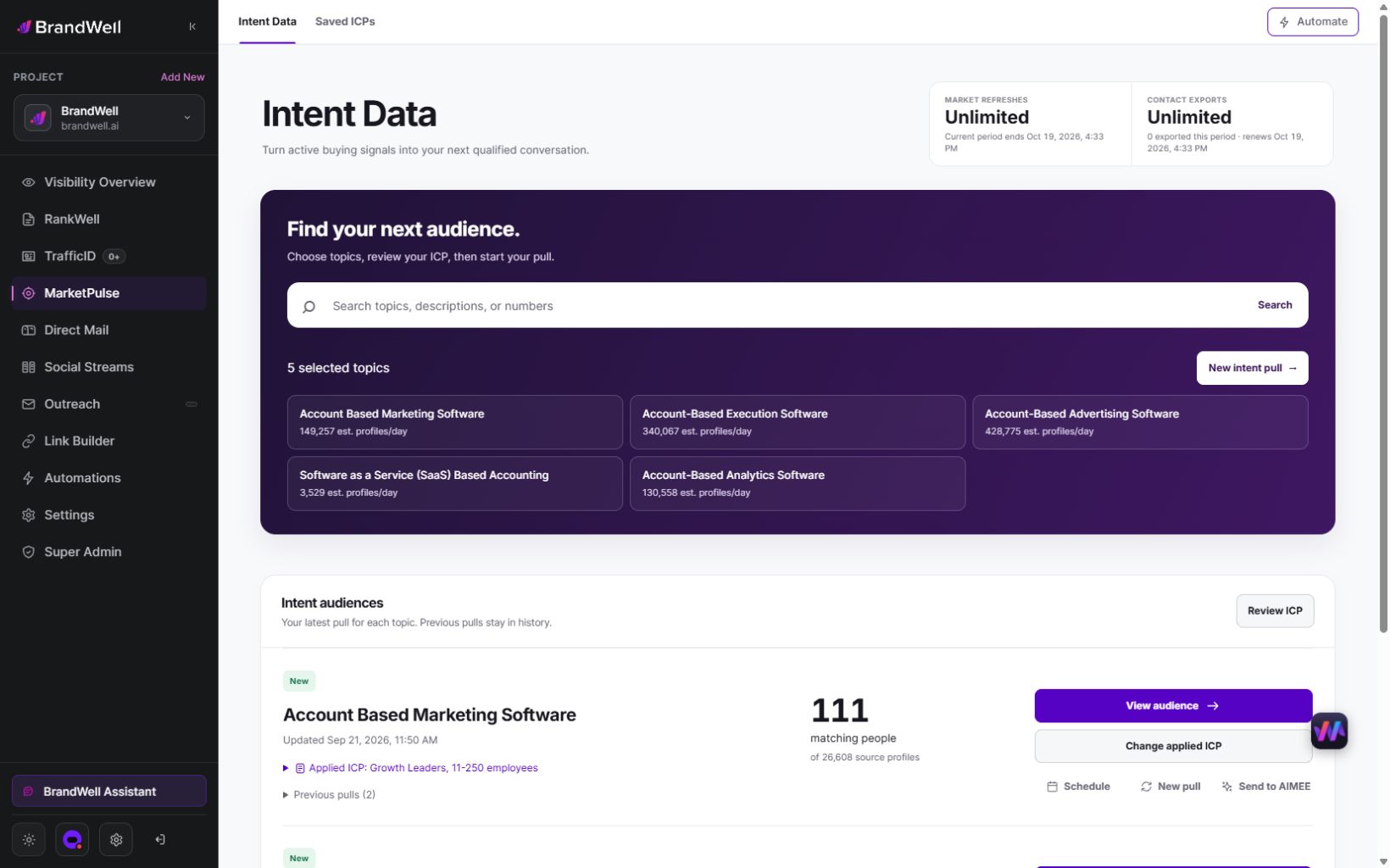
Select a relevant topic, apply your ICP and review available records. Track missing fields, usefulness and review time before proposing an activation workflow. AIMEE can help prepare research and tasks through configured tools and access; keep review responsibilities and outcome records explicit.
Watch the MarketPulse demo and review current plans or browse the BrandWell product directory.
Reviewed and updated October 3, 2026.

Written by