


On this page
- 1. Choose posts using relevance and evidence
- 2. Decide what to keep, update or retire
- 3. Read the whole article before editing
- 4. Improve the answer with original value
- 5. Use the current BrandWell workflow
- 6. Check presentation and technical details
- 7. Show dates honestly
- 8. Compare performance without claiming causation too quickly
- How often should an old post be reviewed?
- Is there an 80/20 rule for blog refreshes?
- A refresh is complete when the page is verified
Refresh an old blog post by checking whether it still answers a useful question, correcting outdated information and improving the explanation, evidence and presentation. Keep the existing URL when it still fits, record the substantive changes and compare performance after publication.
A refresh is useful maintenance, not a guaranteed traffic increase. Changing a date or replacing a few phrases does not make an incomplete article helpful.
1. Choose posts using relevance and evidence
Build an inventory with each article’s URL, topic, owner, product references and last substantive review. Add available Search Console impressions, clicks, CTR and position for a defined period.
Prioritize articles with a reason to change:
- Product details, prices or instructions have become inaccurate.
- The article receives impressions but does not clearly answer the searches it appears for.
- A previously useful page has lost visibility and needs investigation.
- Broken sources, obsolete screenshots or confusing formatting impair the answer.
- Several pages overlap and need a clearer purpose.
Do not assume low CTR is a title problem. Check query, position, device and country differences where the data allows. A page appearing far below the first results has a different problem from a prominent result with an unclear promise.
2. Decide what to keep, update or retire
Keep useful material that remains accurate. Update explanations that still fit your audience but need better evidence or current instructions. Consider consolidation when several pages answer the same question with little distinct value.
Retire a page when its purpose depends on a discontinued product or an offering you no longer provide. Preserve a backup and assess inbound links and a genuinely relevant destination before changing its public status. Do not redirect every unrelated page to a generic sales page.
Historical information can remain valuable when clearly labeled as history. An old announcement should not imply that a retired feature is available today.
3. Read the whole article before editing
Review the body, tables, captions, links, images and calls to action. A new introduction will not correct an outdated claim halfway down the page.
Create a short edit record:
- Keep: useful explanations and examples that still apply.
- Correct: inaccurate facts, product details and instructions.
- Source: material claims requiring supporting evidence.
- Add: questions or decision criteria missing from the answer.
- Remove: unsupported claims, irrelevant material and obsolete images.
Open the original source for each statistic. Record its date, population and limits. Remove a figure you cannot verify rather than replacing it with another attractive but unexplained number.
4. Improve the answer with original value
Read relevant search results to understand the question and available formats. Add something useful you can support: an original worked example, current product walkthrough, clear checklist or explanation of a common mistake.
Do not turn the article into a summary of other ranking pages. Give readers a direct answer, then enough evidence and detail to act. Use headings for real subquestions and trim repetition.
For example, a vague statement that “content updates increase traffic” can become a practical explanation of how to choose pages, preserve the baseline and distinguish clicks from conversion outcomes.
5. Use the current BrandWell workflow
Use BrandWell Visibility for relevant research and opportunities. Bring your page-level search evidence and source notes into the content plan.
Use RankWell for the brief, draft and editorial review. Specify which material must remain, which claims need checking and what the revised article should help the reader accomplish.
- Prepare the edit brief from the complete article review.
- Revise the draft and add verified sources and original examples.
- Check the editor’s search preview and recommendations.
- Replace outdated media with relevant current screenshots.
- Approve the content and publish through the configured connection.
- Inspect the actual public page before closing the task.
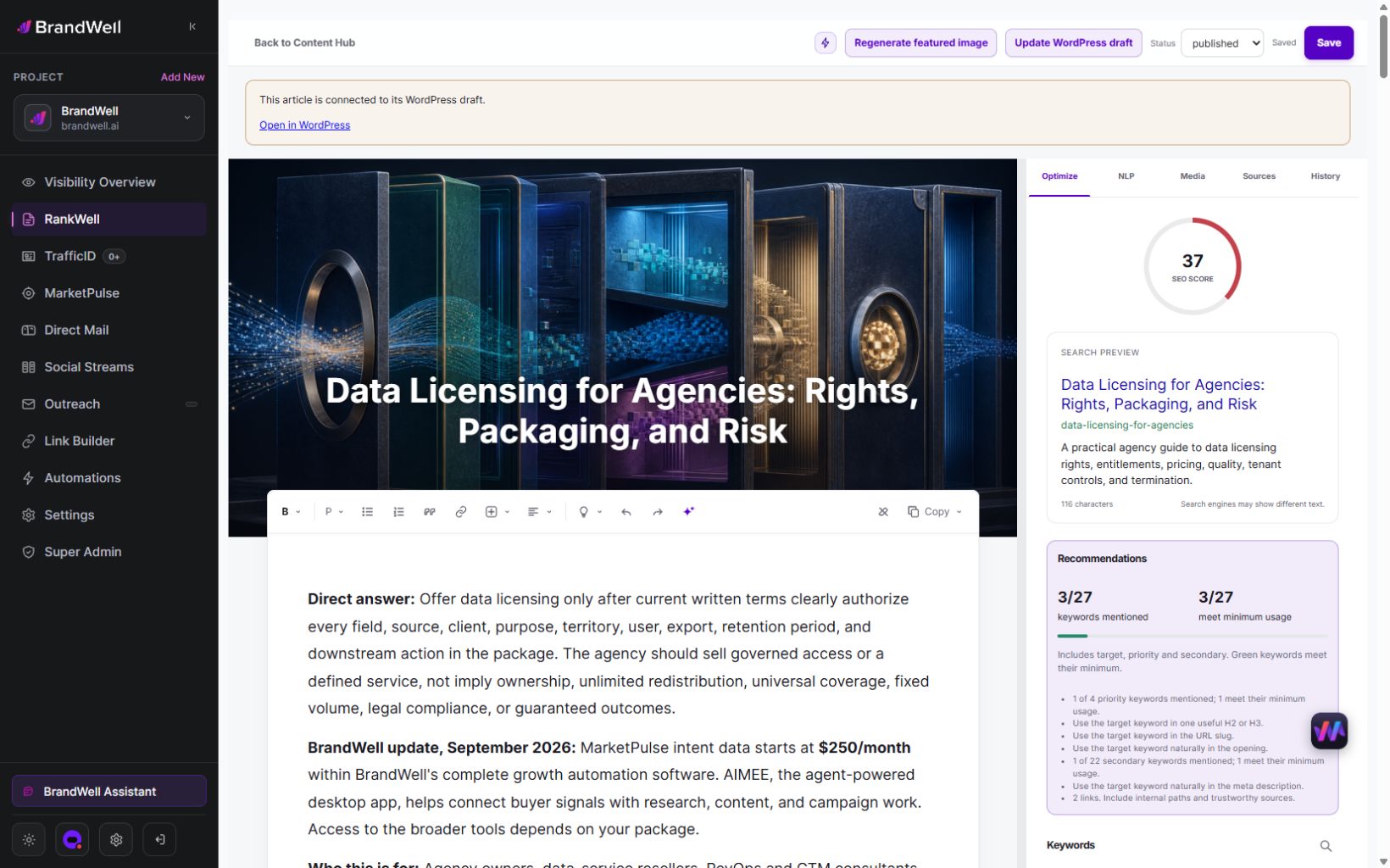
Do not follow old instructions for an automatic website audit or a specific Refresh/Rewrite button unless that control actually exists in your workspace. A generated revision still needs evidence and editorial approval.
6. Check presentation and technical details
Make the title and description accurately describe the revised answer. Keep internal links relevant and confirm that external references support the nearby claims.
Check images for relevance, clarity and appropriate alternative text. Remove duplicate or obsolete screenshots. Preview the page on mobile, including long headings, tables and embedded media.
Confirm that the intended URL loads, the canonical points to the intended page and indexing settings are appropriate. Check loading problems separately from the content revision. A smaller image will not correct an unsupported claim, and better wording will not repair a broken page.
7. Show dates honestly
Preserve the original publication history and show a clearly labeled update date for a substantive review. Keep visible and structured dates consistent. Google’s byline-date guidance explains that it uses multiple signals and that dates should describe the page’s publication or update, rather than an event discussed in the article.
Do not change the date simply to make old advice appear new. Record what changed so readers and your team can assess the update.
8. Compare performance without claiming causation too quickly
Save the pre-edit baseline, revision date and measurement period. Compare the same URL over comparable periods and inspect query and position changes. Keep qualified inquiries or purchases separate from search clicks.
This original hypothetical example illustrates the calculation: a page has 8,000 impressions and 80 clicks before an update, giving 1% CTR. Later it has 8,000 impressions and 120 clicks, giving 1.5% CTR. That is a 0.5 percentage-point increase, or 50% relative growth in CTR.
The arithmetic does not prove the edit caused the change. Seasonality, ranking changes, query mix and other activity can affect the result. Record those factors and give the page time to collect meaningful evidence.
How often should an old post be reviewed?
Use the risk and rate of change of its content. A pricing or interface guide may need review when the product changes. A stable explanation may need less frequent maintenance. Set an owner and a review trigger instead of a universal schedule.
Is there an 80/20 rule for blog refreshes?
It can be a planning heuristic, but it is not proof that 20% of your posts produce 80% of your results or that you should spend exactly 80% of your time promoting. Use your own inventory and outcome data to allocate work.
A refresh is complete when the page is verified
Finish with an accurate answer, current product references, working sources, readable media and a documented review. Promote the updated article where it is useful, then measure what happens. Keep the baseline separate from any later performance result.
Reviewed and updated October 3, 2026.

Written by
Jeff Joyce has been helping brands grow online since the Myspace era, when custom HTML layouts were still a competitive advantage. What started in design quickly evolved into a career spanning social media, content strategy, video, agency ownership, and growth marketing. After building his own agency and testing countless AI tools, Jeff joined BrandWell with a clear focus: helping marketers understand how AI can actually improve the way they create, optimize, and scale content. Today, Jeff brings a CMO-level perspective to BrandWell's marketing strategy, blending brand positioning, content, video, customer education, and growth. His work centers on turning complex AI concepts into clear, practical marketing that helps brands move faster, create better content, and stay competitive without losing their voice.
 Farnaz Kia