On this page
- Current MarketPulse research input
- Who this is for
- Five renewal plays for an intent-data retainer
- The renewal timeline and accountable owners
- Build a decision-grade renewal evidence pack
- The five renewal artifacts to standardize
- Compare renewal options across risk and margin
- Renewal pricing and cost assumptions
- Metrics for a renewal decision
- Choose a renewal path from the evidence
- Signal evidence and trust at renewal
- Renewal risks to resolve in writing
- Where BrandWell fits in renewal and expansion
- A 45-minute renewal meeting agenda
- Frequently asked questions
- Copyable renewal decision record
Renew an intent data agency retainer by proving that the service changed useful decisions – not by presenting a larger pile of signals. Start the renewal process before the notice window, reconcile the signed scope with actual delivery and adoption, separate attributed activity from incremental evidence, repair the weakest workflow, and offer expansion only where a client owner is ready to act. Protect margin by renewing the operating model, capacity, and change controls along with the result story.
The core discipline in renewing intent data retainers is showing which decisions changed, what evidence supports continuation, and which operating changes will protect the next term.
Current MarketPulse offer: intent-data plans start at $500/mo. See the product, demo, and current plans. Updated October 3, 2026.
Current MarketPulse research input
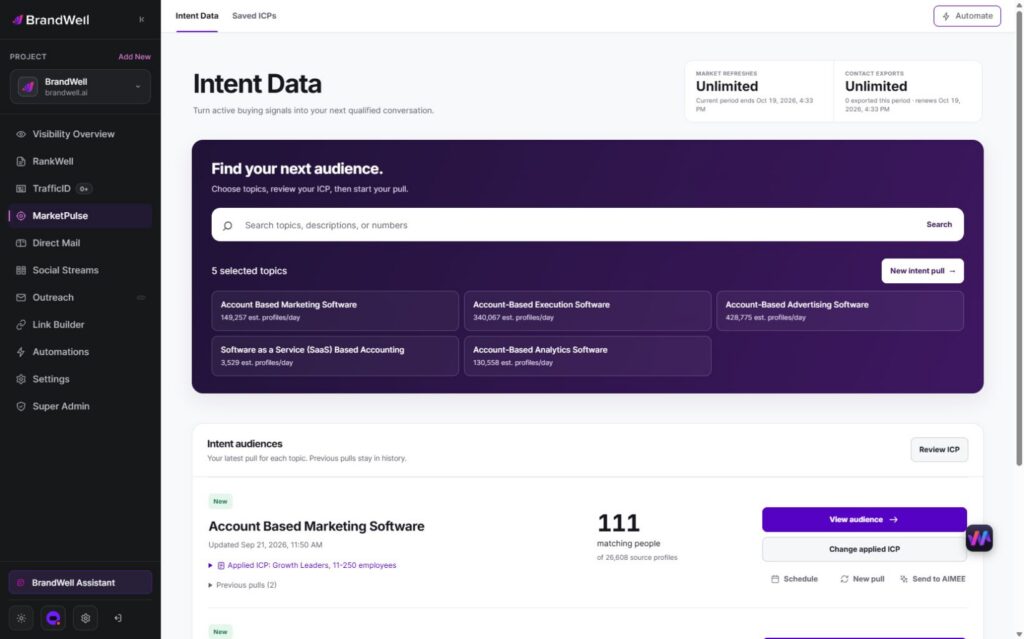
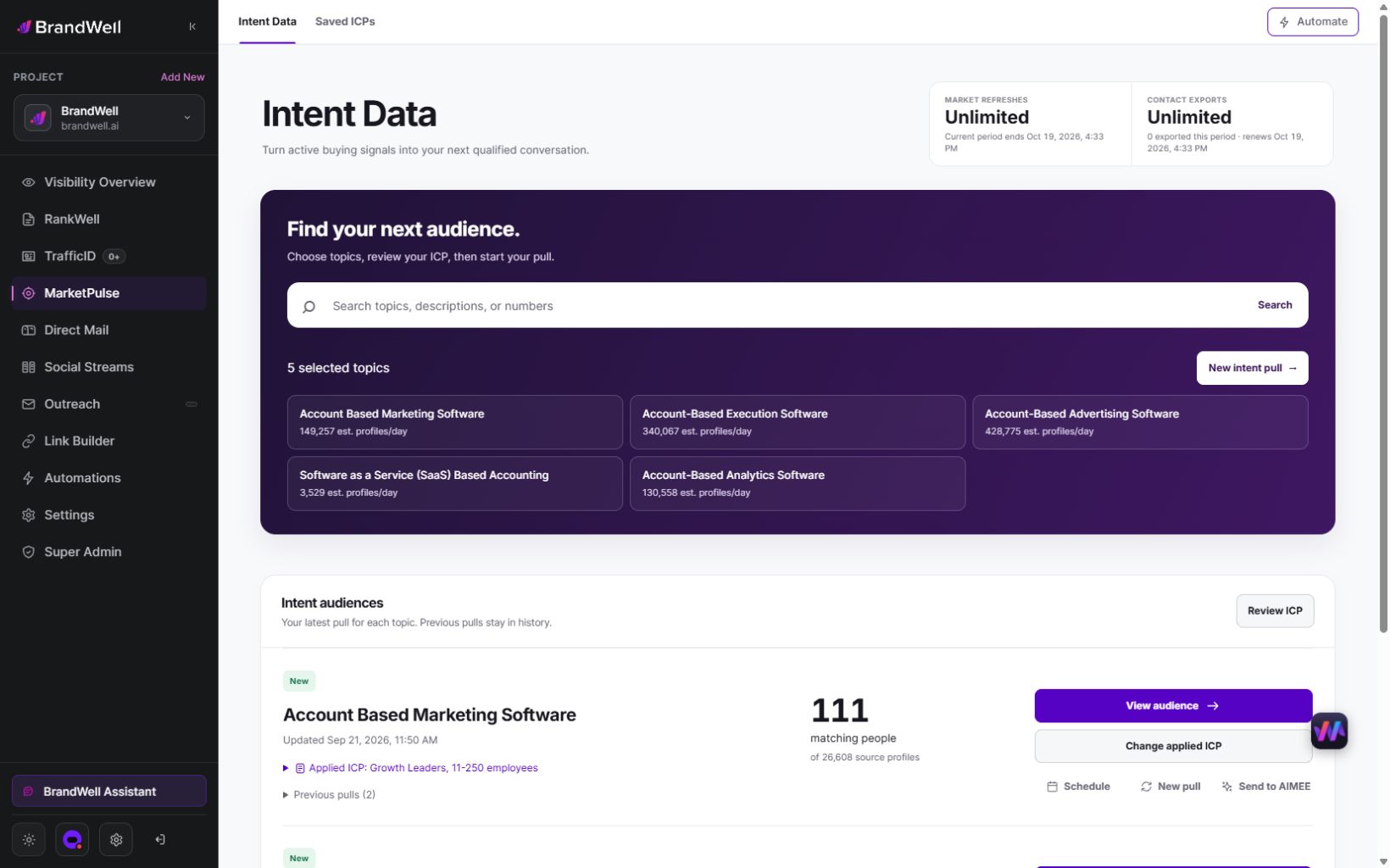
BrandWell MarketPulse research is starting at $500/mo. Review relevant topics, saved ICP filters and available match details before deciding on an approved action.
| Plan | Topics and refreshes | Monthly exports |
|---|---|---|
| Starter | 1 topic, weekly | 25,000 contacts |
| Growth | 3 topics, daily | 100,000 contacts |
| Scale | 10 topics, daily | Unlimited contacts |
Swipe the table to see all columns.
A pull retrieves available data from the previous 24 hours for one topic. Daily use across all included topics provides 90 Growth pulls or 300 Scale pulls in a 30-day month. Weekly Starter pulls vary by calendar month. Available audience size and contact fields vary, and audiences may overlap. Refreshes stop at the plan limit without overage charges.
- Find and qualify: search the topic catalog, save your ICP, and review the people and companies that match.
- Act on the research: export qualified contacts or prepare an Outreach or Direct Mail workflow. Connected products, channel usage, and fulfillment may cost extra.
- Get help from AIMEE: Growth and Scale include AIMEE for the initial user to research accounts and prepare the next step through connected tools.
Agencies and other service businesses can build client deliverables around their available Intent Scans and exports. Keep each client’s scope, permissions, and service fees clear. A subscription is not a promise of a white-label platform or exclusive access to a market.
Explore MarketPulse and watch the demo or compare plans starting at $500/mo. Any early-access discount is a separate, time-limited offer shown to an eligible recipient.
Who this is for
- Agency owners, client services leaders, and account directors responsible for retainer retention.
- Demand generation, RevOps, paid-media, and outbound agencies that sell recurring intent services.
- Client sponsors deciding whether to renew, resize, expand, or exit an intent-data engagement.
- Service businesses that need a repeatable renewal review across separately scoped client engagements.
Intent signals and identity matches are probabilistic. A renewal should not imply that every observed account was ready to buy or that associated pipeline was caused by the service. The defensible question is: did the program produce timely, usable evidence that led to better actions at an acceptable cost and risk?
Five renewal plays for an intent-data retainer
Choose one primary renewal play before building the deck. Mixing retention, rescue, expansion, and repricing into one ambiguous ask makes the buyer work too hard.
1. Renew the proven core
Use this play when delivery is reliable, the client acts on the output, outcomes are visible, and the current scope fits capacity. Show the chain from observed signal to accepted action and downstream evidence. Keep the next term focused on the same decision, with only small rule improvements.
The core renewal is not “same feed for another year.” It includes the operating cadence, owners, qualification logic, exception handling, measurement, and ongoing optimization that made the feed useful.
2. Repair and renew
Use this when the data arrives but adoption or quality is weak. Diagnose the bottleneck: unsuitable topics, stale events, poor account fit, incomplete identity, destination failure, slow approval, seller overload, or an offer that does not match the observed research.
Offer a bounded repair period with one hypothesis, specific changes, acceptance criteria, and a commercial decision date. Do not discount indefinitely to hide a workflow nobody owns.
3. Right-size and retain
Use this when the client gets value but has excess topic, account, record, report, or support capacity. Reduce unused scope while protecting the parts that drive decisions. This can improve trust and gross margin if it removes exception-heavy work along with unused platform capacity.
Right-size when actual unused scope and delivery constraints support it. Record the released capacity, service obligations, termination requirements and separately agreed reactivation terms.
4. Expand from evidence
Expand only into a use case that shares verified inputs and has a named owner. Examples include adding an approved paid-media audience to a working seller-prioritization program, applying a proven topic model to a second segment, or using competitive research signals for a customer-success review.
The expansion must have its own baseline, permissions, acceptance criteria, action capacity, and price. It should not inherit a causal claim from the original use case.
5. Exit cleanly
Recommend a managed exit when the client lacks market fit, lawful permitted use, internal ownership, action capacity, measurement, or sufficient economic value. A clean exit protects the relationship and the agency’s team from months of exception work.
Define final report, exports, deletion or return, destination disconnection, credential revocation, topic release, and transition support. An honest non-renewal can create a stronger future referral than a weak retainer kept alive by optimistic reporting.
The renewal timeline and accountable owners
Illustrative planning cadence: Work backward from the actual contractual notice and renewal dates. The timeboxes below are a planning template, not a universal benchmark.
Work backward from the contract’s notice and decision dates. The executed Order Form – not a blog post – controls commitment, price, agreed service scope, and renewal mechanics.
Eight to twelve weeks before decision: reconcile
The account lead compares the order, change requests, invoices, delivery logs, usage, support, and actual client expectations. Data operations reconciles delivered events, reports, destination writes, errors, and suppressions. Finance calculates monthly delivery cost and contribution margin by client.
Create a discrepancy log. If the agency has performed unpriced work, do not quietly bake it into the next term. Name it, stop it, standardize it, or price it.
Six to eight weeks before decision: diagnose
Interview the executive sponsor, day-to-day owner, and action users separately. Ask what decisions they made, which outputs they ignored, where trust broke, which outcomes they can defend, and what would make the service indispensable next term.
Review rejected and expired records. Positive outcomes alone cannot reveal whether qualification is precise or whether a few successes survived a noisy process.
Four to six weeks before decision: test
Run one bounded improvement where feasible. Change one major variable: topic cluster, fit threshold, freshness, enrichment requirement, routing, play, or approval time. Preserve old and new cohorts. Set the decision rule before viewing results.
Keep the repair hypothesis, cohort definitions, changed variable and decision rule explicit. Multiple simultaneous changes make the cause of an observed difference harder to interpret.
Two to four weeks before decision: recommend
Send a concise pre-read with the recommendation, evidence, limitations, next-term scope, price, and decision required. The live renewal meeting should discuss tradeoffs and ownership, not reveal an oversized deck for the first time.
After decision: document
Record the accepted scope, topics, capacities, data uses, owners, destinations, approval rules, service levels, fees, changes, and exit terms. Update the operating runbook before the new term starts.
Build a decision-grade renewal evidence pack
A useful intent data QBR or renewal report has five sections.
1. Contract and delivery truth
Show purchased scope beside actual delivery: topics, market, clients, modules, records, reports, reviews, destinations, service levels, changes, and exclusions. Include failures and recovery, not just on-time outputs.
2. Signal quality
Report unique eligible events, freshness, duplicate rate, schema completeness, identity/enrichment yield, accepted-signal rate, rejection reasons, suppressions, and sampled false positives. Define denominators and time windows.
3. Adoption
Show who reviewed the output, what percentage received a decision, which actions were accepted, time to action, action completion, expired records, and client capacity. A high-quality record that nobody sees has no operational value.
4. Outcome evidence
Connect accepted actions to qualified responses, meetings, opportunities, pipeline, revenue, retention, or media outcomes. Label the evidence:
- Descriptive: events and outcomes observed in the same cohort.
- Platform-attributed: a destination applied its own attribution rule.
- Modeled: a model estimated contribution or a counterfactual.
- Experimental: treatment and comparison groups estimate incremental effect.
Keep descriptive, attributed, modeled and experimental evidence distinct. A recorded pipeline association does not establish incremental pipeline. Preserve uncertainty and the actual comparator rather than presenting attributed outcomes as causal lift.
5. Economics and risk
Show platform and usage, direct labor, support, integration maintenance, media/tools, manual exception time, utilization, contribution margin, and unpriced changes. Add compliance complaints, opt-outs, access issues, incidents, and unresolved security questions.
The purpose is not to make the agency look flawless. It is to demonstrate control: what worked, what failed, what changed, what it cost, and what the next term will do differently.
The five renewal artifacts to standardize
- Contract-versus-delivery reconciliation: every obligation, capacity, dependency, and change.
- Signal-to-outcome ledger: event ID through qualification, action, and downstream evidence.
- Client adoption map: users, decisions, action capacity, SLA, and bottleneck.
- Economics calculator: allocated platform and tools, labor, support, utilization, setup recovery and defined delivery margin.
- Renewal decision memo: renew, repair, right-size, expand, or exit; next scope; price; risks; decision date.
A dashboard can organize evidence but cannot replace scope, cost and outcome records. Keep contract variance, manual effort, unresolved outcomes and evidence strength visible in the renewal brief.
Compare renewal options across risk and margin
| Option | Client disruption | Evidence required | Agency margin effect | Main risk |
|---|---|---|---|---|
| Renew unchanged | Low | stable adoption and economics | predictable | stagnation or hidden scope creep |
| Repair then renew | Medium | diagnosed bottleneck and test | improves if repair standardizes work | open-ended rescue labor |
| Right-size | Low to medium | usage and value by module | can improve utilization | buyer perceives retreat |
| Expand | Medium to high | proven core plus new owner/baseline | increases revenue if reuse is real | expansion before adoption |
| Exit | High short-term | clear disqualifier and exit plan | stops negative margin | poor transition damages trust |
Swipe the table to see all columns.
Do not default to a price reduction. A lower fee does not fix a slow approval queue, weak topic map, or seller capacity problem. Exchange price for a real scope change, commitment, standardized process, or capacity reduction.
Renewal pricing and cost assumptions
Calculate the next-term client cost from the service the agency will actually operate:
Incurred monthly delivery cost = allocated platform/usage + direct labor + support + integration maintenance + other delivery tools/media. Define the allocation boundary and count each cost once. Show an unspent risk reserve separately in the budget.
Client contribution margin = (client fee – incurred delivery cost) / client fee. This is a scoped delivery margin, not company net profit; disclose excluded overhead and taxes.
Review topic and client capacity, records, enrichment, destinations, report frequency, review time, users, support window, integrations, custom creative, legal/security work, and exceptional data repair. Price add-ons only where an owner and evidence plan exist.
Explain a proposed price change through separately scoped work, actual usable volume, additional approved activation, service commitments or documented labor. Do not infer exclusive topic rights or native client portals from the research subscription.
Metrics for a renewal decision
Use four decision gates rather than a single ROI number.
Quality gate
- unique eligible events and freshness distribution;
- accepted-signal rate and rejection reasons;
- identity/enrichment yield by intended action;
- duplicate, suppression, and destination-failure rates;
- unresolved exception age.
Adoption gate
- percentage of accepted events reviewed and acted upon;
- median event-to-decision and decision-to-action time;
- action completion and expiry;
- users or teams adopting reports, portal, and play cards;
- owner capacity and SLA adherence.
Outcome gate
- qualified responses, meetings, opportunities, pipeline, wins, retention, or media outcomes;
- cohort denominator and time window;
- baseline or comparison group;
- evidence type and uncertainty;
- negative or null results.
Economics gate
- utilization of purchased topics, clients, records, and reviews;
- direct labor and manual exception minutes;
- support and integration burden;
- setup-fee recovery and payback;
- contribution margin and expected next-term change.
Agree on gate thresholds before the final renewal meeting. Otherwise, every metric can be reinterpreted after the fact.
Choose a renewal path from the evidence
Renew the core when the client has a stable ICP, an observable market, action owners, compliant destinations, adoption, outcome capture, and sufficient economics. Repair when the client remains a fit but one bounded bottleneck blocks value. Right-size when unused capacity is identifiable. Expand when a new use case shares verified data and has its own accountable owner.
Exit when the service depends on unsupported sensitive use, the client expects perfect identity or a promised fixed lead outcome, no team can act within the signal’s useful window, measurement cannot be improved, or direct delivery cost consistently exceeds the fee without a credible redesign.
Signal evidence and trust at renewal
Preserve six layers: observed topic or behavior, account fit, identity confidence, freshness, action, and outcome. Show where the chain is missing. A company researching a topic is not automatically the person shown in an enrichment record. A website match is not proof of the visitor’s role. An opportunity opened after a signal is not automatically incremental.
Keep uncertain identity, research context and contact enrichment separate. A topic association does not establish that a named contact performed the research or has buying authority. Evaluate the usefulness of the review process without promising certainty.
Renewal risks to resolve in writing
- Scope creep: unpriced topics, destinations, reports, revisions, and client support.
- Adoption theater: meetings and dashboards without completed actions.
- Attribution inflation: counting all associated pipeline as caused revenue.
- Identity overreach: treating account research as a named person or purchase decision.
- Compliance drift: new sources, channels, jurisdictions, or client uses without review.
- Automation drift: an agent changes rules or sends externally without approval.
- Capacity mismatch: client demand exceeds seller, media, or review capacity.
- Topic ambiguity: protection, exclusions, geography, use case, term, and release are not renewed explicitly.
- Exit ambiguity: data, credentials, audiences, and client access remain after termination.
Verify the actual jurisdiction, recipient, channel, purpose, source and opt-out requirements before activation. Resolve missing approvals and retain suppression evidence. Obtain qualified advice for unresolved legal requirements.
Where BrandWell fits in renewal and expansion
MarketPulse provides topic research and available match context. Verify current product scope and guarantee conditions on the product page. A subscription does not imply exclusivity, protected territory or custom delivery rights.
An agency may operate its own separately scoped service using permitted research outputs. Custom branding, reports, client interfaces, integrations and billing require verified implementation, rights, scope and fees.
AIMEE can organize supplied context through configured tools. Named owners approve actual exports, messages and destination writes. A prepared instruction is not proof that an action executed successfully.
Research and automation do not guarantee incremental revenue. Keep actual product capabilities, custom service commitments and buyer-confirmed outcomes separate.
A 45-minute renewal meeting agenda
Use this as an illustrative timebox and adjust it to the actual evidence gaps and decision owners.
Keep the meeting centered on decisions rather than a tour of every dashboard panel.
- Decision and context – 5 minutes: restate the contracted outcome, the next-term decision, and material scope changes since kickoff.
- What the evidence supports – 10 minutes: show delivery, quality, adoption, and outcome evidence with denominators and limitations.
- What failed or remained unused – 8 minutes: review exceptions, rejected signals, delayed actions, unused capacity, and recovery.
- Economics and risk – 7 minutes: show client value context, agency delivery burden, open compliance/security issues, and capacity constraints without exposing irrelevant internal detail.
- Recommendation – 10 minutes: present one primary play and at most one alternative, with scope, price, owner changes, and expected decision improvement.
- Decision and next actions – 5 minutes: record questions, evidence still required, approvers, contracting steps, and the decision deadline.
Send the pre-read in advance. In the meeting, use a decision log with four columns: issue, evidence, owner, and due date. If procurement needs a price comparison, normalize modules, topic and client capacity, usage, implementation, services, contract term, and internal labor. A lower quoted platform fee can still create a higher total cost when the agency must build reporting, tenant controls, or exception handling.
Renewal scorecard
Score each dimension from 0 to 2: zero means absent or failing, one means usable with a defined repair, and two means reliable.
| Dimension | 0 | 1 | 2 |
|---|---|---|---|
| Scope control | material unpriced work | changes identified | order and delivery reconcile |
| Signal quality | unusable or unknown | bounded issue | accepted with monitored exceptions |
| Adoption | no accountable action | partial team adoption | consistent decision and action |
| Outcome evidence | no traceable outcome | descriptive/attributed | fit-for-purpose comparison or strong contribution evidence |
| Economics | negative/unknown margin | repairable | sustainable at expected utilization |
| Governance | unresolved high risk | control plan exists | roles, permissions, and audit evidence operate |
Swipe the table to see all columns.
A total score does not make the decision automatically. Use it to expose asymmetry. A program with strong attributed pipeline but zero governance is not ready for expansion. A program with excellent delivery but zero adoption needs a client operating change, not more signal volume.
Frequently asked questions
How should an agency protect growth and margin during renewal?
Start early, reconcile contract to delivery, calculate client-level contribution margin, choose one renewal play, and price every new obligation. Renew only a scope that the client can adopt and the agency can operate repeatedly.
How should the review cadence be chosen?
An illustrative cadence is weekly delivery-exception review during launch, monthly adoption review and quarterly commercial-scope review. Adjust it to the actual evidence gaps, signal lifetime, service obligations and contractual notice window.
Which renewal tools matter most?
Standardize a contract reconciliation, signal-to-outcome ledger, adoption map, economics calculator, and decision memo. A portal can supply data but should not be the only renewal artifact.
How should pricing change?
Change price when capacity, modules, implementation, support, service level, labor, or commitment changes. Exchange any discount for reduced scope, standardization, term, or a measurable adoption commitment – not vague goodwill.
Which metrics prove value?
Use quality, adoption, outcome, and economics together. State denominators, baseline, time window, and whether results are descriptive, attributed, modeled, or experimental. Raw record count is not proof.
When should an agency expand?
Expand after the core workflow is adopted and the new use case has an owner, baseline, permission, capacity, and evidence plan. Avoid adding feeds to a process that already ignores its current queue.
What should a managed-service renewal document?
Renew the actual managed-service scope, responsibilities, reports, support boundaries, destination permissions and exit requirements. Verify separate custom client access and billing arrangements rather than assuming wholesale units or a white-label platform.
Which clients are poor renewal candidates?
Clients are poor candidates when they have no stable ICP, no action owner, no lawful planned use, no destination or outcome capture, or a demand for guaranteed person-level identity and sales. Consider a narrow advisory project only if one bounded gap can be fixed.
Which signal evidence should appear in the QBR?
Show source and observed time, topic or behavior, account fit, identity level and confidence, freshness, qualification decision, suppression, proposed and completed action, rejection or exception reason, and downstream outcome. Keep account research separate from a claimed individual researcher.
What is the biggest renewal mistake?
The biggest mistake is using associated pipeline to skip the adoption and causality questions. A decision-grade renewal states what was observed, what the team did, what happened later, which alternatives were considered, and what the evidence cannot establish.
Copyable renewal decision record
Decision: [Renew, repair, right-size, expand or exit.] Scope: [Actual obligations and notice date.] Evidence: [Mature cohort, denominators and missing outcomes.] Economics: [Fee, incurred delivery cost, excluded overhead and separate reserve.] Gates: [Rights, quality, adoption and ownership.] Owner: [Approver and next review.]
Update the estimate with actual costs
The GAO cost-estimating guide includes assumptions, sensitivity analysis and updating estimates with actual costs. It supplies no agency-margin benchmark.
Unused reserve is not incurred delivery cost
A fictional monthly client fee is $2,500 and incurred delivery cost is $2,000. The scoped contribution is $500, or 20%, before excluded overhead and taxes. A separate $400 unspent contingency is a budget reserve, not another incurred expense. If an extra $600 of actual delivery work occurs, the contribution becomes negative $100. Price or remove the added obligation before expanding.
A high score does not clear a failed gate
A fictional renewal has strong adoption and delivery scores but unresolved permission for the proposed destination. Hold that activation until the permission gate is resolved. Do not use a summed score to override a mandatory requirement.
Keep feedback and pipeline denominators visible
A fictional cohort contains 40 eligible accounts, 30 accepted actions and 24 completed feedback records. Four unique opportunities are reported. Six accepted actions have missing feedback. Report four of 24 feedback records and four of 30 accepted actions separately; do not count the same opportunity in multiple plays or call the association incremental revenue.
Review current research: explore MarketPulse and current plans.
Reviewed and updated October 3, 2026.

Written by