On this page
- Current MarketPulse research workflow
- Review evidence before assigning work
- Define nine routing steps
- Use seven routing artifacts
- Compare forms, triage and signal routing
- Count actual implementation and review costs
- Measure routing states and outcomes
- Check ownership and exception capacity
- Preserve six evidence dimensions
- Test retries, suppression and drift
- Scope separately managed routing
- Copyable routing acceptance record
- Frequently asked routing questions
Review buyer intent signals for source, fit, identity support, freshness, permitted purpose and suppression before routing. Preserve event time, receipt, acceptance, assignment, approval and actual action separately. Define owners, exceptions and retry behavior; a raw signal does not authorize contact, CRM overwrites or spending. Evaluate outcomes under consistent rules and a suitable comparison.
Who is this for? RevOps, demand generation, sales operations, marketing operations, and agencies trying to focus human attention on high-fit, high-timing opportunities without creating another noisy alert feed.
Current MarketPulse offer: intent-data plans start at $500/mo. See the product, demo, and current plans. Updated October 3, 2026.
Current MarketPulse research workflow
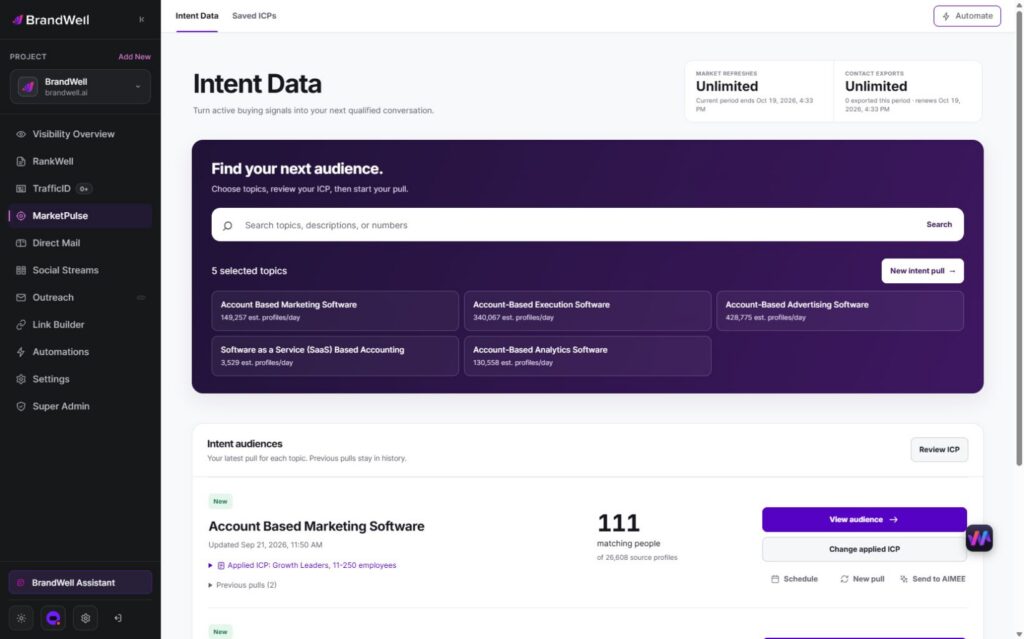
BrandWell MarketPulse: intent data starting at $500/mo. Find people researching topics relevant to what you sell, apply saved ICP filters, and review available contact details before taking action.
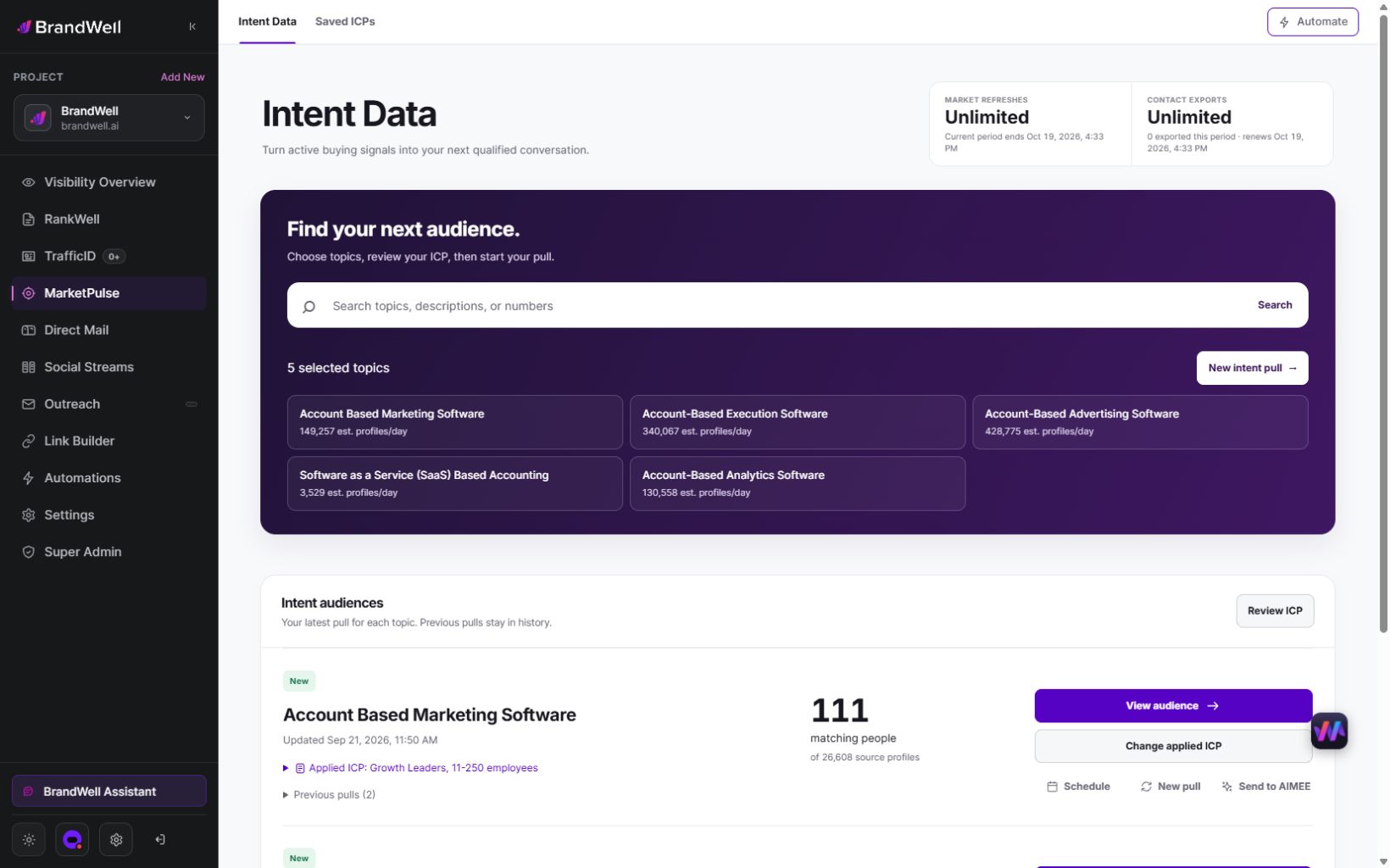
MarketPulse plans are starting at $500/mo. Verify current package scope and offers on the product page.
| Plan | Topics and refreshes | Monthly exports |
|---|---|---|
| Starter | 1 topic, weekly | 25,000 contacts |
| Growth | 3 topics, daily | 100,000 contacts |
| Scale | 10 topics, daily | Unlimited contacts |
Swipe the table to see all columns.
A pull retrieves available data from the previous 24 hours for one topic. Daily use across all included topics provides 90 Growth pulls or 300 Scale pulls in a 30-day month. Weekly Starter pulls vary by calendar month. Available audience size and contact fields vary, and audiences may overlap. Refreshes stop at the plan limit without overage charges.
- Find and qualify: search the topic catalog, save your ICP, and review the people and companies that match.
- Act on the research: export qualified contacts or prepare an Outreach or Direct Mail workflow. Connected products, channel usage, and fulfillment may cost extra.
- Get help from AIMEE: Growth and Scale include AIMEE for the initial user to research accounts and prepare the next step through connected tools.
Agencies and other service businesses can build client deliverables around their available Intent Scans and exports. Keep each client’s scope, permissions, and service fees clear. A subscription is not a promise of a white-label platform or exclusive access to a market.
Explore MarketPulse and watch the demo or compare plans starting at $500/mo. Any early-access discount is a separate, time-limited offer shown to an eligible recipient.
Review evidence before assigning work
Intent-signal routing is a decision system between evidence and action. Its first job is not to assign a seller. Its first job is to decide whether the event should be accepted, held, rejected, or suppressed.
An accepted signal needs a known source, event time, evidence type, fit state, freshness rule, identity state, eligible purpose, and destination options. “Visited a pricing page,” “matched a contact,” and “researched a topic” mean different things and carry different uncertainty. Intent and resolved identity are probabilistic evidence; neither proves that a person has budget, authority, an active purchase project, or responsibility for the observed behavior.
After acceptance, a proposed useful action may be seller research, account-owner review, marketing nurture, ad-audience eligibility review, service follow-up, suppression, or no action. Sales should receive only the context appropriate to the confidence tier. Measure actual alert relevance and reviewer feedback; use public business context without exposing private research.
Define nine routing steps
- Normalize the event. Store a stable event ID, source, observed time, received time, signal type, subject level, and evidence payload. Preserve the original rather than overwriting it.
- Resolve the commercial object. Connect the event to an account, buying group, matched person at a stated confidence level, or known first-party contact. Quarantine ambiguous joins.
- Check eligibility. Apply ICP fit, customer status, territory, open-opportunity, suppression, consent/permitted-use, sensitive-category, and channel rules.
- Score transparently. Keep fit, timing, identity confidence, and engagement separate even if a combined priority band is produced. Save the rule version and inputs.
- Select an outcome. Use explicit accept, reject, suppress, hold, manual-review, sales, nurture, and ad-review states. “No action” is a legitimate route.
- Choose the owner. Resolve account ownership, territory, partner/client boundaries, vacation coverage, and conflict rules before creating work.
- Define the service clocks and approval rules. Preserve observed-event age, intake delay, review delay, acceptance-to-assignment and actual action timing. If the agreed SLA begins at acceptance, show the pre-acceptance queue separately so delayed review cannot make total latency disappear. Named owners approve consequential messages, spend and CRM changes.
- Deduplicate and test action retry behavior. Define stable event and action identifiers at the correct scope. A timeout does not prove the destination did nothing. Reconcile actual destination state before retrying; an external ID alone does not guarantee idempotency, collision handling or exactly-once execution.
- Log and learn. Store decision, owner, action, timestamps, exceptions, override, and outcome so the next routing version can be evaluated.
Use seven routing artifacts
Evaluate these seven artifacts against actual explainability, implementation, reversibility, ownership and error recovery. A schema or decision table does not establish correct underlying evidence or a native routing capability in the research subscription.
1. Signal data contract
Define required fields, types, allowed values, subject level, event time, source, confidence, retention, and owner. Limitation: a schema cannot establish whether the underlying signal is accurate or permitted; validate the source separately.
2. Acceptance and rejection gate
Apply minimum fit, freshness, confidence, consent/permitted-use, suppression, and duplication rules before scoring. Limitation: thresholds can hide useful edge cases; maintain a sampled review queue.
3. Next-action decision table
Map evidence states to sales research, nurture, ad review, hold, reject, suppress, or manual review. Show the reason for every route. Limitation: a static matrix will drift as offers, territories, and policies change.
4. Stable-ID and idempotency registry
Use event and action keys to stop retries, re-enrollment, and batch reruns from creating duplicates. Limitation: a poorly chosen key can merge distinct events; document its grain.
5. Ownership and SLA ledger
Record owner source, fallback, service level, pause rules, holidays, and escalation. Limitation: a fast route is not a good route if the seller rejects the context or the account is ineligible.
6. Exception and manual-review queue
Give uncertain identity, conflicts, policy questions, missing fields, and high-consequence actions a visible holding area with reason codes. Limitation: an unstaffed exception queue becomes a data graveyard; assign capacity and aging rules.
7. Outcome and rule-version log
Connect each decision to acceptance, action, override, meeting, opportunity, and rejection evidence. Limitation: outcomes after routing are not automatically caused by routing; use a valid comparison when estimating lift.
Compare forms, triage and signal routing
- Equal lead treatment is easy to explain and can work for a small queue with similar leads. Test whether differing volumes and quality require distinct review paths.
- Form-fill scoring prioritizes explicit first-party responses and should remain a clear path. A form-only path does not observe accounts that never submit; assess the actual form context rather than assuming every response establishes readiness.
- Intent-signal routing combines multiple evidence types with fit, freshness, identity, eligibility, ownership, and action rules. It can focus capacity, but requires more data governance, maintenance, and error handling.
- Manual triage is often the best starting alternative. A human team can discover useful reasons and edge cases before automation freezes bad assumptions.
Use forms as explicit triggers, not merely another score input. Use aggregate analytics for content and channel decisions. Add intent routing when the queue is large enough, the signals are interpretable, and different evidence states genuinely require different actions.
Count actual implementation and review costs
Intent signal routing cost includes signal acquisition, enrichment or identity resolution, CRM and automation licenses, integration, data storage, rules and scoring design, monitoring, exception review, enablement, privacy/security review, and ongoing maintenance. A vendor quote rarely represents the full operating cost.
Separate one-time work – data contract, field creation, ownership rules, backfill policy, routing test, and launch training – from recurring work such as exceptions, drift review, rule changes, quality sampling, and reporting. Model volume-based data and automation charges separately from fixed platform fees.
Count actual labor across intake, reviewed records, accepted briefs, exceptions, blocked handoffs and maintenance. Early rejection may reduce downstream work but still consumes review and setup effort. Use actual volumes, system complexity and service windows rather than a universal cost benchmark.
Measure routing states and outcomes
Intent signal routing KPIs should measure both the decision engine and the business process:
- valid-event rate and rejection reasons;
- accepted, held, suppressed, and manual-review shares;
- duplicate prevention and integration-error rates;
- time from observed event to acceptance, assignment, approval, and action;
- seller acceptance, override, and “not relevant” reason rates;
- action completion by route and SLA;
- qualified meetings, opportunities, stage progression, and contribution margin;
- incremental difference versus a comparable manual or status-quo control where feasible.
Report denominators and windows. “Most opportunities had a routed signal” measures coverage, not routing ROI. Compare the new decision system with the previous process, include full cost, and keep influenced pipeline separate from attributed or incremental outcomes.
Check ownership and exception capacity
Check actual ICP, stable account ownership, interpretable evidence, distinct useful actions, required service windows, reliable outcome fields and staffed exceptions. Multi-client work needs separately verified client boundaries and access rights. A research subscription does not establish a native tenant-separated client portal.
Start manually when the team cannot agree on what a signal means, ownership changes frequently, suppression is incomplete, seller feedback is unstructured, or there are too few events to validate thresholds. Repair CRM data before automating around it. A routing engine cannot compensate for missing account IDs or conflicting territories.
Use no action when the record is sensitive, stale, low confidence, unsupported by fit, or not permitted for the proposed channel. Protecting attention and buyer trust is part of the routing outcome.
Preserve six evidence dimensions
A practical intent signal routing framework stores each dimension independently:
- Fit: ICP band, region, size, industry, customer/opportunity state, and exclusions.
- Evidence: source, signal type, subject level, observed behavior, and alternative explanations.
- Freshness: event time, received time, decay rule, and repeated-event handling.
- Identity: anonymous, account, matched person with confidence, or known first-party contact.
- Eligibility: purpose, suppression, consent/permitted-use, channel, sensitive-category, and advertiser/client authority.
- Action and outcome: route, owner, SLA, approval, exposure, override, and downstream result.
Do not label a combined score “predictive” or “objective” without disclosed inputs, validation, calibration, monitoring, and overrides. A score is a decision aid. Keep the raw evidence and reason codes available to the human receiving it.
Test retries, suppression and drift
Test actual enrollment, re-entry, suppression and stop behavior for the configured object and implementation. Record the approved rule version and reconcile retries, manual edits, removed permissions and late-arriving events. Do not infer supported behavior from a generic automation label.
Common mistakes are routing on receipt time instead of event time, treating missing confidence as high confidence, letting retries create duplicate tasks, overwriting verified CRM truth, failing to suppress customers or opt-outs, exposing sensitive research details, and optimizing rules only toward easily observed outcomes.
Keep necessary fields under defined access, retention, correction, deletion, incident and exit ownership. Verify actual controls and permissions in the implementation; a subscription, reseller or connected tool does not remove these responsibilities.
Scope separately managed routing
An agency package can include signal intake, data-contract maintenance, acceptance rules, owner/SLA logic, exception handling, seller feedback, monthly quality review, and quarterly rule recalibration. Report accepted and rejected evidence, not just lead volume. Put client-specific action and approval rights in the service agreement.
MarketPulse supplies topic research and available match details. AIMEE can organize supplied context through configured tools. An agency operating service, branded weekly report, CRM synchronization or custom client interface needs separately verified implementation, rights, scope and fees. The research subscription does not establish those delivery capabilities.
AIMEE can prepare a review brief through configured connected tools. Keep proposed actions separate from actual approvals and destination acknowledgements. Confirm the implementation and permissions before execution.
BrandWell is a poor fit when the client expects a data provider to repair ownership, define legal authority, replace CRM governance, or make autonomous outreach decisions. A strong recurring service keeps the routing logic visible, the exceptions staffed, and the final action accountable.
Copyable routing acceptance record
Unit: [Unique event, account, contact and action scope.] Evidence: [Source, observation time, receipt and uncertainty.] Gates: [Fit, identity, freshness, permitted purpose and suppression.] Route: [Owner, approved action, hold, reject or no contact.] Clocks: [Review, acceptance, assignment, deadline and pauses.] Retry: [Action key, destination state, collision and exception rules.] Feedback: [Actual acknowledgement, seller response, buyer outcome and unknowns.]
A retry must preserve intended action semantics
AWS’s idempotent-API guidance explains retries without additional side effects and explicit caller request identifiers. Applied to custom routing, verify actual key scope, destination behavior and state reconciliation. This is an implementation pattern, not evidence that MarketPulse supplies custom APIs, CRM routing or exactly-once actions.
One accepted event should not become three tasks
A fictional event E-17 is accepted for one approved account-research task. Three network attempts with the same intended action are retries, not three new tasks. Reconcile the destination acknowledgement and suppress duplicate creation under the tested action key. A genuinely new task with a different purpose must have its own key; using account ID alone could silently merge distinct work. Preserve original events and the intended action separately.
Show all elapsed time, not only the post-acceptance SLA
Suppose a fictional event is observed Monday 09:00, received Tuesday 09:00, accepted Tuesday 11:00 and assigned Tuesday 11:30. Assignment takes 30 minutes after acceptance, but the evidence is 26.5 hours old at assignment: 24 hours intake delay, two hours review and 30 minutes assignment. A one-hour post-acceptance SLA may be met while a separately defined 24-hour evidence-age rule fails. Use the actual configured rules, time zone and pause conventions; these invented thresholds are not BrandWell service promises.
Routing coverage is not routing impact
In a fictional quarter, 20 opportunities exist and 15 have a routed signal under the written association rule. That is 75% opportunity coverage. It does not show that routing caused 15 opportunities. In a separate 100-account routing cohort, 60 pass review, 40 receive seller acceptance and 30 have an actual acknowledged action. Seller acceptance is 66.7% of reviewed accounts; action acknowledgement is 75% of seller-accepted accounts. Keep each unit and denominator visible.
Queue capacity needs the actual skill
A fictional week requires ten hours routine review and five hours specialist exception work. Twelve routine hours and four specialist hours leave a one-hour specialist gap despite aggregate spare time. Do not route more exceptions simply because another role is available. Record actual coverage, blocked dependencies, urgency and a bounded repair plan.
Count implementation and exception costs
A fictional pilot with $500 standard Growth subscription, $400 setup and $600 review/exception work costs $1,500 across those categories. Thirty acknowledged actions imply $50 each; adding $300 correction makes it $60. Ten seller-approved outcomes instead imply $180 each after correction. Acknowledgements and approvals are not qualified opportunities. Acquisition, media, general overhead, tax and financing are excluded. These are invented service inputs, not BrandWell managed-routing prices.
Prepare a review brief inside MarketPulse
Review an available topic, saved ICP and actual preceding-24-hour matches. Verify public account context and variable contact fields before proposing a route. AIMEE can organize supplied context through configured tools. Owners approve exports, messages, audience uploads and CRM writes. Custom routing, scoring, client interfaces, suppression synchronization and destination retry handling require separately verified implementation, permissions, scope and fees.
Frequently asked routing questions
Does an external ID guarantee exactly-once execution?
No. Test actual semantics, collisions, retries and destination reconciliation.
Can a short assignment SLA hide old evidence?
Yes. Show event age and every pre-acceptance delay separately.
Does opportunity coverage prove causal impact?
No. Preserve the association rule and a credible comparison.
Does spare routine time clear specialist exceptions?
Only when actual skills and responsibilities support the work.
Review the research input: explore MarketPulse and current plans.
Reviewed and updated October 3, 2026.

Written by