On this page
- Choose the reader’s task before the keyword
- Select the format that matches the question
- Create a brief with a claim checklist
- Research opportunities and draft in BrandWell
- Show the workflow with useful images
- Edit for an answer readers can use
- Prepare for search and AI discovery without promises
- Measure useful outcomes and maintain the article
- SaaS blog-writing questions
SaaS blog writing explains a software-related problem, shows a practical way to solve it and helps the reader decide on the next step. A useful post connects the audience’s task to accurate product information, original examples and verifiable evidence. It does not turn every paragraph into a sales pitch.
Start with one reader, one question and one intended outcome. Then research, outline, draft, verify and publish. Keep the article current when the product or supporting evidence changes.
Choose the reader’s task before the keyword
A software buyer, administrator and daily user may need different answers. Define the role, situation and decision before planning the post. Use real sales and support questions, your product experience and relevant search data.
For an original example, “How to prepare payroll data before migration” is a different task from “What does payroll software cost?” The first needs a preparation process and clear boundaries. The second needs current pricing assumptions, inclusions and exclusions. Combining them into an unfocused overview can leave both readers without an answer.
- Reader: Who is doing the work or making the decision?
- Situation: What prompted the question?
- Answer: What can the reader understand or do after reading?
- Evidence: Which sources and firsthand details support the answer?
- Next step: What related action is appropriate?
Select the format that matches the question
Walkthroughs and checklists
Show the actual steps, prerequisites and expected result. Include screenshots from the current interface where they clarify an action. State the product version or capture date when interface details may change. Avoid inventing buttons or pretending a mockup is a live result.
Customer examples
Explain the starting situation, implementation and measured outcome. Obtain permission and verify the figures. Distinguish a documented customer result from a hypothetical scenario. Do not imply that one result predicts every customer’s experience.
Decision guides
Compare approaches, trade-offs and suitability. For example, a manual spreadsheet and a software workflow can be evaluated by maintenance effort, review needs and data requirements. You can explain those choices without linking readers to competing products.
Research and statistics
Use the original report where possible. Record the year, sample, question and geographic scope. If you cannot find a source that supports the exact claim, remove or narrow it. A useful post does not need an unsupported statistic in its opening paragraph.
Create a brief with a claim checklist
Write the core answer first, then an outline that covers the steps, evidence, limits and next action. Add a claim checklist for the reviewer: product features, prices, numerical results, compliance statements and any assertion about competitors or industry behavior.
This is an original brief example for a payroll-data preparation guide:
- Identify the reader as an operations lead preparing an implementation.
- Explain what information they should gather before the project starts.
- Show a blank sample checklist, without employee data.
- Document which steps the actual software supports and which require a specialist.
- Flag legal, tax and security claims for appropriate review.
- End with the current implementation explanation or a suitable consultation step.
The blank checklist is an example, not legal or payroll advice. Use qualified review for guidance that could materially affect employee pay, taxes or sensitive records.
Research opportunities and draft in BrandWell
Use Visibility for keyword research and relevant search opportunities. Then organize the strategy, queue and calendar work in the current Content Hub, and use RankWell for the brief, draft and editorial review.
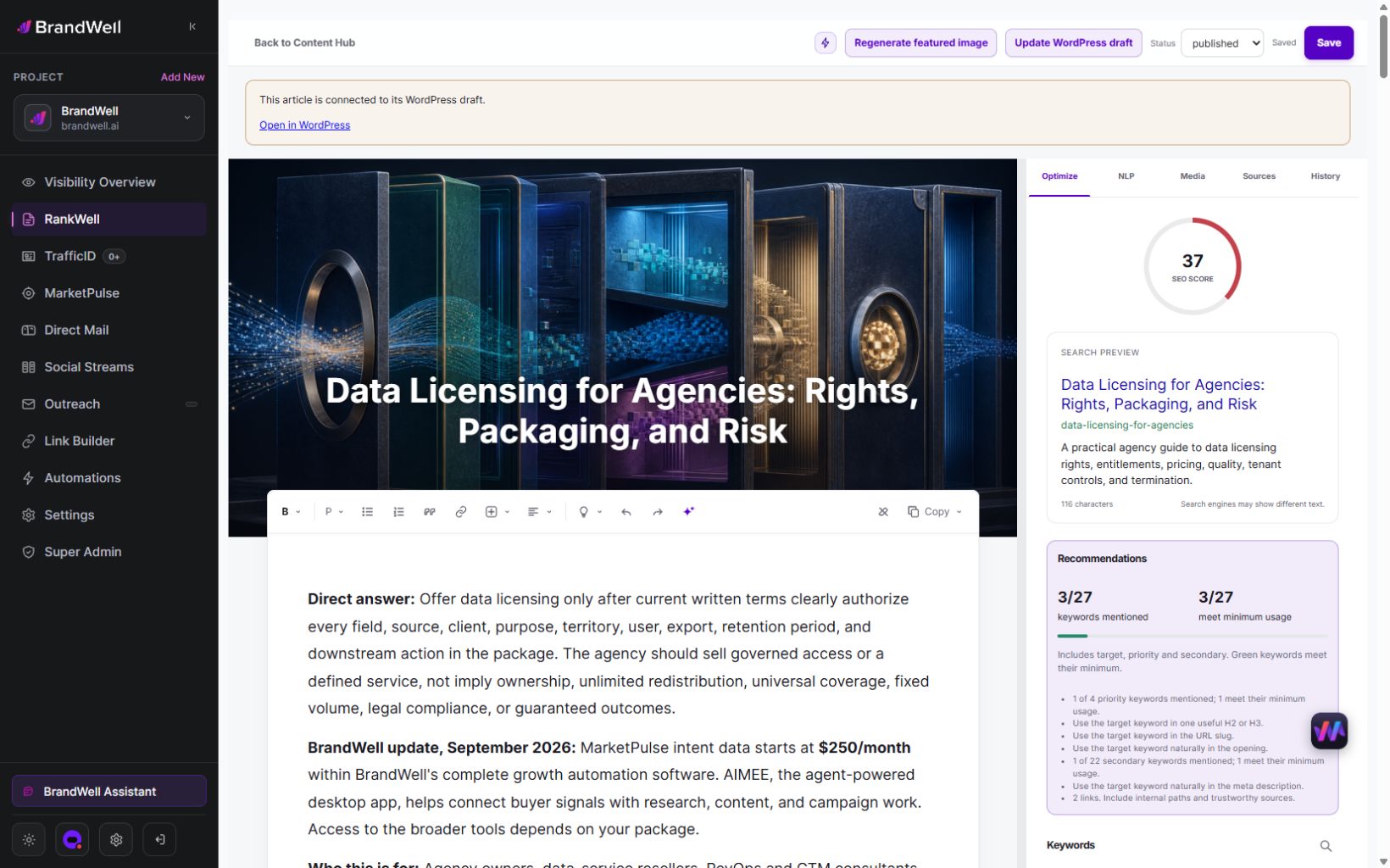
Supply original product notes and reliable sources. An instruction could say: “Write for an operations lead evaluating this workflow. Use the provided steps and screenshots. Do not invent customer outcomes, product features or survey statistics. Mark any unsupported claim for review.”
Check the finished draft against the live product. A generated article or recommendation score is an editing aid, not a promise of search rankings or conversions. Use configured publishing tools only after the work has been approved.
Show the workflow with useful images
A screenshot should answer a question: where to start, what to enter or how to recognize the result. Crop unrelated areas, remove sensitive data and provide nearby text explaining the step. Make the image large enough to understand on a phone, or break a complex screen into separate views.
Use a relevant featured image as the social preview. Avoid old product screens with obsolete names or plans. Add alternative text for meaningful images, and keep the substantive instructions in readable text rather than relying on the screenshot alone.
Edit for an answer readers can use
- Opening: Answer the main question directly.
- Structure: Use descriptive headings in a logical order.
- Evidence: Link claims to primary, relevant sources.
- Examples: Label invented scenarios and calculations clearly.
- Product fit: Explain the actual workflow, prerequisites and limits.
- Mobile: Check image loading, table scrolling, links and paragraph readability.
- CTA: Offer a next step that follows from the reader’s task.
Remove repeated introductions and broad claims such as “fresh content always ranks better” or “longer sessions automatically boost SEO.” Do not add extra sections merely to reach a word count.
Prepare for search and AI discovery without promises
Google’s guidance on AI features says existing SEO fundamentals remain relevant and no special additional optimization is required for AI Overviews or AI Mode. Eligibility does not guarantee inclusion.
Make the answer understandable, support it with original evidence and keep important information available as text. Use descriptive titles and useful internal links. Those choices help readers assess the page; they do not ensure that an AI system will cite it.
Measure useful outcomes and maintain the article
Review relevant page-level impressions, queries and clicks in Search Console. A low CTR can reflect position or query mix, so investigate before rewriting the title. Use on-site measurement to evaluate the next action separately from search visibility.
For an original example, 1,000 visits generate 40 demo requests and ten qualified opportunities. That is a 4% visit-to-request rate and a 1% visit-to-qualified-opportunity rate. If a rewrite increases requests but reduces qualified opportunities, it has not necessarily improved the business outcome.
Record major edits and compare suitable periods after enough data arrives. Update the article when screenshots, plan details, cited facts or instructions change. Refreshing a date without improving the content does not make the information current.
SaaS blog-writing questions
How technical should the article be?
Match the reader’s task and knowledge. Explain unfamiliar terms and include enough detail to complete the step. An administrator may need implementation specifics that an initial buyer does not.
Can AI write a SaaS blog?
AI can assist with organization and drafting. A knowledgeable reviewer should verify the product instructions, claims and examples before publication.
How do I start?
Choose one recurring customer question, assemble the evidence and current product steps, then build a focused brief. Explore RankWell for the content workflow that supports that process.
Reviewed and updated October 2, 2026.

Written by
Julia McCoy has contributed articles to BrandWell on content marketing, writing, and search engine optimization. This archive retains her original bylines; individual articles may be updated by the BrandWell editorial team.