On this page
- What SaaS content writing should accomplish
- Five original SaaS content examples
- A nine-step workflow for the SaaS blog
- Explain features, functions and benefits separately
- Prepare and review the article in RankWell
- Maintain resources and show evidence honestly
- Measure the page’s actual purpose
- Frequently asked questions
Useful SaaS content explains a customer’s task, shows how to complete it and states the evidence and limitations behind the product claim. A tutorial, cost example, troubleshooting resource or decision guide can do that. Choose the format for the question rather than assuming a particular article length or template will convert best.
The examples below are original editorial examples using current BrandWell workflows. They are not customer quotations, independent rankings or measured conversion results. Use them as structures for writing accurate product content.
What SaaS content writing should accomplish
SaaS content helps prospective and existing users understand a problem, evaluate a workflow, complete a task or resolve an obstacle. Marketing content and support content can share an explanation, but their next steps differ. A buyer may need to compare scope; an existing user may need to finish setup.
Start with the reader’s situation. Identify the actual product capability, prerequisite and outcome you can substantiate. Avoid replacing a working explanation with claims such as “revolutionary,” “best” or “guaranteed.” The reader needs to know what the software does and where human judgment remains necessary.
Five original SaaS content examples
1. An educational explanation
Example opening: “A topic signal is an input for research, not a confirmed sales opportunity. Start with the topic and ICP, review available company and contact information, then choose a permitted next action.”
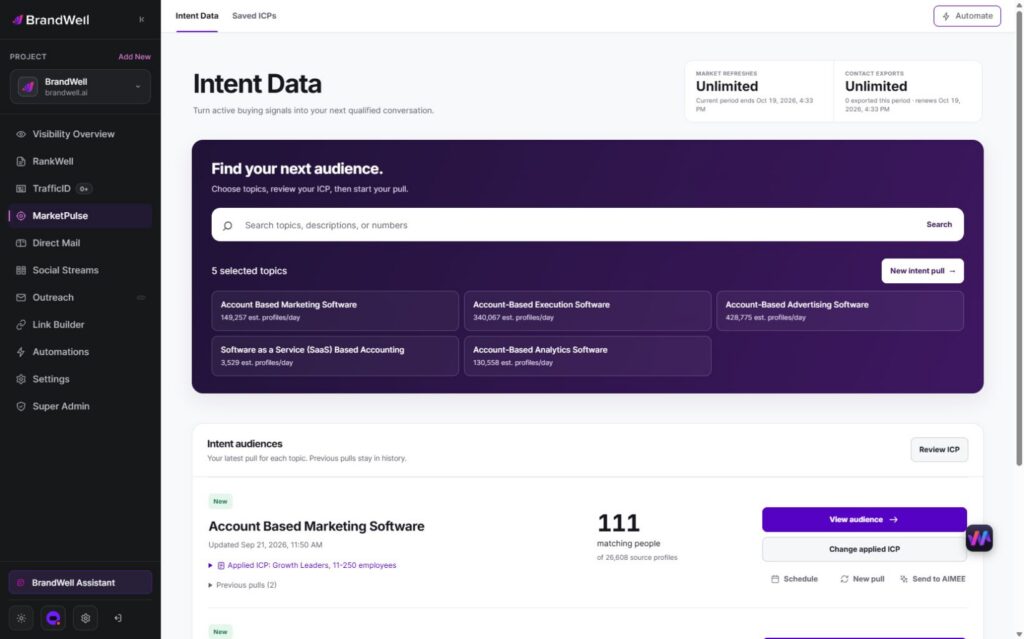
This structure defines the concept before introducing the product. Follow it with the relevant distinction, a concrete workflow and what the evidence cannot establish. In a MarketPulse article, keep account context, contact information, overlap and qualified opportunities distinct.
Useful next step: review a relevant topic in MarketPulse. Do not imply every observed person is ready to buy.
2. A task-based how-to
Example opening: “Before commissioning another article, review the question and existing coverage in the Content Hub. Decide whether to create a new page, improve an existing one or merge overlapping material.”
Build the tutorial around a task the current app supports. State the starting point, required inputs, steps and visible result. Include a screenshot near the step it explains, identify the capture date, and provide a fallback when the expected option or evidence is missing.
A RankWell guide can show the transition from a buyer question to a brief, draft, source review and approved publication. An editor score does not replace the author’s source and accuracy checks.
3. A transparent cost example
Example passage: “MarketPulse Growth’s standard $500/month plan includes three daily topics. Daily use across all three topics provides 90 pulls in a 30-day month, so subscription cost divided by included pulls is approximately $5.56 per pull.”
Then explain the denominator. A pull retrieves available data from the preceding 24 hours for one topic. It is not one contact, a guaranteed audience size or a qualified lead. Review work and activation costs are separate.
For Scale, $1,000 divided by 300 included pulls in a 30-day month is approximately $3.33 per pull. Weekly Starter pulls vary with the calendar. These are standard subscription calculations, not a promise of a particular early-access offer or ROI.
4. A customer troubleshooting resource
Example opening: “If an audience looks too narrow, check the selected topic and saved ICP before concluding that the market has no relevant research. Review exclusions and available fields, then record what remains uncertain.”
A troubleshooting article should list observable symptoms, safe checks and escalation evidence. Avoid telling users to disable important controls or repeatedly run a costly action without explaining its effect. If the article requires access or permissions, state those prerequisites.
Separate a source or filtering limitation from an integration failure. Screenshots and the expected visible result help users identify which issue they have.
5. An expert-reviewed decision guide
Example opening: “Choose a plan by the topics you need to monitor, refresh cadence, export allowance and operating capacity. Document the workflow before treating a higher allowance as a better fit.”
The expert contribution should be specific: the questions to ask, exceptions to inspect and tradeoffs that matter. Identify who reviewed the technical or domain claims and when. Compare defined workflows or plan scopes instead of inventing a universal winner.
Use real customer evidence only with an appropriate basis and context. A fictional scenario can illustrate a decision, but must stay clearly fictional. A testimonial does not independently establish typical results.
A nine-step workflow for the SaaS blog
- Define the decision. Specify whether the page helps a buyer evaluate, a user complete setup or an operator fix a problem.
- Identify the reader. Record role, current knowledge, prerequisites and the question they need answered.
- Choose the topic. Review product questions, support patterns and research opportunities. Avoid creating several pages that serve the same purpose without a clear reason.
- Review existing evidence. Inspect the current app, product scope, primary documentation and exact-page search data. Do not invent customer results or substitute sitewide queries for page-specific evidence.
- Prepare the publishing destination. Verify editable titles, descriptions, canonical URLs, images and supported publishing. A CMS publishing workflow is separate from selling a WordPress customization product.
- Assign a calendar and owner. Link draft, reviewer, publication and future maintenance to the article’s purpose rather than a posting-frequency quota.
- Outline the explanation. Put the answer, prerequisites, steps, evidence, limitations and next action in a useful order.
- Write and demonstrate. Use current product details and relevant visuals. Label examples, forecasts, assumptions and customer reports accurately.
- Review and maintain. Check sources, arithmetic, links, mobile readability, metadata and product changes before and after publication.
Explain features, functions and benefits separately
A feature names a capability; a function explains what it does; a benefit explains why that matters for the reader’s task. The benefit may remain a hypothesis until measured.
For example, a sources panel is a feature. Reviewing the draft’s supporting material is the function. Making unsupported statements easier for an editor to inspect is the intended use. Do not silently change that into a measured reduction in errors without an actual study.
Digital.gov’s plain-language guidance emphasizes writing for the specific audience, using short sections and making responsibilities clear through active voice.
In a product guide, replace “reconciliation is performed” with “the finance reviewer reconciles the usage ledger.” State who acts, what they check and the expected output. Use specialist terms when necessary, with a definition rather than an unrelated synonym.
Prepare and review the article in RankWell
- Use the Content Hub to inspect the relevant topic or buyer question and existing coverage.
- Define the brief with the reader, task, supported claims and required sources.
- Prepare the draft, then review its actual explanations and examples.
- Use the editor’s SEO recommendations, NLP, media and sources as review inputs.
- Check the search preview, title and description against the finished article.
- Verify facts, links and mobile formatting, then publish through the supported workflow after approval.
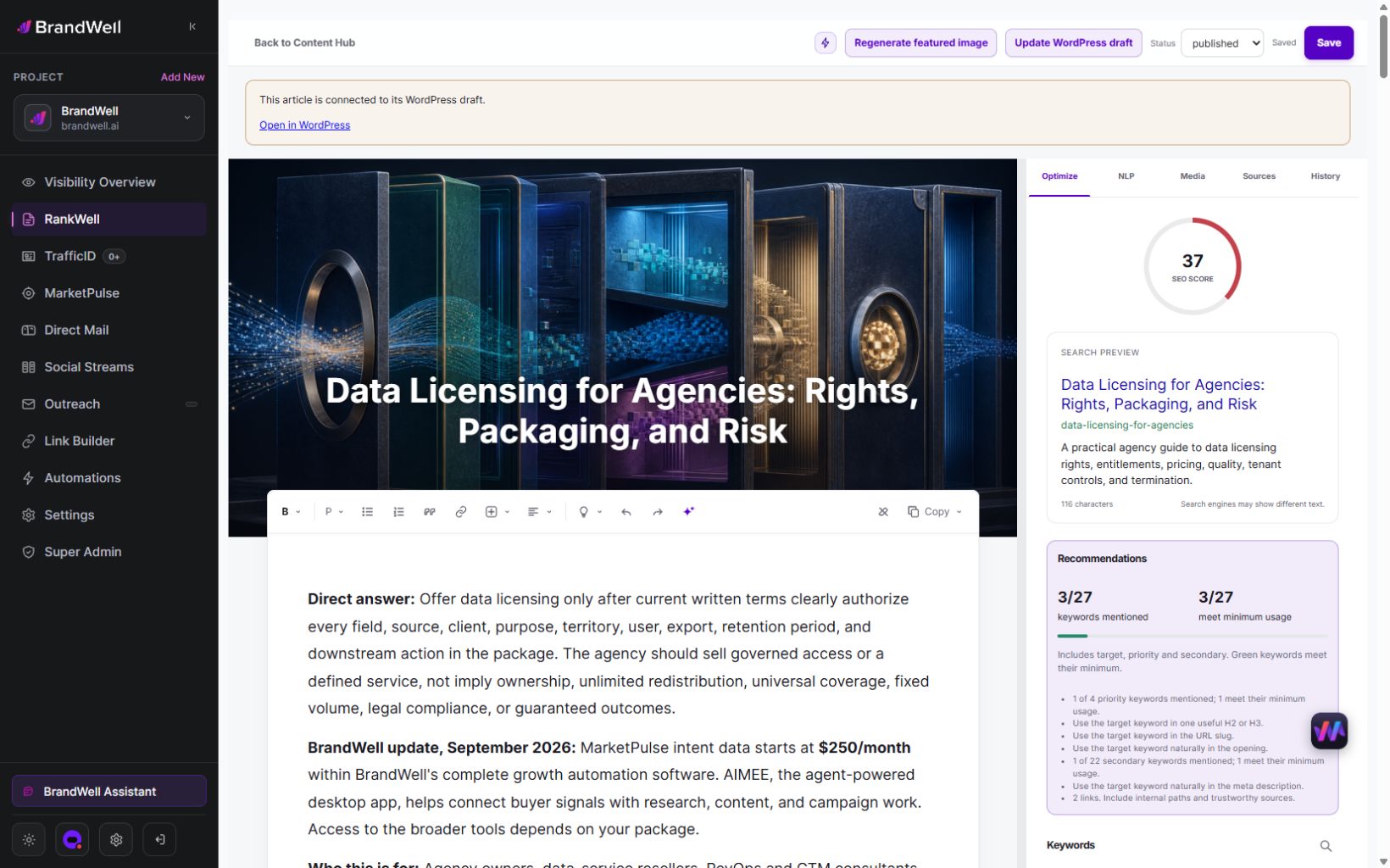
The Content Hub organizes articles, strategy, queue and calendar work. The editor combines the article, search preview, SEO recommendations, NLP, media, sources and history. Human review remains responsible for claims, context and the publication decision.
Explore RankWell’s current content workflow to research, prepare and review work inside BrandWell.
Maintain resources and show evidence honestly
For each changing claim, keep a source, review date and owner. Prices, allowances, screenshots, integrations and prerequisites can age quickly. A durable concept may remain useful while its product example needs replacement.
FTC guidance for social-media endorsements explains disclosing material brand relationships. Keep promotional relationships clear when using that content.
For a customer example, state the observed period, population, method and limitations. Distinguish a reported result from an independently verified one. For an original hypothetical example, show the assumptions and calculation rather than attributing it to a customer.
Measure the page’s actual purpose
A tutorial might be evaluated by completion or fewer repeated setup questions. A buying guide might support relevant product exploration. Search impressions and clicks describe visibility and traffic; they do not establish revenue impact by themselves.
In a fictional reporting period, a page receives 1,000 search impressions and 20 clicks: CTR is 2%. If five visitors view a demo, report that behavior separately with its own measurement scope. Do not claim that all five became customers or that an edit caused the result.
Use comparable periods and disclose changes in query mix, position, device and demand. A title revision is an editorial hypothesis to evaluate, not a guaranteed improvement. Keep conversion definitions and attribution windows stable enough to interpret the result.
Frequently asked questions
Which SaaS content format converts best?
No format is universally best. Choose the question and next action, then evaluate relevant outcomes for the actual audience.
How long should a SaaS article be?
Use enough detail to explain the task, evidence and limitations. Remove repetition; do not treat length as a substitute for usefulness.
Can I use fictional product examples?
Yes, when clearly labeled and based on supported capabilities. Keep assumptions separate from customer results and verified measurements.
What should I check before publishing?
Verify product scope, sources, arithmetic, examples, links, mobile layout, title, description and imagery. Assign an owner for future maintenance.
Reviewed and updated October 3, 2026.

Written by
Julia McCoy has contributed articles to BrandWell on content marketing, writing, and search engine optimization. This archive retains her original bylines; individual articles may be updated by the BrandWell editorial team.