On this page
- What an entity salience score means
- Salience is different from keyword frequency and ranking
- How to analyze a draft responsibly
- Five ways to improve topical clarity
- Worked example: clarify an article about payroll software
- Review topic coverage in the current RankWell workflow
- Measure the page rather than the score
- Frequently asked questions
An entity salience score describes how central an identified entity is to the text being analyzed. It is useful as a text-analysis clue. It is not a target keyword density, a probability of ranking or a demonstrated shortcut to better search positions.
Use salience analysis to ask whether a draft focuses on the intended subject. Then review the answer, supporting evidence, structure and usefulness for the reader. Do not rewrite a helpful article merely to raise a number.
Reviewed October 3, 2026.
What an entity salience score means
An entity is an identifiable subject such as a person, organization or location. An entity-analysis system may identify a phrase, associate a type with it and return supporting information. Detection can be ambiguous or incomplete.
Google Cloud’s v1 Entity reference defines salience on a zero-to-one scale as an entity’s importance or centrality to the document. Higher values indicate greater centrality in that analysis. The documentation describes an API field, not a search-ranking guarantee.
Keep the API version and tool output attached to your analysis. Do not assume every interface or version returns the same fields. A document-level result also depends on the text submitted: including navigation, repeated boilerplate or unrelated sections changes what you are analyzing.
Salience is different from keyword frequency and ranking
- Frequency counts mentions under a defined matching rule.
- Salience describes centrality in a particular text-analysis output.
- Search performance concerns observed impressions, clicks and positions for a page and query context.
These are different measurements. Ten repetitions are not proof that an entity is the right focus. A salience value of 0.8 is not an 80% chance of ranking, and a change from 0.3 to 0.6 does not establish a ranking improvement.
The cited API definition does not establish that front-loading a noun, capitalizing it, lengthening sentences or reducing synonyms will improve search positions. Write naturally and resolve ambiguity for the reader. Avoid turning an analysis aid into a set of unsupported ranking rules.
How to analyze a draft responsibly
- State the reader’s question. Define what the page should explain or help someone do.
- Select the actual article text. Exclude menus, duplicated footers and unrelated recommendations when evaluating editorial focus.
- Use an appropriate analysis tool. Check its current input requirements, version, returned fields and data-handling terms before submitting content.
- Inspect the entities. Check whether names, organizations and concepts are interpreted correctly.
- Investigate surprises. An incidental subject dominating the analysis may indicate a distracting section, ambiguous reference or extraction problem.
- Edit for meaning. Improve the answer and supporting explanation, then rerun only if it helps evaluate the change.
Record the text version, extraction scope and analysis settings. A comparison using different text lengths, boilerplate or settings can be misleading. Do not submit confidential client material to an external tool without the necessary authorization.
Five ways to improve topical clarity
1. Use a clear content structure
Lead with the answer, then explain definitions, steps, examples and limits. Use headings that describe the section. A reader should understand the article’s purpose without searching through a long introduction.
2. Introduce the central subject naturally
Name the product, concept or problem where it helps the explanation. Remove unrelated opening material. This is an editorial choice for clarity, not a formula requiring a fixed number of early mentions.
3. Resolve ambiguous references
If “Apple” could mean the company or the fruit, clarify the intended meaning in context. Use names and pronouns naturally once the reference is established. Repeating the full name in every sentence can make the article harder to read.
4. Keep structured data consistent with the page
Review any structured data for accurate names, authorship, dates and page type. Do not add unsupported entities or claims merely to emphasize a subject. Markup does not establish that a page will receive a particular search feature.
5. Review the explanation as a reader
Check whether the steps answer the question, the examples are meaningful and the facts have suitable sources. Short sentences are often clearer than deliberately complex ones. Remove sections that repeat the subject without adding useful information.
Worked example: clarify an article about payroll software
Imagine a draft titled “How to evaluate payroll software.” Its opening spends several paragraphs discussing a famous technology company before reaching payroll requirements. An entity analysis emphasizes that company.
The useful edit is to replace the detour with the actual decision: supported jurisdictions, payroll accuracy checks, integrations, implementation responsibilities and the buyer’s requirements. Explain each point with appropriate evidence and a concrete evaluation task.
If the revised analysis places more emphasis on payroll concepts, that is consistent with a clearer focus. It does not prove the page will rank higher. Judge the change first by whether it better serves the reader, then monitor actual search performance.
Review topic coverage in the current RankWell workflow
- Prepare the brief with the reader, question, scope and intended product context.
- Create or open the draft in RankWell.
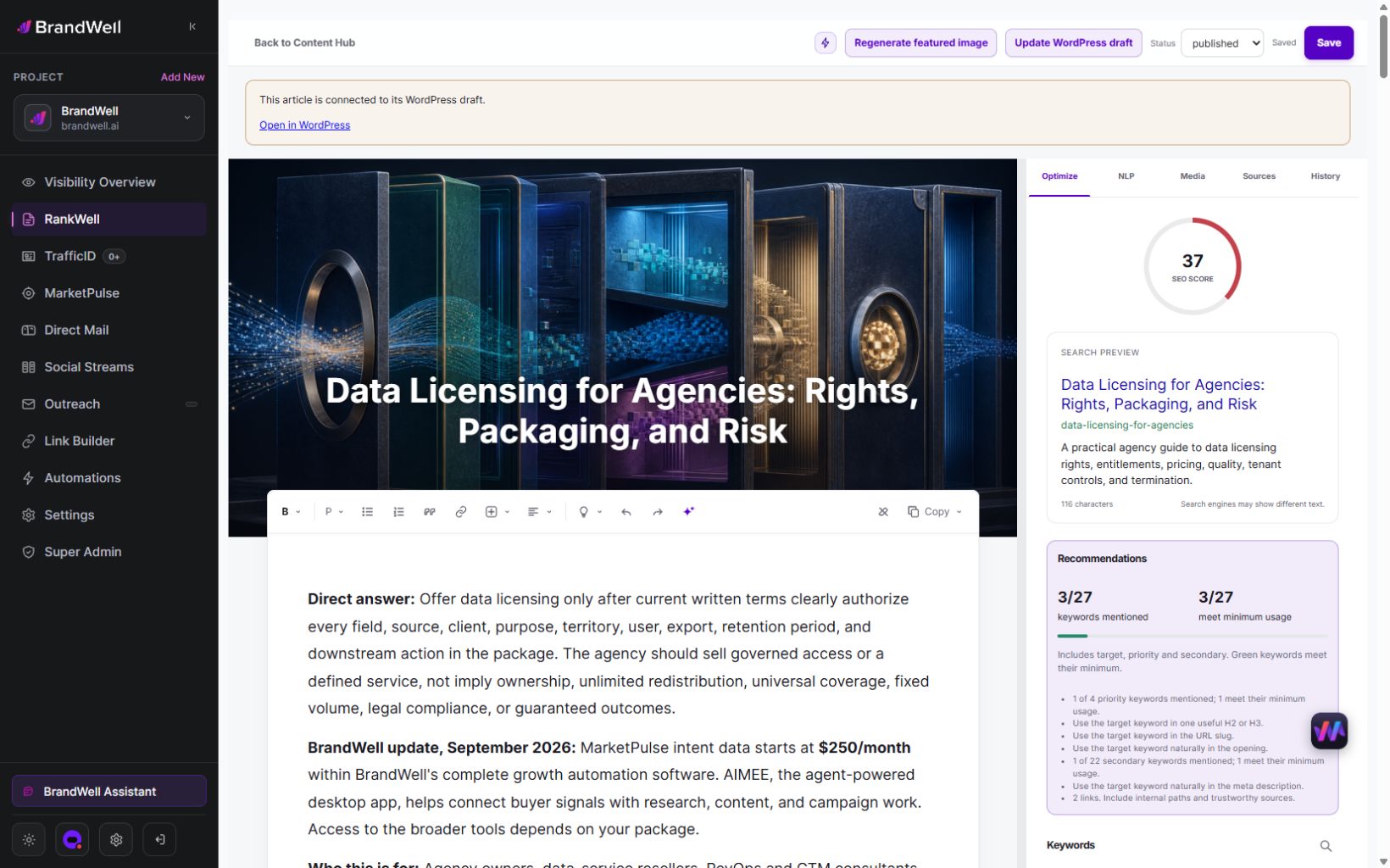
- Review the editor’s available optimization and NLP information as suggestions to inspect, not mandatory words to insert.
- Check factual claims and sources, add your own expertise and remove unsupported promises.
- Review the finished article, metadata, links and media in preview.
- Approve the work before publishing through the configured destination.
Use the actual features available in your current workspace. This guide does not establish that RankWell returns Google Cloud’s exact salience field, uses a particular API version or compares precisely three other pages. Keep a tool’s content recommendations distinct from a documented API metric.
Measure the page rather than the score
Record the publication or edit date and the specific changes. In Search Console, compare the exact page over suitable date ranges and inspect relevant queries, devices and countries. Use impressions, clicks, CTR and average position with their actual definitions and context.
For a fictional example, three clicks from 100 impressions is 3% CTR. Four clicks from another 100 impressions is 4%. That is one additional click and a one-percentage-point difference. It does not establish that a salience edit caused the change; query mix, position, seasonality and other changes may differ.
Check whether the article now answers the queries actually shown for it. A title that promises a “secret to better rankings” can set an expectation the analysis does not support. Use a clear title and description that match the content.
Frequently asked questions
Should the main entity have a score close to 1?
No universal target is established here. Focus on a clear, useful answer rather than forcing the number upward.
Is entity salience the same as sentiment?
No. Centrality and sentiment describe different aspects of text. Check the exact fields returned by the tool and version you use.
Does increasing salience guarantee better rankings or an AI Overview citation?
No. The API definition provides no such guarantee. Review quality and actual search evidence separately.
Can I use entity analysis without changing the article?
Yes. If the article already answers the question clearly and the analysis adds no actionable insight, there may be no useful edit to make.
Explore RankWell’s current content workflow to prepare, review and publish useful material with appropriate sources and editorial approval.
Reviewed and updated October 3, 2026.

Written by