On this page
Search intent is the task a person may be trying to accomplish with a query. They might want an explanation, a particular website, help choosing an option, or a way to complete an action. Use intent as a planning hypothesis, then check the results and evidence rather than assuming you know an individual searcher’s motives.
A query can support several tasks. “Payroll software” could come from a buyer comparing options, an existing customer looking for support, or a student researching the category. The words alone do not establish a person’s budget or readiness to purchase.
Four useful planning categories
Informational, navigational, commercial, and transactional are common editorial labels. They are not a verified percentage breakdown of all searches or a rule that every query has exactly one intent.
| Category | Possible task | Original example | Useful page |
|---|---|---|---|
| Informational | Understand or complete a task | How to prepare employee records for an import | Tested instructions and checklist |
| Navigational | Reach a known destination | BrandWell portal login | The correct login destination |
| Commercial | Evaluate a choice | Payroll software requirements for a small team | Decision criteria and verified scope |
| Transactional | Complete an action | Book an IT onboarding consultation | Clear service details and booking route |
Swipe the table to see all columns.
Location can introduce another practical need, such as finding a nearby service. A person may also need both an explanation and an action on the same page. Treat the categories as aids to judgment rather than forcing every query into a fixed funnel stage.
Why intent matters to the article brief
A product page is a poor substitute for a missing troubleshooting answer. A long definition is a poor substitute for a visitor’s request to log in. Clarifying the task helps you choose the page type, structure, examples, and next step.
Google’s people-first content guidance asks whether the material satisfies an intended audience and contributes useful original work. Matching a task supports that goal, but does not guarantee a ranking or conversion.
Determine intent using evidence
Read the complete query
Modifiers such as “how,” “price,” “requirements,” or “login” can suggest a task. They are clues, not psychological proof. A longer phrase may clarify scope, but length alone does not determine intent or commercial value.
Inspect current results for the relevant market
Look at whether the results emphasize instructions, products, local services, videos, or official destinations. Record the market, device context, and date because the result mix can change. Identify the useful task those pages address and what evidence your own page can contribute.
Do not copy another site’s article or assume the most common format is the only permissible one. The opportunity may be a clearer worked example, a current instruction, or an answer the existing resources leave incomplete.
Review your own query and page performance
The Search Console Performance report lets you inspect query and page context alongside clicks, impressions, CTR, and average position. Compare consistent filters and periods.
A page receiving irrelevant queries may have a scope problem. A relevant page appearing far down the results may need more than a new title. A prominent result with weak CTR warrants checking the displayed answer, title, result features, and competing expectations. Aggregate data does not identify the motives of a specific visitor.
Ask customers and the team
Support and sales questions can reveal what readers actually need. Check whether the proposed article answers those questions accurately. Use approved examples and remove private customer details.
Build a brief for the task
- Define the reader: the role or situation the page serves.
- State the question: the specific task to answer.
- Choose the deliverable: explanation, instructions, comparison criteria, or action route.
- List evidence: primary sources, actual product scope, and original examples.
- Identify unknowns: information the query does not establish.
- Choose the next step: something appropriate to the reader’s task.
- Define success: a useful completed action or observable result, with limitations.
An original example for “IT provider onboarding checklist” would focus on information to prepare, owners, secure handoffs, and verification. Its next step could be reviewing the provider’s actual process. It should not require a purchase before answering the checklist question.
Use BrandWell research and RankWell together
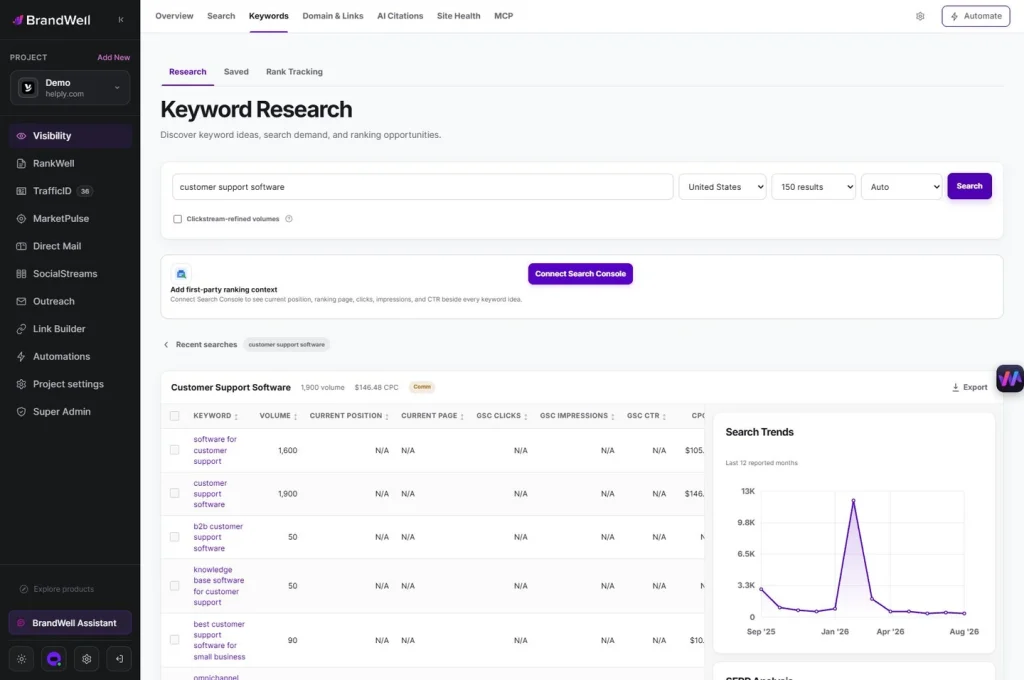
In the current BrandWell portal, choose the relevant Company Project and available keyword research workspace. Inspect related terms and market context, then compare connected first-party search evidence when available.
Use RankWell to develop the content from the reviewed brief. Verify facts and instructions, add relevant expertise, and check that the introduction answers the actual question. A generated label or recommendation should remain subject to review.
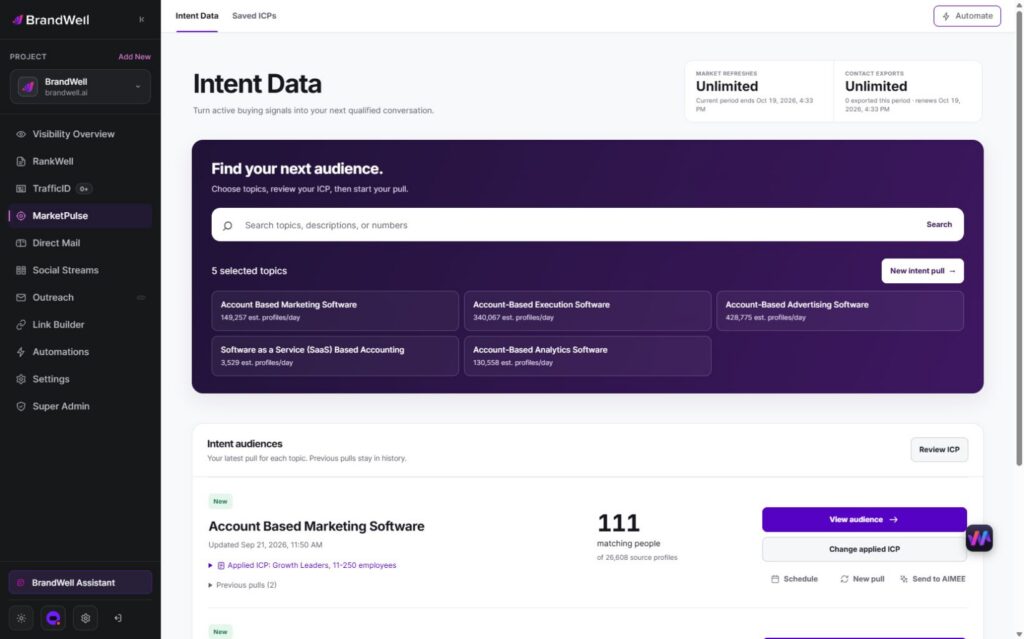
Search intent and MarketPulse topic-research audiences are different concepts. The former helps plan an answer to a query; the latter provides audience context for further evaluation. Neither automatically proves that a particular person is ready to buy.
Keep the answer clear for readers and AI search
Place the direct answer near the beginning. Use headings describing real subquestions, support factual statements with sources, and add an example that shows how the idea works. Keep the answer usable without requiring readers to infer the core point from promotional copy.
Google’s AI search guidance does not establish a special paragraph length or secret tag for inclusion. Clear, accessible information can serve readers across search experiences; it does not guarantee an AI Overview citation.
Common questions
Are informational queries always low value?
No. Instructions can support evaluation, onboarding, retention, or a buying decision. Evaluate the actual task and business outcome instead of assigning every informational query a low-value label.
Does “buy” prove someone will purchase?
No. It suggests an action-oriented query, but the person’s circumstances and eventual behavior remain unknown.
Should every intent category get a separate page?
Create separate pages when the tasks and useful answers are meaningfully different. Improve an existing page when it already serves the same question.
Reviewed and updated October 2, 2026.

Written by
Julia McCoy has contributed articles to BrandWell on content marketing, writing, and search engine optimization. This archive retains her original bylines; individual articles may be updated by the BrandWell editorial team.