



On this page
An SEO competitor analysis compares the pages appearing for relevant searches with your own content, navigation and technical experience. Use it to identify unanswered buyer questions and practical improvements. Public rankings do not reveal another company’s actual traffic, revenue or conversion rate.
Start with a small set of searches that matter to your customers. Record the location, device and date of your observations. Search results vary, so a single result page is a snapshot rather than a complete market report.
A practical SEO competitor analysis checklist
- Define the audience and task: specify what the searcher needs to accomplish.
- Identify relevant search results: record recurring domains and page types for the selected queries.
- Compare coverage: identify questions, examples and evidence each page provides.
- Review titles and navigation: check whether the page promise and next step are clear.
- Inspect sources and links: distinguish useful citations from unsupported claims.
- Test the technical experience: review mobile layout, loading, forms and accessible navigation.
- Choose an original improvement: add knowledge your business can substantiate.
- Measure your own results: use a dated baseline and consistent reporting scope.
Identify search rivals by the task
A business rival and a search rival are not always the same. A product query may surface vendors; a troubleshooting query may surface documentation or educational resources. Compare pages serving the same need rather than treating every ranking domain as a company to imitate.
Group the selected queries by intent: learning a concept, comparing options, completing a task or finding a known product. A guide that answers a different question is not a useful template simply because it ranks well somewhere else.
Keep observations separate from estimates
- Public observation: headings, examples, page speed diagnostics and visible links.
- Your verified data: Search Console performance and your configured analytics.
- Third-party estimate: modeled traffic, difficulty or search volume, with its source and limitations.
- Unknown: another site’s private conversion rate, revenue or customer quality.
A ranking change does not prove why a page moved. Do not diagnose a penalty, content failure or revenue loss from a tool’s visibility estimate alone. Treat an apparent gap as a hypothesis to investigate.
Compare usefulness before counting words
Read the pages. Look for missing steps, obsolete screenshots, unverified statistics, confusing definitions and examples that never show the actual task. A longer article or a higher publishing frequency does not establish better content.
Google’s SEO Starter Guide emphasizes useful, organized content and descriptive navigation. Apply those principles to your own audience rather than copying another page’s headings or target word count.
Write descriptive titles that match the finished page. Google’s title-link guidance recommends concise, distinct titles and avoiding keyword stuffing. Google may generate the displayed title from several signals, so changing your title tag is not a guarantee of a particular search snippet or CTR.
Inspect links and technical experience
Review whether citations support the nearby claims and whether internal links help readers continue a task. Link counts and third-party authority scores are clues, not a universal threshold for deciding which sources or relationships are worthwhile.
Earn relevant links through useful resources and appropriate relationships. Avoid schemes designed to manipulate ranking; consult Google’s spam policies before adopting a link tactic.
Test your page on a real mobile layout for text, tap targets, forms and horizontal overflow. Use performance diagnostics to identify slow resources, then review real-user data where available. Core Web Vitals and a lab score answer different questions; one successful lab run does not establish that all visitors have a fast experience.
Only use structured data that accurately describes the page. Google’s structured-data guidance explains eligibility and validation. More elaborate markup does not guarantee a rich result.
Original example: improve an IT services guide
Suppose several results explain backup options but none helps a small team prepare for a restore test. This is a hypothetical opportunity, not a measured ranking result.
- Reader question: what should we check before attempting a restore?
- Original addition: a checklist reviewed by your technical team, with responsibilities and an example test record.
- Evidence: current documentation for the systems discussed and clearly labeled internal examples.
- Next step: an appropriate consultation or supporting resource.
- Measurement: relevant search queries, visits to the guide and configured consultation outcomes.
This improves the actual task. It does not require claiming that the guide will outrank a particular domain.
Develop the improvement in BrandWell
Use BrandWell’s keyword research workspace to explore relevant opportunities, then prepare an approved brief for RankWell. Include source links, the missing question and the original evidence your team can supply. Review the resulting draft before configured publishing.
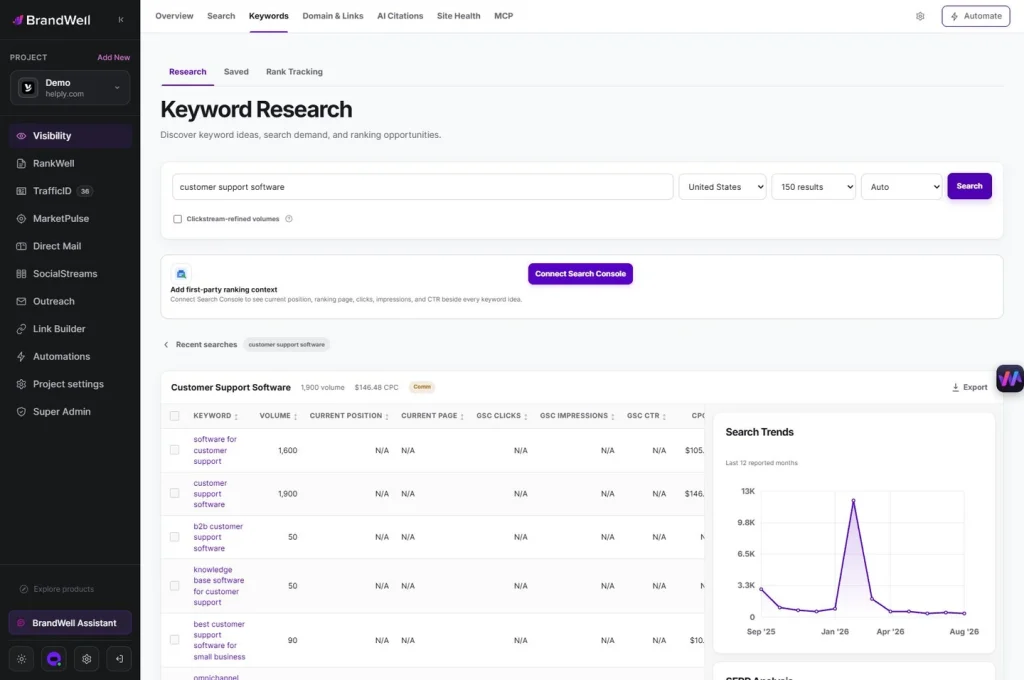
Record a baseline in Search Console for the updated URL and relevant queries. Compare equivalent periods and inspect device, position and query mix before attributing a CTR change to your edit. Keep business outcomes in your own analytics rather than inferring them from a rival’s public search presence.
Reviewed and updated October 2, 2026.

Written by

