



On this page
- 1. Define a business goal and its measurement
- 2. Identify the reader and the question
- 3. Inspect the search landscape and your own evidence
- 4. Audit existing content before creating more
- 5. Prioritize topics and build a workable calendar
- 6. Choose formats that explain the task
- 7. Prepare, source, and review the content
- 8. Distribute through appropriate channels
- 9. Review results and maintain the plan
- Three strategy examples you can adapt
- Frequently asked questions
A content marketing strategy defines who you will help, which decisions your content will support, how you will produce and distribute it, and how you will measure useful outcomes. It connects articles, demonstrations, email, and social content to a business purpose rather than a publishing quota.
A practical plan needs an audience, a prioritized topic list, evidence, owners, a review process, a distribution plan, and a measurement baseline. Use the nine steps below to build one, then adapt the clearly labeled examples to your own business.
1. Define a business goal and its measurement
Choose a result the team can describe and track. “Publish more” measures activity. “Help prospective customers understand the migration process and request a qualified consultation” describes a reader decision and a business outcome.
Define the period, starting point, qualification criteria, and responsible owner. Track intermediate behavior without treating it as the final result: impressions are not visits, visits are not inquiries, and inquiries are not customers.
Record what you can influence, such as completing an approved guide, separately from uncertain outcomes such as traffic or sales. Your strategy should explain the relationship you expect to test, not promise that the relationship already exists.
2. Identify the reader and the question
Use customer interviews, approved support questions, sales conversations, and existing site data to understand the decisions people struggle with. Write down their situation, the information they need, and what would count as a useful answer.
A role label alone is not a brief. A payroll manager considering a system change may need a migration checklist; a first-time business owner may need definitions and responsibilities. Those readers need different content even when both search for payroll information.
Do not invent demographic details or motivations to complete a persona. Collect only the information needed for the task and preserve uncertainty when the evidence is incomplete.
3. Inspect the search landscape and your own evidence
Review the relevant search results to understand which tasks they address, how current their information is, and what original detail your company can add. This is a relevance check, not an instruction to copy another publisher’s headings or claims.
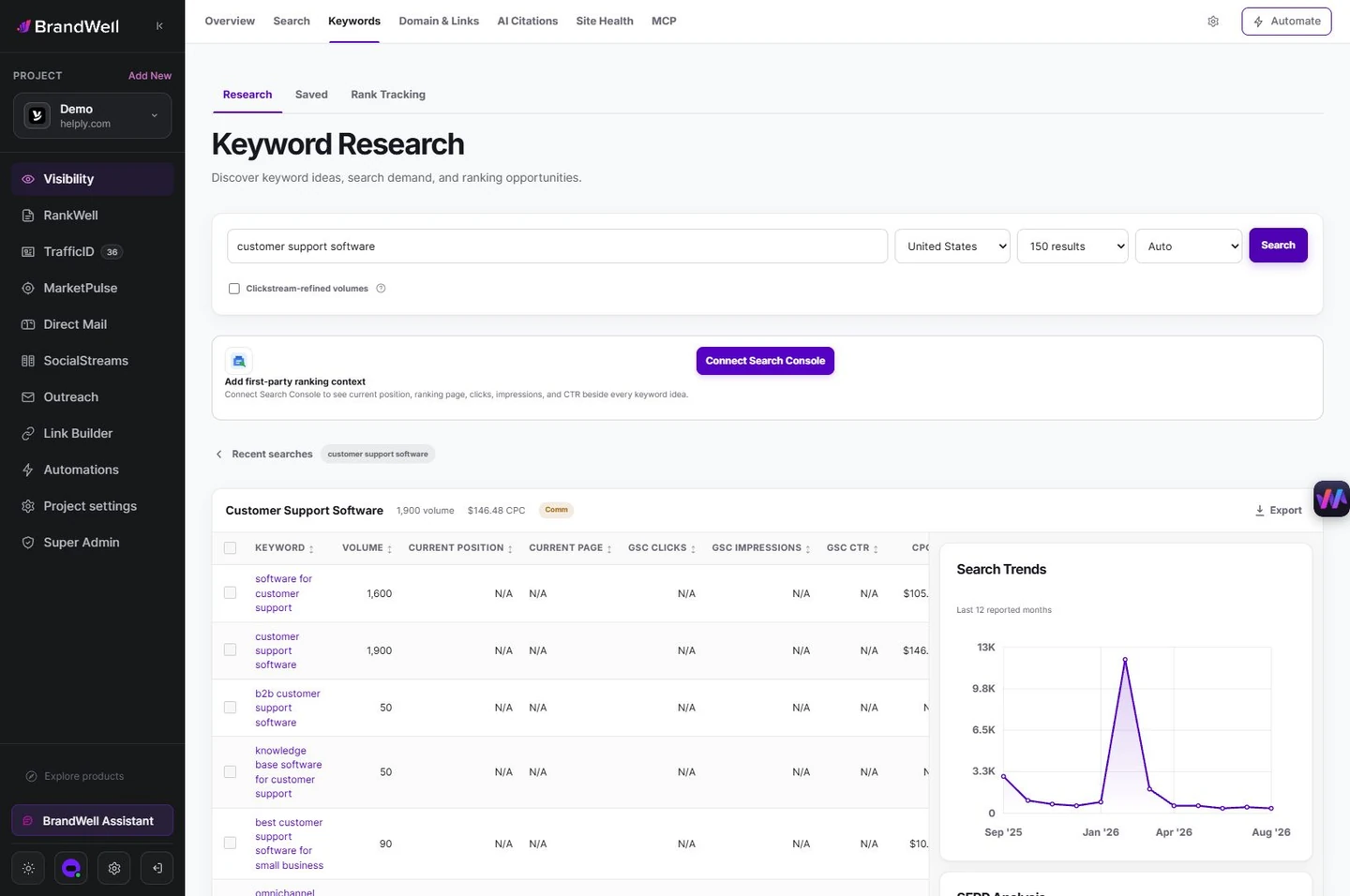
Separate keyword suggestions from measured data. Record the source, date, market, and meaning of any search-volume or difficulty figure. A difficulty estimate is not a guarantee that a topic will be easy or impossible to rank for.
Inside BrandWell, use the available keyword research workflow to evaluate candidate topics, then connect a selected topic to a reader brief. Keep the business question visible when comparing metrics.
4. Audit existing content before creating more
Inventory relevant URLs, reader tasks, current product references, factual claims, source dates, images, and next actions. Identify which pages need a substantive update and which repeat an answer already covered elsewhere.
Use Search Console to monitor search performance and investigate indexing issues. Pair that view with your own inquiry and customer records rather than assuming search visibility equals business value.
- Update: The reader task is useful, but facts, screenshots, or instructions are stale.
- Improve: The page is relevant but does not answer the question clearly or provide sufficient evidence.
- Consolidate carefully: Several pages serve substantially the same task. Plan the retained page and any URL handling before making changes.
- Retire: The article describes an abandoned product or a use case the business no longer supports.
Keep a backup and a change log. Correcting the underlying information matters more than replacing the year in the title.
5. Prioritize topics and build a workable calendar
Choose topics by audience fit, decision value, available evidence, and production effort. Include useful introductory explanations and deeper implementation material where the reader needs both. A large keyword list does not require a large publishing schedule.
In BrandWell’s current Content Hub, organize article, strategy, queue, and calendar work. For each item, assign the brief, sources, author or draft owner, reviewer, deadline, distribution owner, and maintenance date.
Hypothetical monthly plan: A small team prepares three articles, two social summaries based on those articles, and one product demonstration update. These are six planned deliverables, not six unrelated research projects. The demonstration still needs its own production and approval process; an article draft does not automatically create a finished video.
6. Choose formats that explain the task
Match the format to the information. Use an article for a searchable explanation, a screenshot sequence for interface instructions, a video for a process that benefits from motion, and a worksheet for a repeatable decision or handoff.
Do not choose video merely because a general survey says it is popular. Ask whether the actual reader needs it and whether the team can maintain it. Give images useful captions and descriptive alternative text, and provide accessible supporting material for important audio or visual instructions.
Repurposing can extend a useful explanation, but each version needs review. A social summary should preserve the qualifications in the original article instead of turning a careful finding into an absolute claim.
7. Prepare, source, and review the content
Use RankWell to support preparing and reviewing an article within the current BrandWell workflow. Bring your brief, source material, and original examples to the draft. The editor includes the article, search preview, SEO recommendations, NLP, media, sources, and history.
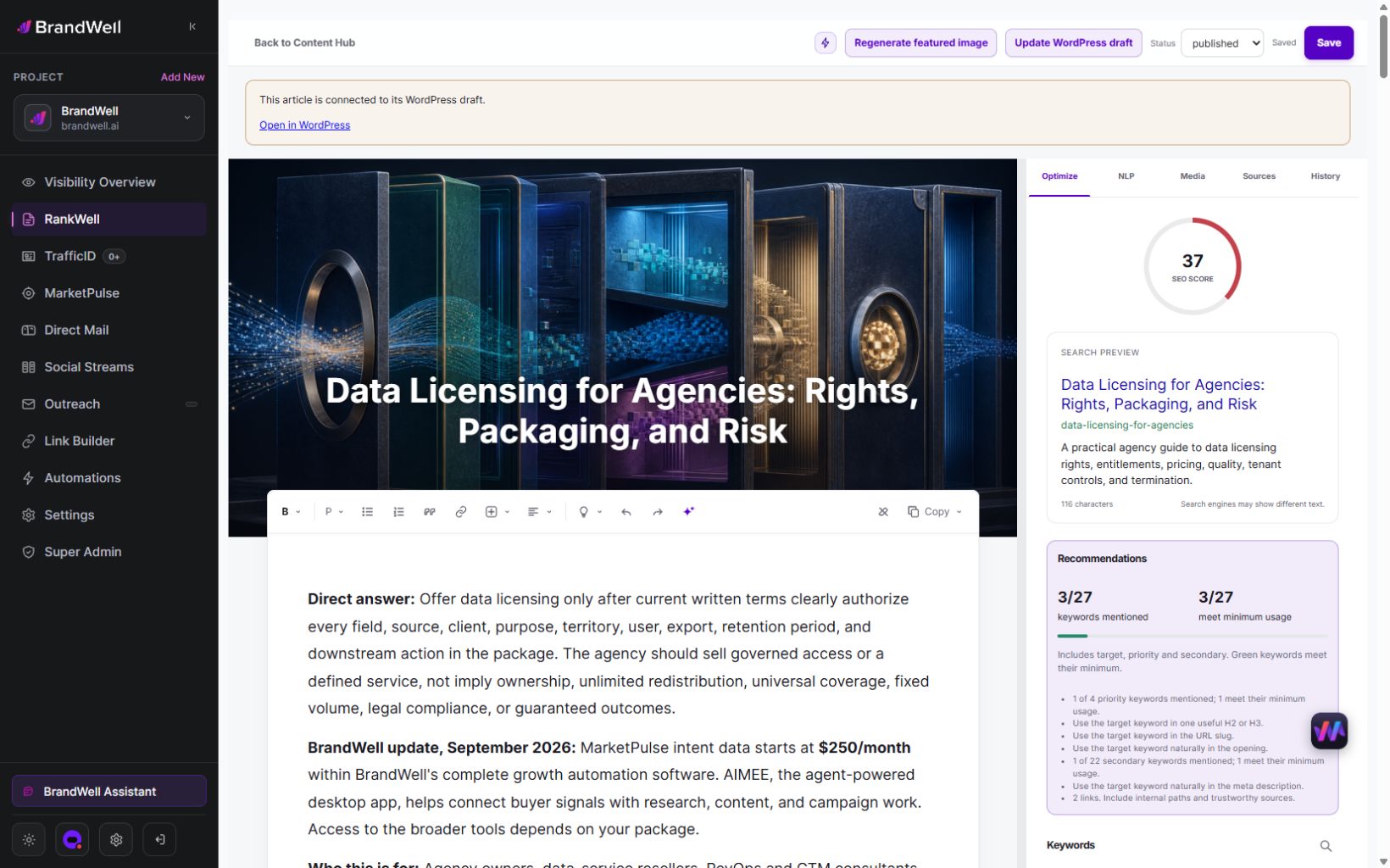
Answer the main question early. Verify statistics, quotations, instructions, and product claims against the original source. Add examples that explain a real decision, label hypothetical numbers, and remove unsupported claims rather than dressing them up as facts.
Use a clear title and headings that match the page. Google’s title-link guidance recommends descriptive, concise titles and avoiding keyword stuffing; Google can use multiple page sources to generate the displayed search title. Do not promise an exact search-result title or click-through improvement from an edit.
8. Distribute through appropriate channels
Publish to your configured destination and inspect the live result. Then prepare relevant distribution, such as an opted-in newsletter summary, an approved social post, a sales enablement link, or a support answer.
Use tools configured for your workspace, with appropriate permissions and review. AIMEE can help research and prepare the next step within that scope; this does not establish that every channel, integration, or autonomous action is available.
If you use paid promotion, define its separate budget, audience, landing page, and outcome. Available intent or visitor data is not itself permission for every contact channel. A content subscription should not be described as an entire unattended marketing operation.
9. Review results and maintain the plan
Compare search impressions, clicks, relevant visits, qualified inquiries, and customer outcomes using the same definitions and suitable periods. Investigate high-impression pages with weak clicks by checking query fit, the current search result, title accuracy, and the usefulness of the page.
Hypothetical example: A page records 10,000 search impressions and 100 clicks, giving a 1% click-through rate. Those visits produce 5 qualified inquiries. That is 5% of the recorded visits, but it does not mean 5% of all impressions became inquiries or that an editorial change caused the result.
Account for seasonality, query mix, ranking changes, device differences, and other site changes. Use each report’s actual definitions instead of treating a single-page visit as an automatic sign of poor content. Revisit facts and product instructions as part of maintenance.
Three strategy examples you can adapt
The following are fictional planning examples, not customer results.
An IT services company
The reader is a business owner comparing managed support options. Prepare a service-scope guide, an onboarding checklist, and a demonstration of the support handoff. The next action is a qualified consultation. Measure inquiries that meet the company’s geography and service criteria, not just guide downloads.
A payroll software company
The reader is a payroll manager planning a migration. Prepare a record inventory guide, a validation worksheet, and current interface screenshots. The next action is a demonstration aligned with the migration requirements. Keep general process advice distinct from legal and system-specific instructions.
A marketing agency
The reader needs to evaluate an agency’s operating process. Prepare a clear brief template, an evidence-review checklist, and a labeled cost example. Show how research becomes an approved deliverable. Measure qualified service conversations and delivery effort separately from engagement.
Frequently asked questions
How is content strategy different from SEO strategy?
Content strategy plans useful material, production, distribution, and maintenance across channels. SEO strategy includes search discovery and technical considerations. They overlap, but a content plan should still serve the reader beyond a ranking target.
How much should a team publish?
Choose a volume the team can research, review, distribute, and maintain. More drafts do not necessarily mean more useful content or better business outcomes.
Can BrandWell support the process?
Use the current keyword research, Content Hub, and RankWell editor to support topic preparation and editorial work. Confirm your configured tools and permissions before extending the workflow into other channels.
Explore RankWell to prepare and review content as part of a focused BrandWell growth workflow.
Reviewed and updated October 3, 2026.

Written by
Julia McCoy has contributed articles to BrandWell on content marketing, writing, and search engine optimization. This archive retains her original bylines; individual articles may be updated by the BrandWell editorial team.
2 comments