On this page
- Distinguish the stages
- Make important pages discoverable
- Understand robots.txt and noindex
- Review server responses and resources
- Keep the sitemap accurate
- Use URL Inspection for one page
- Use Crawl Stats for patterns
- Original diagnosis: a published service guide is missing
- Prepare and inspect content with BrandWell
- Measure the correct result
Crawling is when a search engine fetches content from a discovered URL. Indexing is a separate process that analyzes and stores information for search. A crawled page is not automatically indexed, and an indexed page is not guaranteed to rank for a particular query.
Google’s explanation of Search separates discovery, crawling, indexing and serving results. Use those distinctions to diagnose the actual problem rather than treating every missing result as a crawl error.
Distinguish the stages
- Discovery: the search engine learns about a URL.
- Crawling: a crawler fetches the page and relevant resources.
- Indexing: the content is analyzed for potential inclusion.
- Serving: results are selected for a user’s query.
Links and sitemaps can help discovery. Access restrictions and server behavior can affect fetching. None of those steps guarantees the next one.
Make important pages discoverable
Link relevant articles from useful category, navigation and contextual pages. Use wording that tells the reader what the destination provides. A page with no useful incoming internal link can be difficult for readers to find even if it appears in a sitemap.
Google’s link guidance describes crawlable anchor elements with an href. Do not rely on a script-only control when the intent is an ordinary navigable link.
Understand robots.txt and noindex
Robots.txt manages crawler access. It is not a reliable way to keep a page out of search or secure private information. A blocked URL may still be known through other references.
To process a noindex rule, Google needs access to crawl the page. Avoid blocking the same page in robots.txt while expecting a newly added noindex to be read. Private material needs actual access controls rather than a crawler request.
Review server responses and resources
Check whether the public URL returns the intended page. Investigate unexpected redirects, loops, access challenges, server failures and resources needed to understand the content. Preserve the observed response and time before changing configuration.
A deliberate removed page and a broken link to an important live resource need different remedies. Do not redirect every missing URL to the homepage simply to make a report look cleaner.
Keep the sitemap accurate
Include intended canonical URLs that represent the pages you want discovered. Remove stale destinations and inspect accidental test or duplicate entries. Confirm that important URLs work and have the expected indexing instructions.
A sitemap is a discovery aid, not a promise of immediate indexing. Keep meaningful internal navigation as part of the site rather than making the sitemap the only route to articles.
Use URL Inspection for one page
URL Inspection shows information about Google’s indexed version and provides a live test. Compare the reported canonical, crawl information and access status with the current page.
The indexed view can lag behind a recent change. A live test answers different questions and does not prove inclusion in results. Record which version you examined before reporting a fix as complete.
Use Crawl Stats for patterns
The Crawl Stats report provides request and response patterns. Review host availability, response types and timing rather than assuming fewer requests mean lower content quality.
Where authorized server logs are available, compare the relevant requests with deployments and incidents. Verify crawler identity before treating a user-agent label as conclusive evidence.
Original diagnosis: a published service guide is missing
Suppose a team publishes a restore-test checklist and cannot find it in search. First it opens the exact public URL, checks navigation and confirms that the intended content is accessible. It records the status, canonical and indexing instructions.
Next it inspects the URL in Search Console. If the live page is blocked by an unintended rule, the team reviews that configuration. If the page is accessible but not indexed, it assesses the reported reason, originality and overlap before requesting further action.
This fictional workflow avoids jumping from “not visible for my query” to “Google cannot crawl it.” A page can be accessible or indexed without appearing for that specific search.
Prepare and inspect content with BrandWell
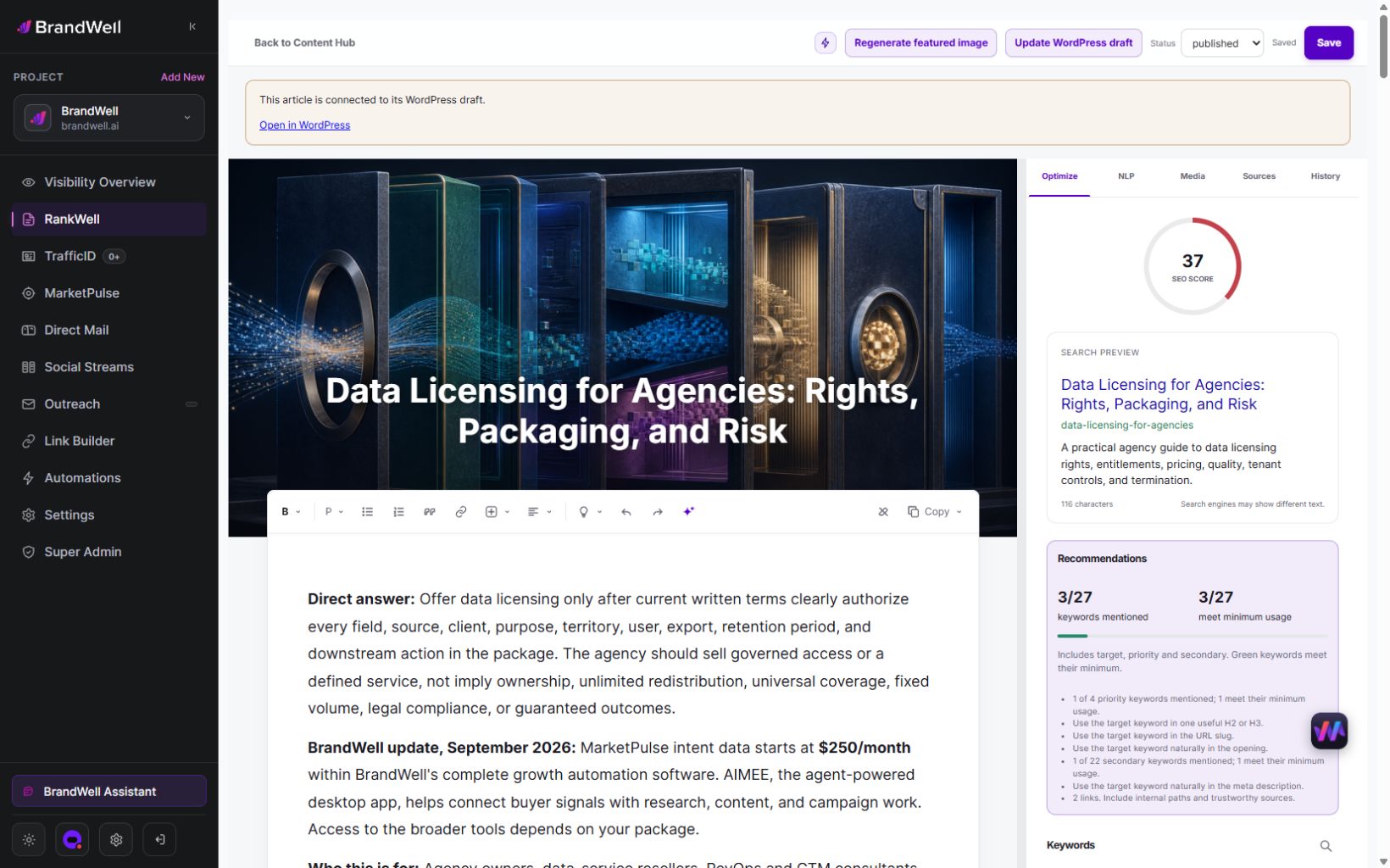
In RankWell, review the article, sources, media and search preview. Use a clear reader task and original evidence. Confirm the publishing path configured for the project.
AIMEE can help organize approved work through configured tools. Its output or an editor score does not establish that Google fetched or indexed the destination. Verify the actual public page and relevant search reports.
Measure the correct result
Track whether the intended page is accessible and whether the reported issue has changed. Review search impressions and relevant visits over an appropriate period. Crawl frequency alone is not a ranking or revenue KPI.
Keep a change log for content, redirects, robots rules and template updates. That makes future diagnosis more useful than an unsupported list of supposed ranking factors or predictions about crawler behavior.
Reviewed and updated October 2, 2026.

Written by
Julia McCoy has contributed articles to BrandWell on content marketing, writing, and search engine optimization. This archive retains her original bylines; individual articles may be updated by the BrandWell editorial team.