On this page
- Understand what the ranking number means
- Start with a page-level diagnosis
- Use documented systems, not a secret formula
- Match the reader’s task
- Make the content worth choosing
- Improve the title when impressions do not become clicks
- Check technical usability
- Bring the review into BrandWell
- Consider AI search without inventing a separate formula
- Frequently asked questions
An SEO ranking is a page’s position for a particular search in a particular context. It is not one permanent score for an entire website. Rankings can differ across queries, devices, locations, and search features, so useful reporting connects visibility to the audience and business outcome.
Improvement starts with diagnosing the page’s actual problem. A clearer title cannot fix an inaccessible page, and a technical repair cannot make an irrelevant article answer the reader’s question.
Understand what the ranking number means
A manually observed result is a snapshot. Search Console’s average position is an aggregate measure with its own rules. Google’s explanation of impressions, position, and clicks describes how these metrics are counted across search layouts.
Use consistent filters when comparing periods. A shift in query mix can change an average even when important individual queries remain stable. Do not describe a site’s average position as the exact place every customer sees it.
For example, gaining impressions for several new queries at lower positions may reduce the overall average while expanding visibility. Inspect page and query groups before calling the change a failure.
Start with a page-level diagnosis
- Confirm the intended URL is accessible and eligible for indexing.
- Check the queries for which it receives impressions.
- Compare the page’s purpose with those searches.
- Review its title and description for a clear, accurate promise.
- Check the actual content, sources, examples, and next step.
- Inspect mobile usability and performance.
- Record the change and compare suitable periods afterward.
Work on the biggest mismatch first. If visitors want a practical worksheet and the page offers only a definition, expanding the introduction may not solve the problem.
Use documented systems, not a secret formula
Google’s ranking systems guide describes multiple systems, including language understanding, link analysis, and freshness for queries that need it. It does not provide a universal checklist that guarantees a top position.
A new publication date alone is not a meaningful update. Correct changed facts, improve the explanation, or add original evidence. Keep a stable guide’s useful material rather than rewriting it simply to make it appear recent.
Likewise, a third-party score is not Google’s ranking formula. Use tool outputs to identify questions and prioritize review, then inspect the underlying evidence.
Match the reader’s task
Search intent is a working interpretation of what someone needs. A query about a definition calls for a direct explanation. A query about implementation needs steps, prerequisites, and limitations. A buying query needs concrete product information.
For an original example, “payroll migration checklist” suggests a usable checklist and explanation of responsibilities. A page that spends most of its space describing what payroll is has probably missed the task.
Provide the answer early, then the details needed to use it. Headings should describe real decisions or steps. Do not repeat near-identical questions just to include every keyword variation.
Make the content worth choosing
- Use a worked example that helps someone perform the task.
- Link factual claims to primary sources that directly support them.
- Explain assumptions and limits of any calculation.
- Show relevant product screens when they clarify a workflow.
- Remove unsupported superlatives, invented experience, and stale statistics.
There is no universal click-through rate for the first result that predicts your page’s performance. Branded searches, question searches, commercial searches, and different result layouts create different opportunities.
Improve the title when impressions do not become clicks
Look for a specific mismatch between the visible promise and the searcher’s task. Replace a vague headline with the concrete answer, format, or use case the page actually provides.
For example, “A Complete Guide to Payroll” is less specific than “Payroll Migration Checklist: Owners, Checks, and Cutover Steps” when the article genuinely contains those elements. Do not add a year, a number, or a “best” claim that the content cannot support.
Keep a record of the prior title and the date changed. Compare similar query groups and account for position changes before attributing a CTR shift to the wording alone.
Check technical usability
A search visitor should be able to read the page, use the navigation, and complete the relevant action on mobile. Inspect images, tables, forms, overlays, and layout changes, not only the headline.
Google’s page experience guidance covers more than speed. Good performance supports a usable page but does not override relevance or guarantee a ranking.
Use internal links to connect genuinely related resources. Fix broken destinations and confusing navigation. Avoid adding links just to make someone spend longer on the site.
Bring the review into BrandWell
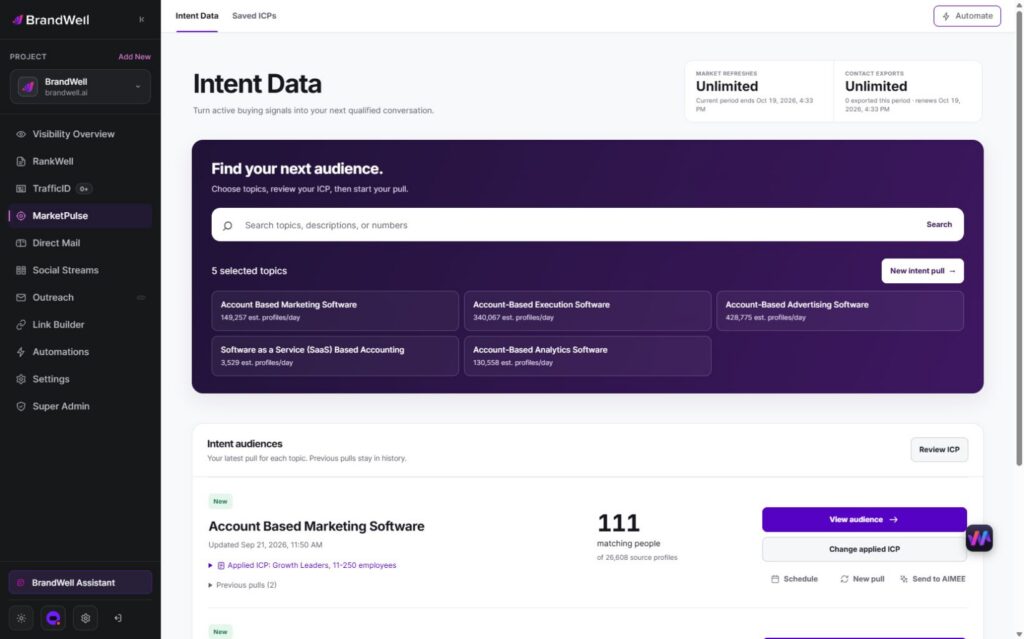
Use Visibility to support ongoing search and AI visibility review, and RankWell for the content workflow. Keep the selected query, audience task, evidence, and proposed improvement together in the brief.
Ask AIMEE to help organize research or prepare a revision from approved materials. Check the draft against the source and your real product capabilities before publishing. A fluent answer is not proof of accuracy.
Consider AI search without inventing a separate formula
Google’s generative AI optimization guide emphasizes useful, original content and normal search fundamentals. There is no required special schema or exact paragraph length that guarantees inclusion.
Make definitions easy to understand, examples concrete, and sources easy to follow because these help readers. Observe AI visibility separately where reporting is available rather than assuming that a conventional ranking equals an AI citation.
Frequently asked questions
How quickly will a ranking improve?
There is no reliable universal timeline. Record the change, allow for recrawling, and evaluate an appropriate period with enough data to be useful.
Does a lower bounce rate prove better SEO?
No. Engagement data can help diagnose visitor behavior, but a change in that metric alone does not establish search causation.
Should every page target the highest-volume keyword?
No. Choose a relevant task your page can satisfy and connect it to an appropriate business goal. Irrelevant visibility is not the same as useful demand.
Reviewed and updated October 2, 2026.

Written by
Julia McCoy has contributed articles to BrandWell on content marketing, writing, and search engine optimization. This archive retains her original bylines; individual articles may be updated by the BrandWell editorial team.