On this page
- Separate call eligibility from research priority
- Build eight reviewed-call steps
- Verify research and separate phone implementation
- Compare manual and research-assisted queues
- Budget full calling-workflow costs
- Measure qualified outcomes and defects
- Check fit and inappropriate uses
- Scope a separate agency calling service
- Run daily queue review and QA
- Test approved talk tracks
- Record the calling decision
- Copyable reviewed-call decision record
- Frequently asked research-assisted calling questions
Direct answer: An intent signal alone does not justify calling a person. Verify actual fit, identity, phone source, timing, calling eligibility and suppressions before rep review. Keep account observations separate from person behavior. A weighted priority score cannot resolve missing permission or an opt-out.
Who this is for: SDR leaders, sales enablement teams, founders, and agencies building a governed phone-first play. It is not a guide to cold email or a generic multichannel sequence.
Current MarketPulse offer: intent-data plans start at $500/mo. See the product, demo, and current plans. Updated October 3, 2026.
Separate call eligibility from research priority
Review account fit, relevant actual observations, plausible contact role and the approved calling context separately. Hold uncertain identity, rights or suppression checks before any contact. Weak research evidence does not automatically authorize nurture through another channel.
Treat signal origin as evidence with a confidence label. First-party pricing-page activity, third-party topic research, competitor research, and a website identification event answer different questions. None proves that the person wants a sales call. Reps should open with the business problem or observable company context, not “we saw you researching us.”
A phone-specific priority score
Run pass/fail checks for actual calling eligibility, suppressions, source rights and unresolved jurisdiction or recipient requirements first. For records that pass, a fictional 0-3 score across fit, research context, freshness, role and identity can help order rep review. Set and version your own thresholds; no default band is a validated probability or permission to dial. A stop request is a block, not a three-point deduction.
Build eight reviewed-call steps
- Ingest and label the event. Preserve source, topic or page, account, observed time, confidence, and permitted use. Never flatten all signals into one “intent” field.
- Apply fit and freshness. Compare industry, size, geography, technology, and exclusions. Expire volatile signals quickly; retain the raw date for audit.
- Resolve the account before the person. Confirm the company, then identify plausible roles. An account-level signal must remain account-level in the evidence card.
- Validate contact data. Check the number, role, employment status, country, and source rights. Separate business numbers from personal/mobile data where policy or law requires different handling.
- Run suppression and jurisdiction checks. Apply internal do-not-call lists, applicable registries, time zones, client exclusions, contractual restrictions, and automated/prerecorded-call rules.
- Create a rep evidence card. Show fit, signal type, age, confidence, role hypothesis, approved opener, what not to claim, and the next allowed action.
- Require human approval. A rep accepts, defers, corrects, or suppresses the record. Automatic dialing is a separate risk decision and should not be smuggled into an “AI workflow.”
- Write outcomes back. Record connection, disposition, correction, objection, opportunity link, and suppression request. Use feedback to recalibrate scoring.
Opening without being creepy
An opener to review is context, problem hypothesis and a request to continue. For example: “I work with operations teams that are trying to reduce manual lead routing. I might have the timing wrong – would it be unreasonable to ask how you handle that today?” Do not name private browsing activity, imply surveillance, or state that a specific person showed intent unless you have a verified first-party event and an approved disclosure basis.
Verify research and separate phone implementation
BrandWell publishes this guide. Evaluate current MarketPulse research separately from phone verification, dialing, custom CRM routing and managed agency delivery. This is a reviewed-call workflow rather than an independent provider ranking.
Identify the actual missing capability: research, verified phone context, eligibility review, dialing or outcome feedback. A topic subscription does not establish a dialer, calling permission or a client-ready calling service.
Current MarketPulse research input
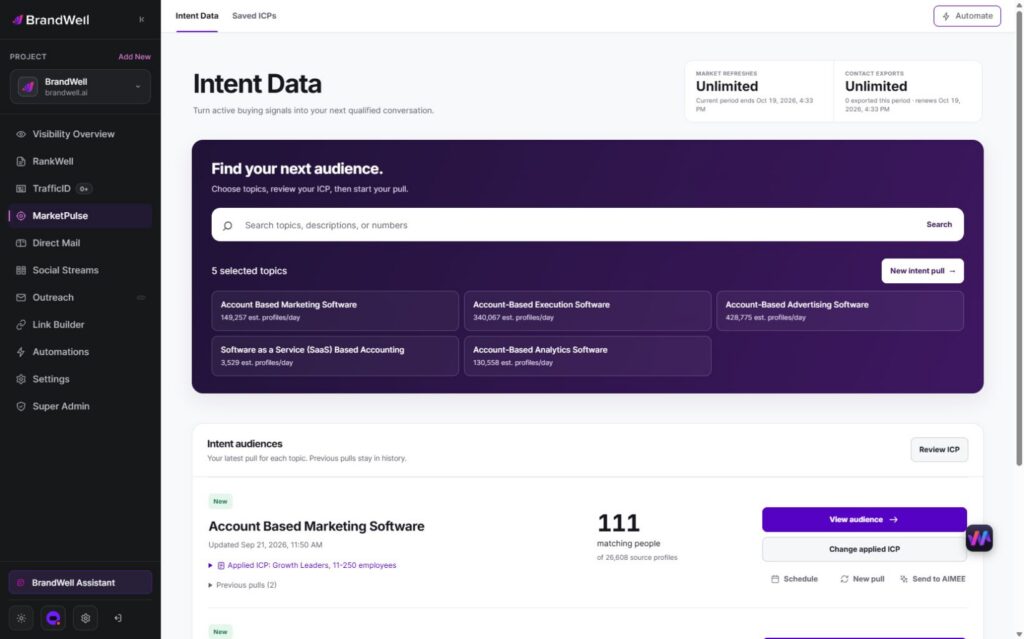
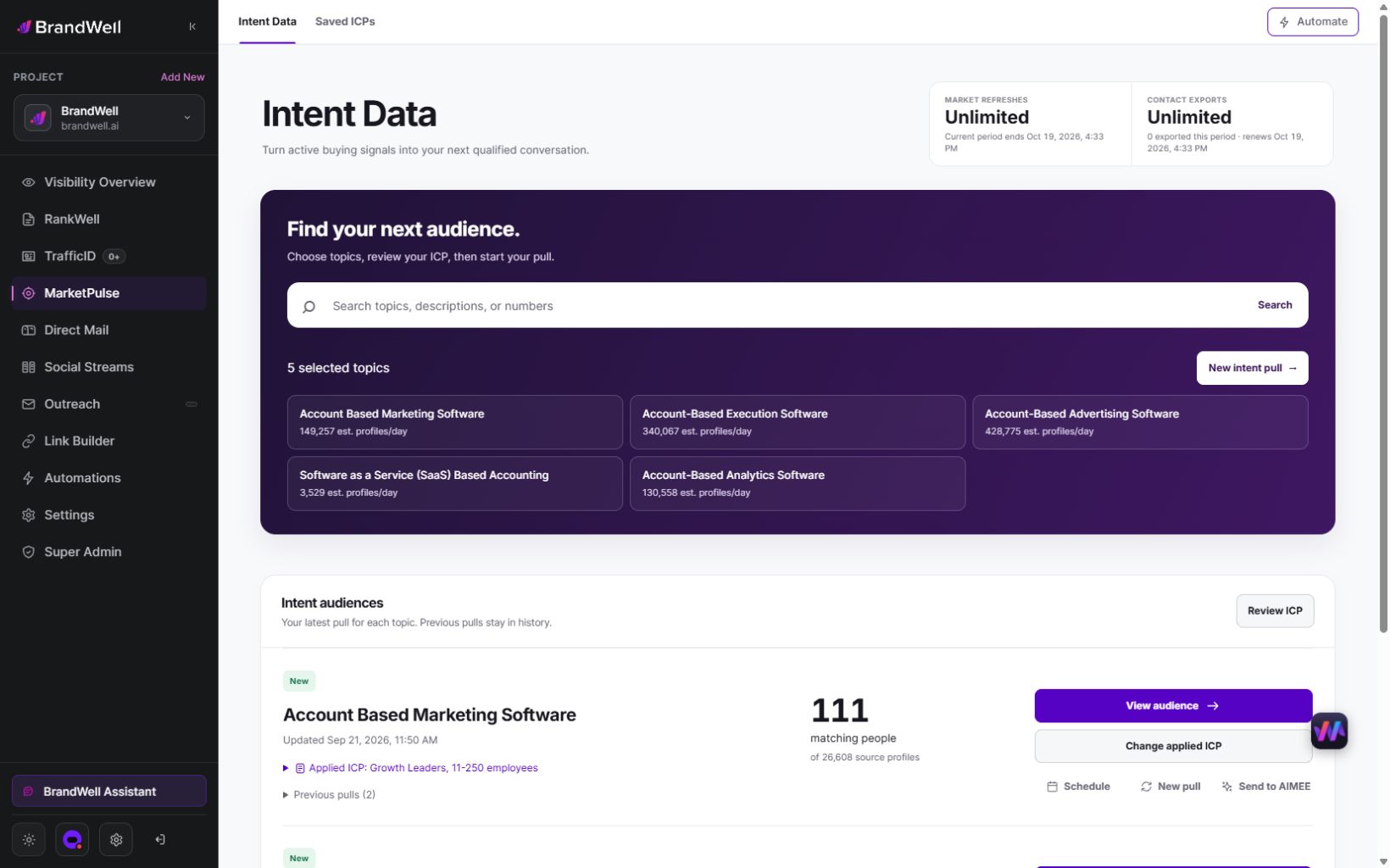
BrandWell MarketPulse: intent data starting at $500/mo. Find people researching topics relevant to what you sell, apply saved ICP filters, and review available contact details before taking action.
| Plan | Topics and refreshes | Monthly exports |
|---|---|---|
| Starter | 1 topic, weekly | 25,000 contacts |
| Growth | 3 topics, daily | 100,000 contacts |
| Scale | 10 topics, daily | Unlimited contacts |
Swipe the table to see all columns.
A pull retrieves available data from the previous 24 hours for one topic. Daily use across all included topics provides 90 Growth pulls or 300 Scale pulls in a 30-day month. Weekly Starter pulls vary by calendar month. Available audience size and contact fields vary, and audiences may overlap. Refreshes stop at the plan limit without overage charges.
- Find and qualify: search the topic catalog, save your ICP, and review the people and companies that match.
- Act on the research: export qualified contacts or prepare an Outreach or Direct Mail workflow. Connected products, channel usage, and fulfillment may cost extra.
- Get help from AIMEE: Growth and Scale include AIMEE for the initial user to research accounts and prepare the next step through connected tools.
Agencies and other service businesses can build client deliverables around their available Intent Scans and exports. Keep each client’s scope, permissions, and service fees clear. A subscription is not a promise of a white-label platform or exclusive access to a market.
Explore MarketPulse and watch the demo or compare plans starting at $500/mo. Any early-access discount is a separate, time-limited offer shown to an eligible recipient.
Compare manual and research-assisted queues
Compare a reviewed manual account list, research-assisted ordering and a hybrid under the same actual eligibility rules and outcome definitions. Research-assisted calling is a hypothesis to test, not a universally better approach. Keep sources and rejection reasons visible.
The tradeoff is false precision. Manual lists expose their assumptions; model scores can hide them. Require an explanation field and test whether high-ranked accounts outperform a matched baseline. If they do not, simplify the model.
Budget full calling-workflow costs
Count actual subscription, phone validation, implementation, review, enablement, QA and rep labor. Separate commitments, billing and incurred costs. Obtain current scope and fees for each implementation rather than relying on removed competitor price comparisons.
MarketPulse research is starting at $500/mo. Verify current topics, refreshes, exports and included tools on the product page. Phone validation, dialing, CRM routing and managed client delivery require separately verified implementation, rights and fees.
Measure qualified outcomes and defects
Track the funnel in layers: eligible signal accounts; identities accepted after validation; records sent to rep review; approved calls; connections; qualified conversations; meetings; accepted opportunities; closed-won gross profit. Report rates and denominators, not only totals.
Run a holdout where feasible. Compare signaled accounts assigned to the play with similar eligible accounts kept in business-as-usual treatment. Guard against rep cherry-picking, duplicated outreach, pre-existing opportunities, and different territory quality. “Influenced” pipeline is descriptive; incremental lift requires a credible counterfactual.
Useful quality metrics include wrong-company rate, wrong-person rate, stale-role rate, suppression defects, median signal-to-review time, rep rejection reasons, complaints, and opportunities per 100 approved calls. A lower dial count can be a success if qualified conversations and gross profit improve.
Check fit and inappropriate uses
This play fits companies with a defined ICP, enough account volume to prioritize, measurable phone outcomes, trained reps, and an owner for governance. It is a poor fit for low-consideration self-serve products, tiny markets already covered manually, teams without reliable CRM disposition data, or jurisdictions and channels the company has not reviewed.
Common failures are calling every surge, exposing the surveillance source, confusing account intent with person intent, letting old signals persist, skipping mobile-number governance, and rewarding meetings without inspecting quality. Another failure is buying a platform before deciding who will act on each alert.
Verify actual calling requirements for the recipient, source, jurisdiction, technology and purpose. Business-to-business status is not a universal exemption. Maintain reviewed procedures, suppression records, calling windows, correction and stop handling. Resolve uncertain requirements before contact.
Scope a separate agency calling service
A recurring agency package can include topic and ICP design, signal intake, identity validation, a daily reviewed call queue, weekly QA, branded topic reports, monthly pipeline analysis, and quarterly recalibration. Define service levels for freshness and review – not guaranteed meetings or revenue. The agency bills its client and remains responsible for its own retail scope, promises, and compliance decisions.
Review current MarketPulse research and plans, starting at $500/mo. Evaluate actual topic fit, available fields and operating effort. Verify current guarantee conditions before testing. A bounded review cannot establish future calls, meetings or revenue.
Agent-ready operating instructions
AIMEE can prepare a review brief through configured connected tools. Keep proposed actions separate from actual approvals and destination acknowledgements. Confirm the implementation and permissions before execution.
Run daily queue review and QA
A reliable program needs a daily control loop. Before local calling hours begin, operations processes new events, removes expired signals, resolves duplicates, validates assigned owners, and checks suppression updates. Reps review evidence cards rather than receiving an unexplained score. At the end of the day, operations audits rejected records, disconnected numbers, objections, and unlogged outcomes. Once a week, sales, RevOps, and compliance review defects and change one rule at a time.
Score call quality separately from call outcome. A useful QA form awards points when the rep confirms the correct company and role, uses an approved context statement, asks permission to continue, avoids unsupported claims, records an accurate disposition, and honors a stop request immediately. It subtracts points for revealing surveillance-like details, presenting account activity as person behavior, skipping identity validation, creating duplicate opportunities, or continuing after a negative signal. A meeting does not erase a governance failure.
Evidence-card template
Each card should show: account and domain; ICP reasons; raw signal type and source; observed time; account- or person-level granularity; identity confidence; role hypothesis; number source and validation status; jurisdiction and time zone; suppression result; CRM owner; recent touches; approved problem hypothesis; prohibited claims; recommended action; and a visible approve, defer, correct, or suppress choice. Store the card version used for the call so later audits do not rely on a changed model.
Timing and frequency rules
Freshness should match signal volatility. A pricing-page event might deserve same-day account-owner review, while a multi-week third-party research surge might support a slower research task. Do not invent one universal “call within five minutes” SLA. Instead, measure performance by freshness band and source. Use tighter frequency caps for personal/mobile numbers, sensitive industries, or uncertain identities. A second stakeholder should not be called simply because the first did not answer; the committee and collision plan must justify it.
Test approved talk tracks
Test the hypothesis, not a creepy personalization trick. Create two or three approved openings tied to a common operational problem. Randomly assign them within comparable segments, keep follow-up policy constant, and measure qualified conversations and complaints. Review recordings only under applicable notice, consent, security, and retention rules.
Reps should be able to say “I might have this wrong.” That phrase creates room for correction and gives you data. Capture whether the problem exists, who owns it, current process, timing, and permission for a next step. Do not score a rep down for discovering that the signal was irrelevant. Accurate rejection protects future pipeline.
Launch checklist
Before launch, obtain written approval for data sources and calling regions, load suppression lists, test time-zone logic, verify caller identification, sample phone validation, and rehearse correction and stop requests. Assign one person to pause the queue. During the first week, cap volume, review every disposition, and compare the accepted-call rate with a manual list. Expand only after operators can explain why each record entered the queue and prove that suppressions propagate.
Record the calling decision
Test whether research-assisted review changes qualified outcomes under the actual calling rules. Build a small, auditable queue; protect the distinction between account and person evidence; measure opportunity quality against a baseline; and give reps permission to reject the score.
Copyable reviewed-call decision record
Account: [Actual company, fit and source observation.] Contact: [Verified role, phone source, identity and uncertainty.] Eligibility: [Actual calling requirements, rights, jurisdiction and suppression.] Context: [Approved problem hypothesis and prohibited claims.] Owner: [Rep decision, local window and prior touches.] Outcome: [Unique account, conversation disposition, correction and stop.] Review: [Mature feedback, full costs and next test.]
Do not treat B2B as a universal exemption
The FTC’s 2024 telemarketing update expanded misrepresentation prohibitions to B2B telemarketing and updated recordkeeping. Review the actual applicable requirements before calling.
A high priority score cannot offset a stop request
A fictional account has strong fit and recent research context, but the actual contact has asked not to be called. Block that contact under the reviewed suppression process. Do not subtract points and keep it in a dial queue; verify downstream acknowledgement separately.
An account observation is not a contact request
A fictional company-level topic signal is linked to three plausible roles. Record one company observation and three candidate contacts. Do not tell any of them that they personally researched the topic or requested a call. Resolve actual identity, eligibility and role before review.
Enriched phone data is not texting permission
A fictional research record contains a mobile number from enrichment, with no recorded text-reminder choice. The number does not establish an SMS opt-in. Keep source, purpose and actual permission separate; an approved calling context does not automatically approve messaging.
Count calls, people and accounts separately
A fictional pilot has 40 eligible accounts, 30 approved contact records and 45 dial attempts. Twelve unique contacts connect and six have qualified conversations. The attempt-to-connection ratio is 26.7%; the qualified-conversation rate is 50% of connected contacts or 20% of approved contact records. Do not call 45 attempts 45 unique leads. Preserve account-level overlaps, complaints and unresolved dispositions separately.
A booked meeting does not erase a defect
A fictional rep books a meeting after stating that a particular person researched a topic, though the source contains only account-level context. Keep the meeting outcome and unsupported-claim defect separate. Review the actual call and correction process; a positive outcome does not substantiate the claim.
Use supported research within scope
MarketPulse research is starting at $500/mo. Search a relevant topic, save the approved ICP and inspect available matches. AIMEE can organize supplied context through configured tools; owners approve actual exports and proposed actions. Phone validation, dialing, CRM routing and managed client services require separately verified implementation, rights and fees.
Frequently asked research-assisted calling questions
Does high intent establish permission to call?
No. Resolve actual eligibility and suppression independently.
Can a stop request be treated as a score penalty?
No. Follow the actual suppression process and verify propagation.
Does an enriched mobile number establish SMS opt-in?
No. Record and review the actual purpose and permission.
Are repeat attempts unique leads?
No. Report attempts, contacts, accounts and outcomes separately.
Review current research: explore MarketPulse and current plans.
Reviewed and updated October 3, 2026.

Written by