


On this page
- Define the outcome and budget
- Check these capabilities before adding tools
- Fifteen channel and offer options
- An original four-week campaign plan
- Use the current BrandWell workflow
- Review your own website audiences with TrafficID
- Make follow-up useful and owned
- Should you outsource lead generation?
- Common questions
Small-business lead generation works best as a manageable process: reach the right audience, offer a useful next step, record the request and follow up appropriately. Start with one customer need and one campaign you can maintain. More contact records are not automatically more qualified demand.
Before buying more software or running additional channels, check whether your existing page, form, owner and follow-up work. A broken handoff can waste the attention you already earned.
Define the outcome and budget
Write down the service or product, supported customer, region where relevant and available delivery capacity. Decide what counts as an inquiry, a qualified conversation and a customer. Set a budget that includes your time as well as media and software.
The SBA’s business-management guide provides starting points for marketing planning and business finances. Use the plan to connect campaign decisions to capacity and costs.
Check these capabilities before adding tools
- Capture: a working form or other clear request route with confirmation.
- Records: a place to store source, request, owner and next action.
- Content: a process for preparing, checking and publishing useful answers.
- Audience review: research relevant signals without assuming every record is a buyer.
- Follow-up: connected tools, eligible recipients and a responsible owner.
- Measurement: successful actions and qualified outcomes, with consistent denominators.
Map what you already have. A tool should address a specific missing step, not duplicate an existing system because its category is popular. Verify plan limits, connections and operating effort before adopting a workflow.
Fifteen channel and offer options
- Useful opt-in resources: offer a relevant checklist or guide and explain the communications requested.
- Discounts: state the real price, conditions and deadline. Check margins before using a discount to generate volume.
- Instructional videos: show a concrete task or decision, then link to the relevant destination.
- Eligible retargeting: check tracking choices, audience permissions and platform rules before activation.
- Local discovery: maintain accurate service information, locations, hours and contact routes where your business is eligible.
- Subscribed email: deliver useful updates to people who asked for that program.
- Detailed resources: create a worksheet or guide worth the reader’s time. Length alone does not make it valuable.
- Social participation: answer relevant questions and explain your work without treating every comment as a sales request.
- Events and webinars: set a clear subject, schedule and follow-up expectations. Use actual registration and attendance records.
- Creator partnerships: define the deliverable, audience fit, evidence and disclosure of the relationship.
- Professional networking: develop conversations relevant to the person’s role and stated needs.
- Industry meetings: record the actual conversation and agreed next step rather than inventing familiarity later.
- Paid campaigns: set a spending limit, a supported offer and a measurable outcome. Traffic is not guaranteed qualified demand.
- Page improvements: check readable copy, usable forms, mobile layout and the complete destination journey.
- Referrals: explain introductions, rewards and ownership. Confirm governing terms rather than using an old commission example.
Choose a few options you can operate well. Do not launch all fifteen before establishing how requests will be handled.
An original four-week campaign plan
Consider a hypothetical commercial photography business serving local retailers. This example is a planning exercise, not a customer case study.
- Week one: define supported shoot types and locations. Publish a clear quotation page with preparation requirements and a working inquiry form.
- Week two: publish a guide explaining how to prepare products, backgrounds and shot lists. Use authorized original examples and identify illustrative images.
- Week three: distribute the guide through selected appropriate channels and record source details on resulting inquiries.
- Week four: review qualified requests, quotes, bookings and reasons for rejection. Fix the biggest observed bottleneck before increasing spend.
Suppose the campaign uses $300 in media, $100 in software allocation and ten hours valued at $40 per hour. Total cost is $800. If it produces 20 inquiries and four customers, cost per inquiry is $40 and cost per customer is $200. These invented figures do not establish profitability: include shoot costs, cancellations and margin before assessing returns.
Use the current BrandWell workflow
Research relevant opportunities in Visibility. Prepare the brief, draft and editorial review in RankWell. Provide approved facts, current offer details and useful original examples. Review the live page after publishing through your configured workflow.
For research into available topic activity, MarketPulse plans are starting at $500/mo. A pull covers available data from the previous 24 hours; profile counts and contact coverage vary by topic and filters, and audiences can overlap. A research signal is separate from an inquiry or consent record.
Review your own website audiences with TrafficID
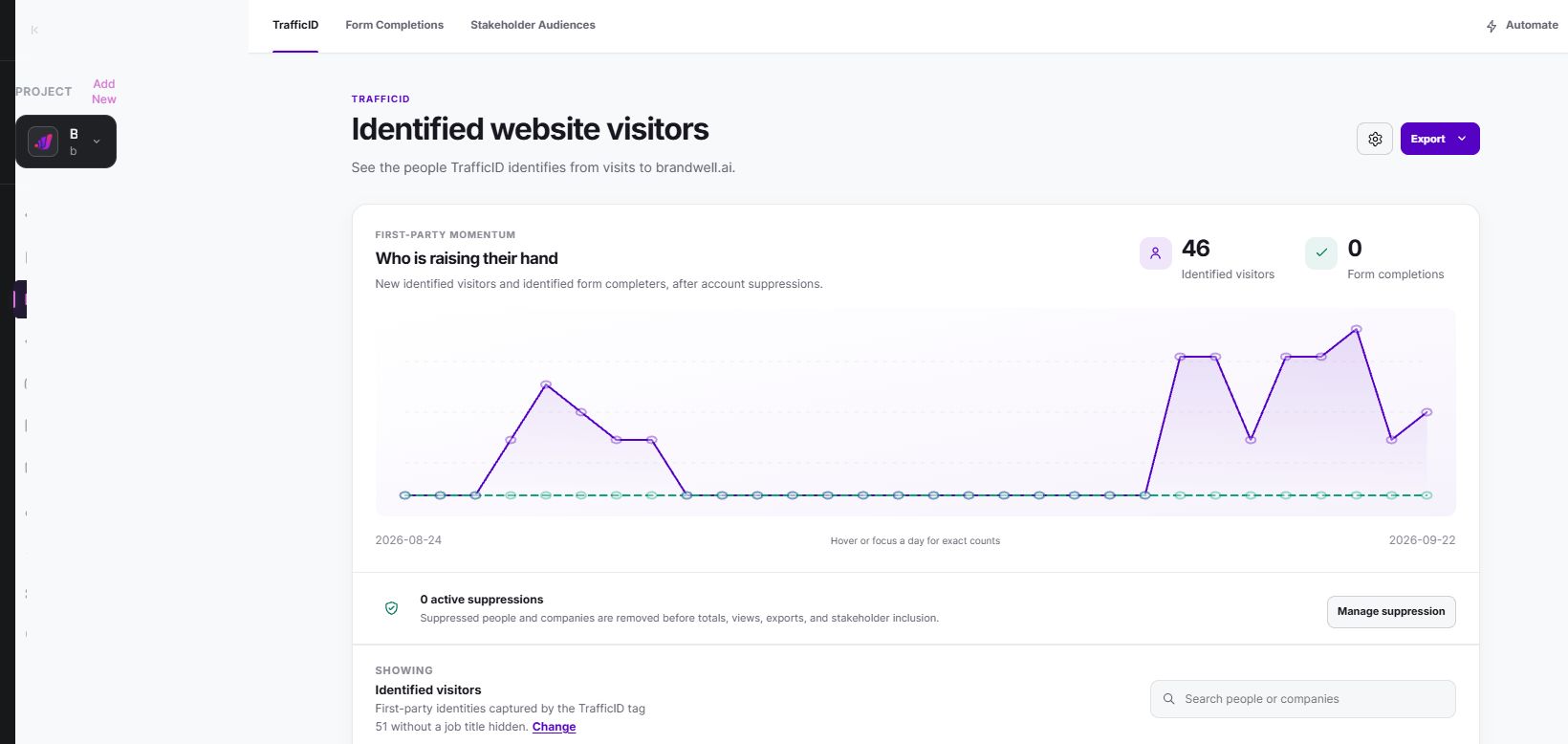
TrafficID surfaces identified visitors and available profile, company, source and activity fields. It does not identify every visitor, establish every person’s interest or automatically make a contact eligible for outreach.
- Select the intended project and inspect TrafficID settings.
- Review the website tag, installation status, exclusions and applicable tracking choices.
- Check Identified visitors, filters and suppression controls.
- Keep Form Completions and Stakeholder Audiences separate from identified visits.
- Review fit and permissions before moving a record to Automate or a configured campaign.
Use event registration systems to establish webinar attendance; a website visit is not an attendance record. Likewise, a traffic increase after an event does not establish that every visitor attended.
Make follow-up useful and owned
Assign each request to a person and document the next action. Answer the stated question, explain scope and timing, and pause if the person declines or the service does not fit.
In BrandWell Automations, configure the trigger, eligible recipients, waiting conditions and approval steps. Verify connected tools and suppression behavior before enabling a sequence. AIMEE execution depends on the tools and permissions you configure.
A supplied or enriched phone number is not permission for text marketing. Preserve a person’s actual program-specific choice separately from contact enrichment.
Should you outsource lead generation?
Compare the work and total costs rather than assuming an agency will be cheaper or faster. Define the required audience, what counts as an accepted lead and who is responsible for the response.
- Scope: identify channels, deliverables, approval rights and exclusions.
- Quality: specify acceptance criteria, duplicate handling and rejected records.
- Ownership: clarify account access, assets and source records.
- Data: document permitted use, recipients, retention and suppression.
- Costs: include setup, ongoing fees, media, internal review and follow-up time.
- Exit: define how the work and records are returned when the arrangement ends.
Retain someone internally who understands the offer and can inspect quality. Outsourcing production does not remove responsibility for the customer’s experience.
Common questions
Do I need a large software stack?
No. Start with the capabilities needed for your defined campaign and verify what existing systems can do. Add a tool only when it solves a demonstrated gap.
Should I count identified visitors as new customers?
No. Track visitors, inquiries, qualified opportunities and purchases separately. Available signals help research; they do not establish a sale.
What should I improve first?
Check the complete request journey and ownership. Then use actual counts and conversations to decide whether to improve the offer, traffic quality, form or follow-up.
Reviewed and updated October 3, 2026.

Written by

