On this page
- Current MarketPulse research workflow
- Define client operating prerequisites
- Assign five service responsibilities
- Specify handoffs and acceptance
- Compare five staffing arrangements
- Keep approvals under named ownership
- Calculate actual labor capacity and costs
- Measure queues and qualified outcomes
- Match responsibilities to client capability
- Preserve the evidence chain
- Resolve governance and action boundaries
- Test the service remainder
- Use a staffing release checklist
- Copyable staffing capacity record
- Frequently asked staffing questions
Intent service staffing becomes expensive when roles follow tools instead of decisions. One person exports a list, another loads an audience, a third explains the numbers, and no one owns whether the client acted. Scaling that arrangement adds handoffs without adding accountability.
A better design begins with the operating loop and assigns clear decision rights. Generalists can cover several steps at low volume, but the role still needs a named outcome, queue, backup, and escalation rule. The question is not how many analysts to hire; it is where judgment, repetition, and risk accumulate.
Staff an agency intent-data service around strategy, data operations, activation, client success and approval ownership. Measure actual work by role, including review, exceptions, reporting and backup coverage. Hire against sustained demand and the constrained skill, rather than record volume or total spare hours.
Current MarketPulse offer: intent-data plans start at $500/mo. See the product, demo, and current plans. Updated October 3, 2026.
Current MarketPulse research workflow
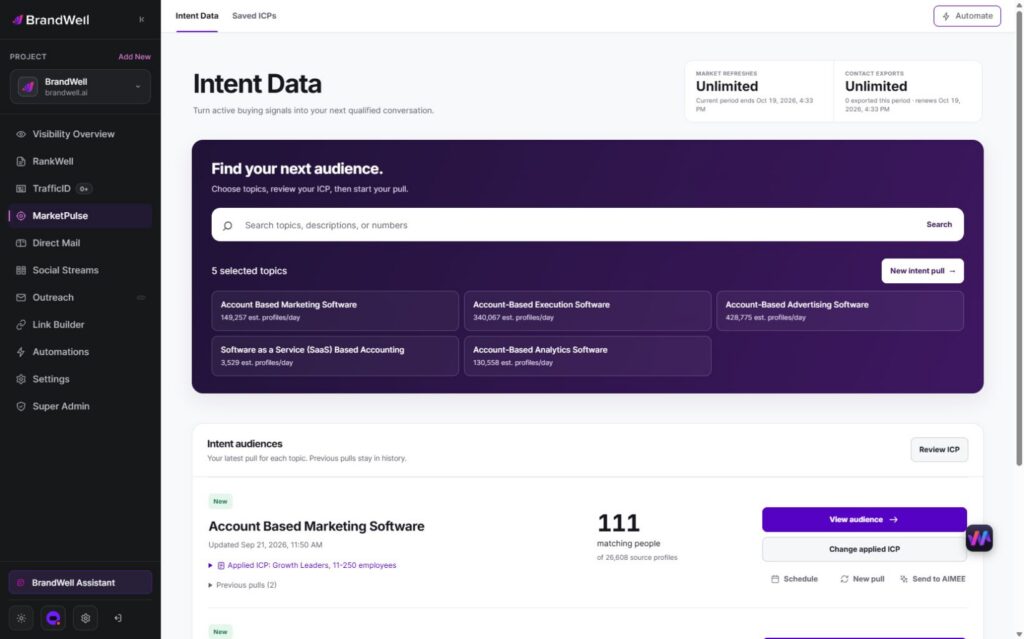
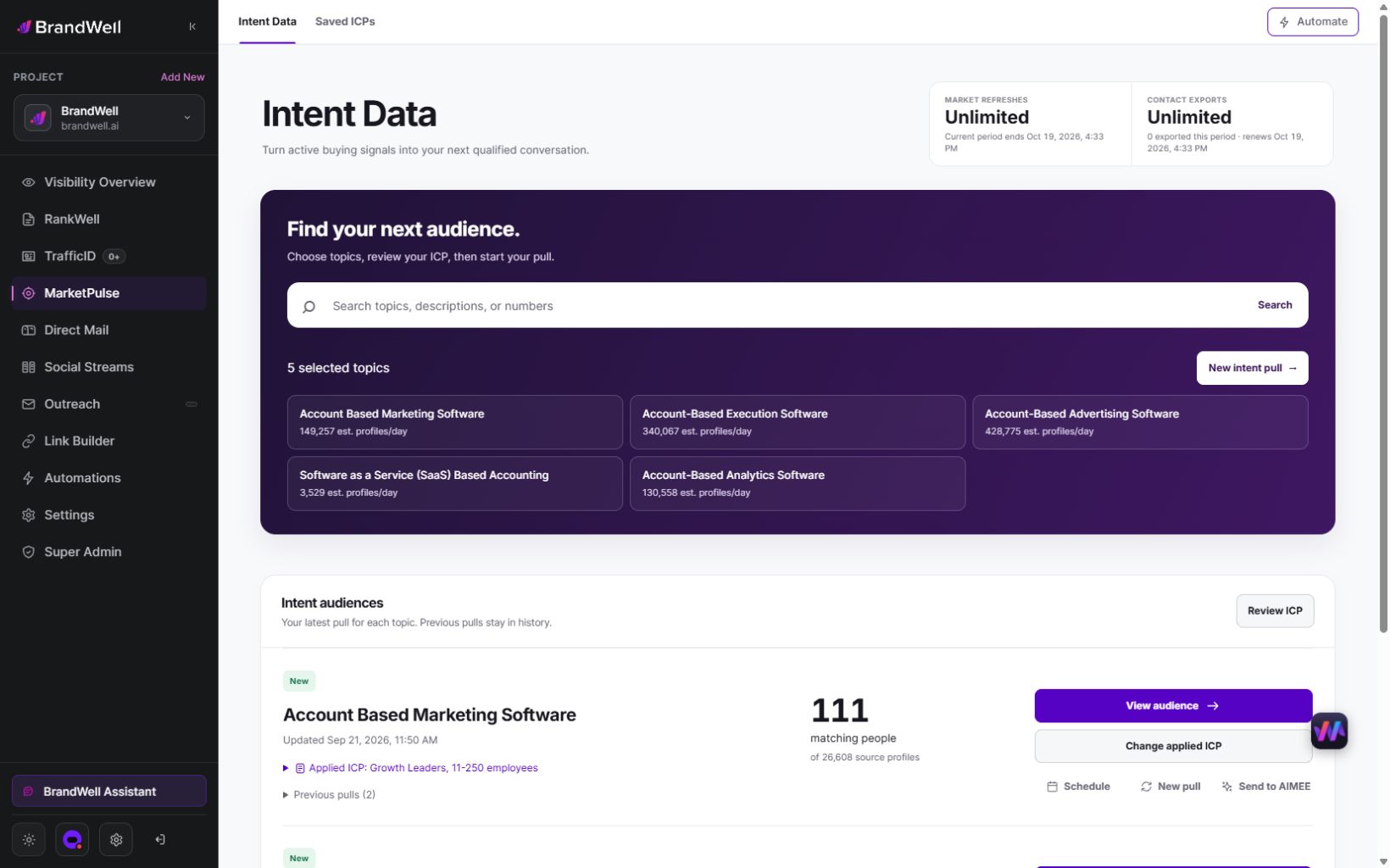
BrandWell MarketPulse: intent data starting at $500/mo. Find people researching topics relevant to what you sell, apply saved ICP filters, and review available contact details before taking action.
| Plan | Topics and refreshes | Monthly exports |
|---|---|---|
| Starter | 1 topic, weekly | 25,000 contacts |
| Growth | 3 topics, daily | 100,000 contacts |
| Scale | 10 topics, daily | Unlimited contacts |
Swipe the table to see all columns.
A pull retrieves available data from the previous 24 hours for one topic. Daily use across all included topics provides 90 Growth pulls or 300 Scale pulls in a 30-day month. Weekly Starter pulls vary by calendar month. Available audience size and contact fields vary, and audiences may overlap. Refreshes stop at the plan limit without overage charges.
- Find and qualify: search the topic catalog, save your ICP, and review the people and companies that match.
- Act on the research: export qualified contacts or prepare an Outreach or Direct Mail workflow. Connected products, channel usage, and fulfillment may cost extra.
- Get help from AIMEE: Growth and Scale include AIMEE for the initial user to research accounts and prepare the next step through connected tools.
Agencies and other service businesses can build client deliverables around their available Intent Scans and exports. Keep each client’s scope, permissions, and service fees clear. A subscription is not a promise of a white-label platform or exclusive access to a market.
Explore MarketPulse and watch the demo or compare plans starting at $500/mo. Any early-access discount is a separate, time-limited offer shown to an eligible recipient.
Define client operating prerequisites
Agency founders, operations leaders, RevOps consultants, and demand-generation teams deciding how many people and which roles are required to operate an intent service profitably. It is a role-architecture and labor-economics guide, not a generic org chart.
Use this staffing architecture to expose workload and decision rights, while confirming product facts, labor assumptions, privacy duties, and client dependencies before hiring or pricing the service.
Assign five service responsibilities
The service strategist owns the client problem, topic portfolio, target definition, and change priorities. Data operations owns ingestion, mapping, identity checks, deduplication, QA, and reproducibility. Activation owns destinations, play readiness, execution records, and safeguards. Client success owns decisions, acceptance, training, and renewal narrative. An approval owner authorizes sensitive data use, material targeting changes, and externally visible actions.
One person may hold multiple accountabilities in an early pod, but do not collapse the accountabilities themselves. A founder acting as strategist and approver should still document which hat is making the decision. That distinction exposes bottlenecks before the agency responds by hiring another undefined generalist.
- Write the decision each role must produce, not merely the task someone performs.
- Name the role owner, staffing approver, handoff evidence, cutoff, exception route, and client dependency.
- Use a bounded pilot and revise the operating rule from observed exceptions.
Specify handoffs and acceptance
Design handoffs around an evidence packet. Strategy hands operations an approved topic and target definition; operations returns a quality-controlled set with lineage and exceptions; activation returns execution receipts; client success returns acceptance and dispositions; the approval owner records decisions that change risk or scope.
Set response and completion expectations for each queue, then inspect aging and rework. Quality gates should verify client, window, field mapping, identity confidence, suppression, destination, approval, and output version. A handoff is complete when the receiver can act without a private explanation from the sender.
- Freeze the approved input and record its version.
- Run deterministic validation before subjective capacity review.
- Route ambiguous or high-impact cases to a named human role owner.
- Record the operator action, approval, handoff evidence, and downstream result.
- Feed repeated exceptions into process improvement rather than hiding rework.
Compare five staffing arrangements
These are operating designs, not companies or universal rankings. Compare them on workload shape, decision ownership, technical depth, client proximity, fixed cost, backup coverage, and the stated limitation.
Agency-led generalist pod
Consider for an agency proving demand across a small client set. A strategist-client lead coordinates setup, QA, activation, and reporting with a shared technical reviewer. Test handoff count, context retention and actual decision delay. Judge it on decision ownership, documented backup, protected QA time, and a hard limit on custom work. Its meaningful limitation is key-person dependence: exceptions, sales calls, and production peaks can collide, making founder heroics look like capacity.
Operating test for the agency-led generalist pod: estimate weekly work units, name the accountable decision owner and backup, define the receiving evidence packet, and identify the threshold at which this design must add specialization or change scope.
Capacity trigger: split the role when scheduled production plus expected exception work consumes most of the pod’s protected delivery window for several cycles. Add operations support before adding another client lead if QA, mappings, and reconciliation dominate; add client coverage when meetings, approvals, and explanation delay otherwise-complete work.
Economics check: track actual founder handling, context switching, after-hours interventions and deferred work. Include replacement labor costs and sustainable capacity. Unrecorded founder hours do not demonstrate an inexpensive delivery model.
Specialized data-operations pod
Consider when source mapping, identity resolution, deduplication, QA, and exports create a steady technical queue. Operations specialists serve several client leads through standardized intake and evidence packets. Check whether documented inputs and review rules improve repeatability without losing client context. Require clear priority rules and a service owner who translates business context. Its meaningful limitation is distance from the client: a technically clean deliverable may be late or irrelevant if the pod cannot see campaign and sales decisions.
Operating test for the specialized data-operations pod: estimate weekly work units, name the accountable decision owner and backup, define the receiving evidence packet, and identify the threshold at which this design must add specialization or change scope.
Capacity trigger: add another operator when queue age or review load breaches the defined service window, not when raw record volume rises by itself. Improve validation and reusable mappings first. Add a lead when exception adjudication, schema change, and cross-client priority decisions begin consuming specialist production time.
Economics check: measure cost per accepted evidence packet, first-pass acceptance, rework by requesting team, and unused custom pipelines. The pod creates leverage only if its interface is standardized. Bespoke intake, undocumented transformations, and private analyst knowledge turn a shared service into five miniature client teams.
Paid-media extension team
Consider when the commercial promise centers on audience activation and campaign iteration. A channel lead works with data operations and client success to move approved segments into ad platforms, monitor delivery, and record outcomes. Measure actual approval and execution delays. Its meaningful limitation is channel bias: teams may optimize media delivery while neglecting CRM routing, seller adoption, broader identity evidence, or non-paid plays.
Operating test for the paid-media extension team: estimate weekly work units, name the accountable decision owner and backup, define the receiving evidence packet, and identify the threshold at which this design must add specialization or change scope.
Capacity trigger: separate audience operations from channel strategy when destination QA, taxonomy, suppression, and delivery monitoring crowd out testing and creative decisions. Keep one owner for the signal-to-audience contract so a handoff does not let targeting logic drift between the agency’s data and media groups.
Economics check: distinguish media-management labor from intent-service labor and attribute shared work explicitly. Margin disappears when audience refresh, troubleshooting, and client explanation are treated as free additions to a percentage-of-spend fee. Model low-spend accounts too, because their governance workload may resemble larger programs.
Fractional RevOps delivery
Consider for clients whose biggest constraint is CRM governance, routing, lifecycle definitions, or sales process. A fractional RevOps lead can align fields, ownership, dispositions, and reporting while agency operators run the signal workflow. Verify the contracted decision rights, availability and actual review workload. Its meaningful limitation is availability and context switching; strategic operators can become expensive bottlenecks if they must approve routine work or support too many incompatible client stacks.
Operating test for the fractional RevOps delivery: estimate weekly work units, name the accountable decision owner and backup, define the receiving evidence packet, and identify the threshold at which this design must add specialization or change scope.
Capacity trigger: reserve the fractional lead for lifecycle definitions, ownership conflicts, governance, and material system decisions. Train an operator to handle documented mappings, testing, and recurring QA. If routine approvals wait for the fractional lead, the role design – not the person’s calendar – is the bottleneck.
Economics check: price scarce decision time separately from production hours and set a monthly decision budget. Track meetings, preparation, system research, and stakeholder negotiation, not just configuration. This path works when high-value authority unlocks the process; it fails when the client expects an always-available administrator.
Build-and-operate internal team
Consider after the agency has repeatable demand, documented work units, and enough volume to support dedicated specialists. The agency can hire for data operations, activation, client success, and service leadership, with shared governance support. Check whether internal ownership improves actual feedback completeness and response. Its meaningful limitation is fixed cost: recruiting ahead of stable volume creates bench time, while narrow roles can harden a process that should still be changing.
Operating test for the build-and-operate internal team: estimate weekly work units, name the accountable decision owner and backup, define the receiving evidence packet, and identify the threshold at which this design must add specialization or change scope.
Capacity trigger: hire from a twelve-week view of committed recurring work, realistic utilization, setup peaks, leave, and sales probability. Stage roles in the order the queues require rather than copying a mature vendor’s org chart. Preserve cross-training until each specialty has enough stable work and backup coverage.
Economics check: include recruiting, ramp, management, software, benefits, quality oversight, bench time, and the opportunity cost of process change. Compare that loaded cost with contractors or shared specialists. Internal control is valuable, but ownership does not make idle capacity or premature specialization disappear.
Phase capacity before committing to another hire
Start with a weekly demand ledger by work unit and role. Reserve capacity for recurring production, predictable client meetings, change requests, exception review, training, leave, and a modest surge buffer. Compare required hours with sustainable available hours after internal meetings and management – not with the number of hours printed on a calendar. A four-week average can hide setup peaks, so inspect both the baseline and the busiest credible week.
Use a sequence of interventions before headcount: remove unnecessary work, standardize intake, improve source quality, clarify acceptance, batch low-urgency changes, automate deterministic checks, cross-train a backup, and shift scarce reviewers toward exceptions. Hire when the remaining queue is recurring, valuable, role-appropriate, and supported by contracted or highly probable revenue. Hiring to absorb preventable rework simply embeds the defect in payroll.
Model coverage as well as throughput. Every production-critical responsibility needs a documented backup who has rehearsed the work, access to the same records, and authority to make the normal decision. Escalation coverage does not require every person to be interchangeable; it requires the agency to know which work can pause, which work can be reassigned, and which higher-risk action must wait for a qualified approver.
Revisit the design when the client mix changes. A new regulated vertical, international activation, warehouse delivery, person-level workflow, or multi-brand approval structure can change risk faster than volume. Record the assumption that justified each role, then test it against actual queue time, errors, client adoption, and margin. That discipline keeps the team aligned to the service rather than to yesterday’s job descriptions.
Finally, run a tabletop handoff before expansion: remove the normal owner for one simulated cycle and watch where access, definitions, judgment, or client history disappears. Repair those gaps in the runbook and evidence packet before new client demand turns them into missed commitments.
Keep approvals under named ownership
Verify which configured tools can collect, validate, transform, compare or propose for the actual implementation. Humans interpret ambiguous evidence, negotiate scope, approve permitted uses and material actions, handle reputational risk and explain uncertainty. A suggested action is separate from approved execution.
Use automation to reduce toil in schema checks, repeatable QA, report assembly, reminders, and evidence collection. Keep a rollback path and named approver for CRM writes, campaign launches, external messages, and suppression changes. The staffing gain comes from fewer repeated steps, not from pretending judgment disappeared.
Calculate actual labor capacity and costs
Convert the service into work units: topic setup, source ingest, 1,000 records reviewed, exception investigated, destination configured, campaign approved, client meeting, custom analysis, and change request. Estimate touch time, review time, rework, and utilization. Add management, training, leave, and peak-load coverage rather than pricing from ideal productive hours.
Measure queues and qualified outcomes
Capacity metrics include queued hours, work-in-progress age, utilization by role, review load, rework, exception rate, on-call interruptions, and senior escalations per client. Service metrics include first-pass acceptance, activation completion, disposition coverage, correction time, and client decision latency.
Commercial metrics should connect labor to gross margin and renewal risk. Monitor delivery hours versus scoped hours, setup recovery, expansion work, and concentration in key people. A pod that meets deadlines only through founder intervention is not scalable, even if the client reports satisfaction.
- Define the denominator and time window before collecting a KPI.
- Separate service loop handoff evidence from commercial attribution.
- Review capacity misses, reversals, and unresolved cases – not just successful actions.
- Keep capacity metric definitions stable enough to compare periods and clients.
Match responsibilities to client capability
Early clients with one destination and a narrow topic set can fit a generalist pod with specialist review. Data-heavy clients need stronger operations ownership. Clients purchasing paid-media execution may justify channel specialists. A client with complex CRM governance may need fractional RevOps authority before signal volume increases.
Match the team to the client’s approval speed, data hygiene, source mix, number of markets, activation complexity, and appetite for custom analysis. Avoid staffing prestige. A senior specialist is wasted on repeatable assembly; an untrained coordinator is risky when identity ambiguity or privacy decisions determine who gets contacted.
Preserve the evidence chain
Staff every link: source onboarding, identity reconciliation, validation, topic governance, prioritization, exception review, activation, monitoring, evidence capture, client explanation, feedback, and change control. Missing ownership in any link turns into invisible work for client success or the founder.
Record the actual observation unit, identity method, source and uncertain or conflicting fields. An account association or available contact record does not establish who researched or whether they intend to purchase. Assign correction and suppression owners and preserve uncertainty in client explanations.
Resolve governance and action boundaries
Use least-privilege access, client-specific workspaces, documented retention, and separation of duties for material changes. The person building an audience should not silently approve a new data use. Escalate privacy requests, suspected incidents, and policy changes to a qualified owner rather than treating them as routine tickets.
Write the approval matrix into the runbook and proposal. Identify who can add a topic, change a threshold, export person-level data, create an audience, launch a campaign, approve client-facing copy, or close an exception. Staff coverage for vacations and departures, but do not invent continuity or uptime promises the product has not approved.
- Document purpose, permissions, retention, suppression, deletion, and correction.
- Require approval before material targeting, operating data-use, spend, or external-message changes.
- Preserve provenance and a reversible record of transformations and decisions.
- Escalate uncertainty rather than converting it into an unsupported certainty claim.
Test the service remainder
A scalable pod turns recurring work into documented units, keeps specialists focused on exceptions, and gives every client a consistent decision cadence. Review role profitability quarterly and change the process before adding headcount. The aim is predictable client value at a workload the agency can defend in renewal and hiring plans.
AIMEE can prepare a review brief through configured connected tools. Keep proposed actions separate from actual approvals and destination acknowledgements. Confirm the implementation and permissions before execution.
Review an available MarketPulse topic, saved ICP and actual preceding-24-hour matches for the approved research purpose. Keep uncertain company context visible. AIMEE can organize supplied context through configured tools; named owners approve actual exports, messages, audience uploads and CRM writes.
Use a staffing release checklist
- Translate the service loop into strategy, operations, activation, client-success, and approval queues.
- Estimate touch time, review time, rework, management, leave, and surge coverage by work unit.
- Give each queue an accountable role, trained backup, evidence packet, and escalation route.
- Measure sustainable availability after meetings and administration instead of calendar capacity.
- Automate deterministic checks while reserving ambiguous, sensitive, or reputational decisions for people.
- Run a simulated owner absence to expose hidden access, context, and judgment dependencies.
- Choose a staffing path that matches recurring workload rather than an aspirational org chart.
- Separate fractional authority, specialist production, channel work, and client communication in the labor model.
- Tie hiring triggers to contracted demand, queue age, quality, utilization, and loaded gross margin.
- Revisit role assumptions whenever the source mix, client maturity, region, or activation risk changes.
The staffing test is whether a trained backup can take a queue, follow the evidence packet, apply the approval matrix, and meet the service window at sustainable utilization. If founder intervention remains the hidden fallback, the apparent capacity is not real.
Copyable staffing capacity record
Demand: [Actual clients, work units, period and peaks.] Roles: [Routine, specialist, approval and backup ownership.] Effort: [Observed handling, review, exceptions and correction time.] Capacity: [Hours available by skill after other responsibilities.] Cost: [Loaded labor, subscriptions, support and excluded expenses.] Evidence: [Acceptance, completed actions, feedback and unresolved cases.] Decision: [Queue limit, repair, defer, contract or hire with review date.]
Budget compensation beyond wages
BLS employer compensation reporting separates wages and salaries from benefit costs. Use actual compensation inputs, not a general labor average as an agency staffing benchmark.
In a fictional month, $8,000 of defined loaded labor covers 160 paid hours, or $50 per paid hour. Forty hours go to non-client work, leaving 120 delivery hours: $66.67 per delivery hour. State what the loaded cost includes and avoid adding the same benefits or leave cost twice. These invented values are not BrandWell prices or staffing benchmarks.
Check the constrained role, not just total hours
A fictional week needs 20 routine hours and six specialist hours. Capacity is 24 routine hours and four specialist hours. Total capacity of 28 hours exceeds total demand of 26 hours, but the specialist shortfall is still two hours. Do not assume the roles are interchangeable. Reassign only with demonstrated skills, defer work or secure the actual specialist capacity.
Separate baseline workload from exceptions
Reviewing 100 fictional records at six minutes each takes ten hours. Twenty exceptions needing an additional 15 minutes each add five hours: 15 total. Count the additional exception work once and retain the original routine work. A record count alone does not capture workload.
A monthly average can hide a weekly queue
Four fictional weeks require 20, 20, 20 and 40 hours. The average is 25 hours, but a fixed 30-hour weekly capacity still leaves a ten-hour gap in the busiest week. Confirm actual deadlines, carryover, skill availability and backup coverage before accepting more recurring work.
Include correction work in the service remainder
A fictional $2,500 service fee against $500 research, $1,200 labor, $300 QA and $300 support leaves $200 before excluded overhead, tax and financing. Eight extra correction hours at the defined $50 rate add $400 and make the remainder negative $200. Do not count unspent contingency as an incurred expense. Cost per accepted output is undefined when no outputs are accepted.
Use supported research within a separate service scope
MarketPulse research is starting at $500/mo. Search a relevant topic, save the approved ICP and review actual available matches. AIMEE can organize supplied context through configured tools. Named owners approve exports, messages, audience uploads and CRM writes. Staffing, custom reporting, synchronization and client interfaces require separately verified implementation, rights and fees.
Frequently asked staffing questions
Does spare total time prove capacity?
No. Check available hours for each required skill and approval owner.
Can a monthly average determine staffing?
Inspect actual peaks, deadlines, carryover, leave and backup coverage too.
Should labor costs include benefits?
Use actual loaded compensation and disclose the definition without double counting.
Does MarketPulse include a managed agency team?
Verify separate staffing, implementation, service scope and fees.
Review current research: explore MarketPulse and current plans.
Reviewed and updated October 3, 2026.

Written by