


On this page
- What is website visitor retargeting?
- Start with one campaign decision
- Keep website evidence separate from audience eligibility
- Where TrafficID fits in the current BrandWell app
- Platform-specific checks
- Write useful creative without intrusive assumptions
- Measure outcomes and test carefully
- Frequently asked questions
Updated October 3, 2026. Website visitor data can help you decide which messages and audiences to test in social advertising. A page visit is evidence of activity, not proof that someone wants to buy. Separate your site observations, the ad platform’s audience matching and the results you measure. None guarantees improved conversion.
What is website visitor retargeting?
Retargeting is advertising to a defined audience with a previous interaction, such as an eligible website visit. It differs from prospecting, which seeks a new audience. A customer-file audience also differs from a website-event audience: uploading permitted identifiers is a separate process with its own requirements.
Available observations might include a page visited, a repeat visit or an action you have actually instrumented. Avoid interpreting a pricing-page view as confirmed budget or purchase intent. The visitor could be a customer, job applicant, researcher or colleague. Anonymous events and identified records should remain distinguishable.
Start with one campaign decision
Write the objective before building a segment. Examples include an eligible demo request or a completed purchase. Traffic, clicks and engagement can diagnose a campaign, but they do not replace the business outcome.
- Product-page visitors: test a useful explanation or demonstration that matches the page’s subject.
- Case-study readers: test an invitation to inspect a comparable use case, without assuming their industry or role.
- Checkout visitors: confirm that the checkout event and purchase exclusion work before proposing a reminder.
- Existing customers: exclude them from an acquisition offer when that offer is not applicable.
These are proposed segments, not a claim that every platform supports every rule. Set an observation window, documented inclusion and exclusion logic, and an owner. Review whether the segment is large enough and suitable for the selected platform.
Keep website evidence separate from audience eligibility
Before activating data, review the actual source, permissions, notices, applicable requirements and platform rules for the intended use. Having an email address does not by itself authorize a customer-file upload. A matching process or a hashed identifier does not remove those checks.
A tracking tag may not observe every visit, and a platform may not match every eligible observation. Report site events, deduplicated records, uploaded records where applicable, matched audience and delivered ads as different quantities. Do not promise that every person in a website report will see an ad.
Where TrafficID fits in the current BrandWell app
TrafficID surfaces identified visitors to your own website and available profile or activity information. Review the actual record and timestamp, assess fit and apply suppression. Identification coverage and available fields vary. A related stakeholder added to a record is not necessarily the person who visited.
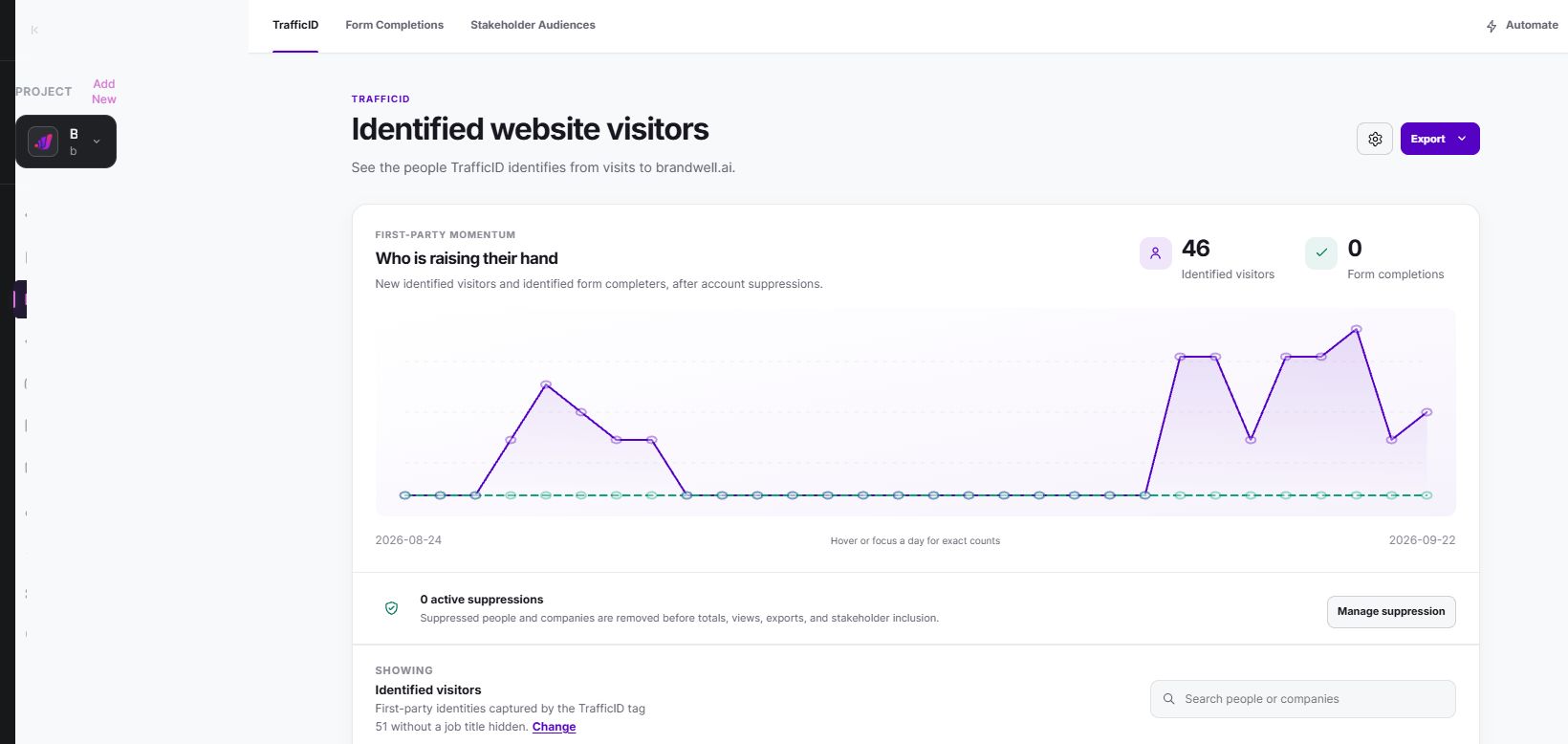
Use that review to prepare a campaign hypothesis: which observed page or activity supports which message? Verify the connected destination and supported actions in your package before planning activation. This article does not promise automatic syncing to every ad platform, native ad creation or an accurate prediction of future purchases.
AIMEE can help prepare work through configured tools and access. Assign an owner and approval point and check the result at the destination. Keep unverified audience attributes out of ad copy. MarketPulse provides topic-based buyer research; it is distinct from TrafficID’s observations on your own site.
Platform-specific checks
Facebook and Instagram
Check the current Meta account’s supported audience source, event configuration and rules before choosing a website or customer-file approach. Confirm the source you actually connected rather than treating a visitor export as a completed retargeting audience. Avoid a step-by-step menu recipe that has not been verified in the current interface.
LinkedIn’s website-retargeting guidance describes using the Insight Tag to match website visitors to member accounts. That platform audience is separate from an identified visitor report. Review eligibility and current Campaign Manager requirements, then inspect the audience’s status before launch.
TikTok
TikTok’s website-traffic audience instructions require a configured Pixel and a defined event. The guidance states a minimum audience size of 1,000 for targeting a Custom Audience in an ad group. That is a platform requirement, not a promise that 1,000 site visits will yield 1,000 matched people.
Choose a platform from evidence about your customers and the campaign, not a blanket stereotype about age or profession. Referral traffic from a network does not establish every visitor’s account activity on that network.
Write useful creative without intrusive assumptions
Connect the creative to the page’s topic. A visitor to a payroll-software page could receive an explanation of an implementation workflow. Do not write “we know you are buying payroll software” or disclose a person’s supposed browsing behavior. Keep the offer and destination consistent.
Use a clear headline, an accurate benefit, a relevant visual and one action. Check image legibility at a phone-sized preview and review the landing page. A limited-time offer must have a real, accurately described deadline. Do not advertise a trial that is not currently offered.
Paid-ad frequency and an organic posting schedule are separate decisions. Inspect the platform’s delivered frequency and outcome data rather than inferring an ideal posting hour from a few identified visitors.
Measure outcomes and test carefully
Record source, campaign and creative consistently. Use campaign identifiers to join the visit to reporting without placing personal data in a public URL. Keep the platform’s attributed result distinct from your deduplicated purchase or lead records, with a stated attribution window.
Calculate CTR as clicks ÷ impressions, CPC as ad spend ÷ clicks, and acquisition cost as the included cost ÷ qualifying acquisitions. State which cost you include. ROAS is attributed revenue ÷ ad spend; it is not profit or proof that advertising caused the sale.
For a fictional example, $600 of ad spend and three attributed purchases totaling $1,200 produce $200 ad-spend cost per purchase and 2.0× ROAS. Refunds, servicing costs, fees and incrementality are not included. These figures are arithmetic illustrations, not a TrafficID result or expected benchmark.
Test one stated hypothesis and predefine the outcome and observation period. Randomized allocation with comparable conditions can support a stronger comparison than two campaigns run in different weeks. A retargeted audience already has prior contact with your business, so comparing its raw conversion rate with a cold audience does not establish causal lift.
Review duplication, purchaser exclusions, attribution overlap and insufficient sample size before scaling. AI can help draft a brief or summarize recorded observations; it does not replace missing evidence or guarantee which ad will work.
Frequently asked questions
Does identification guarantee an ad match?
No. Data eligibility, match coverage, audience availability and delivery are separate checks.
Does visiting a pricing page establish purchase intent?
No. It supports a hypothesis worth testing, not a verified buying decision.
Which social platform is best?
Choose using your audience, objective, available setup and measured results. There is no universal winner.
How should I start with BrandWell?
Review a small set of available records, write a documented campaign hypothesis, verify the intended destination and approvals, then measure the actual outcome. See TrafficID’s current visitor workflow.
Reviewed and updated October 3, 2026.

Written by
Jeff Joyce has been helping brands grow online since the Myspace era, when custom HTML layouts were still a competitive advantage. What started in design quickly evolved into a career spanning social media, content strategy, video, agency ownership, and growth marketing. After building his own agency and testing countless AI tools, Jeff joined BrandWell with a clear focus: helping marketers understand how AI can actually improve the way they create, optimize, and scale content. Today, Jeff brings a CMO-level perspective to BrandWell's marketing strategy, blending brand positioning, content, video, customer education, and growth. His work centers on turning complex AI concepts into clear, practical marketing that helps brands move faster, create better content, and stay competitive without losing their voice.

 Farnaz Kia