On this page
- Technical SEO vs content SEO: the practical difference
- When to investigate technical issues first
- Correct an outdated pagination assumption
- When to prioritize the content
- An example of two different fixes
- Use BrandWell for the editorial workflow
- Check performance and usability separately
- Measure progress with a change log
- Frequently asked questions
Technical SEO addresses how a website delivers and exposes its pages. Content SEO addresses what those pages communicate and whether they answer the audience’s questions. Prioritize the confirmed obstacle: an inaccessible page needs a technical investigation; an accessible page with an incomplete answer needs editorial work. Many projects need both.
Technical SEO vs content SEO: the practical difference
- Technical work: page access, crawl and indexing controls, URL handling, links, performance and delivery across devices.
- Content work: audience research, the question answered, evidence, structure, wording, examples and the appropriate next step.
- Shared work: clear navigation, useful internal links, readable mobile layouts and accurate search presentation.
The division is useful for assigning responsibility, not for deciding that one discipline always matters more. A developer and an editor can work on the same page for different reasons.
When to investigate technical issues first
Start with technical evidence when a valuable page does not load, sends visitors to the wrong destination, hides its main content or has an unexpected search status. Document the exact URL, device, symptom and observation time.
- Open the page: check its main content, links and forms as a visitor.
- Inspect its search status: use Search Console evidence to identify the reported indexing issue.
- Check URL handling: confirm redirects and canonical choices match the intended page.
- Test the important interaction: a page can load while its form or navigation still fails.
- Assign the fix and verify it: record the result in the same conditions that showed the problem.
Do not turn every technical report into a sitewide change. An intentional exclusion may be correct for a page that should not appear in search. Investigate purpose and configuration before removing controls.
Correct an outdated pagination assumption
Google no longer uses rel="next" and rel="prev" to identify pagination relationships. Its current pagination guidance recommends sequential crawlable links and distinct page URLs. It also advises against making the first page the canonical for every page in the sequence.
For a blog archive, test how readers reach older articles. A “load more” experience needs an implementation that exposes the relevant content and URLs to search engines; do not assume a crawler will press the button like a visitor.
When to prioritize the content
Investigate the answer when the page is accessible but reaches the wrong audience, contains obsolete instructions, makes unsupported claims or leaves readers without the information promised by its title.
- Define the reader and the decision they need to make.
- Answer the main question early, then explain important conditions.
- Replace unsupported numbers with sourced facts or labeled examples.
- Remove repetition and material that belongs on a different page.
- Update screenshots and product references to the current workflow.
- Choose a next step that fits the reader’s stage.
Search impressions and click-through rate can point to opportunities, but they do not explain the whole problem. Read the page and its actual queries before changing the headline.
An example of two different fixes
This is an original hypothetical example. An IT provider has a service page and an onboarding guide. The service page’s mobile inquiry button opens a broken form; its editor cannot solve that by adding another paragraph. The onboarding guide works technically but describes an old process and omits who approves access; compressing its images cannot repair those instructions.
Assign the form problem to the implementation owner and the guide problem to an editor with a process reviewer. Give each task an acceptance condition: successful form submission for one, complete and current responsibilities for the other.
Use BrandWell for the editorial workflow
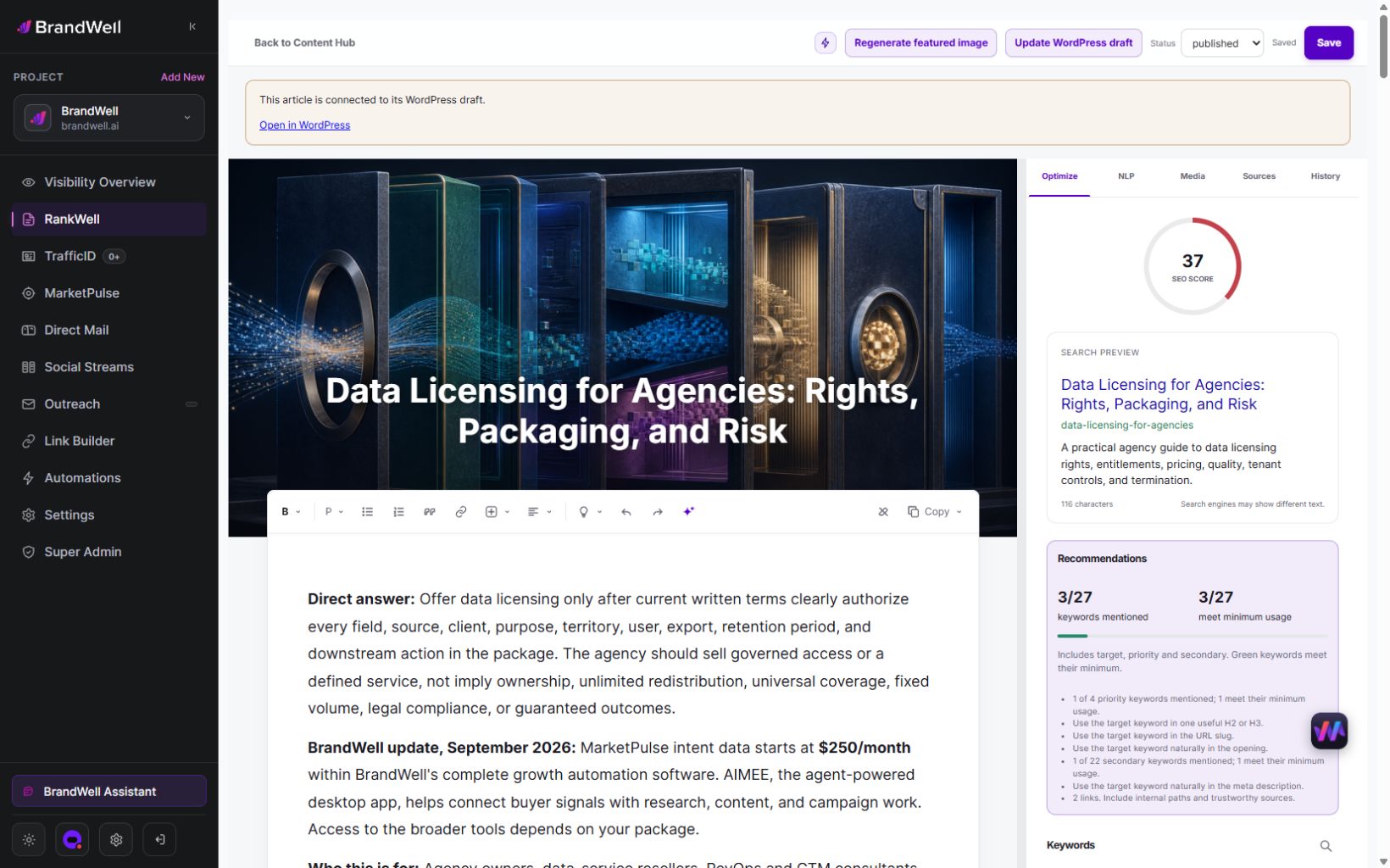
Use Visibility research to investigate topics and opportunities in the current BrandWell portal. Create a brief that includes the audience, question, evidence and intended action. Use RankWell to draft and review the article before publishing through a configured connection.
Confirm sources, product details and instructions yourself. An editor workflow does not automatically repair server settings, redirects or every website performance issue.
Check performance and usability separately
Use performance diagnostics to identify expensive resources and slow interactions. Then inspect the actual page on mobile: text should be readable, controls usable and important content visible without sideways scrolling.
Prioritize resources that interfere with the main task. An oversized decorative image and a slow payment interaction have different consequences. Test the affected page again after the change rather than treating a higher diagnostic score as proof that the whole experience is fixed.
Measure progress with a change log
Keep technical and editorial acceptance checks separate from marketing results. A broken form being repaired is a verified implementation outcome. More qualified inquiries after that repair is a business observation that can have several causes.
Hypothetical arithmetic: a page with 10,000 impressions and 100 clicks has a 1% click-through rate. Another period with 12,000 impressions and 180 clicks has a 1.5% rate. Record the 0.5 percentage-point difference alongside the changed title, query mix and any offer changes. Do not attribute the entire difference to one fix without evidence.
Frequently asked questions
Can strong content overcome every technical problem?
No. Readers still need to reach and use the page. Fix confirmed access and interaction failures instead of adding content around them.
Does a technically clean website guarantee rankings?
No. It can still answer the wrong question or offer little useful information. Technical improvements also do not make a website immune to future changes.
Should I split the work between teams?
Assign owners based on the task, then use shared page-level acceptance checks. A short brief and issue log can prevent the same symptom from being passed repeatedly between teams.
How does this relate to AI-answer opportunities?
Accessible pages with clear answers, relevant evidence and original examples are easier to understand and reference. Monitor appearances where possible; do not promise that a technical or content change will secure inclusion.
Explore RankWell to organize the content side of your search improvement plan.
Reviewed and updated October 3, 2026.

Written by
Julia McCoy has contributed articles to BrandWell on content marketing, writing, and search engine optimization. This archive retains her original bylines; individual articles may be updated by the BrandWell editorial team.