On this page
- Evaluate the relevant BrandWell product
- Who is this for?
- Define “accuracy” before you run the test
- Ten steps to test identity resolution accuracy
- Tools and artifacts required for the evaluation
- Compare resolution methods with the same criteria
- Design a sample that exposes hard cases
- Model identity resolution pricing and total cost
- Tie accuracy to pipeline without skipping the evidence chain
- Privacy, security, correction, and provenance
- Make accuracy QA a recurring agency service
- How to evaluate BrandWell in the same framework
- Agent-ready evaluation instructions
- Buying checklist and acceptance gate
- A worked identity-linkage example
- Frequently asked questions
- Review the audience before expanding
Test identity resolution with a blinded, labeled sample that represents your intended use. Report coverage, link correctness, missed matches, field correctness, freshness and operational usability separately. Match rate alone is not an accuracy result.
Define the entity and action before the test. A company research queue, person-level contact list and CRM merge have different consequences when a link is wrong. Freeze the required evidence and acceptance criteria before comparing methods.
A direct identifier, a deterministic rule and a probabilistic match have different evidence paths. None alone establishes permission to contact someone, buying authority or a future purchase.
Evaluate the relevant BrandWell product
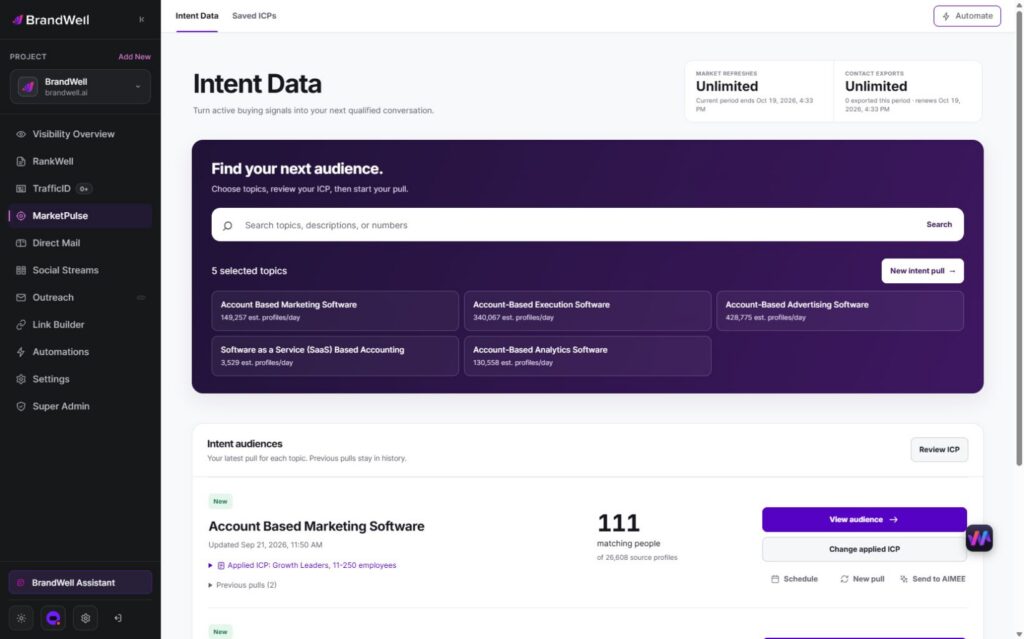
MarketPulse supports topic research intent audiences and saved ICP filters, starting at $500/mo. TrafficID concerns identifiable visitors to an authorized website. Keep topic research, observed visits, submitted forms and added company stakeholders distinct when designing a test.
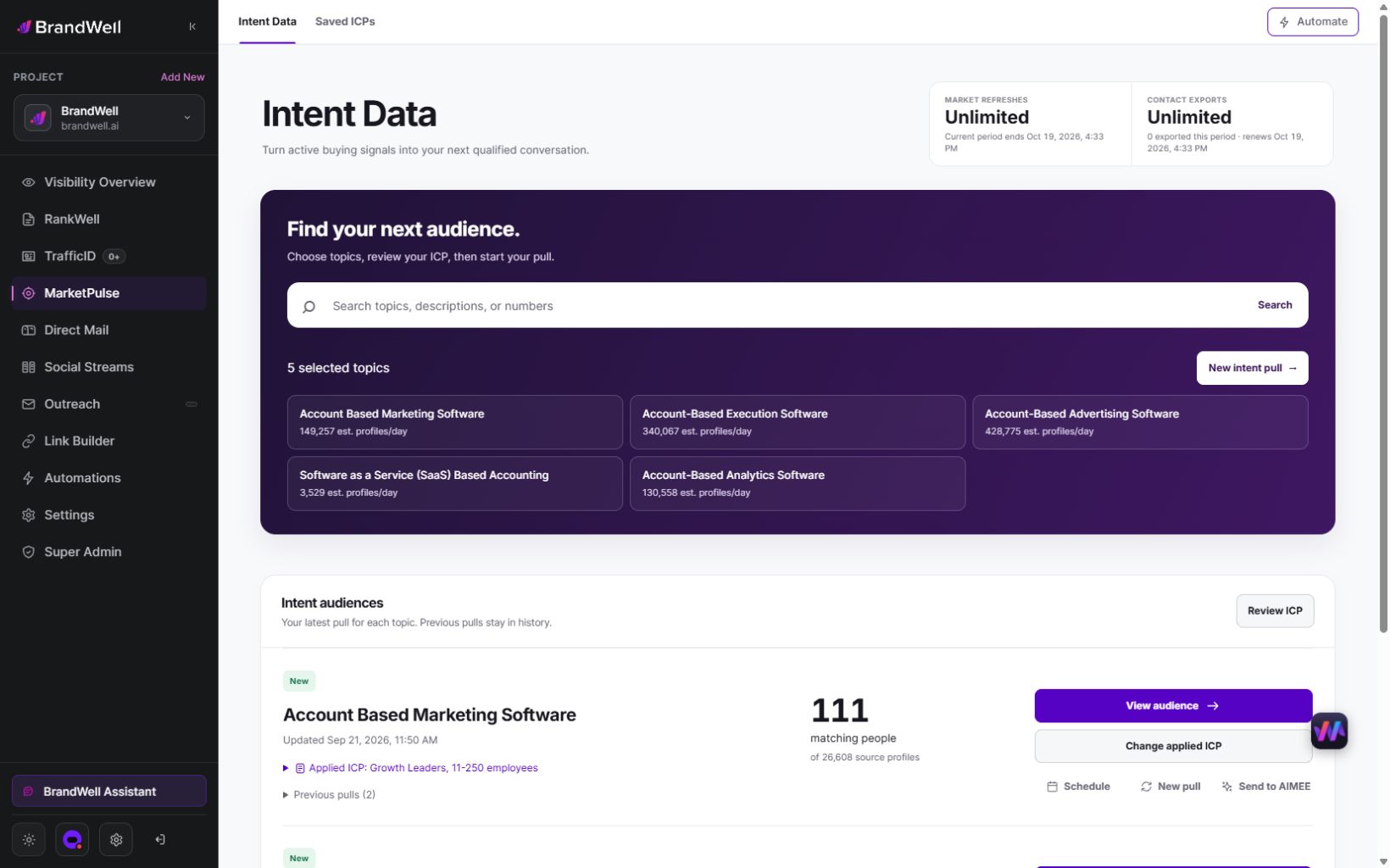
Standard MarketPulse monthly plans are Starter with one weekly topic and 25,000 contact exports, Growth with three daily topics and 100,000 exports, and Scale with ten daily topics and unlimited exports. Confirm current fields, scope and terms before testing. A subscription is not a promise of an identity benchmark, native custom API or white-label portal.
Who is this for?
This guide is for:
- B2B data and RevOps teams evaluating identity resolution;
- growth teams routing visitor or intent signals;
- agencies validating data they will deliver to clients; and
- privacy, security, compliance, legal, and procurement reviewers.
It is not a request for one universal accuracy benchmark. It is a protocol for deciding whether a resolver is accurate enough for a defined population, action, and risk.
Define “accuracy” before you run the test
Identity resolution accuracy contains several questions:
- Coverage: What share of eligible inputs received any proposed resolution?
- Precision: What share of assigned links were correct?
- Recall: What share of the true links were found?
- False-link share: What proportion of assigned links were incorrect? Label a false-positive rate separately, using all known nonmatches as its denominator.
- Missed-link share: What proportion of known true matches were not linked? Do not use all unlinked pairs as the denominator.
- Field accuracy: Were returned company, role, email, phone, domain, or other attributes correct?
- Calibration: Did higher confidence scores correspond to higher observed correctness?
- Freshness: Were current employment, domain, and status fields still usable?
- Operational usability: Did the accepted result land in the right system, owner, and workflow without creating harmful duplicates?
The Office for National Statistics states that match rate gives no indication of linkage quality. It also calls for estimates of precision and recall because both false positives and false negatives occur. That guidance comes from statistical linkage, not B2B vendor certification, but the denominator discipline applies.
Ten steps to test identity resolution accuracy
Use the same protocol for each provider or method. Change the threshold only when the business action changes.
1. Define the decision and the cost of error
Name the action: internal research, account routing, contact enrichment, visitor follow-up, record merge, audience creation, outreach staging, suppression, or deletion. Estimate the harm of a false link and a missed link separately.
Deliverable: decision-and-error-cost brief. Acceptance gate: thresholds match the action’s risk. Failure mode: one generous threshold is reused for every consequence.
2. Freeze the population and entity unit
Specify person, account, domain, location, subsidiary, parent, geography, source mix, and time window. Decide how duplicates, shared domains, contractors, job changes, and unknowns are handled.
Deliverable: population contract. Acceptance gate: every finalist receives the same eligible rows. Failure mode: denominator changes make the comparison meaningless.
3. Build a representative labeled sample
Include known matches, known non-matches, missing identifiers, common names, aliases, duplicates, subsidiaries, role changes, stale records, shared networks, and records the system is likely to reject. Stratify by the segments that matter to the use case.
Deliverable: ground-truth sample with provenance. Acceptance gate: easy and hard cases are represented. Failure mode: a convenience sample exaggerates performance.
4. Blind the answer and run the test
Remove labels from the input. Freeze provider settings, field mappings, and transformations. Hash or otherwise identify the exact input. Require raw output, returned entity IDs, source fields, confidence, and a clear no-match state.
Deliverable: immutable input/output pair. Acceptance gate: the provider cannot tune on disclosed answers. Failure mode: a demo-selected file tests the presenter’s skill rather than the system.
5. Normalize without overwriting raw output
Map provider-specific fields into a common evaluation schema. Preserve original values, source, timestamp, confidence, and null state. Do not silently convert “unknown” into a negative value.
Deliverable: normalized evaluation file. Acceptance gate: every scored value traces to raw output. Failure mode: normalization hides contradictions and missingness.
6. Adjudicate ambiguous records
Use two reviewers or a documented escalation rubric for uncertain cases. Record disagreement and unresolved status instead of forcing certainty. Reviewers should not see the vendor’s marketing label or expected result while labeling.
Deliverable: adjudication log. Acceptance gate: reviewer disagreement is measured. Failure mode: human ground truth is treated as flawless.
The government linkage-quality chapter discusses false links, missed links and review limitations. Use it as methodological background, rather than certification of a commercial product.
7. Calculate metrics by stratum
Report precision, recall, false-link rate, missed-link rate, coverage, and field accuracy for the complete sample and for meaningful segments. Include denominators. Show unresolved records rather than excluding them from the headline.
Deliverable: field-level accuracy scorecard. Acceptance gate: another analyst can reproduce every result. Failure mode: one aggregate hides poor performance for a key region, source, company type, or identifier pattern.
8. Check confidence calibration and freshness
Group outputs into confidence bands and compare the stated confidence with observed correctness. Test current employment, domain ownership, contactability, and other time-sensitive fields separately.
Deliverable: calibration and freshness review. Acceptance gate: operational thresholds match observed risk. Failure mode: a high-confidence but stale record is treated as usable.
9. Test the destination and rights workflows
Send accepted, held, rejected, and corrected test records to a sandbox. Exercise deduplication, merge prevention, suppression, correction, deletion, access restrictions, and rollback. Do not use the test as an excuse to activate real people.
Deliverable: destination and governance report. Acceptance gate: no production write occurs without named human approval. Failure mode: accurate data creates operational or rights failures after import.
10. Price usable outcomes and decide
Include license, minimums, credits, integration, storage, QA, human review, false-link rework, missed opportunities, security review, support, renewal, export, and exit. Calculate cost per returned record, correct record, and correct usable record.
Deliverable: total-cost and acceptance memo. Acceptance gate: approve, conditionally repair, or reject against the frozen thresholds. Failure mode: the smallest apparent cost per match becomes the highest cost per useful result.
Tools and artifacts required for the evaluation
You do not need a complex lab. You do need a controlled process:
- a secure sampling environment;
- a labeling and adjudication tool;
- an immutable input/output store;
- a normalization script or mapping sheet;
- a metric workbook or notebook;
- a destination sandbox; and
- an approval and decision log.
The essential identity resolution accuracy templates are the population contract, ground-truth schema, test-file specification, field map, reviewer rubric, confusion matrix, segment scorecard, calibration view, error taxonomy, total-cost model, and acceptance memo.
Binette and colleagues’ 2024 entity-centric evaluation paper proposes labeled benchmarks, pairwise and cluster metrics, and error analysis. It tests an inventor-name-disambiguation application and simulations, not BrandWell or a B2B lead product. Keep that scope explicit when using the methodology.
Compare resolution methods with the same criteria
Compare the methods on entity unit, required inputs, precision-recall tradeoff, explainability, scale, freshness, privacy, best fit, and limitation.
Exact matching
Exact matching links records only when selected identifiers agree. It is explainable and can favor precision when identifiers are reliable. Its limitation is low recall when fields are missing, formatted differently, or outdated.
Deterministic multi-field matching
Deterministic rules combine trusted identifiers such as normalized domain, email, phone, name, and address. It can recover more links while remaining explainable. Its limitation is brittle rules and conflicts when identifiers are shared or stale.
Probabilistic resolution
Probabilistic methods weigh multiple clues and return a likelihood or confidence. They can recover matches that exact rules miss. Their limitation is false-link risk, calibration drift, and weak explainability when evidence is hidden.
Reverse-IP or network-level identification
Reverse-IP methods can suggest a company or network context for website activity. Their limitation is the entity unit: shared networks, remote work, service providers, and privacy controls can make person-level conclusions inappropriate. Treat account context and person identity as different outputs.
Manual reconciliation
Human review is useful for low-volume, high-value, or ambiguous cases. Its limitation is cost, inconsistency, fatigue, and lack of scale. Measure reviewer agreement and retain the reasoning.
Design a sample that exposes hard cases
Stratify the sample by:
- geography and language;
- company size and entity structure;
- parent, subsidiary, location, and domain type;
- identifier completeness and conflicts;
- common and changed names;
- current and former employment;
- duplicates and near-duplicates;
- shared, residential, mobile, or remote network context;
- source age; and
- intended action.
Include negative controls – records that should not link – and known positives where a link should exist. Do not copy a universal sample size from a blog. The required size depends on prevalence, desired uncertainty, segment coverage, and error cost. Ask a qualified analyst for statistical design when the decision is material.
Model identity resolution pricing and total cost
Use this equation:
Total cost = platform and data + minimums and credits + integration + storage + QA + human review + error correction + security and privacy work + support + renewal and exit cost.
Then calculate:
- cost per input record;
- cost per returned result;
- cost per correct result;
- cost per correct result that passes fit, freshness, policy, and destination checks; and
- cost of false and missed links.
Do not state that a provider is universally less expensive. Ask each provider to quote the same fields, population, volume, refresh, integrations, services, rights, support, term, overages, and exit.
Tie accuracy to pipeline without skipping the evidence chain
Technical quality comes first. Then track:
- records accepted by the destination;
- duplicates or merge reversals;
- corrections and suppression conflicts;
- time from accepted record to owned action;
- sales acceptance and rejection reasons;
- responses and qualified opportunities;
- cost per accepted outcome; and
- harms avoided through holds or rejection.
Carry one evidence ID from source through outcome. Keep fit, intent, identity, freshness, permitted use, and activation approval separate. A resolved identity is not automatically a qualified prospect.
Use a holdout, phased rollout, or matched cohort when practical. A correlation between resolved records and pipeline does not prove the resolver caused pipeline. Attribution and incrementality answer different questions.
Privacy, security, correction, and provenance
Before purchase, test whether the operating model can:
- collect only needed identifiers;
- explain source, purpose, and permitted use;
- restrict access and separate clients;
- retain raw output and confidence without uncontrolled duplication;
- apply correction, suppression, opt-out, and deletion;
- monitor error and bias by segment;
- roll back a bad merge or write;
- document service-provider responsibilities; and
- stop consequential actions pending review.
Set these requirements for the actual data and client workflow. Review responsibilities with the appropriate privacy, security and legal owners. A published provider assurance does not substitute for testing your own access, correction and rollback process.
Make accuracy QA a recurring agency service
An agency can package:
- initial test design and labeled sampling;
- periodic precision and coverage sampling;
- confidence and freshness monitoring;
- exception and ambiguous-record review;
- source and field-level error analysis;
- correction, suppression, and deletion reconciliation;
- destination QA and rollback testing; and
- a branded quality and acceptance report.
Sell the monitoring and decision, not a promise that accuracy will remain fixed. Data sources, populations, matching logic, and customer records change.
How to evaluate BrandWell in the same framework
BrandWell MarketPulse is topic-based intent-data software for businesses and agencies. Choose relevant research topics, apply saved ideal-customer-profile filters, review available names, roles, companies and contact details, and export the audience or prepare a connected workflow. Plans start at $500/mo. TrafficID identifies visitors to your own website and is a separate product. A MarketPulse subscription does not by itself promise a white-label portal, custom API implementation, exclusive topics, or managed client delivery.
Test BrandWell like any other provider: freeze the population, fields, topics, entity level, destinations, permitted uses, truth labels, thresholds, costs, and exit requirements. Confirm current coverage and entitlements in the written scope. Do not treat a profile reveal as proof of identity or a person researching a topic.
Assess the audience and the operating cost before expanding the service. Explore MarketPulse with the data, tools, and client delivery scope you need.
Identity correctness must be evaluated against the underlying evidence and use case. A product name does not determine whether a link is exact, rule-based or probabilistic. Correctness, permission to use a record and the expected business outcome remain separate questions.
Agent-ready evaluation instructions
Give your approved analyst or AI workspace the frozen population contract, field schema, ground-truth labels in a protected reference, blind input, raw output, normalization rules, error costs, and acceptance thresholds. Instruct it to:
- verify input and output hashes;
- preserve raw values and no-match states;
- normalize fields without inventing missing values;
- compare output with labels only after the blind run;
- calculate coverage, precision, recall, false and missed links, field accuracy, and segment errors;
- flag ambiguous cases for human adjudication;
- test confidence bands and freshness;
- prepare a sandbox payload without executing it;
- request named human approval for consequential actions; and
- draft an approve, repair, or reject memo with total cost.
Buying checklist and acceptance gate
Buy only when you can answer yes to these questions:
- Is the entity unit and population explicit?
- Was the test blinded and representative?
- Are positive and negative controls present?
- Can precision, recall, false links, missed links, and field accuracy be reproduced?
- Do confidence and freshness support the intended action?
- Do hard segments meet their own thresholds?
- Can the destination accept, correct, suppress, delete, and roll back records?
- Are source, permitted use, access, retention, and responsibilities documented?
- Does cost per correct usable result fit the economics?
- Are renewal, export, and exit terms written?
If the system passes coverage but fails correctness, do not rationalize the errors. If it passes correctness but lacks operational rights or rollback, it is still not ready. The best identity resolution accuracy decision is the one tied to a specific use, a visible error budget, and evidence the buyer can reproduce.
A worked identity-linkage example
Consider a fictional test of 100 candidate pairs with known labels: 50 true matches and 50 nonmatches. The resolver assigns 40 links, of which 36 are correct and four incorrect. It misses 14 true matches and correctly leaves 46 nonmatches unlinked.
- Precision: 36 correct links divided by 40 assigned links = 90%.
- Recall: 36 found true matches divided by 50 known true matches = 72%.
- False-link share: four incorrect links divided by 40 assigned links = 10%.
- False-positive rate: four incorrect links divided by 50 known nonmatches = 8%.
- Missed-link share: 14 missed matches divided by 50 known true matches = 28%.
The 40% assigned-link share in this candidate-pair sample is not visitor identification coverage or a population benchmark. Sampling and pair construction affect interpretation. Unknown truth labels require a separate unresolved category, not an invented correct or incorrect answer. Report uncertainty and segment results for the decision being made.
If the test costs $900 and 30 of the correct links also pass freshness, fit and destination checks, cost is $22.50 per assigned link, $25 per correct link and $30 per correct usable link. Additional costs would change these figures. These are fictional calculations, not BrandWell performance claims.
Frequently asked questions
Is a high match rate proof of accuracy?
No. A match count does not establish which links are correct. Use labeled evidence and report the relevant correctness and missed-match denominators.
Can I compare scores from two providers directly?
Only after establishing what each score means and testing its calibration on the relevant labeled population. A similarly named confidence field may represent a different quantity.
Should test records trigger production outreach?
Keep destination tests in a controlled sandbox. Demonstrate approval, suppression, correction and rollback before allowing the relevant production action.
What should an agency include in its report?
The population, entity unit, method, sample construction, labels, unresolved cases, metric denominators, segment results, limitations, costs and acceptance decision. Keep customer outcomes separate from technical linkage quality.
Review the audience before expanding
Explore MarketPulse and its current plans, then evaluate the relevant fields against your use case. AIMEE can help prepare research and an evidence summary through connected tools. Review the configured permissions and product scope before promising execution or client delivery.
Reviewed and updated October 3, 2026.

Written by