On this page
- Who this is for
- What topic-intent targeting is – and is not
- A ten-step paid-audience workflow
- Data, integrations, and team responsibilities
- Map topic clusters to distinct creative hypotheses
- Topic intent versus native, demographic, and lookalike audiences
- Budget, pricing, and total cost
- Measuring lift, incrementality, and pipeline
- Best-fit companies and use cases
- Signal quality, privacy, and platform-policy risks
- Packaging topic-intent targeting as an agency service
- Frequently asked questions
- Worked example: compare the assigned groups
- Start with the current MarketPulse workspace
Topic-intent audience targeting can make B2B paid media more selective, but only when intent is treated as timing evidence layered onto fit, not as a replacement for an ideal customer profile. Start with accounts that can buy, require a recent and relevant topic signal, resolve identity at the level the ad platform accepts, apply policy and suppression rules, and compare the result with a control. A topic signal should change budget, creative, or sequence only when the team can explain why.
The practical model is:
eligible paid-media audience = ICP fit × relevant topic × freshness × identity confidence × platform eligibility
This is an illustrative set of eligibility gates, not a validated scoring or probability model. A failed required gate stops activation. Passing every gate does not establish that the record is a buyer or that an ad will create incremental value.
Current MarketPulse offer: intent-data plans start at $500/mo. See the product, demo, and current plans. Updated October 3, 2026.
Who this is for
- B2B advertisers and paid media agencies trying to reduce waste in account-based campaigns.
- Demand generation leaders connecting topic research with offers, creative, and pipeline.
- RevOps and marketing operations teams responsible for identity, audiences, CRM outcomes, and governance.
- Agency owners productizing topic-intent targeting as a recurring client service.
This strategy fits high-consideration B2B markets best. It is less useful when the account universe is undefined, deal value cannot support the data and media cost, topic coverage is too sparse, or the platform cannot accept an eligible audience at useful scale.
What topic-intent targeting is – and is not
Topic intent is observable research activity associated with a subject, problem, category, competitor, implementation question, or related theme. It can originate from third-party research networks, a client’s owned web properties, content engagement, product usage, search behavior available within a platform, or other approved sources. Each source supports different inferences.
A topic event does not necessarily identify the exact buyer, establish consent for outreach, reveal a buying stage, or prove that spend will be incremental. An account can research a topic for customer delivery, recruiting, education, or competitive analysis. That is why topic context, firmographic fit, recency, identity confidence, and downstream evidence matter.
Use topic intent for three decisions:
- Eligibility: should this account enter a paid-media test?
- Treatment: which message, offer, channel, and frequency fit the observed research?
- Priority: how should budget or sequencing change relative to other qualified accounts?
Do not use a single score to answer all three.
A ten-step paid-audience workflow
Platform features and policies change, so verify the destination’s current requirements before activation. The workflow below is platform-neutral.
1. Define the business outcome and control
Choose a defined outcome and freeze the eligible account universe. Randomize eligible accounts to the planned treatments where feasible, retaining original assignments. Matching similar accounts can still leave selection and confounding; it does not by itself establish a causal comparison.
2. Build a topic dictionary with context
Group terms by buying question: problem recognition, category exploration, comparison, implementation, integration, risk, and migration. Add excluded meanings and negative contexts. Map each cluster to a creative hypothesis and landing experience. If two topics would receive the same treatment, they may not need separate audiences.
3. Set freshness by the decision window
Choose the decision window for the actual source and use observed timestamps rather than report dates. A longer analysis window requires permitted retained history; it is not a native MarketPulse pull setting. A MarketPulse pull retrieves available data from the previous 24 hours for one topic. Set expiry rather than leaving an account permanently in market.
4. Join intent with account fit
Require industry, size, geography, technology, account tier, or other defensible ICP attributes. Remove existing customers when the campaign is acquisition-only and preserve separate expansion rules. A fit-first join prevents a popular topic from filling the audience with accounts that cannot buy.
5. Resolve identity and platform eligibility
Account-level advertising may use company or domain resolution where the destination supports it. Person-level customer lists require appropriate identifiers, data rights, and platform rules. Validate contact fields and apply suppression before upload. Do not downgrade the evidence standard because a platform technically accepts a file.
6. Create audience cohorts, not one mixed pool
Separate high-fit/high-intent, high-fit/emerging-intent, and fit-only control groups. Keep source, topic, freshness, identity, and rule version attached outside the ad platform so results can be reconciled later.
7. Match treatment to the research question
Problem-stage research may receive an educational diagnostic. Comparison activity may receive a decision guide. Implementation research may receive a workflow, calculator, or pilot. Avoid ad copy that reveals or implies surveillance, such as telling a person you know what they researched.
8. Apply spend and frequency guardrails
Set audience minimums, budget caps, channel overlap rules, frequency limits, and expiry. Smaller intent cohorts can concentrate frequency quickly. A high CPM can still be economical for a valuable account, but only when the treatment and measurement justify it.
9. Return outcomes to the account record
Capture exposure, engagement, qualified site activity, form events, opportunity status, pipeline, and revenue where permitted. Reconcile platform identity with CRM accounts carefully. Preserve no-result and rejected outcomes.
10. Optimize one variable at a time
Change the intended variable separately where feasible and record rule versions, concurrent campaigns and crossover. Before-and-after differences may reflect seasonality, selection or other changes even when only one setting is intentionally altered. Treat them as directional unless the design supports a stronger conclusion.
Data, integrations, and team responsibilities
The minimum data model includes client ID, account domain, fit tier, topic, source, observed time, signal strength, identity level, eligibility, audience cohort, destination, creative treatment, activation time, spend, and outcome. Give each row a stable ID so uploads and retries reconcile.
The core team is small:
- Strategy owner: defines the ICP, topic-to-message map, hypothesis, and budget.
- Data/RevOps owner: handles identity, joins, suppression, destinations, and outcome reconciliation.
- Media owner: creates audiences, campaigns, bids, frequency rules, and experiments.
- Client or compliance approver: approves data use, platform eligibility, claims, and sensitive scenarios.
- Agency service owner: monitors SLAs, quality, reporting, margin, and changes.
A spreadsheet can run the first controlled pilot. Automation becomes valuable after the schema, thresholds, destination requirements, and exception rules are stable.
Map topic clusters to distinct creative hypotheses
Topic targeting adds value only when the research context changes the treatment. Build a small topic-to-creative matrix before creating audiences.
- Problem recognition: offer a diagnostic, checklist, or cost-of-status-quo guide. The hypothesis is that the account needs language for the problem, not a product comparison.
- Category education: offer a framework or requirements guide. The hypothesis is that the buying group is defining what a solution must do.
- Vendor comparison: offer an evaluation matrix, pilot design, or migration plan. The hypothesis is that decision criteria and risk reduction matter more than broad awareness.
- Implementation and integration: offer architecture, rollout steps, or a technical workshop. The hypothesis is that feasibility is blocking progress.
- Security, privacy, or procurement: offer verified documentation and a buyer checklist. The hypothesis is that approval risk, not interest, is the next constraint.
- Competitor or replacement research: offer a fair switcher guide and migration considerations. Do not make unsupported claims about the incumbent.
Write one primary message and one proof requirement for each cluster. Keep the creative respectful: describe the problem or decision without revealing that a particular person was observed researching it. If two topic cohorts receive identical ads and landing pages, combine them for the first test; splitting them adds reporting complexity without creating a meaningful hypothesis. Conversely, if one broad cohort contains both early education and late implementation research, separate it before bidding more aggressively.
Topic intent versus native, demographic, and lookalike audiences
| Audience approach | Selection basis | Primary strength | Main limitation | Best use |
|---|---|---|---|---|
| Topic-intent cohort | recent research plus fit | adds timing and message context | probabilistic, coverage and identity vary | high-consideration B2B tests |
| Platform-native in-market or interest | platform-observed behavior | easy activation and scale | definitions and portability are limited | reach and directional demand capture |
| Firmographic or named-account | company attributes and list | high control over fit | no current timing signal | ABM foundation and controls |
| Lookalike or modeled audience | similarity to a seed | efficient expansion | may amplify seed bias and weak fit | discovery after seed quality is proven |
| Demographic or role targeting | user attributes | understandable segmentation | role data can be broad or stale | awareness and buying-group coverage |
| Retargeting | first-party engagement | strong known interaction | limited scale and possible over-frequency | sequencing and conversion support |
Swipe the table to see all columns.
The best program often layers approaches rather than declaring one universal winner. Use named-account or firmographic audiences for fit, topic intent for timing and treatment, and a fit-only cohort as the comparison. Use lookalikes to discover incremental reach, not to claim current demand.
Budget, pricing, and total cost
Model:
topic-audience TCO = data and identity + platform and usage + media + setup + direct labor + measurement + risk reserve
Separate the data-service fee from ad spend. Include audience refresh, match loss, minimum sizes, creative variants, landing pages, CRM reconciliation, analyst review, and client support. Enterprise platforms may bundle several capabilities; an agency service may separate topics, identity, activation, reporting, and media management into modules.
Set a learning budget large enough to reach the destination’s viable audience and conversion threshold, but cap it by the economic value of the account universe. Do not promise a standard CPM, match rate, cost per lead, or return without a scoped test.
Measuring lift, incrementality, and pipeline
Start with data quality, then media, then revenue:
- Audience quality: eligible accounts, match rate, duplicate and suppression rate, freshness, and accepted-signal sample.
- Delivery: reach, frequency, spend, CPM, and cross-channel overlap.
- Engagement: qualified account visits, target-page depth, content actions, and form events.
- Revenue: meetings, opportunities, pipeline, won revenue, sales-cycle change, and gross profit.
- Agency economics: direct labor, media-management cost, data cost, gross margin, renewal, and expansion.
Define each metric’s unit and denominator before launch. Upload acceptance, audience matching, unique reach, qualified engagement and won revenue are different stages. Preserve missing and rejected records rather than quietly removing them from the denominator.
Best-fit companies and use cases
Topic-intent targeting best fits B2B SaaS, technology, services, industrial, and other high-consideration markets with a defined account universe, meaningful deal value, enough signal coverage, and a sales or demand team that can use topic context. It is particularly useful for comparison, migration, implementation, security, or problem-specific campaigns.
It is a poor fit when the audience is mostly consumer, topics are ambiguous, account identity is unreliable, the market is too small for destination minimums, or creative and offers do not vary by intent. If the only treatment is the same generic brand ad, a simpler fit-based audience may be enough.
Signal quality, privacy, and platform-policy risks
Common mistakes include broad topics, stale windows, assuming account activity identifies a person, uploading unvalidated identifiers, ignoring minimum audience rules, revealing surveillance in creative, combining sensitive attributes, over-frequency, and optimizing to platform-reported leads without CRM quality.
Review the actual destination and collection context before proposing an upload. Google’s personalized advertising policy restricts targeting in sensitive categories and certain opportunity-related categories. Technical acceptance does not establish permitted use. Review other platform requirements separately.
Packaging topic-intent targeting as an agency service
A recurring offer can include:
- Topic audience report: monitored topics, qualified accounts, monthly branded report, and recommendations.
- Audience activation: report plus identity checks, audience refresh, one paid channel, creative mapping, and outcome reconciliation.
- Managed intent media: additional approved topics and channels, a documented experiment, exception review and reporting of defined campaign and CRM outcomes. Scope implementation, client access and service work separately; these are proposed deliverables, not automatic product entitlements.
The agency controls retail pricing and client billing. Put data, platform, identity, and media costs in clear modules. Define audience refresh, review, campaign, reporting, and support SLAs. Keep new topics, markets, channels, custom creative, and measurement studies behind change control.
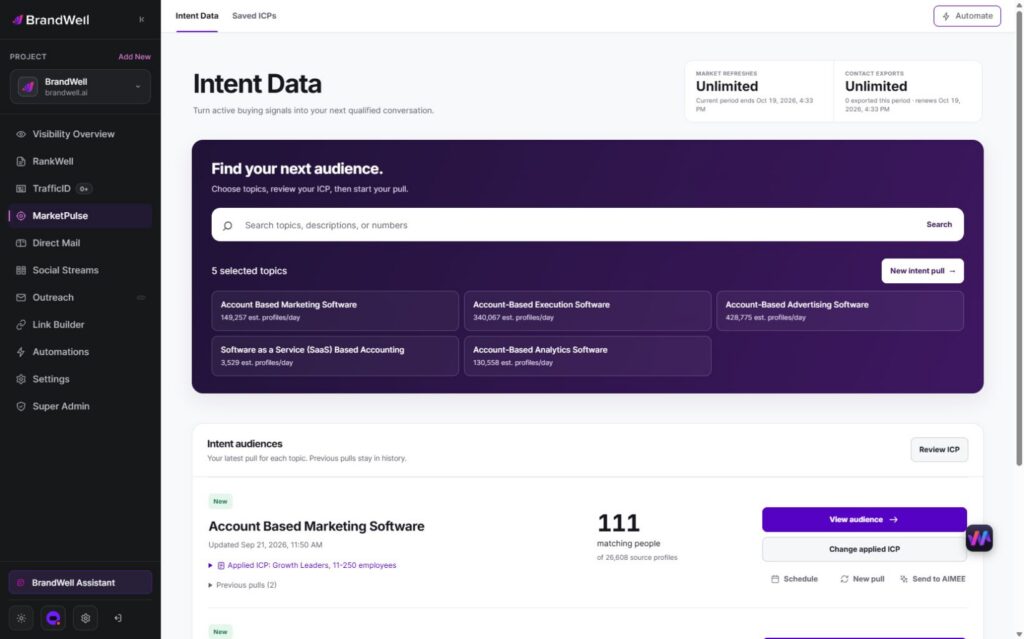
Start with a relevant topic and defined ICP in MarketPulse. Inspect available matches, then document the actual source, permissions and destination rules before proposing a paid-media workflow. Confirm any additional implementation and service deliverables separately.
Frequently asked questions
How should B2B advertisers approach topic-intent audience targeting?
Layer fresh, relevant topic evidence onto a fit-qualified account universe, apply identity and policy gates, map each topic to a treatment, and compare with a control.
What workflow and team are required?
Define outcomes, topics, freshness, fit, identity, cohorts, creative, spend guardrails, outcome return, and rule review. Assign strategy, data, media, approval, and service owners.
Which tools and resources are useful?
Prioritize transparent topic methodology, account matching, eligible destinations, reliable refresh, outcome reconciliation, agency controls, and total cost. A topic dictionary and experiment plan are essential resources.
How does topic intent compare with native and lookalike audiences?
Topic intent adds external timing and context; native audiences are easy and scalable; named accounts maximize fit; lookalikes expand from a seed. Test layers and combinations rather than assuming one always wins.
What budget and pricing should buyers expect?
Total cost includes data, identity, platform, usage, media, setup, creative, labor, measurement, and risk. Scope a viable test rather than relying on an unverified market average.
How should ROI be measured?
Track audience quality, delivery, qualified engagement, pipeline, gross profit, and agency margin. Use randomized holdouts or the strongest feasible quasi-experimental design and state attribution limits.
Which companies are the best fit?
High-consideration B2B companies with clear accounts, observable topics, valuable deals, adequate audience size, and an activation owner are the strongest fit.
How should fit, identity, and freshness be combined?
Make each a required gate. Preserve the evidence chain from source and timestamp through account match, eligibility, activation, and outcome.
What are the biggest mistakes and privacy risks?
Broad topics, stale signals, identity overclaims, sensitive inference, invalid uploads, revealing creative, excessive frequency, poor suppression, and causal overstatement are common failures.
How should an agency include this in a recurring service?
Sell monitored topics, branded reporting, audience refresh, approved channels, creative mapping, measurement, and review as fixed modules with usage limits, SLAs, and change control.
Worked example: compare the assigned groups
In a fictional experiment, 400 eligible accounts are randomly assigned equally to two groups. Over a fixed follow-up, 12 of 200 treatment accounts and 8 of 200 comparison accounts create the defined qualified opportunity. The observed rates are 6% and 4%, a difference of 2 percentage points.
These small counts do not by themselves establish reliable lift. Report uncertainty, original assignment, contamination, missing outcomes and the exact qualification rule. Comparing only people who clicked would introduce another selection step. Account rates are not person-level rates.
If the treatment incurs $1,200 of media and $800 of data preparation and review, its defined cost is $2,000. Dividing by 12 recorded opportunities gives $166.67 per recorded opportunity. It is not acquisition cost per customer or cost per incremental opportunity, and it excludes any costs outside the definition.
Start with the current MarketPulse workspace
- Select a relevant topic and apply the ICP.
- Inspect available people and company information.
- Check the actual source and proposed destination requirements.
- Prepare a topic-to-message brief and review it before activation.
- Verify any additional integration rather than assuming the subscription includes a native ad connector.
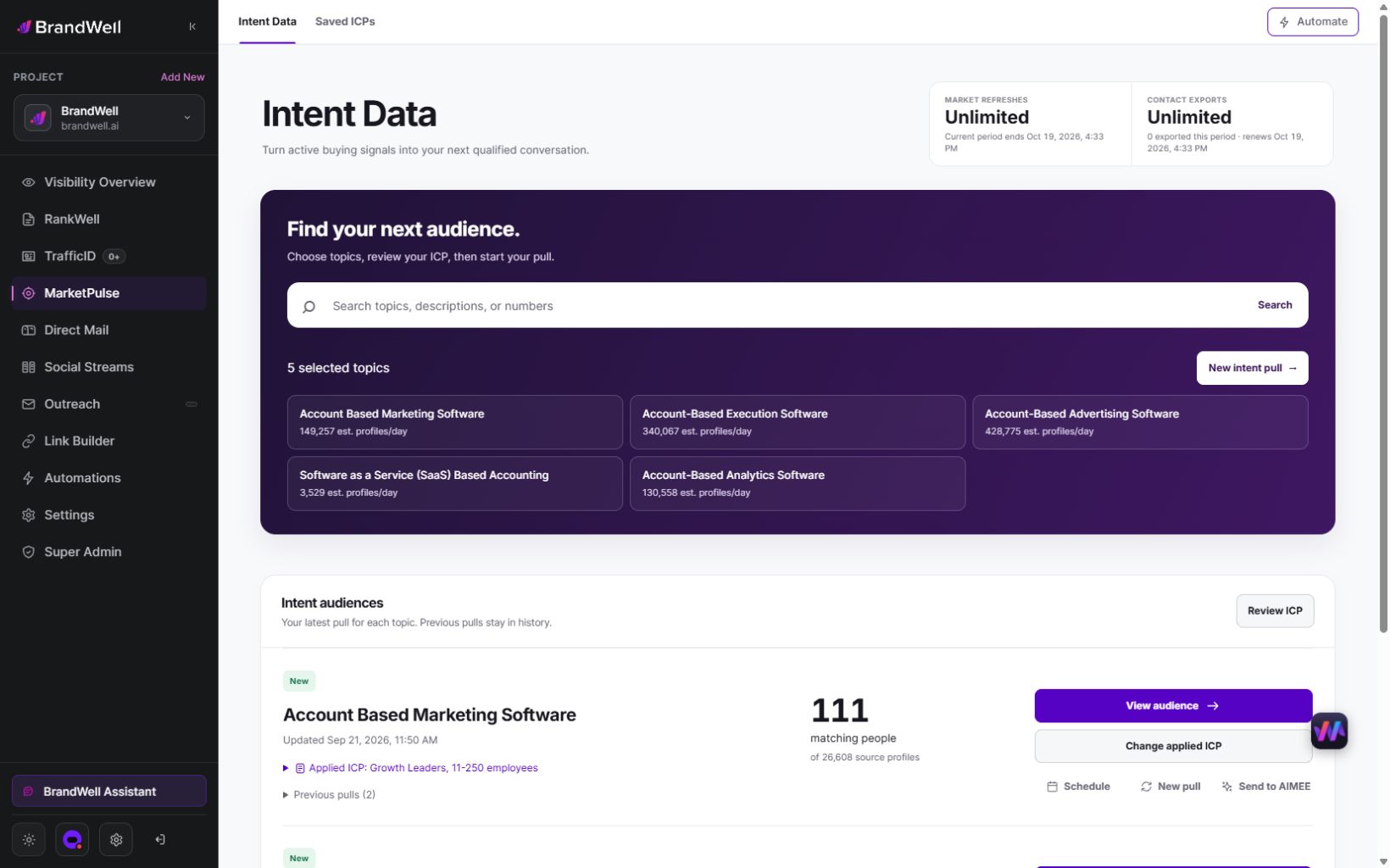
Standard MarketPulse plans are starting at $500/mo for one weekly refreshed topic and 25,000 monthly exports. Growth includes three daily topics and 100,000 monthly exports. Scale includes ten daily topics and unlimited exports. Audience size and contact fields vary, and topic audiences can overlap. Connected products, media and additional implementation may cost extra.
Watch the demo and compare the current plans. An eligible early-access offer is separate from standard pricing.
Reviewed and updated October 3, 2026.

Written by