On this page
- Current MarketPulse research workflow
- Train decisions and product boundaries
- Compare five training systems
- Define role scorecards and supervised practice
- Compare shared and role-specific learning
- Budget full training costs
- Measure readiness and observed performance
- Check the actual training need
- Teach the evidence-to-outcome chain
- Review access and workforce requirements
- Scope current BrandWell capabilities
- Use staged internal role approval
- Frequently asked training questions
- Copyable agency enablement review
Train agency staff on current product boundaries, evidence interpretation and role-specific decisions. Use representative scenarios, isolated practice, observed work, explicit internal approval limits and remediation. A completed course or high quiz score does not establish production readiness, independent accreditation or business impact.
Who is this for? Agency owners, enablement leaders, sales and delivery managers, RevOps and GTM consultants, and team leads building a recurring intent-data service. This training agency teams to sell and deliver intent data guide covers strategy, implementation, frameworks, templates, tools, planning, pricing, cost, ROI, KPIs, examples, benchmarks, checklists, comparisons, alternatives, activation workflows, signal quality, and workforce risks.
Current MarketPulse offer: intent-data plans start at $500/mo. See the product, demo, and current plans. Updated October 3, 2026.
Current MarketPulse research workflow
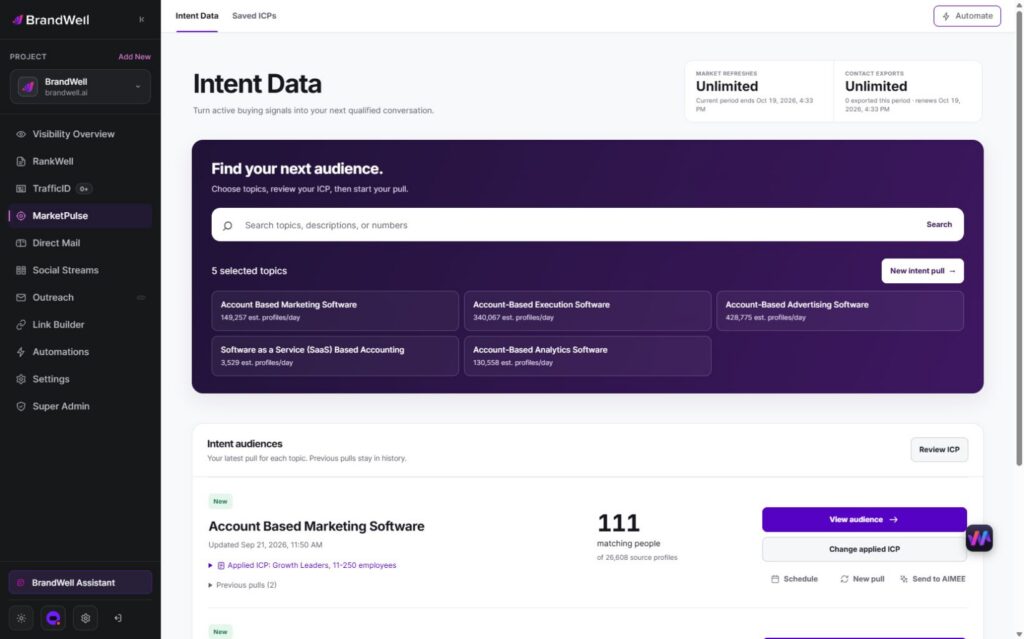
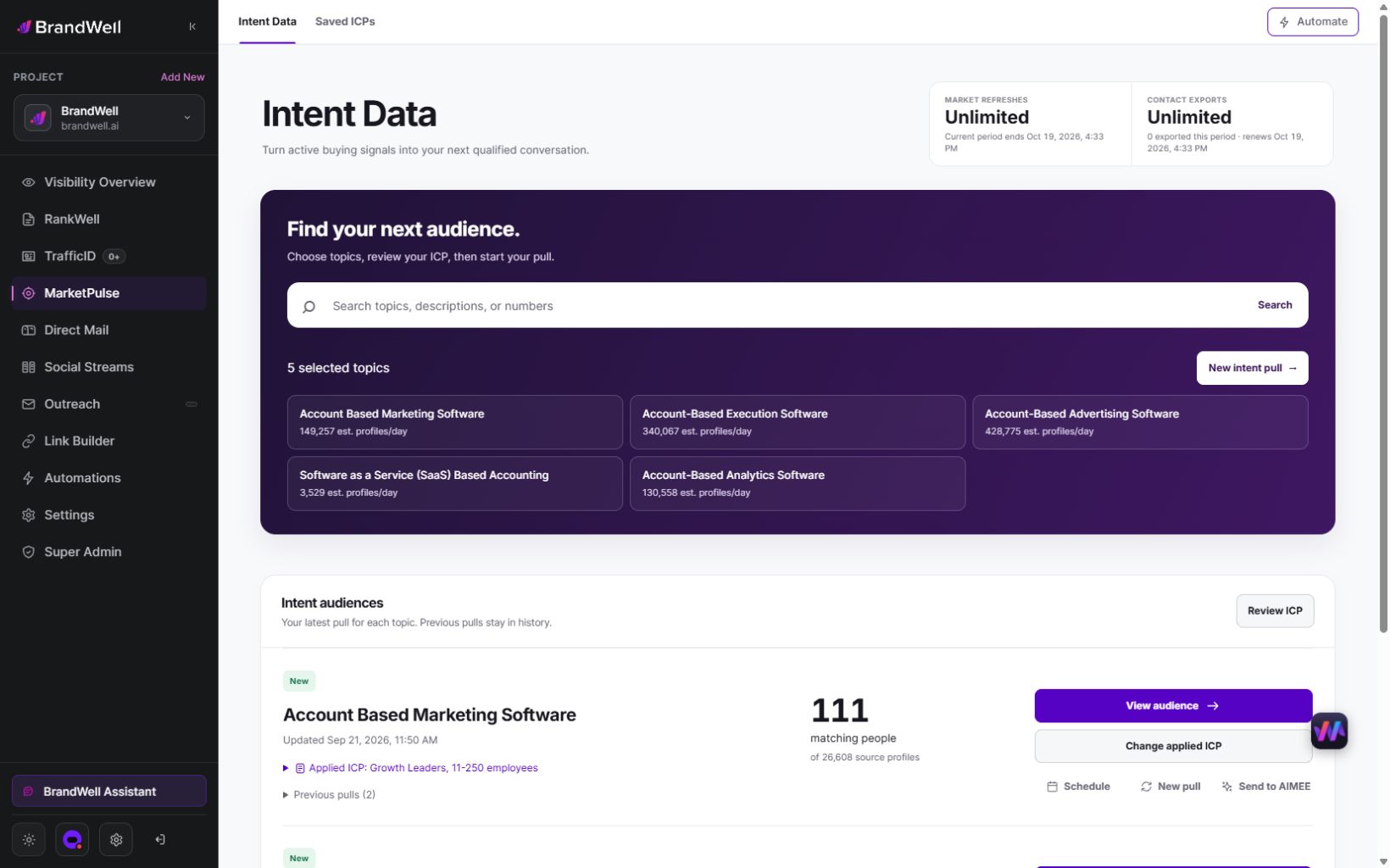
BrandWell MarketPulse: intent data starting at $500/mo. Find people researching topics relevant to what you sell, apply saved ICP filters, and review available contact details before taking action.
| Plan | Topics and refreshes | Monthly exports |
|---|---|---|
| Starter | 1 topic, weekly | 25,000 contacts |
| Growth | 3 topics, daily | 100,000 contacts |
| Scale | 10 topics, daily | Unlimited contacts |
Swipe the table to see all columns.
A pull retrieves available data from the previous 24 hours for one topic. Daily use across all included topics provides 90 Growth pulls or 300 Scale pulls in a 30-day month. Weekly Starter pulls vary by calendar month. Available audience size and contact fields vary, and audiences may overlap. Refreshes stop at the plan limit without overage charges.
- Find and qualify: search the topic catalog, save your ICP, and review the people and companies that match.
- Act on the research: export qualified contacts or prepare an Outreach or Direct Mail workflow. Connected products, channel usage, and fulfillment may cost extra.
- Get help from AIMEE: Growth and Scale include AIMEE for the initial user to research accounts and prepare the next step through connected tools.
Agencies and other service businesses can build client deliverables around their available Intent Scans and exports. Keep each client’s scope, permissions, and service fees clear. A subscription is not a promise of a white-label platform or exclusive access to a market.
Explore MarketPulse and watch the demo or compare plans starting at $500/mo. Any early-access discount is a separate, time-limited offer shown to an eligible recipient.
Train decisions and product boundaries
The competency goal is a client decision that is both useful and defensible. A salesperson must qualify the buyer and avoid certainty claims. A strategist must define topics and fit. Operations must preserve source and confidence. QA must hold ambiguous or ineligible records. Paid media and SDR teams must confirm channel authority. Client success must explain outcomes without claiming causation.
Create a signal-versus-certainty rubric. Topic research may suggest that an account fits a monitored theme; it does not prove a named individual performed the research. A visitor match can prioritize investigation; it does not establish identity with certainty. A validated contact supports deliverability work; it does not create permission or intent. Pipeline association is not automatically incremental revenue.
Training should make the right behavior easier under pressure. Staff need language for disqualifying a buyer, narrowing scope, explaining confidence, holding activation, escalating a data question, correcting a report, and resisting a forecast built on unsupported volume. Managers must reward those behaviors or the curriculum will lose to the sales target.
Compare five training systems
These five training systems cover knowledge, practice, tools, supervised performance, and continuing improvement. They use the same criteria so an agency can compare resources, risks, costs, measurements, and limitations instead of buying a generic course and assuming the team is ready.
1. Truth and claims certification
Best fit and exclusions: Best for every employee, contractor, partner, and leader who sells, presents, reports, or supports the service. Exclude feature-only training that never tests whether a person can explain uncertainty, limitations, fit, and disqualifying conditions.
Inputs, workflow, and ownership: Create a truth rubric for topic evidence, account fit, visitor or company matching, person identity, contact validation, in-market language, causation, and ROI. Staff practice correcting overclaims in calls, proposals, reports, ads, and outreach; an accountable reviewer certifies them.
Data, privacy, and governance risk: Overstatement can lead to deceptive promises, intrusive messaging, mishandled data, and loss of client trust. Training examples should use synthetic or authorized data, avoid sensitive inference, and require escalation when law, policy, rights, or evidence is unclear.
Cost and commercial effect: Cost includes curriculum design, source verification, facilitator time, practice, scoring, remediation, and recertification. Test whether it changes rework when managers enforce the truth standard in forecasts, proposals, and delivery – not merely in a course.
Measurement and meaningful limitation: Measure scenario accuracy, overclaim and correction rate, escalation judgment, proposal defects, client questions, complaints, and recertification. Passing a quiz is a minimum; it does not prove someone can handle an ambiguous client conversation.
2. Role-based signal-to-action labs
Best fit and exclusions: Best after the whole team shares a truth standard. Sales, strategy, data operations, QA, paid media, SDR, RevOps, and client success need different practice because they make different decisions and hold different access.
Inputs, workflow, and ownership: Build one realistic scenario with role-specific inputs and outputs. Sales qualifies and scopes; strategy defines topics and fit; operations checks provenance and freshness; QA holds uncertain records; channel owners preflight activation; client success reports adoption and limitations.
Data, privacy, and governance risk: Role training should not become permission for broad access. Use least privilege, separation of duties, synthetic records, controlled sandboxes, and clear handoffs. Each role must know when it may act, when it must seek approval, and what it must never infer.
Cost and commercial effect: Labs require scenario design, facilitators, sandbox tools, reviewer time, and coverage for staff away from billable work. Reuse the core case while changing evidence and failure modes so practice remains efficient without becoming memorization.
Measurement and meaningful limitation: Measure task accuracy, handoff completeness, approval behavior, time, rework, and evidence retained. A role can perform its own step well while still failing the service if upstream assumptions or downstream ownership are unclear.
3. Tools, templates, and workflow sandbox
Best fit and exclusions: Best when staff must operate portals, reports, CRM fields, audience preflights, research prompts, QA queues, or client handoffs. Exclude live-client practice that could trigger spend, contact, data exposure, or configuration changes.
Inputs, workflow, and ownership: Provide a data dictionary, discovery brief, scope register, evidence card, approval matrix, release checklist, outcome taxonomy, cost worksheet, report template, and test workspace. Owners demonstrate normal, ambiguous, rejected, corrected, and rollback cases.
Data, privacy, and governance risk: Templates can spread an error quickly. Version them, restrict credentials, use non-production data, remove live destinations, inspect generated output, and require human approval at consequential boundaries. Tool proficiency does not establish a lawful or permitted use.
Cost and commercial effect: Costs include sandbox setup, licenses, maintenance, test data, workflow updates, and coaching. Standard resources reduce repeated explanation, but custom client exceptions and platform changes still need deliberate training and change control.
Measurement and meaningful limitation: Measure completion, test-case pass, time to find evidence, configuration errors, unsafe automation attempts, release defects, and rollback performance. A clean sandbox run does not guarantee production data quality or integration behavior.
4. Supervised sales and delivery review
Best fit and exclusions: Best before a person independently sells, configures, approves, activates, or presents client work. Use progressive responsibility instead of treating course completion as production readiness. Exclude supervision by a reviewer who cannot challenge the same claims and controls.
Inputs, workflow, and ownership: Require observed discovery, proposal or call review, sample configuration, QA disposition, client deliverable, and debrief. A qualified reviewer scores the role rubric, records evidence, provides remediation, and approves only the responsibilities the person demonstrated.
Data, privacy, and governance risk: Supervision must protect client confidentiality and worker fairness. Limit access to what the trainee needs, disclose review practices, secure recordings or notes, separate coaching from unnecessary monitoring, and consult employment or contractor counsel where applicable.
Cost and commercial effect: Reviewer time and slower early utilization are deliberate costs. Capacity plans should include shadowing, feedback, remediation, and a buffer before assigning full client load. Avoid creating a hidden unpaid mentorship burden for senior delivery staff.
Measurement and meaningful limitation: Measure observed competency, corrections before release, time to independence, early defect rate, client feedback, and escalation. A single successful call or deliverable is weak evidence; use varied scenarios and a sustained observation window.
5. Recertification and closed-loop enablement
Best fit and exclusions: Best once the service, sources, modules, platforms, policies, or failure patterns change. Recertify material decisions rather than repeating generic training on a calendar. Exclude performative annual courses with no link to observed defects.
Inputs, workflow, and ownership: Feed QA findings, lost-deal reasons, client questions, incidents, source changes, new modules, and platform-policy updates into a versioned curriculum. The service owner prioritizes; specialists review claims; managers coach; staff acknowledge and demonstrate changed behavior.
Data, privacy, and governance risk: Training records and performance data can themselves be sensitive. Limit access, define retention, separate learning evidence from unrelated evaluation, and avoid automated scoring as the only basis for consequential personnel decisions.
Cost and commercial effect: Costs include change monitoring, curriculum updates, reviewer time, temporary capacity loss, and remediation. Test whether training changes actual defects, onboarding, support costs and client outcomes – not course completion counts.
Measurement and meaningful limitation: Measure recurrence of targeted failures, time to adopt a change, QA escape, support, utilization, client retention evidence, and margin. Recertification cannot compensate for an unstable product, impossible scope, or managers who reward overclaiming.
Define role scorecards and supervised practice
Start with a role scorecard that lists decisions, required knowledge, observable behaviors, tools, access, approval limits, handoffs, quality measures, and disqualifying errors. Separate hiring criteria from trainable skills. For example, judgment, communication, analytical thinking, and respect for controls may matter more at hiring than familiarity with one portal.
- Define the shared truth rubric and the service’s approved claims, limitations, and escalation paths.
- Create role scorecards for sales, strategy, operations, QA, activation, RevOps, client success, and leadership.
- Teach concepts, then run realistic positive, negative, ambiguous, and high-risk scenarios in a sandbox.
- Observe calls and deliverables, score evidence, remediate gaps, and grant only demonstrated production responsibilities.
- Use QA, client feedback, source and policy changes, and commercial results to update and recertify material competencies.
Onboarding needs explicit handoffs. Sales cannot promise a data use delivery has not approved. Operations cannot activate a destination because sales mentioned it. QA needs authority to hold work. The account lead needs the limitations and exception history before presenting results. Training evidence should travel with access and role assignment.
Compare shared and role-specific learning
One shared playbook is efficient for product boundaries, language, claim integrity, security basics, and the end-to-end service. It is weak for role judgment. Pair a common foundation with separate scenarios and approval limits for each role. Compare actual role performance instead of assuming one learning format is universally better.
Employees may justify deeper cross-functional training and long-term access. Contractors can add specialist capacity but need scoped training, access, supervision, classification review, and clear client boundaries. Partners require an agreed responsibility and evidence model. Automation can support prompts, checklists, routing, and QA, but it should not certify itself or make consequential decisions without review.
External courses and sales trainers may help with communication or channel expertise. Internal service owners still need to supply current product truth, data rights, source limitations, client examples, commercial boundaries, and approval paths. A vendor certificate does not replace the agency’s own responsibility.
Budget full training costs
Fully loaded training cost includes curriculum design, subject-matter review, tools, sandbox, facilitator and learner time, manager coaching, supervised production, QA review, remediation, recertification, and the opportunity cost of delayed utilization. Add recruiting, background or role checks, access administration, and contractor or partner onboarding where relevant.
Estimate payback from avoidable rework, shorter time to safe independence, better utilization, fewer proposal and delivery defects, lower support and incident cost, and improved retention evidence. Do not assign a fictional revenue number to training without a baseline and a reasonable attribution method.
Capacity planning should show how many learners one reviewer can support, how much client work remains protected during onboarding, and which responsibilities can be granted in stages. Budget senior review and compare actual correction costs; no universal savings follow from the training design.
Measure readiness and observed performance
Readiness metrics include truth-rubric score, scenario performance, correct escalation, tool and workflow accuracy, evidence retained, and approval behavior. Delivery metrics include defect escape, rework, time to release, identity or activation holds, client corrections, and incident findings. Sales metrics include qualification, scope accuracy, overclaim findings, and handoff completeness.
Workforce measures include time to independent responsibility, utilization after readiness, reviewer capacity, remediation, attrition, and cross-role coverage. Client measures include clarity, adoption, support questions, trust signals, qualified outcomes, and renewal evidence. Pair speed with quality so faster onboarding does not mean weaker gates.
Use benchmarks from the agency’s own cohorts and versioned curriculum. Compare new hires, experienced transfers, contractors, and recertification by role and service version, while respecting employment and privacy obligations. Completion rate is a process metric; it does not prove competent client behavior.
Check the actual training need
Assess whether the actual gap concerns knowledge, practice, access, workflow, product reliability, staffing or incentives. Training alone cannot fix every gap. Multiple roles, new sources, destinations, wider access, recurring defects or unclear ownership can justify a formal needs review; they do not establish a universal headcount threshold.
An early agency can start with a small truth rubric, one role scorecard, one end-to-end scenario, and supervised work. A larger team needs version control, learning records, sandbox isolation, role-based access, reviewer capacity, change alerts, and recertification. The workload and risk decide the system, not an arbitrary headcount.
Teach the evidence-to-outcome chain
Teach staff to preserve the complete evidence card: source, topic or event, account fit, freshness, identity state, contact validation, permitted use, suppressions, destination eligibility, approval, action, outcome, cost, and limitation. Staff should be able to explain why a record moved, stopped, or changed.
Use cases should include a strong account signal with no usable contact, a valid contact with no permitted outreach, an eligible first-party audience with weak topic relevance, a high-confidence match outside the ICP, a stale surge, a destination rejection, a client request for over-specific messaging, and a positive outcome that cannot be attributed solely to intent.
Agent-ready instructions can help staff prepare analysis, check evidence, and draft workflow steps, but generated output must be inspected against source records, rights, policy, and client context. A model’s fluent answer is not evidence that a signal is accurate or an action is allowed.
Review access and workforce requirements
Verify actual necessary fields, permissions, role boundaries, approved training examples, access, retention, security and supervision. Keep practice isolated from live destinations. Resolve applicable workforce, privacy, contract and marketing requirements with qualified review rather than treating a training badge as permission.
Verify actual necessary fields, permissions, role boundaries, approved training examples, access, retention, security and supervision. Keep practice isolated from live destinations. Resolve applicable workforce, privacy, contract and marketing requirements with qualified review rather than treating a training badge as permission.
Verify actual necessary fields, permissions, role boundaries, approved training examples, access, retention, security and supervision. Keep practice isolated from live destinations. Resolve applicable workforce, privacy, contract and marketing requirements with qualified review rather than treating a training badge as permission.
Scope current BrandWell capabilities
AIMEE can prepare a review brief through configured connected tools. Keep proposed actions separate from actual approvals and destination acknowledgements. Confirm the implementation and permissions before execution.
Use current MarketPulse research and TrafficID own-site visitor context as separate inputs. AIMEE can organize supplied training briefs through configured tools. The agency owns scenarios, reviewer qualifications, access, internal role approval and client communications. Custom reports, client portals and managed service delivery need separately verified implementation, rights and scope.
BrandWell MarketPulse is topic-based intent-data software for businesses and agencies. Choose relevant research topics, apply saved ideal-customer-profile filters, review available names, roles, companies and contact details, and export the audience or prepare a connected workflow. Plans start at $500/mo. TrafficID identifies visitors to your own website and is a separate product. A MarketPulse subscription does not by itself promise a white-label portal, custom API implementation, exclusive topics, or managed client delivery.
Review an available MarketPulse topic, saved ICP and actual preceding-24-hour matches for the approved research purpose. Keep uncertain company context visible. AIMEE can organize supplied context through configured tools; named owners approve actual exports, messages, audience uploads and CRM writes.
Use staged internal role approval
Run enablement in stages: common truth foundation, role knowledge, sandbox practice, observed work, limited production authority, full responsibility, and continuing recertification. Every stage should have evidence, an approver, a remediation path, and a clear statement of what the learner may not yet do.
- Foundation: product boundary, signals versus certainty, client fit, data rights, and claims.
- Role lab: decisions, inputs, tools, handoffs, quality, and escalation.
- Supervision: observed calls or deliverables using approved examples and access.
- Certification: evidence-based approval for specific responsibilities, not a universal badge.
- Recertification: targeted review after material service, source, module, policy, or defect changes.
Frequently asked training questions
Should sales and delivery use the same training?
They need the same truth standard and service map, then different practice. Sales qualifies, scopes, and communicates; delivery configures, checks, and releases. Both need to understand the other’s boundaries so a promise and a workflow remain aligned.
Can contractors be certified?
Yes, for defined responsibilities, but certification does not settle worker classification, confidentiality, access, supervision, or client consent. Use appropriate contracts and counsel, grant least privilege, observe work, and recertify when the role or service changes.
What should be an automatic failure?
Presenting a probabilistic signal as certain identity or purchase intent, bypassing suppression, using unapproved live data, exposing another client, activating without authority, inventing evidence, hiding a material limitation, or refusing a required escalation should block independent responsibility until corrected.
How often should the team recertify?
Use material change and observed risk as primary triggers: a new data source, module, destination, geography, policy, claim, role, or recurring defect. A periodic review can catch drift, but a calendar alone should not decide the curriculum.
What is the best training tool?
A system to test combines an approved truth rubric, role scorecard, representative scenarios, safe sandbox, templates, reviewer evidence, QA feedback, and access decisions. A learning platform can organize that work, but it cannot supply current product truth or managerial enforcement.
How does the agency prove readiness to a client?
Share the operating controls relevant to the engagement: named roles, training and access requirements, review gates, escalation, QA, and change process. Avoid exposing private personnel records or claiming an external accreditation the agency does not have.
Copyable agency enablement review
Question: [Actual role decision and observed gap.] Scope: [Role, product version, learners and period.] Evidence: [Source records, uncertainty and approved examples.] Practice: [Representative cases and isolated destinations.] Ownership: [Reviewer, access boundary and remediation.] Outcome: [Observed work, defects and missing follow-up.] Decision rule: [Internal approval, full costs and change triggers.]
Check whether training addresses the gap
CDC’s Quality Training Standards start with a needs assessment and connect learner assessment to learning objectives. These public-health training standards are a design reference, not an agency accreditation or a sales-performance benchmark.
If an operator knows the suppression rule but the connector ignores it, repeating a quiz will not repair the connector. If the rule is unclear, revise the actual process and role brief. If a person cannot apply a clear rule to an ambiguous case, use guided practice and observed remediation. Keep the actual defect and owner visible.
An average score cannot hide a critical failure
In a fictional exercise, a learner gets nine of 10 decisions right but exports another client’s records on the tenth. A 90% aggregate score does not establish independent access readiness. Define critical hold conditions before scoring. Internal approval applies only to demonstrated responsibilities; it is not an external certification or a basis for automated personnel decisions.
Check reviewer capacity and outcome coverage
A fictional cohort has 12 learners, each needing 45 minutes of observation and 15 of feedback: 12 reviewer hours. Six remediation cases needing another 30 minutes add three hours. A reviewer with 10 hours available has a five-hour gap, even if the learning platform shows all courses completed.
If 10 learners complete the course and eight receive observed-work review, report completion as 83.3% of 12 and review coverage as 66.7% of 12, or 80% of completers. Six approved learners mean 75% of reviewed learners or 50% of the cohort. Four unreviewed learners are unresolved, not demonstrated failures or successes.
Separate gross time savings from payback
A fictional pilot costs $500 product research, $800 curriculum, $600 learner time, $500 reviewer time and $300 administration: $2,700. Claimed monthly rework savings of 20 hours at $50/hour are $1,000 gross. If ongoing coaching costs $400/month, modeled net benefit is $600 and simple payback is 4.5 months, only if savings persist and costs are complete. With zero or negative net benefit, no positive payback is established. Additional remediation of $300 raises initial cost to $3,000 and modeled payback to five months. These invented values exclude tax, general overhead and financing and are not BrandWell benchmarks.
Verify current product boundaries in practice
MarketPulse research is starting at $500/mo. Practice reviewing a topic, saved ICP and available matches with approved examples. Keep TrafficID visitor context separate. AIMEE can organize supplied context through configured tools; owners approve actual exports, messages, audience uploads and CRM writes. Custom delivery, reporting and client interfaces require separately verified rights and implementation.
Review current research: explore MarketPulse and current plans.
Reviewed and updated October 3, 2026.

Written by