On this page
- Define the current MarketPulse product
- Keep six research-to-action checks separate
- Use a scope and evidence checklist
- Prepare a bounded product review
- Review the current topic-research workflow
- Measure data usefulness and mature outcomes
- Review source and destination requirements
- Scope an agency operating service separately
- Frequently asked MarketPulse questions
- Try a focused MarketPulse research review
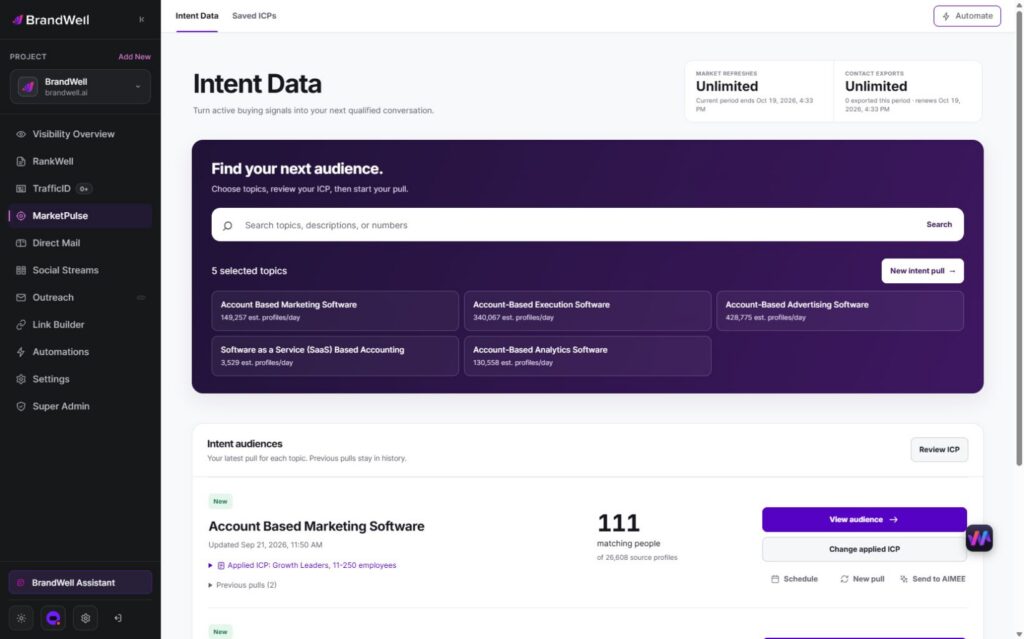
Direct answer: MarketPulse is BrandWell’s topic-based intent-research product. Choose a relevant topic, apply a saved ICP and review available matching people, companies and contact fields. Research is a starting point for review, not proof of a buying project or permission to contact. MarketPulse research is starting at $500/mo; verify current product scope and offers.
Who this is for: Growth, sales, marketing, RevOps and service businesses reviewing topic research. Keep MarketPulse’s off-site topic context separate from TrafficID’s own-site visitor context and additional stakeholders. Custom client interfaces, reporting and agency delivery require separately verified implementation and rights.
Current MarketPulse offer: intent-data plans start at $500/mo. See the product, demo, and current plans. Updated October 3, 2026.
Define the current MarketPulse product
Start from the buyer problem and relevant research topic. MarketPulse supplies a research audience; your team reviews actual fit, available fields and the appropriate next action. A subscription does not establish a branded multi-client service or a buyer-confirmed opportunity.
AIMEE can prepare a review brief through configured connected tools. Keep proposed actions separate from actual approvals and destination acknowledgements. Confirm the implementation and permissions before execution.
That boundary matters because intent is probabilistic. A research event can mean genuine buying activity, casual education, competitor research, employment interest, or noise. Identity resolution can produce a plausible match without establishing who initiated a specific research event. Enrichment can add useful attributes without making the source record correct. Activation can create an action without making that action appropriate.
Use BrandWell to improve prioritization and timing. Do not present it as mind reading, individual consent, a deterministic attribution system, or a replacement for a sound offer and sales process.
Keep six research-to-action checks separate
A responsible BrandWell workflow has six gates:
- Signal intake. Preserve the actual MarketPulse topic context; keep separately sourced TrafficID own-site observations distinct. Record actual source and observation window rather than relabeling every input as the same event.
- Eligibility. Check geography, account type, suppression rules, client instructions, and whether the contemplated use is permitted.
- Identity and enrichment. Resolve a company or person where coverage allows, then attach the attributes needed for qualification. Preserve confidence and provenance rather than flattening every match into “known buyer.”
- Qualification. Apply the client’s ICP, exclusions, recency, frequency, role, and account rules. A signal becomes a candidate only after these tests.
- Action review. Decide the actual next permitted action from fit, source, available fields and destination requirements. Owners approve exports, messages, audience uploads and CRM writes; custom destinations need their own implementation evidence.
- Evidence return. Capture acceptance, suppression, engagement, opportunity, revenue, false-positive, and no-action outcomes. Use those outcomes to tune the service – not to rewrite history around wins.
The product boundary is therefore: market or site activity → eligible record → possible identity → qualification → controlled activation → outcome evidence. BrandWell can support the middle operating layer; it cannot supply the client’s strategy, lawful basis, channel permissions, response discipline, or closed-loop data by itself.
Use a scope and evidence checklist
| Layer | Useful capability | Evidence the buyer should request | Important limitation |
|---|---|---|---|
| Topic intent | Find accounts or people associated with research around configured topics | Topic definition, source categories, lookback, timestamps, sample output, coverage test | A topic event is not proof of a purchase project or a named person’s action |
| Separately scoped TrafficID website activity | Detect and enrich eligible visitors where identification is available | Installation instructions, match reporting, excluded traffic, geography and browser constraints | Many visits remain anonymous; identification varies and must not be treated as consent |
| Identity | Connect permitted identifiers to a person or company | Match method, confidence or status, input lineage, null behavior, correction process | Wrong, stale, shared, or ambiguous identifiers can create false matches |
| Enrichment | Add firmographic and contact attributes for qualification | Field dictionary, freshness, validation status, source rights, sample null rates | More fields do not guarantee accuracy or relevance |
| Qualification | Apply ICP, recency, frequency, role, and suppression rules | Rule specification, acceptance criteria, rejected-record reasons, change log | Weak rules simply automate noisy selection |
| Separately verified action implementation | Review supported product handoffs; test any custom reports, CRM writes or ad destinations separately | Destination map, approval step, retry behavior, audit trail, deletion path | Delivery does not equal engagement, and technical sync does not establish lawful use |
| Separately scoped outcome reporting | Show volume, disposition, workflow and outcome evidence | Denominator definitions, timestamps, client feedback, cohort comparison | Dashboards can confuse activity with incremental business value |
Swipe the table to see all columns.
A buyer should ask for this matrix populated with the current contracted scope, not accept a generic product diagram as evidence.
Prepare a bounded product review
Do not evaluate BrandWell from a slide deck alone. Ask for a compact evidence room:
- the current module and field dictionary;
- the source-to-output data-flow diagram;
- a sample branded topic report with synthetic or appropriately redacted records;
- identity, enrichment, and validation definitions;
- usage units, capacity, overage, retention, deletion, and export rules;
- supported activation patterns and approval boundaries;
- privacy, security, data-processing, and subprocessors documentation;
- support ownership and incident escalation;
- A current order covering actual pricing, term, topics, refreshes, exports, included tools and support; separately scope any custom client delivery or special rights.
- a measurement plan that records accepted and rejected signals.
Review the current MarketPulse demo and plans, starting at $500/mo. Evaluate actual topic fit, available fields and operating effort. Verify current guarantee conditions before testing. A bounded review cannot establish future meetings or revenue.
AIMEE can prepare a review brief through configured connected tools. Keep proposed actions separate from actual approvals and destination acknowledgements. Confirm the implementation and permissions before execution.
Review the current topic-research workflow
BrandWell publishes this guide about its current MarketPulse product. Verify the actual feature, entitlement and output separately from custom integrations, client services and outcome claims. This is a product-scope guide rather than an independent provider ranking.
MarketPulse research is starting at $500/mo. Verify current topics, refreshes, exports and included tools on the product page. Custom connectors, branded reporting and managed client delivery need separately verified implementation, rights and fees.
Current MarketPulse research workflow
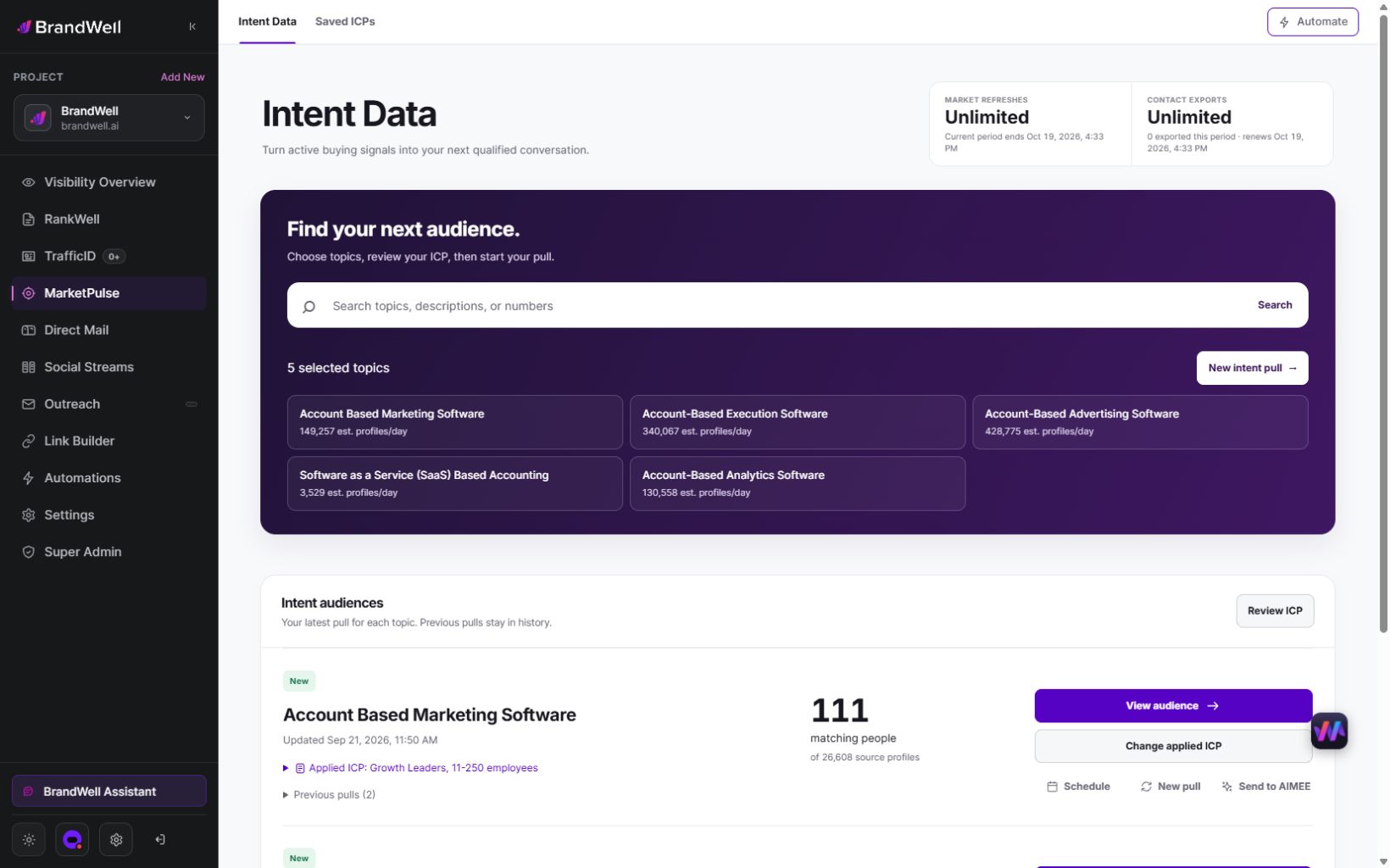
BrandWell MarketPulse: intent data starting at $500/mo. Find people researching topics relevant to what you sell, apply saved ICP filters, and review available contact details before taking action.
| Plan | Topics and refreshes | Monthly exports |
|---|---|---|
| Starter | 1 topic, weekly | 25,000 contacts |
| Growth | 3 topics, daily | 100,000 contacts |
| Scale | 10 topics, daily | Unlimited contacts |
Swipe the table to see all columns.
A pull retrieves available data from the previous 24 hours for one topic. Daily use across all included topics provides 90 Growth pulls or 300 Scale pulls in a 30-day month. Weekly Starter pulls vary by calendar month. Available audience size and contact fields vary, and audiences may overlap. Refreshes stop at the plan limit without overage charges.
- Find and qualify: search the topic catalog, save your ICP, and review the people and companies that match.
- Act on the research: export qualified contacts or prepare an Outreach or Direct Mail workflow. Connected products, channel usage, and fulfillment may cost extra.
- Get help from AIMEE: Growth and Scale include AIMEE for the initial user to research accounts and prepare the next step through connected tools.
Agencies and other service businesses can build client deliverables around their available Intent Scans and exports. Keep each client’s scope, permissions, and service fees clear. A subscription is not a promise of a white-label platform or exclusive access to a market.
Explore MarketPulse and watch the demo or compare plans starting at $500/mo. Any early-access discount is a separate, time-limited offer shown to an eligible recipient.
Measure data usefulness and mature outcomes
Run a prospective test with denominators. For every signal, retain the input source class, timestamp, topic or behavior, company, identity status, enrichment result, qualification decision, activation, and final disposition. Then calculate:
- Coverage: eligible accounts or visitors with any usable signal divided by the defined eligible universe.
- Match rate: records with the required identity level divided by eligible input records.
- Qualification acceptance: candidates accepted by the agreed rules divided by reviewed candidates.
- Freshness: time from observed signal to client-visible delivery and to first approved action.
- False-positive or rejection rate: records rejected for wrong company, person, topic, geography, timing, duplication, or other recorded reason.
- Activation rate: qualified records actually routed or acted upon divided by qualified records.
- Outcome rate: opportunities or another agreed downstream outcome divided by the activated cohort, reported with a comparison cohort and attribution caveat.
Do not cherry-pick only records that became opportunities. Preserve nulls and rejections. Compare against the client’s status quo using the same time window and eligibility rules. A small pilot can establish workflow feasibility; stronger business-value claims need sufficient time, sample size, and a defensible counterfactual.
Review source and destination requirements
Record actual purposes, sources, roles, jurisdictions, recipients, access, retention, correction, deletion, suppression and support ownership before action. A generic security framework does not establish implemented controls or permission. Resolve missing requirements for the actual destination and use.
Ask four plain questions: What was observed? What was inferred? What identity level is actually supported? What use is permitted? Never describe an inferred buyer as having submitted a form, consented to outreach, or requested contact when that did not occur. Do not expose private source provenance or sensitive capture details in a public client report.
Scope an agency operating service separately
A defensible monthly offer has five recurring deliverables: topic and market maintenance, signal qualification, branded reporting, approved activation support, and an evidence review. The agency can add website-visitor identification, enrichment, audience preparation, CRM routing, or research tasks only when the client needs them and the data rights support them.
An agency can bill its separately scoped service under its own agreement. Define actual deliverables, cadence, review effort, usage, approvals and fees. A MarketPulse subscription does not imply native client workspaces or exclusive topic, buyer or market rights.
Review the current MarketPulse demo and plans, starting at $500/mo. Evaluate actual topic fit, available fields and operating effort. Verify current guarantee conditions before testing. A bounded review cannot establish future meetings or revenue.
Frequently asked MarketPulse questions
What is BrandWell intent data, and what does it not do?
MarketPulse is BrandWell’s topic-research product for finding and filtering available matches. It does not establish purchase certainty, consent, verified identity or incremental revenue. A custom branded agency service is a separately scoped implementation.
How does BrandWell intent data work end to end?
Signals enter an eligibility check, move through identity and enrichment where possible, meet qualification rules, route to an approved destination, and return outcome evidence. Each transition needs provenance, ownership, and a rejection path.
What should a buyer request before a demo or pilot?
Request current module and field dictionaries, sample reports, data flow, match definitions, usage units, security and privacy materials, support roles, contract terms, and a disposition-based pilot plan.
Which alternatives should be compared?
Compare a current topic-research subscription with an existing internal account list, first-party observations or a separately implemented service against the actual decision. Check source, unit, rights, workload and feedback before comparing feature breadth.
What pricing questions matter?
Confirm current topics, refreshes, exports, included tools, term, implementation, support, data rights and renewal in the actual order. Separately scope custom client services and special rights; do not infer exclusivity.
What evidence verifies quality and value?
Use coverage, match, acceptance, rejection, freshness, activation, and downstream outcome measures with fixed denominators. Include a baseline or comparison cohort and preserve negative results.
Who is most likely to benefit?
Agencies with a defined B2B niche, recurring client relationship, someone accountable for operations, and clients able to act on timely signals. A company seeking only a one-time list or unable to provide feedback is a weak fit.
What roles do intent, identity, enrichment, activation, and evidence play?
Intent supplies timing, identity identifies a possible entity, enrichment adds decision attributes, activation creates a controlled action, and evidence shows what happened. No single layer substitutes for the others.
What risks require verification?
Verify ambiguity, stale records, incorrect matches, unmatchable traffic, topic noise, source rights, privacy roles, suppression, security, integration failure, client expectations, and the temptation to equate activity with causality.
How should an agency sell the recurring service?
Sell a transparent operating service with defined inputs, cadence, qualification, approvals, reports, usage, and evidence. The agency sets retail pricing and bills the client; BrandWell supplies the selected growth software and data package, not a guaranteed outcome.
Try a focused MarketPulse research review
- Choose the market: Search the live topic catalog for the buyer problem or what you sell. Review the topic meaning rather than choosing only by a large count.
- Apply the ICP: Save relevant role, company-size, industry and fit criteria. Keep exclusions and intended use documented.
- Inspect the audience: Review actual available matches and fields. Preserve uncertain identity and missing contact details rather than calling every match a sales-ready buyer.
- Choose the next step: Review a supported export or configured handoff. Confirm rights, destination requirements, suppression and ownership before actual contact or upload.
- Keep feedback: Record accepted, rejected, corrected and unresolved cases. Compare actual operating effort and mature outcomes before expanding the scope.
Keep data quality information visible
W3C’s Data on the Web Best Practices recommends providing data-quality information. A field-rich record is not proof that every association is correct.
Large topic counts are not qualified leads
A fictional audience has 200 appearances that resolve to 120 unique people at 80 companies. Forty companies meet the approved fit policy and 30 receive an accepted review action. Keep each unit and exclusion visible. Do not call 200 appearances 200 qualified opportunities.
Keep website and off-site context distinct
A fictional contact appears in an off-site topic audience but has no recorded visit to your own site. Do not describe them as a TrafficID website visitor. Additional stakeholder contacts also need their own source label; they are not observed visitors simply because they share an employer.
Measure missing feedback explicitly
A fictional 30-action cohort has 24 mature reports and four qualified opportunities. Feedback coverage is 80%, with six unresolved outcomes. Opportunities are 16.7% of reported cases or 13.3% of all actions. Neither rate establishes causality or the likelihood that every new match will buy.
Review current research: explore MarketPulse and current plans. BrandWell research pricing is starting at $500/mo; verify current product scope and offers.
Reviewed and updated October 3, 2026.

Written by