On this page
- Start with a real reader task
- Build and investigate a candidate list
- Understand what the metrics measure
- Interpret intent without assuming certainty
- Do not define long-tail only by word count
- Original example: an IT services content decision
- Choose create, improve, merge or defer
- Develop the approved content in RankWell
- Measure the published answer
Keyword research is the process of investigating the words and questions people use in search, then deciding which relevant tasks your content should serve. It includes interpreting intent, reviewing existing pages and evaluating available evidence. A keyword list alone is not a content strategy or ranking guarantee.
Start with a real reader task
Collect questions from sales conversations, support requests and existing content. Identify the product or service the business actually provides and what a reader needs to understand before taking a next step.
A phrase with a large search estimate can still be irrelevant. A smaller audience may be useful when its question fits your expertise and offer. Do not dismiss a task solely because a tool has limited data for it.
Build and investigate a candidate list
Begin with a focused subject, related terminology and concrete questions. In BrandWell Visibility, use the keyword-research workspace to examine relevant opportunities. Keep the research context and date with the findings.
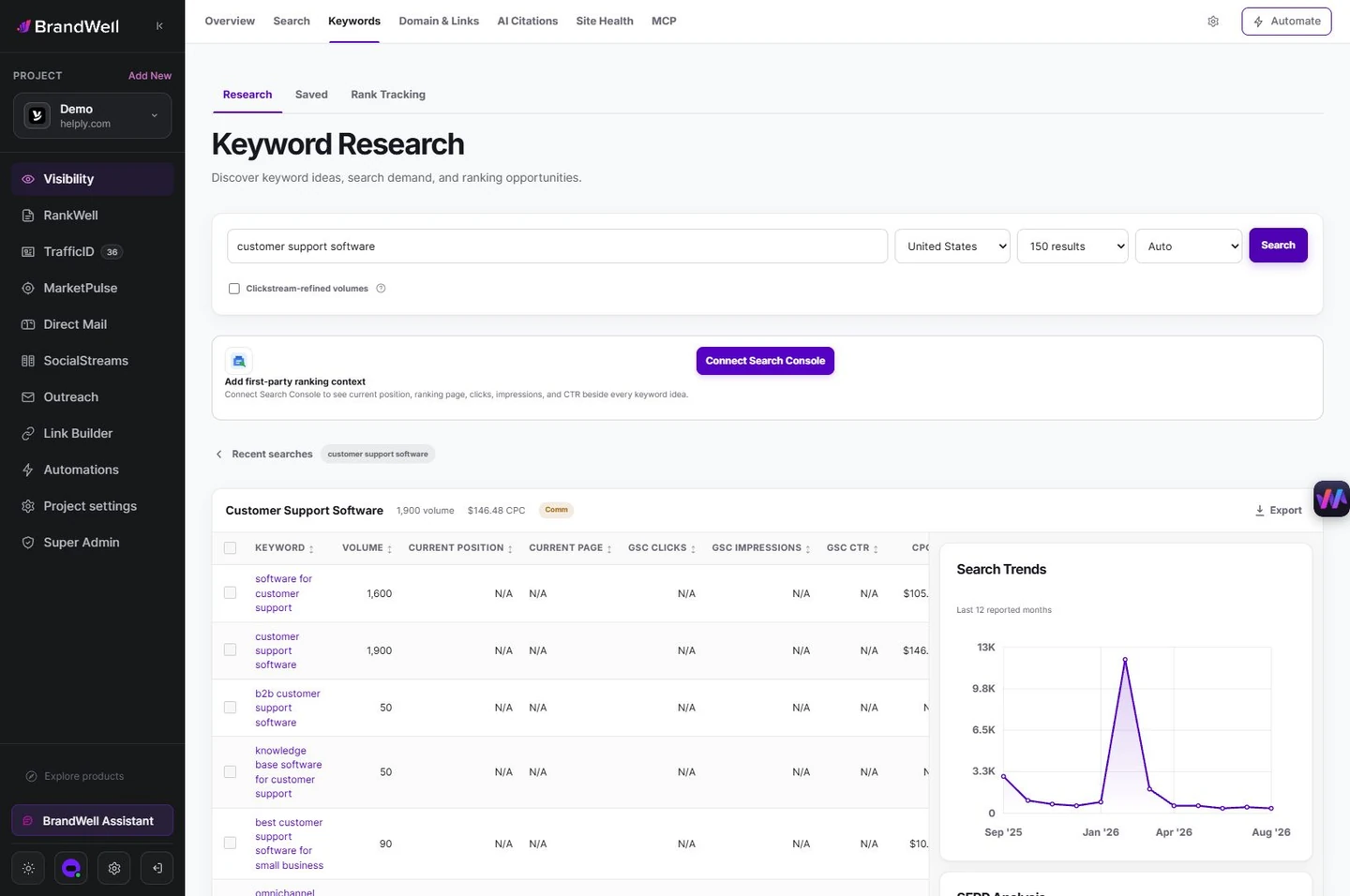
Review available Search Console query and page data for the site you manage. It shows observed search performance within its reporting scope, rather than the full market demand for every phrase.
Understand what the metrics measure
Google’s Keyword Planner metric documentation distinguishes search estimates from advertising competition. Average monthly searches depend on the selected settings and date range. The competition column concerns advertisers, not an organic SEO difficulty score.
Forecasts are estimates with assumptions, not promised visits. Record the source, scope and period instead of combining numbers from different settings as though they were identical.
A difficulty estimate from another research system uses that system’s method. Treat it as one input, then inspect the actual task, existing coverage and evidence you can contribute. Low volume does not automatically mean low competition or easy rankings.
Interpret intent without assuming certainty
A query may seek an explanation, a particular destination, a comparison or a transaction. Those categories help planning but can overlap. Read the phrase in context and inspect the current result types for the relevant audience.
Search results can vary by time, location and device. One result page is a useful observation, not a permanent statement of what every reader wants. Avoid assuming that a query proves a person’s occupation, budget or buying readiness.
Do not define long-tail only by word count
Long-tail refers to the less common portion of a demand distribution, not a universal rule that every phrase with two or more words belongs there. More specific wording can clarify a task, but length alone does not prove low competition or purchase intent.
For planning, focus on the question and useful answer. A precise troubleshooting query can be informational; a short branded query can have strong destination intent.
Original example: an IT services content decision
Suppose an IT services business receives recurring questions about what to document before a system migration. It already has a broad service page but no practical preparation guide. The team considers a checklist with original examples and clearly stated boundaries.
It compares the proposed task with existing articles, records relevant query evidence and asks whether it can provide reliable instructions. If the same answer already exists, it updates that page rather than creating a competing version.
This is an original planning example. It does not establish a particular query’s volume or promise that a checklist will produce customers.
Choose create, improve, merge or defer
- Create when a distinct useful task is uncovered and you can support the answer.
- Improve an existing page when its purpose fits but its information is incomplete or outdated.
- Consider merging pages when they provide substantially the same answer, after reviewing their separate traffic and purpose.
- Defer when the topic falls outside the offer, evidence or maintenance capacity.
Save the target task, intended page, evidence, owner and next review date. A single page can naturally address several related phrases; you do not need one URL for each wording variation.
Develop the approved content in RankWell
Use RankWell to prepare the brief and review the article, sources, media and search preview. Research belongs in the appropriate workflow; do not describe Keyword Research as a RankWell editor tab.
AIMEE can help organize approved tasks through configured tools. Review its suggestions and drafts for factual accuracy and current product details. An NLP recommendation or workspace score does not guarantee indexing or ranking.
Measure the published answer
Save the relevant query and page baseline, then inspect clicks, impressions and reader-task outcomes over comparable periods. Keep search performance and Analytics actions distinct. Consider other campaign, demand and website changes before attributing a result to one edit.
Google’s helpful-content guidance emphasizes useful content for people. There is no preferred word count that turns a keyword into a successful page. Inspect the actual mobile experience and maintain the answer as its facts change.
Reviewed and updated October 2, 2026.

Written by
Julia McCoy has contributed articles to BrandWell on content marketing, writing, and search engine optimization. This archive retains her original bylines; individual articles may be updated by the BrandWell editorial team.