On this page
- Second-party intent is a relationship and rights model
- Implement a second-party intent partnership
- Second-party rights and quality matrix
- Compare the platform approach with simpler alternatives
- Pricing, budget, and total cost
- Measurement and qualified revenue evidence
- Best-fit teams and honest non-fit scenarios
- Data quality, privacy, and failure modes
- Package the capability as a recurring agency service
- The practical takeaway
- A contract is one part of the sharing review
- Calculate usable delivery before buying more
- Review MarketPulse as topic research
- Frequently asked questions
Direct answer: Use second-party intent data when another organization directly collected relevant behavior and grants your organization clearly documented rights to receive and use it. The value comes from a transparent relationship, distinctive audience or context, and faster access – not from calling any purchased dataset “second party.” Verify provenance, participant notice or permission, field-level rights, freshness, identity, and downstream activation before buying.
Who this is for: B2B demand-generation, partnerships, RevOps, procurement, privacy, and agency teams evaluating publisher, marketplace, event, or ecosystem data shared through a direct relationship. This guide does not cover owned first-party collection or opaque syndicated third-party networks.
Current MarketPulse offer: intent-data plans start at $500/mo. See the product, demo, and current plans. Updated October 3, 2026.
Second-party intent is a relationship and rights model
Second-party data is another organization’s first-party data shared directly with you under a defined agreement. Examples can include a publisher’s content registrations, a marketplace’s category and comparison activity, a partner’s co-marketing responses, an event operator’s attendance records, or a distributor’s product research. The label is meaningful only if the collector, source surface, collection method, and permitted use are visible.
Evaluate relevance before volume. A narrow audience that actively compares software, attends a specialist session, or requests a technical asset may be more useful than millions of generic impressions. Ask which exact actions are included, how participants are identified, whether accounts or people are disclosed, what delay occurs, and what happens when a person corrects or withdraws data.
Rights should follow the field and purpose. A partner may allow aggregate analysis but not person-level outreach; a registration may cover event communications but not unrelated promotions; an account signal may be available for advertising but not CRM enrichment. Store permitted uses with the record so downstream tools cannot silently broaden them.
Implement a second-party intent partnership
- Define the shared use case. Name the audience, behavior, buyer decision, fields, geography, frequency, receiving systems, and prohibited actions. Reject vague “full intent feed” descriptions.
- Map provenance and notice. Document the collector, surface, event, timestamp, identity method, notice or consent, partner role, subprocessors, and transfer path.
- Contract field-level rights. Specify purpose, channels, recipients, retention, security, correction/deletion, onward transfer, audit evidence, breach handling, and termination disposition.
- Test a representative sample. Measure coverage, duplicates, identity precision, role fit, freshness, usable-record rate, suppression conflicts, and differences by segment.
- Route conservatively. Begin with research, content, account planning, or human-reviewed tasks. Do not reveal private browsing or event detail in a cold message.
- Reconcile outcomes. Return delivery errors, corrections, suppressions, and outcome reason codes where the agreement permits. Keep the partner from treating all non-response as buyer disinterest.
- Review the partnership. Audit source changes, new fields, notice language, delivery latency, activation uses, client access, and business value before renewal or expansion.
Second-party rights and quality matrix
- Source transparency: collector, surface, action, timestamp, and identity method are inspectable.
- Permission: the notice, consent or other lawful basis, contract, and participant expectations align with the intended purpose.
- Delivery rights: named fields, recipients, geography, channels, retention, onward transfer, and client access are explicit.
- Signal quality: relevance, freshness, identity precision, role fit, duplicates, suppressions, and corrections are measurable.
- Exit controls: deletion or return, downstream propagation, audit evidence, and continuing restrictions survive termination where required.
Use this matrix as a starting hypothesis. Put the same records through each method, disclose exclusions, and make the acceptance threshold depend on the action rather than the vendor’s preferred headline metric.
Compare the platform approach with simpler alternatives
First-party data is preferable when your own surfaces capture enough relevant behavior. Third-party intent can broaden coverage but usually adds more distance from the original collector. Second-party data is strongest when the partner has a unique context and direct rights relationship. Manual partner reports can work for small programs; an API or platform is justified when delivery and activation recur.
Pricing, budget, and total cost
Budget for access or sponsorship, data delivery, CRM mapping, identity and validation, partner management, legal and privacy review, suppressions, activation, measurement, and termination work. Some platforms sell software; others bundle marketplace, content, lead-generation, or event access. Compare one named feed and permitted use, not company-wide procurement medians as if every package were equivalent.
MarketPulse plans are starting at $500/mo. Starter includes 1 topic, weekly refreshes, and 25,000 exportable contacts per month. Growth includes 3 topics, daily refreshes, and 100,000 exportable contacts. Scale includes 10 topics, daily refreshes, and unlimited contact exports. AIMEE for the initial user is included with Growth and Scale. Compare MarketPulse plans and current offers.
Measurement and qualified revenue evidence
Track delivered, unique, matchable, permitted-use-eligible, fit, fresh and accepted records with defined units. Record corrections, suppressions, latency, approved actions and downstream outcomes. Use suitable randomized assignment where feasible; a matched or phased observational comparison can retain confounding. Delivery reports and observed revenue do not establish incremental impact.
Separate leading quality measures from operating adoption, pipeline progression, and closed revenue. Report the attribution method and uncertainty. Do not label influenced pipeline as incremental revenue, and do not let a vendor score become its own proof of value.
Best-fit teams and honest non-fit scenarios
Best fits categories where a publisher, marketplace, event, or ecosystem partner sees distinctive high-consideration behavior that the buyer cannot collect alone. It is a poor fit when provenance is opaque, rights are broad but unsupported, identity cannot be tested, or the receiving team has no action owner. Unique access is not automatically useful access.
Data quality, privacy, and failure modes
Common failures include calling third-party resale “second party,” expanding purpose after transfer, losing participant context, sharing client data back without authorization, and retaining records after the partnership ends. Separate controller and processor roles by activity, not marketing label. Apply access controls and make correction or deletion propagation part of the technical design.
Before launch, test one false-positive scenario, one deletion or correction request, one suppression conflict, and one source outage. Assign an owner who can pause activation. A policy that cannot stop a queue or audience is documentation, not an operating control.
Package the capability as a recurring agency service
An agency can package partner-signal operations: source and rights diligence, field mapping, sample QA, branded client reporting, human-reviewed activation, partner reconciliation, and renewal analysis. The agency must not mix client datasets or assume its reseller agreement grants every client the same rights. Each client order should identify sources, uses, users, and termination duties.
AIMEE can prepare configured research and reconciliation through connected tools. Define the fields, permissions, review points and expected outputs. Verify the result and destination; an instruction is not an implemented integration.
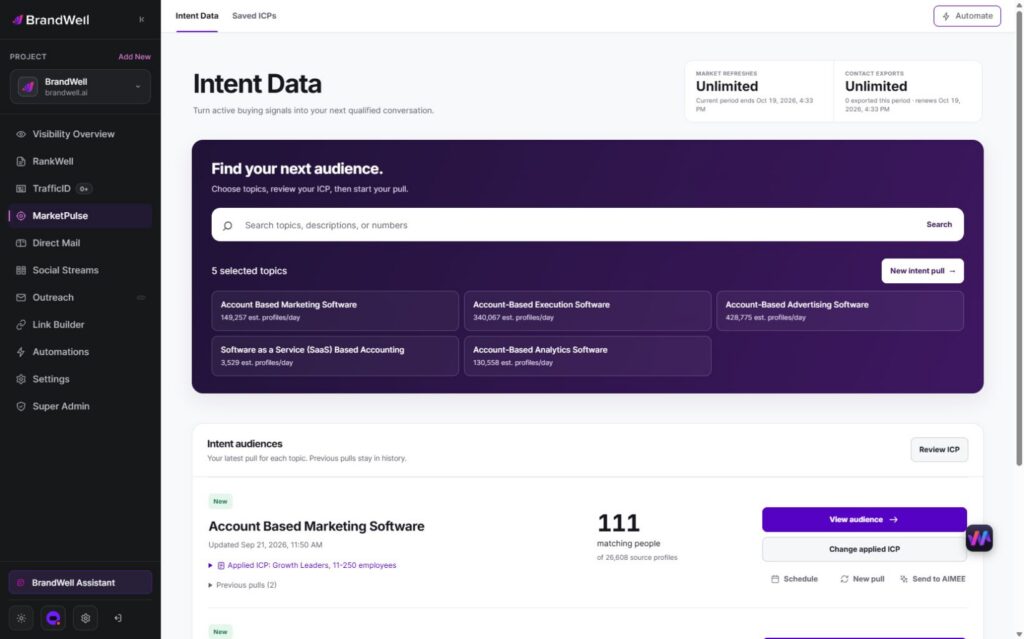
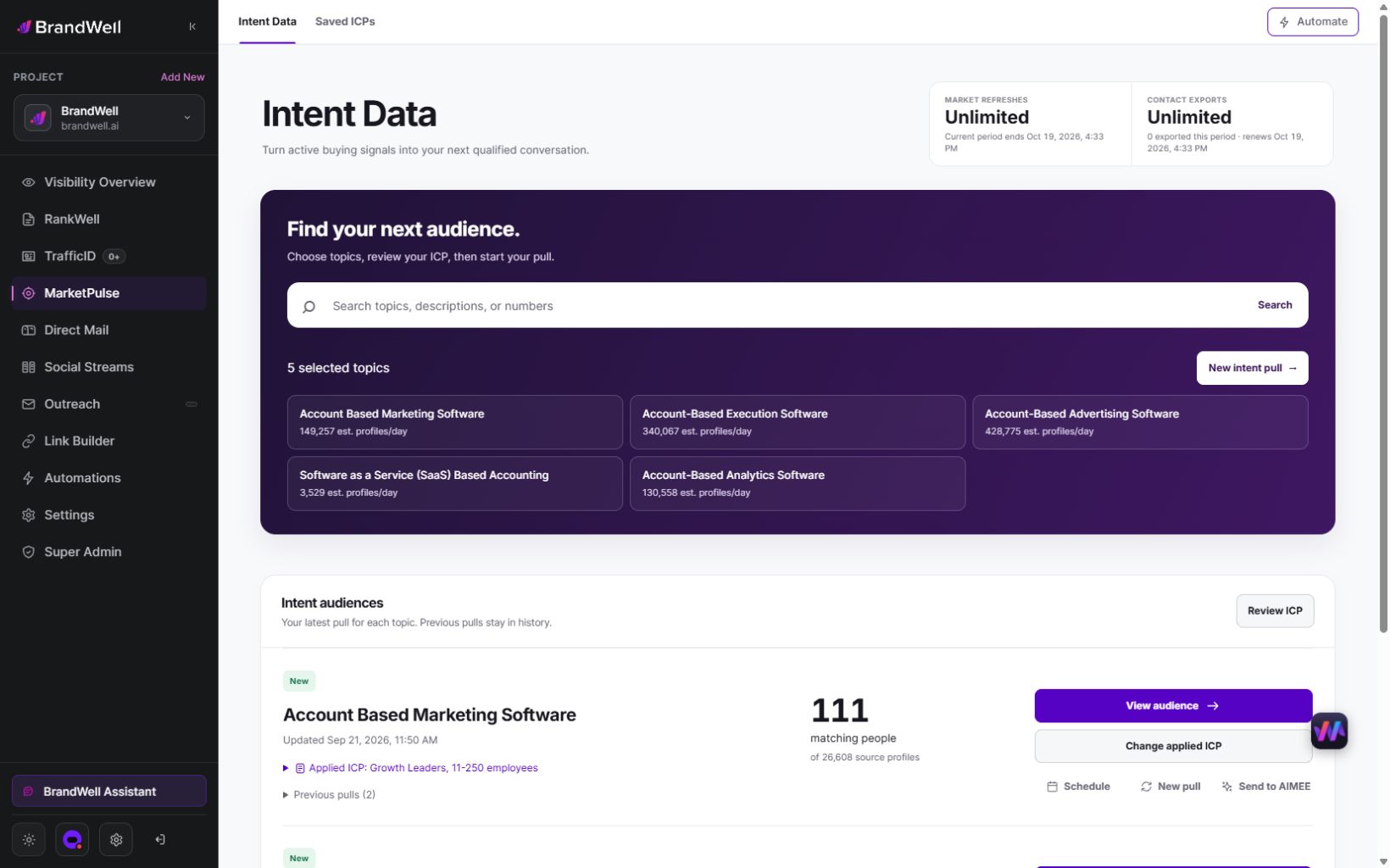
Evaluate a relevant MarketPulse topic and ICP, then review available people, company fields and useful actions. Define client scope and permitted use separately. A subscription does not promise white-label infrastructure, exclusive sources or a native partner-feed integration.
Agent-ready operating instructions
Reconcile received records, allowed uses, matches, duplicates, suppressions, accepted actions, corrections, outcomes and cost. Define client fees separately from software charges and verify additional service or redistribution rights through an explicit agreement.
The practical takeaway
Use second-party intent when the direct relationship makes provenance and permission clearer – and when that distinctive signal survives a same-sample quality test. Create a termination rehearsal before signing: identify every destination, cache, audience, export, client report, model feature, and backup that receives the feed; assign deletion or return duties; and simulate partner notice. The rehearsal exposes hidden onward transfers and operational dependencies while there is still negotiating leverage. It also prevents a commercial cancellation from leaving stale partner data active in CRM, advertising, or agency workspaces. Build a partner-feed acceptance gate before the first scheduled delivery. Reconcile the partner manifest to received fields, counts, event windows, permitted territories, consent states, and deletion keys; then compare a sample with the partner’s own source record. Reject undocumented fields rather than assuming more data is automatically better. Route contract exceptions to a named commercial and privacy owner, while technical defects go to a separate remediation queue. Give clients only the fields and explanations authorized for their service. Each month, recheck a small set of records from receipt through report, activation, correction, and expiry. This chain-of-custody test shows whether contractual promises survive real transformations. It also creates evidence for renewal negotiations: the team can distinguish valuable distinctive supply from duplicates, mismatches, and operational work the headline volume concealed. Score the partnership itself, not just its records. Track delivery punctuality, schema stability, correction speed, duplicate share, right-to-use exceptions, client acceptance, downstream utility, and the hours required to reconcile each release. A feed with lower volume may be more valuable when it is distinctive, timely, and operationally clean. Require the partner to notify you before changing collection, fields, permitted uses, subprocessors, or delivery cadence, then route that notice through a documented impact review. Keep an alternative source or degraded-service procedure for critical workflows. At renewal, compare the original sample, contracted promise, and actual operating history on the same definitions. This turns the negotiation from anecdotes about pipeline into a review of supply quality, rights reliability, and total delivery burden.
Start by reviewing the MarketPulse demo and plans, starting at $500/mo. Choose a relevant topic and ICP, then evaluate audience fit, available contact fields, and the workflow you will use. The first-purchase 3-day satisfaction guarantee requires no data exports and no more than 2 Intent Scans; review the current guarantee terms before testing. A short evaluation can establish fit, but cannot prove future pipeline or revenue.
A contract is one part of the sharing review
The UK ICO’s data-sharing agreement guidance discusses purpose, responsibilities and data handling. It says an agreement does not provide immunity from breaches. The guidance is under review following the Data (Use and Access) Act.
For a proposed partner program, have qualified reviewers assess the actual roles, purposes, jurisdictions, participant information and permitted channels. A source’s commercial license and a legal basis are separate questions. Avoid treating a category label as regulatory approval.
Calculate usable delivery before buying more
In a fictional release, a partner delivers 1,000 records. Deduplication leaves 900 unique records; 600 meet the intended use restrictions; 450 also meet the agreed fit and freshness rules; and 300 receive the approved action. Usable fit-and-fresh output is 45% of delivered records and 75% of permitted-use-eligible records.
If included delivery and review cost is $1,800, cost per accepted record is $4 and cost per activated record is $6. Those denominators do not count unique people unless the record definition establishes that unit. These are illustrative costs, not qualified-lead prices or proof of revenue.
Retain why records were excluded and how corrections propagate. A later feed containing the same records should not appear as new audience growth. If a use restriction changes, stop the affected action while the owner reviews it.
Review MarketPulse as topic research
- Choose a topic relevant to the business question and apply the ICP.
- Review available people and company output without inferring an undisclosed source relationship.
- Define acceptance and exclusions consistently.
- Confirm the particular downstream use, client scope and required integration before taking action.
- Record useful output and operator effort for the next decision.
Explore MarketPulse and compare current plans. Standard subscriptions are starting at $500/mo. Verify additional API, managed-service or redistribution scope separately.
Frequently asked questions
Is purchased data automatically second-party?
No. Inspect the collector and direct relationship. A commercial purchase alone does not explain provenance.
Does a partner contract permit every use?
No. Review the actual fields, purposes, recipients, channels and applicable requirements.
Is a smaller distinctive feed worthwhile?
It can be, if it improves the defined decision with useful evidence at an acceptable full cost. Test relevant output rather than raw volume.
Does MarketPulse promise a specific source model?
Do not infer an undisclosed collection model from the product category. Evaluate actual output and verify the specific scope you require.
Reviewed and updated October 3, 2026.

Written by