


On this page
- Use a confidence contract, not a single “matched” field
- Build the white-label identity resolution workflow
- Compare resolution with simpler alternatives
- Model pricing and total cost before choosing
- Measure identity quality before pipeline
- Identify good-fit and poor-fit clients
- Combine identity, fit, intent, freshness, and outcomes
- Control privacy, quality, and client risk
- Package identity resolution as recurring agency revenue
- Keep client access separate from match quality
- A fictional quality review
- Use BrandWell within its documented scope
White-label identity resolution means delivering a branded service that reconciles fragmented identifiers into documented entity candidates for a client workflow. Evaluate evidence, client isolation, permitted use and correction paths. A candidate match is not verified identity, guaranteed buyer intent or permission to contact someone.
Who this is for: Agency owners, data operations leaders, RevOps teams, growth operators, and privacy reviewers evaluating a repeatable B2B identity service for multiple clients.
This guide addresses commercial B2B identity resolution. It is not a regulated identity-verification, authentication, fraud, or know-your-customer program. A marketing match should never be treated as proof that a person is who they claim to be, has authority to transact, or is ready to buy.
Current MarketPulse offer: intent-data plans start at $500/mo. See the product, demo, and current plans. Updated October 1, 2026.
Use a confidence contract, not a single “matched” field
A practical identity resolution strategy begins with an identity contract. Define the input identifiers, permitted sources, entity levels, output fields, confidence rules, recency limits, and actions allowed at each confidence tier. Keep account, location, domain, device, professional profile, and contact conclusions separate. Joining them into one row does not make every field equally reliable.
Use three proposed decision states. These are workflow labels, not calibrated probability scores or a certification:
- Accepted: the record meets fit, evidence, freshness, permission, and destination rules.
- Review: evidence is useful but ambiguous, so a trained operator must inspect it before activation.
- Rejected or suppressed: the record is stale, conflicting, duplicated, out of territory, disallowed, or too weak for the proposed action.
That structure turns identity resolution into an operational control. Intent data can then add context about research or engagement, but it cannot repair a weak identity match. Resolve and validate the entity first; apply behavior, fit, scoring, routing, and human judgment afterward.
Build the white-label identity resolution workflow
A identity resolution implementation guide should name owners and failure paths, not merely show a connector diagram.
- Define the client purpose. Write the exact decisions the record will support: account prioritization, CRM cleanup, reporting, approved outreach research, audience planning, or another documented use. Reject vague “use it everywhere” requirements.
- Inventory inputs. List CRM identifiers, domains, work emails, form data, account names, website events, campaign IDs, and suppression records. Record source, collection context, update time, and client ownership or license terms.
- Normalize without erasing provenance. Preserve original values and source labels. Normalize domains and documented aliases consistently. SMTP specifies case-insensitive mailbox domains but case-sensitive local parts that must be preserved. Do not blindly lowercase an entire address or merge contacts on casing alone.
- Resolve by entity level. Run deterministic rules first where an exact identifier is available. Use probabilistic candidates only with explicit confidence and conflict handling. Do not silently promote an account match into a named-person conclusion.
- Validate the output. Test deliverability or business validity where appropriate, compare important fields across sources, detect duplicates, and sample false matches. A “complete” record can still be wrong.
- Apply fit, freshness, and permission gates. Enforce geography, client exclusions, existing-customer suppression, recency, channel eligibility, and legal-review requirements before a record reaches activation.
- Route with reason codes. Send the accepted fields, evidence class, confidence tier, source time, and next-step instruction to a CRM, report, queue, export, or approved automation. Put failures in a visible review queue.
- Return dispositions. Capture whether the record was accepted, researched, contacted, converted, rejected, or suppressed. Use those outcomes to tune thresholds rather than claiming the resolver caused revenue.
The minimum team includes an accountable service owner, a data or RevOps operator, the client’s system owner, a privacy/legal reviewer for the intended use, and a channel owner for activation. Add security and procurement reviewers when data rights, access, or contract exposure are material.
Compare resolution with simpler alternatives
White-label identity resolution is not always the correct starting point.
- Single-field matching can be sufficient when a documented, stable internal ID joins the required systems. Exact equality is a matching rule, not proof of identity; email addresses can be shared, reassigned or change. Test conflicts and lifecycle handling.
- Reverse IP alone can provide useful company-level website context without claiming a named person. It is often enough for account analytics, but shared networks, remote work, VPNs, and small businesses can reduce usefulness.
- Manual reconciliation fits low volume, high-value research where an analyst can inspect conflicts. It creates a valuable benchmark, although it does not scale and can become inconsistent without a rubric.
- Multi-source identity resolution fits fragmented, recurring, higher-volume workflows where the value of a better join exceeds the operating and governance cost.
Compare the same eligible inputs and retain the manual decisions as process reference labels. Human review can also be wrong. A manual comparison sample is not automatically a randomized control or proof of incremental effect.
Model pricing and total cost before choosing
Identity resolution pricing can include subscription, usage, records, enrichments, client sites, exports, API calls, branded surfaces, implementation, professional services, and internal labor. Contract rights may matter more than a low unit price: client resale, redistribution, derived data, retention, deletion, portability, and post-termination handling all affect total cost.
Calculate cost per accepted record, not cost per delivered record. Add the labor spent reviewing weak matches, correcting CRM data, managing suppression, producing client reports, supporting integrations, and handling disputes. A cheap feed with a high rejection burden can be the expensive choice.
Measure identity quality before pipeline
Identity resolution KPIs need denominators:
- Candidate yield: candidate records divided by eligible inputs.
- Validation rate: records passing required field and evidence checks divided by candidates.
- Accepted-record rate: records passing fit, freshness, permission, duplication, and routing rules divided by eligible inputs.
- Sampled precision: reviewer-confirmed correct matches divided by reviewed accepted matches. Disclose sample selection, sample size, uncertainty and reviewer criteria; this is not complete ground truth or population accuracy.
- Activation latency: time from eligible input to approved destination.
- Disposition completion: accepted records receiving a documented downstream outcome.
- Incremental outcome: difference between a treatment group and a credible control, with uncertainty and operating differences recorded.
Revenue measurement begins after those quality measures. Link stable event IDs across resolver output, CRM action, opportunity, and outcome. Report sourced, influenced, and incremental results separately. A resolved identity can help a team act; it does not prove the identity system created the sale.
Identify good-fit and poor-fit clients
Good identity resolution use cases have fragmented records, repeated decisions, a defined B2B market, enough volume to test, an operator who can act, and a measurable downstream workflow. Agencies serving multi-location B2B firms, SaaS, professional services, or complex account lists may benefit when existing CRM, website, and campaign identifiers do not reconcile cleanly.
Avoid or delay the service when the client wants regulated identity verification, has no defined permitted purpose, cannot provide usable inputs, lacks suppression and system ownership, expects every visitor to become a named lead, or has too little volume to estimate error. A CRM cleanup project or account-only method may be more appropriate.
Combine identity, fit, intent, freshness, and outcomes
The strongest identity resolution framework is a layered evidence model. Identity answers “which entity might this be?” Fit asks whether the entity belongs in the client’s market. Intent or engagement adds time-sensitive context. Freshness limits how long that context remains actionable. Activation rules select the permitted next step. Outcomes show whether the operating decision was useful.
Do not collapse the layers into a mysterious score. Retain the component evidence and reason codes. A high-fit account with weak identity may go to research. A validated contact with no current signal may remain in nurture. A fresh account-level research signal may justify an account brief, not person-specific outreach. The action must match the weakest consequential inference.
Control privacy, quality, and client risk
Avoid hiding conflicts, stale fields, client mixing and unsupported certainty. NIST’s Privacy Framework is a voluntary privacy-risk tool, not provider certification or a determination of legal compliance.
Before routing, document the permitted purpose, recipient context, channel policy, notices, suppression and accountable reviewer. A matched record alone is not permission to contact someone. Obtain advice for the actual jurisdictions and roles.
Package identity resolution as recurring agency revenue
Sell a governed operating cycle rather than a raw list. A recurring service can include input QA, matching rules, confidence review, enrichment, suppression, routing, exception management, client reporting, threshold tuning, and quarterly data-rights review. Define deliverables, volume, refresh cadence, response responsibilities, service boundaries, and client approvals in writing.
Keep client access separate from match quality
OWASP’s multitenant guidance calls for authorization against the authenticated principal and tenant-owned resource. Apply access checks across client lookups, exports and cached results; separate cache keys alone do not authorize a request.
Test that one client cannot read or change another client’s candidates, suppression records or reports. Record correction, deletion and incident responsibilities in your service specification.
A fictional quality review
Suppose 100 eligible inputs produce 80 candidates, 60 pass validation and 50 are accepted. Candidate yield is 80%; validation is 60/80, or 75%; acceptance is 50/100, or 50%. If reviewers confirm 18 of 20 sampled accepted matches, sampled precision is 90% for that sample. These invented counts are not benchmarks, population accuracy or demonstrated revenue lift.
Use BrandWell within its documented scope
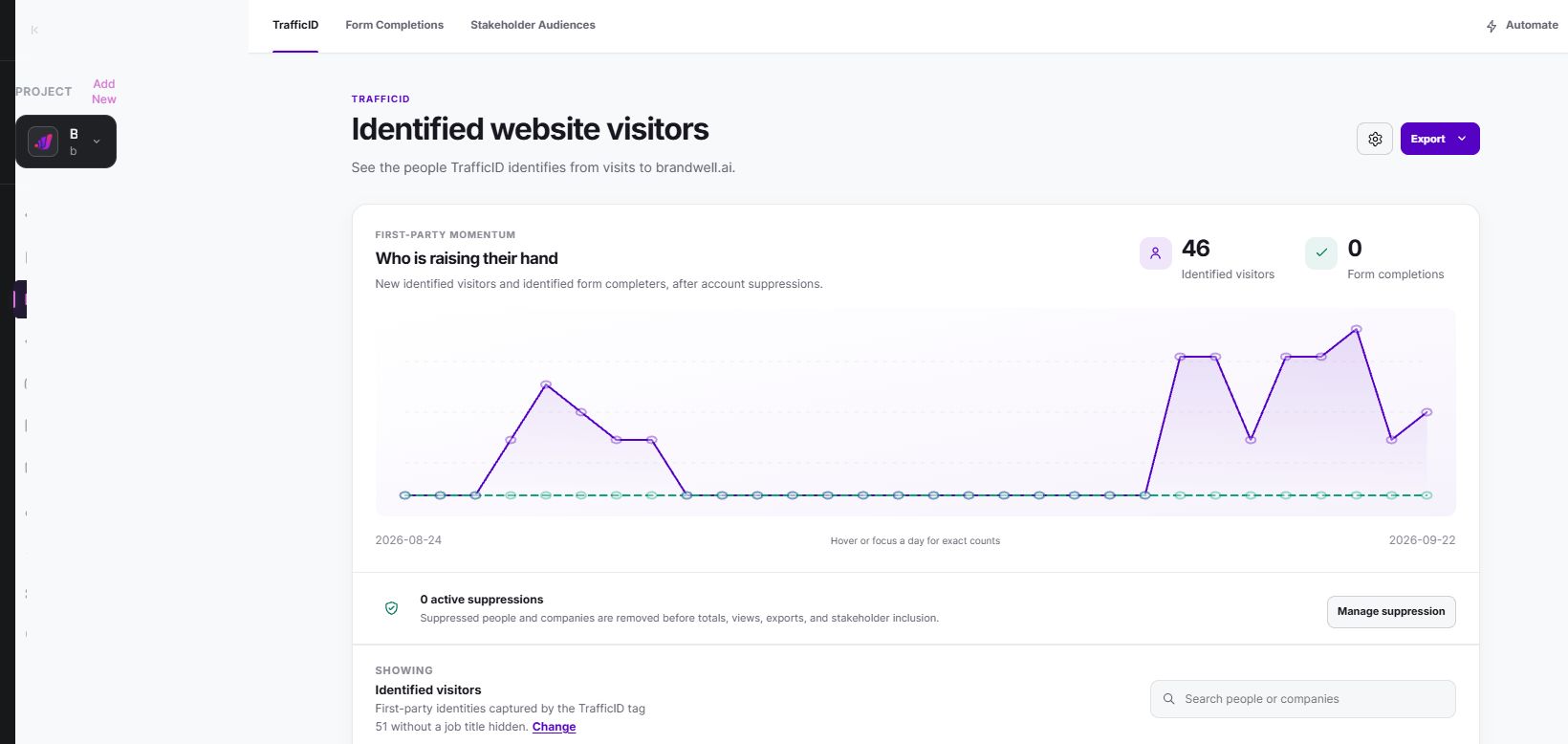
TrafficID helps identify eligible visitors to your own website. Coverage and fields vary; this is not identification of every visitor, regulated identity verification or a promise of a native white-label resolution service.
MarketPulse is a separate topic-research product with standard plans starting at $500/mo. Do not label an offsite topic record as a visit to a client website. Use AIMEE through configured tools to prepare a sourced brief, retaining unresolved fields and the authorized action scope.
Agencies can define their own review and implementation services. Check actual product access, licenses and client permissions before promising an integration, branded output or data resale. Review current BrandWell products.
Reviewed and updated October 3, 2026.

Written by

