On this page
White-label link building is outsourced research, content and outreach delivered under an agency’s brand. It can add capacity, but the agency still owns the client promise and quality review. Publishers decide whether to include a link. Neither outsourced delivery nor software guarantees placements, rankings, AI citations or profitable growth.
Use this guide to decide which work to outsource, how to qualify the provider and how to report a real result. A branded report should make the work understandable; it should not conceal responsibilities or substitute for evidence.
What the service includes
A scoped service might research suitable publications, prepare a useful asset, identify the responsible editor, draft a relevant pitch, manage approved follow-up and check any published placement. Agree on which tasks are deliverables and which depend on an independent publisher’s decision.
- Research: a qualified shortlist with a reason each publication fits the audience.
- Content: an original, fact-checked resource the publisher’s readers would find useful.
- Outreach: a reviewed offer, responsible sender and appropriate follow-up.
- Evidence: the actual page, destination URL, anchor text, link attributes and check date.
- Reporting: completed work, decisions, costs, unresolved items and next steps.
A promised placement, an editor’s reply and a live link are three different states. Keep them separate in both the work queue and the client report.
Benefits and the work that remains
Outsourcing can provide specialist capacity without immediately hiring a full team. It can also introduce onboarding, revision, account-management and review costs. Compare the complete delivered cost rather than assuming a subcontractor is cheaper than an employee.
A useful provider contributes research and editorial expertise. Your team still needs to approve the target page, publisher fit, factual claims, communication approach and client-facing report. Scaling a low-quality process increases the amount of work to repair.
Transparency matters. The client contract should address subcontractors, responsibilities, access and confidentiality as appropriate. A white-label arrangement does not require misleading a client about who performs the work.
Six steps from brief to verified placement
- Choose a page worth promoting. Define its audience, useful evidence and the question it answers.
- Qualify publishers. Inspect topic relevance, real content, the proposed page and editorial requirements. A third-party domain score alone is insufficient.
- Agree on the offer. Record the asset, sender, any compensation and the publisher’s independent decision.
- Prepare and review outreach. Explain the reader benefit, verify claims and contacts, and assign a follow-up owner.
- Verify publication. Check the live page and link rather than treating an agreement as completion.
- Monitor and report. Record changes or losses, agreed repair work and observed traffic separately from causal SEO claims.
Do not sell bulk private-network links or guaranteed ranking credit as an editorial service. If there is a paid placement, its treatment matters: Google’s outbound-link guidance prefers rel="sponsored" for advertisements and paid placements; nofollow remains acceptable. An ordinary editorial reference and an advertisement should not be reported as interchangeable.
How BrandWell supports the workflow
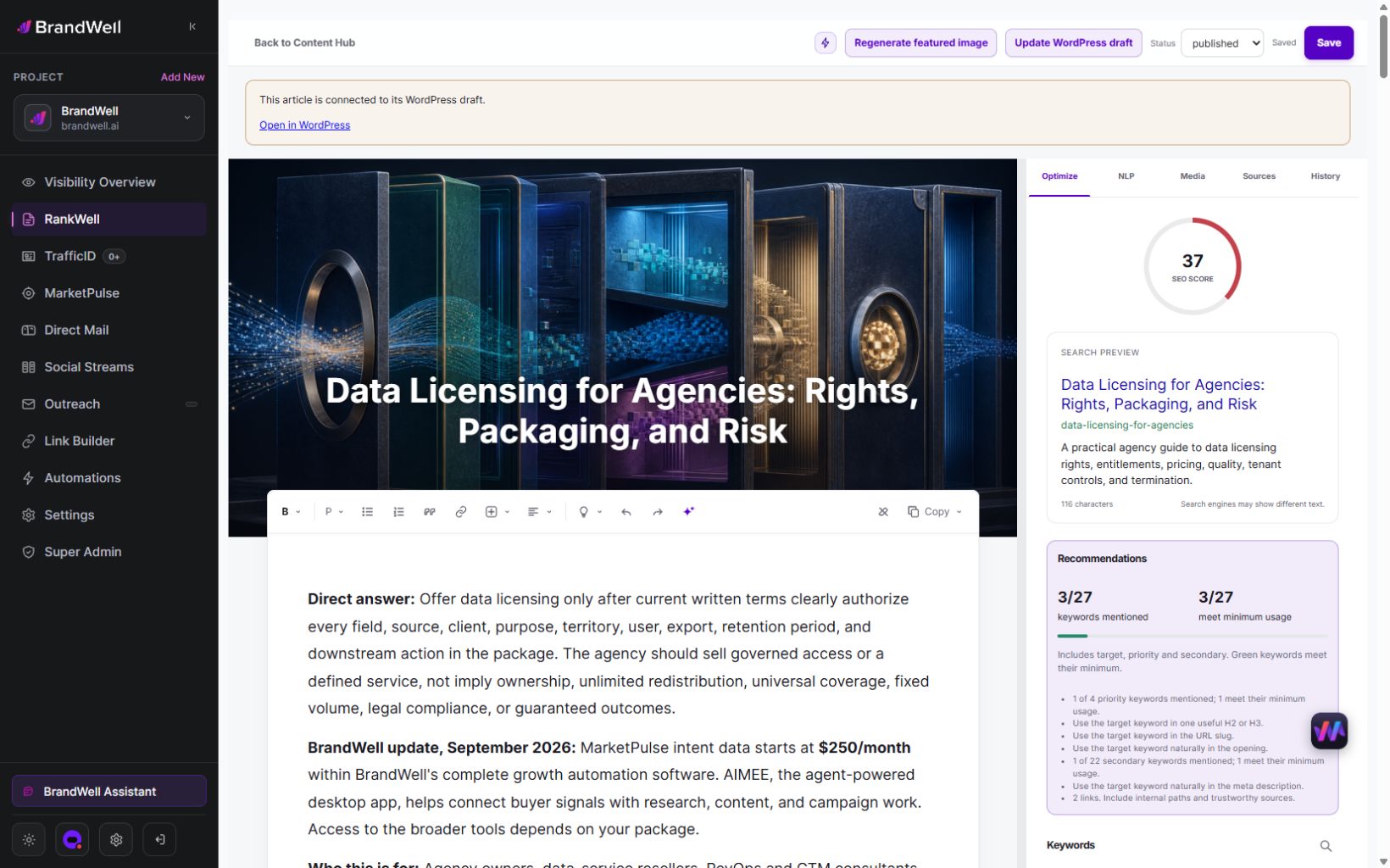
RankWell supports researching, drafting, reviewing and publishing content. Use it to prepare the target resource, then check its facts, originality and audience value before promoting it.
Link Builder is included with RankWell Growth and Scale. It organizes target pages, publisher research, contact candidates, placement stages, tasks and verification evidence. Supported exports and configured agent connections help keep the next step usable beyond the screen.
AIMEE can assist with research, pitches and assigned follow-ups through configured tools. Your team owns the approach, approvals and relationship. A fictional product walkthrough is an example of the workflow, not a promised citation or placement. BrandWell software is not a bundled white-label agency fulfillment contract.
Seven questions for a prospective provider
- What exactly is included? Separate research, content, pitches, follow-up, placement and monitoring.
- How are publications chosen? Ask for the proposed page and editorial-fit evidence, not just a metric.
- Is any placement paid? Require a clear explanation of compensation and link attributes.
- Who checks the content? Define factual review, revisions and use of client information.
- What proves completion? Request a live URL and link evidence with a check date.
- What happens if a link changes? Agree on monitoring, repair responsibilities and limits.
- Who owns reporting and exit? Set access, record portability, client communication and termination arrangements.
Review relevant case studies as specific examples, not typical-result promises. Ask what else changed during the reported period. Decline offers that will not explain methods or require you to make unsupported client claims.
Worked example: delivery cost is not link value
A fictional agency pays $1,000 for research and outreach, $400 for content and $200 for internal review. Defined cost is $1,600. Twenty qualified pitches result in four verified editorial placements, giving a 4 / 20 = 20% placement rate for that pitch cohort and $1,600 / 4 = $400 cost per verified placement.
If only two placements are verified, that cost rises to $800 each. At a $2,000 client service fee, the original $400 remainder is 20% of revenue before overhead, taxes and excluded costs. That remainder is not a client ROI estimate, and a higher placement count alone does not establish quality or sales impact.
These are invented planning inputs. Use actual charges, staff time and a fixed cohort; include rejected opportunities and uncompleted work rather than selecting only successes.
Measure the result without overstating it
Report the qualified shortlist, approved pitches, replies, agreements, verified placements and lost links with clear periods and denominators. Show the published asset and link attributes. Keep referral visits and conversions separate from changes in search visibility.
Rankings and traffic can change alongside content, technical fixes, other campaigns and search conditions. A before-and-after increase is an observation, not proof that one link caused it. A link is also not a guaranteed inclusion in an AI answer.
Frequently asked questions
Should every agency outsource link building?
No. Compare your research and review capacity, the proposed methods, full delivery cost and client requirements. A small internal campaign may be the better starting point.
Is a paid link the same as an earned editorial link?
No. Identify paid placements and apply the appropriate attributes. Keep the commercial arrangement visible in the reporting.
Does white-label delivery guarantee a ranking boost?
No. Publisher choice, page quality, link treatment and many other conditions affect the outcome.
Is Link Builder sold as outsourced fulfillment?
It is software included with RankWell Growth and Scale. Additional agency delivery and commercial rights need separate confirmation.
Keep the work and evidence together: explore Link Builder and compare RankWell plans.
Reviewed and updated October 3, 2026.

Written by
Julia McCoy has contributed articles to BrandWell on content marketing, writing, and search engine optimization. This archive retains her original bylines; individual articles may be updated by the BrandWell editorial team.