BrandWell intent data is best suited to agencies and resellers that already know how they will turn a probabilistic signal into a controlled client decision: a branded market report, an account-prioritization queue, a reviewed activation, or a recurring evidence conversation. It is a poor fit for organizations that need universal identity, guaranteed leads or revenue, an unsupported geography, or a fully outsourced service with no internal owner.

Who this is for: agency owners, GTM consultancies, RevOps agencies, demand-generation teams, and data-service resellers qualifying their own readiness for BrandWell’s separate white-label agency-reseller offer. It does not define the agency’s ideal end client in isolation, describe every product capability, or refer to the legacy BrandWell SEO writer.

The strongest fit is an agency prepared to use the intended white-label sales-and-delivery engine to sell, deliver, and improve a recurring intent service. That complete-engine description is BrandWell-provided positioning subject to current written product scope, and the reseller must verify each included portal, reporting, automation, support, and data component in writing.

Fit is an operating-model decision. The agency must be able to select and contract clients, set retail pricing, bill and support them, define the market and topics, govern data use, operate a report or routing workflow, and measure what happens after delivery. BrandWell supplies only the capabilities and support included in the current written scope. If that division of responsibility is unattractive, a managed operator, point tool, enterprise suite, referral, or custom build may be better.

The fit and qualification model

Use five questions in order:

  1. Is there a specific buyer decision to improve? “Use intent data” is not a use case. “Prioritize which approved accounts receive research this week” is.
  2. Is there a viable population to observe and test? The agency needs a defined account market, region, topic, and enough representative cases – including negatives and hard matches.
  3. Can the agency qualify and govern the output? Someone must own identity thresholds, recency, required fields, suppression, client approval, and channel policy.
  4. Can the client act and return evidence? A report without a decision owner or a routed record without a sales or media operator will not create value.
  5. Does the purchased scope support the path? Delivery, capacity, topics, sites, fields, destinations, support, data rights, and term must be written.

The model addresses the gap between raw signals and a sellable recurring service. It does not prove that a person is ready to buy, supply every contact, guarantee a reply, replace sales execution, make outreach lawful, or complete client billing and support for the agency. That is the core Brandwell intent data best fit use cases overview.

A 100-point agency fit scorecard

Score evidence, not optimism. Any red-line disqualifier overrides the numeric total.

DimensionWeightFull-credit evidence
Offer clarity15One client decision, output, cadence, exclusions, and owner are written
Market viability15Defined U.S.-business ICP, topics, regions, and representative test set
Data operations15Staff can inspect identity, timestamps, nulls, confidence, and quality by segment
Activation readiness10One approved destination, field map, suppression path, and human gate exist
Client participation10Client owner will review, act, report exceptions, and return outcomes
Governance15Purpose, notice, permissions, retention, deletion, access, and channel rules are reviewed
Commercial readiness10Retail pricing, margin, scope limits, contracts, billing, and support are designed
Measurement10Baseline, acceptance, adoption, downstream evidence, and stop conditions are defined

Interpretation:

  • 80–100, with no red line: ready for a narrow proof and one-client launch.
  • 60–79: potentially suitable after closing the named readiness gaps.
  • Below 60: do not buy a broad scope; improve the service model or choose a smaller alternative.
  • Any red line: stop until resolved.

Red lines include no accountable owner, required identity certainty, prohibited or unreviewed data use, no viable account population, no activation owner, no written entitlement for a critical capability, an outcome guarantee in the client contract, or a jurisdiction the workflow cannot support responsibly.

This is how to evaluate Brandwell intent data best fit use cases without turning firm size or agency label into a proxy for maturity.

Minimum-readiness checklist

An agency is ready to test only when it can produce the following artifacts:

  • a one-page offer card naming the client decision, output, cadence, and exclusions;
  • an ICP and account-set definition with good-fit, poor-fit, customer, and difficult examples;
  • a topic brief with plain-language meaning, exclusions, and acceptable age;
  • a field dictionary separating observed, inferred, resolved, enriched, and validated values;
  • an entitlement matrix tied to the Order Form;
  • a responsibility matrix for BrandWell, agency, client, and any third party;
  • a purpose and governance record covering geography, notice, permissions, suppression, retention, deletion, and channels;
  • one destination field map and reconciled dry-run plan;
  • a report that shows denominators, timestamps, thresholds, and uncertainty;
  • acceptance, expansion, and stop criteria.

Useful Brandwell intent data best fit use cases documentation begins with current terms, privacy material, pricing or quote, and the actual purchased scope. Then add data dictionaries, samples, technical instructions for the purchased delivery path, security materials, runbooks, and client disclosures. A marketing page or workflow article can help form questions but should not broaden an entitlement.

A Brandwell intent data best fit use cases demo should use the agency’s sample and show a failure case. Ask how missing fields, duplicates, ambiguous identity, stale signals, suppressions, and destination errors appear. A smooth interface demonstration cannot answer whether the agency can operate the service.

Archetype 1: agency owner launching a recurring data service

Why it can fit: The owner already has client relationships and wants a productized recurring offer that is not tied solely to hours. BrandWell’s agency model can be scoped around branded portals or reports, client accounts, topics, filters, and workflows, while the agency retains the client commercial relationship.

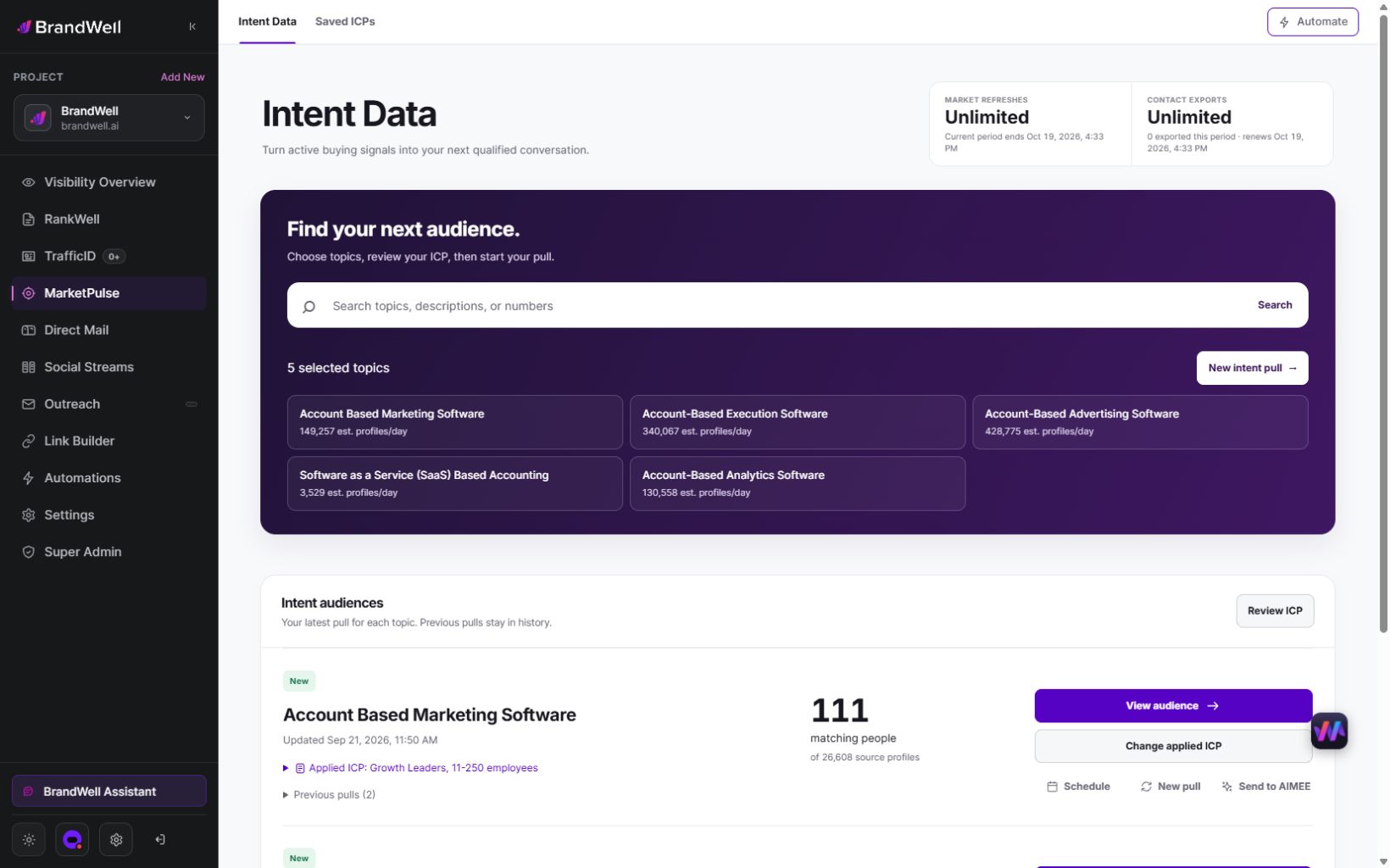
Best first test: One branded topic report for a familiar client segment, followed by a facilitated review that records which accounts were useful, surprising, wrong, or unactionable. Agencies can purchase BrandWell’s $70 seven-day reseller pilot. It includes agency-branded topic reports and the complete sales playbook under the current written pilot terms. Other product capabilities and any topic exclusivity remain subject to their separate current written scope.

Minimum capability: The owner must define the promise, price, capacity, support, and disclosure. A service cannot be “productized” if every report creates unbounded custom research.

Disqualifier: The owner expects BrandWell to select clients, set retail prices, invoice and collect, handle all frontline support, or guarantee outcomes without a written service agreement. Public terms place those commercial duties with the agency.

Recommended next step: Turn the accepted report into a recurring review with one change rule and one measurable client action before adding identity or activation complexity.

Archetype 2: GTM consultancy adding activation

Why it can fit: A GTM consultancy already maps markets, offers, sales plays, and operational handoffs. Intent data can become an input to account prioritization rather than a standalone deliverable.

Best first test: Compare the consultancy’s existing target-account model with a research-signal sample. Review agreement, disagreement, account age, and what action would change. Route accepted accounts into a human research queue before automating outreach.

Minimum capability: The consultancy needs an explicit qualification model and client-approved destination. It must distinguish account-level research from person-level identity and enrichment from permission.

Disqualifier: The value proposition depends on calling every signal a sales-ready lead or contacting people automatically without validation and approval.

Recommended next step: Add an evidence loop that captures research completed, sequence approved, seller action, response, objection, opportunity, and suppression. Use those outcomes to refine thresholds, not to promise universal ROI.

Archetype 3: RevOps agency operationalizing signals

Why it can fit: RevOps teams are accustomed to schemas, routing, deduplication, lifecycle stages, attribution, and change control. They can make a probabilistic input observable and govern how it enters a client’s systems.

Best first test: Use a frozen account set and a controlled export. Define identity level, required fields, recency, rejection codes, deduplication key, and expected CRM objects. Reconcile every source record with a destination or rejection state.

Minimum capability: A named system owner, test environment or safe import method, suppression logic, error queue, access control, and rollback path.

Disqualifier: The client CRM is too unreliable to distinguish duplicates, ownership, lifecycle, or outcomes, and no cleanup owner exists. Adding another feed would make the system less interpretable.

Recommended next step: Productionize one approved route, then monitor match acceptance, freshness, completeness, routing success, action, and downstream progression by client and segment.

Archetype 4: demand-generation agency improving audience quality

Why it can fit: A demand-generation agency can use research and identity context to prioritize approved account audiences, tailor creative strategy, or coordinate sales and media – provided it does not treat an intent score as consent or guaranteed demand.

Best first test: Compare one research-informed account segment with the agency’s existing audience selection under the same campaign objective and measurement plan. Document audience provenance, platform eligibility, suppression, and any platform expansion behavior.

Minimum capability: A current platform-policy review, legal basis and notice analysis, rights to upload or use the audience, client approval, minimum-size viability, and a way to separate data quality from media performance.

Disqualifier: The agency wants to scrape, circumvent platform restrictions, upload data without documented rights, or attribute every impression and opportunity to the signal provider.

Recommended next step: Expand only after the agency can explain eligible accounts, matched platform audience, delivery, spend, engagement, opportunity evidence, and confounders such as creative and bidding.

Archetype 5: data-service reseller needing white-label delivery

Why it can fit: A reseller may already sell lists, research, or data operations and need a branded client experience, repeatable reports, and configurable workflows without building every layer itself.

Best first test: Deliver one branded report under the reseller’s disclosure and support model. Confirm client-account separation, branding surfaces, topic capacity, output rights, report fields, and export behavior in writing.

Minimum capability: A product owner, margin model, quality-review function, client contract, support process, and exit plan. The reseller should be able to say what is observed, inferred, enriched, validated, and missing.

Disqualifier: The business requires undisclosed upstream sourcing, resale rights not in the agreement, universal topic protection, or data ownership that the contract does not grant.

Recommended next step: Add client-specific filters or activation only after the base report is supportable across several review cycles.

Who is not a fit

BrandWell is unlikely to suit an agency that:

  • requires every visitor or active buyer to be identified;
  • needs a guaranteed quantity of leads, meetings, pipeline, or revenue;
  • targets regions or sensitive uses without a validated legal and product path;
  • lacks a viable target-account population or enough traffic for the chosen workflow;
  • has no analyst, system owner, client operator, or governance owner;
  • cannot obtain a current written scope for a required topic, field, site, destination, support term, or data right;
  • assumes every plan includes TrafficID, validation, a public intent API, or a custom portal;
  • needs documented SSO, granular RBAC, audit logs, BCP, RTO, RPO, or an SLA that has not been supplied;
  • cannot disclose uncertainty to clients;
  • wants the platform to replace its client billing, collections, support, and compliance responsibilities;
  • conflates BrandWell’s agency-reseller offer with its legacy content product or with Moxby.

These are not merely Brandwell intent data best fit use cases limitations. Several are limitations of intent-data services as a category. A different vendor will not make a probabilistic research signal become consent or certain purchase readiness.

How the qualification workflow runs from signal to report

The complete Brandwell intent data best fit use cases workflow has eight states:

  1. Define: agency and client agree on market, topic, region, observation window, and exclusions.
  2. Observe: the service records or reports a research or visitor signal with timestamp and source category.
  3. Resolve: the workflow assigns an identity level and confidence without overstating certainty.
  4. Enrich or validate: only purchased and permitted fields are added; validation status remains distinct from consent.
  5. Qualify: ICP, geography, freshness, completeness, suppression, and client rules produce accept, review, or reject.
  6. Approve and activate: a named person or approved rule authorizes the minimum fields to one destination.
  7. Report: the agency shows eligible, observed, resolved, accepted, activated, and outcome counts separately.
  8. Learn: client action, false positives, objections, opportunities, and non-use inform the next threshold or scope decision.

Brandwell intent data best fit use cases integrations should be assessed at the transition between states. Confirm the purchased delivery path, schema, credentials, transformation, deduplication, retry, exception, suppression, deletion, and reconciliation. Do not infer endpoints or webhooks from an underlying provider’s documentation.

Agent-ready workflow instructions for Claude, ChatGPT, and Moxby are part of BrandWell planning, not a verified standard entitlement. Ask for the actual artifact, inputs, version, permissions, output, evaluation, and support boundary. Public material illustrates some AI workflow patterns but does not establish a standardized ChatGPT package. Moxby is a distinct browser-workflow product and should remain separate from BrandWell’s identity. Human approval must remain in front of public content, outreach, audience launch, and destructive actions.

Which alternatives to compare

Brandwell intent data best fit use cases alternatives should be chosen by the agency’s missing capability:

NeedAlternativeTradeoff to examine
One narrow signal or identity problemSpecialist point toolLess breadth, more integration and reporting assembly
Broad enterprise account orchestrationEnterprise ABM suiteGreater implementation, adoption, governance, and commercial scope
Labor and expertise rather than platform accessAgency-managed or specialist serviceStaffing, response, approval, client ownership, and portability
Proprietary workflow is strategicLicensed inputs plus in-house buildPermanent product, engineering, data, security, privacy, and support cost
No operating readiness yetReferral or manual researchLower control and margin, but avoids an unsafe premature service

Use identical criteria in a Brandwell intent data best fit use cases comparison: intended audience and use case; coverage and freshness; identity and validation; integration and activation; implementation effort; privacy and governance; verified pricing and total cost; measurement and attribution; proof; meaningful limitations; and best-fit scenario.

The right alternative is sometimes “do less.” A manually reviewed report can be better than an automated route when the agency is still learning the topic and false-positive cost. A referral can be better than reselling a capability the agency cannot support.

Pricing, packaging, and margin fit

BrandWell’s public pricing is custom quote and scope-sensitive. BrandWell agency plans range from $2,500 to $5,000 per month, depending on topic count, term, and available contractually scoped topic exclusivity. The current written quote and Order Form control. Topic count, term, delivery path, enabled capabilities, client or site capacity, usage, custom work, and available written topic protection affect the total.

Do not sell “topic exclusivity” as universal. If scoped topic protection is available, the agreement should identify territory, use case, exclusions, and term. Do not promise it before written availability is confirmed.

Brandwell intent data best fit use cases pricing questions should cover base quote, setup, capacity, add-ons, usage, client accounts, topics, sites, fields, reports, destinations, support, custom work, term, renewal, overage, export, and termination. Brandwell intent data best fit use cases total cost also includes analyst review, integration, client meetings, support, governance, third-party systems, failed tests, and replacement effort.

Brandwell intent data best fit use cases packaging is viable when the agency can limit the service unit. Define topics, markets, report cadence, client seats or access, data fields, destinations, revisions, meetings, support channels, and custom-analysis rates. The agency controls retail price and bills the client; BrandWell bills the agency. Margin therefore depends on utilization and operational discipline, not simply markup.

A Brandwell intent data best fit use cases managed service must name the operator, tasks, hours or cadence, approvals, support, and exclusions. Public material does not establish that BrandWell supplies a fully staffed client service. A recurring package can include a report, review, controlled activation, and learning loop without claiming guaranteed performance.

Evidence that verifies quality and business value

Use a layered scorecard:

  • Market evidence: eligible account count by agreed definition and segment.
  • Signal evidence: accepted topic observations and age distribution.
  • Identity evidence: match rate by level, collision review, and false-positive sample.
  • Enrichment evidence: required-field completeness, recency, and reviewed errors.
  • Activation evidence: destination success, duplicates, failures, delay, and approvals.
  • Adoption evidence: reports reviewed, records acted on, rejects, and non-use reasons.
  • Commercial evidence: support hours, cost per accepted record, gross margin, retention, and expansion.
  • Outcome evidence: responses, opportunities, and revenue under a documented attribution method.

Brandwell intent data best fit use cases accuracy requires a truth set and task. Brandwell intent data best fit use cases coverage requires an eligible denominator. Brandwell intent data best fit use cases freshness requires event and action timestamps. None should be replaced by a universal public number.

Brandwell intent data best fit use cases ROI should be treated as a testable hypothesis. Compare the workflow with a baseline or holdout where feasible, include all costs, and disclose the influence of message, offer, media, seller behavior, and market conditions. No performance guarantee is supported.

Brandwell intent data best fit use cases evidence is strongest when a reader can trace an outcome backward through activation, qualification, enrichment, identity, and signal. A testimonial or review without population, configuration, denominator, and attribution is context – not proof for a new buyer. Treat Brandwell intent data best fit use cases reviews accordingly.

Privacy, security, compliance, and expectation checks

The public privacy material says matching and intent outputs are probabilistic, match coverage is not universal, and the service is primarily designed for U.S. business use. Agencies remain responsible for their notices, permissions, legal bases, suppression, and channel policies. Before activation, validate the actual geography, roles, purpose, minimum fields, retention, deletion, objections, and destination rules.

Brandwell intent data best fit use cases privacy review should map controller or processor roles as applicable, client instructions, data subjects, source categories, disclosures, and rights handling. Brandwell intent data best fit use cases security review should request current evidence for the purchased scope. Do not claim SSO, granular access, audit logs, tenant isolation, certifications, backups, redundancy, RTO, RPO, or uptime without documentation.

Brandwell intent data best fit use cases compliance is not a badge the agency inherits. Neither BrandWell nor another tool can guarantee the agency’s GDPR, CCPA, CAN-SPAM, HIPAA, or advertising-platform compliance. Legal and platform-policy review must address the actual campaign.

Expectation risk is often the largest risk. Use “accounts showing research behavior under the agreed rule,” not “people ready to buy.” Use “matched at the configured confidence,” not “known visitor.” Show rejected, missing, stale, and suppressed records, not only successes.

Final qualification decision

Brandwell intent data best fit use cases with buyer intent data are strongest when the agency has a clear offer, U.S.-business market, representative test, responsible data operations, a client who will act, and a measurable loop. Brandwell intent data best fit use cases agency reseller use cases are weakest when the agency’s promise depends on certainty, unlimited scope, passive client adoption, or hidden responsibilities.

Proceed with a narrow test when the scorecard is at least 80 and no red line exists. Remediate before buying broad capacity when the score is 60–79. Choose a point tool, enterprise suite, specialist operator, custom build, manual service, or referral when that alternative better matches the missing capability. Stop when governance, entitlement, geography, or outcome expectations cannot be resolved.

The best-fit question is not “Can an agency buy BrandWell?” It is “Can this agency contract, operate, explain, and improve one honest client service with the scope available?” If the answer is yes, the platform can become leverage. If the answer is no, buying more data will not create readiness.

Qualify fit by producing a BrandWell agency intent report for one representative client market and reviewing who can act on it.

How the $70 seven-day reseller pilot works

Agencies pay $70 for seven days of pilot access. BrandWell generates topic reports with the agency’s branding and provides the complete sales playbook for presenting the service and seeking client commitments before the agency enrolls in a full plan.

The purpose is to validate demand and help the agency check whether expected client commitments cover its costs before treating the service as a profit center. Client commitments, cost coverage, and profit are not guaranteed. Review the $70 seven-day reseller pilot.