On this page
- Will AI search make SEO disappear?
- E-E-A-T is a quality framework, not a ranking guarantee
- Build an article around a real reader decision
- Make the evidence easy to verify
- Earn references through useful work
- Use RankWell for the current content workflow
- Measure change before declaring success or failure
- Frequently asked questions
Updated October 3, 2026. SEO still has a role as search incorporates AI-generated answers. That does not mean every site will keep the same traffic, rankings or click-through rate. Separate what Google documents about search from forecasts about your business, and measure the outcomes that matter to you.
Will AI search make SEO disappear?
Google’s May 2026 announcement of its generative-search optimization resource explicitly connects optimization for generative AI features with Search overall. The work still includes helping people find and understand useful information. The announcement is not evidence that any particular website will gain traffic.
The original version discussed SGE as a coming experiment. Use current product names and dated documentation when discussing AI Overviews or AI Mode. Do not present an old demonstration as the experience every user sees today.
Claims that AI can never replace a particular search behavior are predictions, not established facts. Likewise, a changing results page does not prove that all organic discovery has ended. Examine your own queries, pages and business outcomes rather than choosing between those absolute claims.
E-E-A-T is a quality framework, not a ranking guarantee
E-E-A-T refers to experience, expertise, authoritativeness and trustworthiness. Google’s December 2022 rater-guidelines announcement added experience and explains that rater assessments do not directly determine rankings. A byline, social profile or expert quote is not a guaranteed route to the top of Search.
Use the framework to inspect the evidence behind a page. Who did the work? What did they observe? Which statements come from a source, and which are interpretation? A first-hand product review should explain the test conditions and limitations instead of implying that the author’s title proves every claim.
For topics affecting health, finances or other consequential decisions, use appropriately qualified review and clear source references. Do not invent an expert’s experience or treat AI-generated language as verified advice.
Build an article around a real reader decision
Choose a question your audience needs answered. A narrow subject can help establish a useful scope, but narrowing a topic does not automatically improve ranking. Explain what the article covers and what it cannot establish.
- Give a direct answer. State the central distinction early without burying it beneath promotional copy.
- Add evidence. Link important factual claims to a primary source. Identify the source date and relevant population or product edition.
- Add your own useful contribution. Show a tested workflow, permitted screenshot, original analysis or clearly labeled example.
- Address relevant follow-up questions. Include questions that help the reader act. Do not expand the page merely to capture every keyword variation.
- Provide a suitable next step. Match the action to the topic and current offer.
A concise answer and clear headings make information easier for readers to inspect. They should not be sold as a special format that guarantees an AI citation. Avoid an arbitrary word-count target that adds repetition without improving the answer.
Make the evidence easy to verify
Use a real author and reviewer where applicable. Label historical examples and customer-reported outcomes. Separate an illustrative calculation from a measured result. Include the denominator, measurement window and exclusions for statistics.
The previous version included unsourced global traffic percentages, search-volume claims and company revenue figures. Those numbers do not establish whether SEO is useful for your website. This revision removes them rather than preserving a dramatic but unsupported argument.
The same applies to claims about publication count, domain ratings or keyword rankings. If you publish your own results, retain the dated export and explain the metric. A third-party score is not interchangeable with revenue or qualified demand.
Earn references through useful work
Publish work that another reader can evaluate and reference: a documented process, original research, a well-scoped example or an explanatory resource. Guest contributions and collaborations can help reach an audience, but a byline alone does not prove expertise or ranking impact.
Keep editorial references distinct from paid promotion. Review the actual publication arrangement and link treatment before proposing a campaign. Do not promise that a certain number of links will cause a certain ranking.
Social posts can distribute an article or demonstrate a process. Posting on every network is not required to make a page trustworthy. Choose channels where the content serves a relevant audience and measure the response.
Use RankWell for the current content workflow
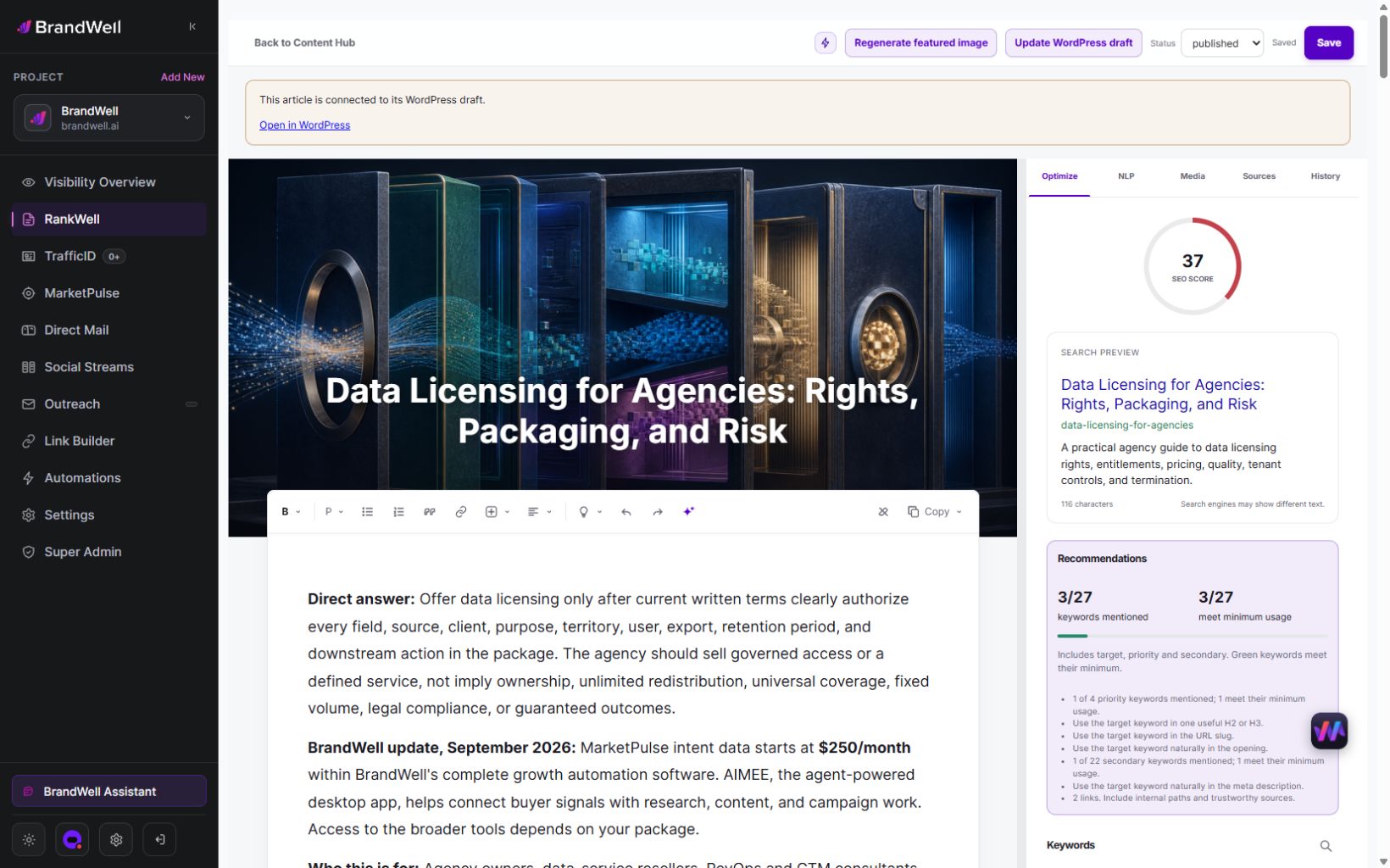
In RankWell, begin a brief with the reader’s question, required sources and your contribution. Review the draft for unsupported claims, outdated product names and unnecessary repetition. Inspect the media and search preview before publishing through a supported connection.
AIMEE can help prepare configured research and work through connected tools. Keep source references and unresolved questions with the draft. Human review should confirm the evidence and the product description; generated confidence is not a fact-check.
Measure change before declaring success or failure
Record a baseline for the relevant page and query set. Compare like periods and note publication dates, seasonality, campaigns and other changes. Examine impressions, clicks and completed business outcomes separately. A page can gain impressions while receiving fewer clicks.
For a fictional example, 100 clicks from 5,000 impressions give a 2% CTR. Five qualifying leads from those 100 clicks give a 5% click-to-lead rate. Neither figure predicts revenue without additional purchase and cost evidence, and neither is a BrandWell benchmark.
When an AI-search report exposes impressions without clicks or CTR, report the available measures and leave unavailable values unknown. Do not enter zero clicks simply because the interface does not provide them. A before-and-after change alone does not establish which edit caused it.
Frequently asked questions
Can a new article guarantee inclusion in an AI answer?
No. Treat a useful, sourced article as a resource for readers, then inspect actual visibility and outcomes.
Should we cover every possible related question?
Cover the questions needed to answer the reader’s problem. Unrelated expansion and repeated answers can make a page harder to use.
Is more AI-written content always better?
No. Judge each article by its accuracy, usefulness and original contribution. Review drafts before publication.
What should a team do next?
Choose one relevant page, document its baseline, strengthen the answer and evidence, and measure subsequent results with the limits stated. See the current RankWell workflow.
Reviewed and updated October 3, 2026.

Written by
Julia McCoy has contributed articles to BrandWell on content marketing, writing, and search engine optimization. This archive retains her original bylines; individual articles may be updated by the BrandWell editorial team.